 Add to Chrome
 Add to Firefox
 Add to Edge
V-RGBX: Video Editing with Accurate Controls over Intrinsic Properties
Dec 12, 2025
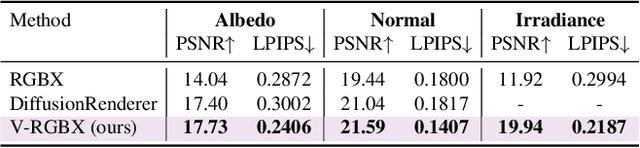
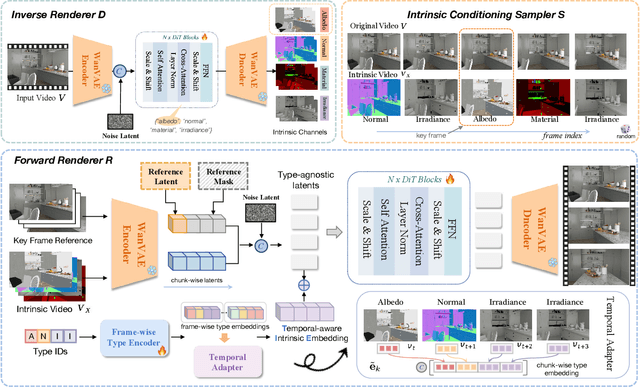
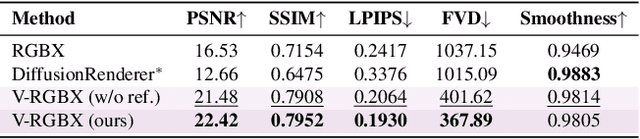
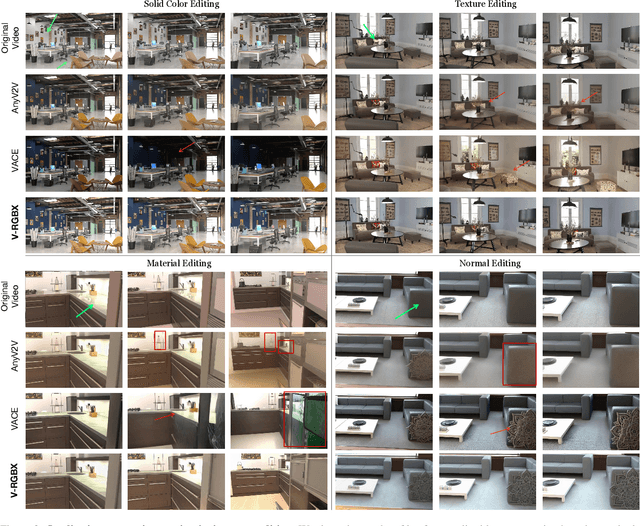
Large-scale video generation models have shown remarkable potential in modeling photorealistic appearance and lighting interactions in real-world scenes. However, a closed-loop framework that jointly understands intrinsic scene properties (e.g., albedo, normal, material, and irradiance), leverages them for video synthesis, and supports editable intrinsic representations remains unexplored. We present V-RGBX, the first end-to-end framework for intrinsic-aware video editing. V-RGBX unifies three key capabilities: (1) video inverse rendering into intrinsic channels, (2) photorealistic video synthesis from these intrinsic representations, and (3) keyframe-based video editing conditioned on intrinsic channels. At the core of V-RGBX is an interleaved conditioning mechanism that enables intuitive, physically grounded video editing through user-selected keyframes, supporting flexible manipulation of any intrinsic modality. Extensive qualitative and quantitative results show that V-RGBX produces temporally consistent, photorealistic videos while propagating keyframe edits across sequences in a physically plausible manner. We demonstrate its effectiveness in diverse applications, including object appearance editing and scene-level relighting, surpassing the performance of prior methods.

Generative Rendering: Controllable 4D-Guided Video Generation with 2D Diffusion Models
Dec 03, 2023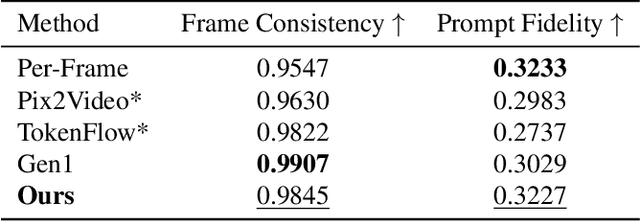

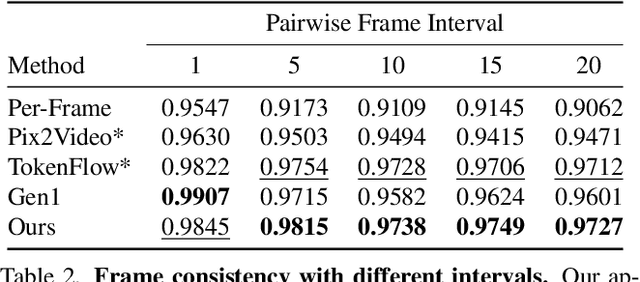
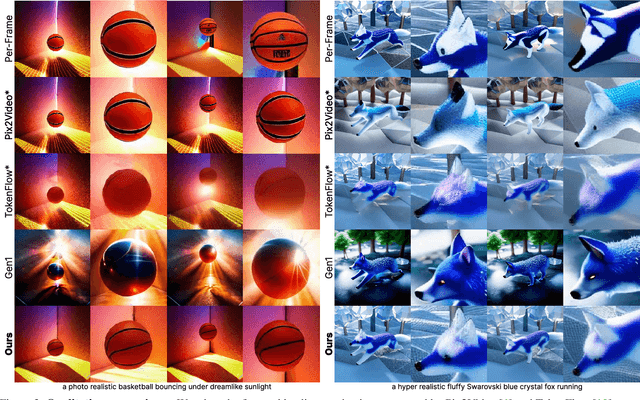
Traditional 3D content creation tools empower users to bring their imagination to life by giving them direct control over a scene's geometry, appearance, motion, and camera path. Creating computer-generated videos, however, is a tedious manual process, which can be automated by emerging text-to-video diffusion models. Despite great promise, video diffusion models are difficult to control, hindering a user to apply their own creativity rather than amplifying it. To address this challenge, we present a novel approach that combines the controllability of dynamic 3D meshes with the expressivity and editability of emerging diffusion models. For this purpose, our approach takes an animated, low-fidelity rendered mesh as input and injects the ground truth correspondence information obtained from the dynamic mesh into various stages of a pre-trained text-to-image generation model to output high-quality and temporally consistent frames. We demonstrate our approach on various examples where motion can be obtained by animating rigged assets or changing the camera path.