 Add to Chrome
 Add to Firefox
 Add to Edge
DiCoDe: Diffusion-Compressed Deep Tokens for Autoregressive Video Generation with Language Models
Dec 05, 2024
Videos are inherently temporal sequences by their very nature. In this work, we explore the potential of modeling videos in a chronological and scalable manner with autoregressive (AR) language models, inspired by their success in natural language processing. We introduce DiCoDe, a novel approach that leverages Diffusion-Compressed Deep Tokens to generate videos with a language model in an autoregressive manner. Unlike existing methods that employ low-level representations with limited compression rates, DiCoDe utilizes deep tokens with a considerable compression rate (a 1000x reduction in token count). This significant compression is made possible by a tokenizer trained through leveraging the prior knowledge of video diffusion models. Deep tokens enable DiCoDe to employ vanilla AR language models for video generation, akin to translating one visual "language" into another. By treating videos as temporal sequences, DiCoDe fully harnesses the capabilities of language models for autoregressive generation. DiCoDe is scalable using readily available AR architectures, and is capable of generating videos ranging from a few seconds to one minute using only 4 A100 GPUs for training. We evaluate DiCoDe both quantitatively and qualitatively, demonstrating that it performs comparably to existing methods in terms of quality while ensuring efficient training. To showcase its scalability, we release a series of DiCoDe configurations with varying parameter sizes and observe a consistent improvement in performance as the model size increases from 100M to 3B. We believe that DiCoDe's exploration in academia represents a promising initial step toward scalable video modeling with AR language models, paving the way for the development of larger and more powerful video generation models.

Moto: Latent Motion Token as the Bridging Language for Robot Manipulation
Dec 05, 2024


Recent developments in Large Language Models pre-trained on extensive corpora have shown significant success in various natural language processing tasks with minimal fine-tuning. This success offers new promise for robotics, which has long been constrained by the high cost of action-labeled data. We ask: given the abundant video data containing interaction-related knowledge available as a rich "corpus", can a similar generative pre-training approach be effectively applied to enhance robot learning? The key challenge is to identify an effective representation for autoregressive pre-training that benefits robot manipulation tasks. Inspired by the way humans learn new skills through observing dynamic environments, we propose that effective robotic learning should emphasize motion-related knowledge, which is closely tied to low-level actions and is hardware-agnostic, facilitating the transfer of learned motions to actual robot actions. To this end, we introduce Moto, which converts video content into latent Motion Token sequences by a Latent Motion Tokenizer, learning a bridging "language" of motion from videos in an unsupervised manner. We pre-train Moto-GPT through motion token autoregression, enabling it to capture diverse visual motion knowledge. After pre-training, Moto-GPT demonstrates the promising ability to produce semantically interpretable motion tokens, predict plausible motion trajectories, and assess trajectory rationality through output likelihood. To transfer learned motion priors to real robot actions, we implement a co-fine-tuning strategy that seamlessly bridges latent motion token prediction and real robot control. Extensive experiments show that the fine-tuned Moto-GPT exhibits superior robustness and efficiency on robot manipulation benchmarks, underscoring its effectiveness in transferring knowledge from video data to downstream visual manipulation tasks.
Divot: Diffusion Powers Video Tokenizer for Comprehension and Generation
Dec 05, 2024

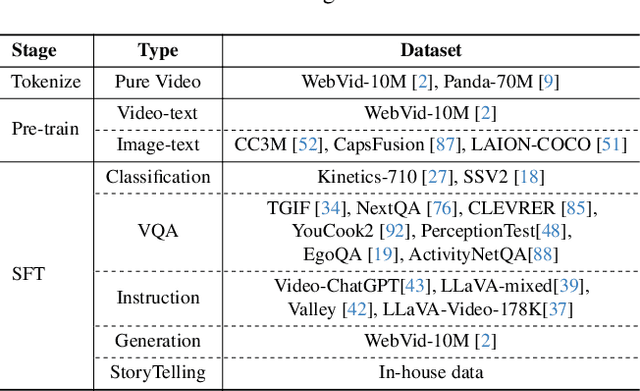

In recent years, there has been a significant surge of interest in unifying image comprehension and generation within Large Language Models (LLMs). This growing interest has prompted us to explore extending this unification to videos. The core challenge lies in developing a versatile video tokenizer that captures both the spatial characteristics and temporal dynamics of videos to obtain representations for LLMs, and the representations can be further decoded into realistic video clips to enable video generation. In this work, we introduce Divot, a Diffusion-Powered Video Tokenizer, which leverages the diffusion process for self-supervised video representation learning. We posit that if a video diffusion model can effectively de-noise video clips by taking the features of a video tokenizer as the condition, then the tokenizer has successfully captured robust spatial and temporal information. Additionally, the video diffusion model inherently functions as a de-tokenizer, decoding videos from their representations. Building upon the Divot tokenizer, we present Divot-Vicuna through video-to-text autoregression and text-to-video generation by modeling the distributions of continuous-valued Divot features with a Gaussian Mixture Model. Experimental results demonstrate that our diffusion-based video tokenizer, when integrated with a pre-trained LLM, achieves competitive performance across various video comprehension and generation benchmarks. The instruction tuned Divot-Vicuna also excels in video storytelling, generating interleaved narratives and corresponding videos.
NVComposer: Boosting Generative Novel View Synthesis with Multiple Sparse and Unposed Images
Dec 04, 2024


Recent advancements in generative models have significantly improved novel view synthesis (NVS) from multi-view data. However, existing methods depend on external multi-view alignment processes, such as explicit pose estimation or pre-reconstruction, which limits their flexibility and accessibility, especially when alignment is unstable due to insufficient overlap or occlusions between views. In this paper, we propose NVComposer, a novel approach that eliminates the need for explicit external alignment. NVComposer enables the generative model to implicitly infer spatial and geometric relationships between multiple conditional views by introducing two key components: 1) an image-pose dual-stream diffusion model that simultaneously generates target novel views and condition camera poses, and 2) a geometry-aware feature alignment module that distills geometric priors from dense stereo models during training. Extensive experiments demonstrate that NVComposer achieves state-of-the-art performance in generative multi-view NVS tasks, removing the reliance on external alignment and thus improving model accessibility. Our approach shows substantial improvements in synthesis quality as the number of unposed input views increases, highlighting its potential for more flexible and accessible generative NVS systems.
Taming Scalable Visual Tokenizer for Autoregressive Image Generation
Dec 03, 2024


Existing vector quantization (VQ) methods struggle with scalability, largely attributed to the instability of the codebook that undergoes partial updates during training. The codebook is prone to collapse as utilization decreases, due to the progressively widening distribution gap between non-activated codes and visual features. To solve the problem, we propose Index Backpropagation Quantization (IBQ), a new VQ method for the joint optimization of all codebook embeddings and the visual encoder. Applying a straight-through estimator on the one-hot categorical distribution between the encoded feature and codebook, all codes are differentiable and maintain a consistent latent space with the visual encoder. IBQ enables scalable training of visual tokenizers and, for the first time, achieves a large-scale codebook ($2^{18}$) with high dimension ($256$) and high utilization. Experiments on the standard ImageNet benchmark demonstrate the scalability and superiority of IBQ, achieving competitive results on both reconstruction ($1.00$ rFID) and autoregressive visual generation ($2.05$ gFID). The code and models are available at https://github.com/TencentARC/SEED-Voken.
DOGE: Towards Versatile Visual Document Grounding and Referring
Nov 26, 2024


In recent years, Multimodal Large Language Models (MLLMs) have increasingly emphasized grounding and referring capabilities to achieve detailed understanding and flexible user interaction. However, in the realm of visual document understanding, these capabilities lag behind due to the scarcity of fine-grained datasets and comprehensive benchmarks. To fill this gap, we propose the DOcument Grounding and Eferring data engine (DOGE-Engine), which produces two types of high-quality fine-grained document data: multi-granular parsing data for enhancing fundamental text localization and recognition capabilities; and instruction-tuning data to activate MLLM's grounding and referring capabilities during dialogue and reasoning. Additionally, using our engine, we construct DOGE-Bench, which encompasses 7 grounding and referring tasks across 3 document types (chart, poster, PDF document), providing comprehensive evaluations for fine-grained document understanding. Furthermore, leveraging the data generated by our engine, we develop a strong baseline model, DOGE. This pioneering MLLM is capable of accurately referring and grounding texts at multiple granularities within document images. Our code, data, and model will be open-sourced for community development.
NovelGS: Consistent Novel-view Denoising via Large Gaussian Reconstruction Model
Nov 25, 2024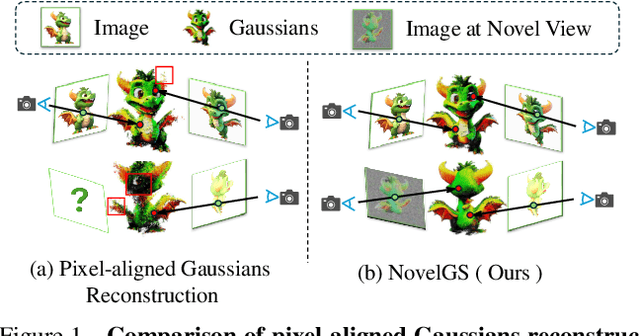
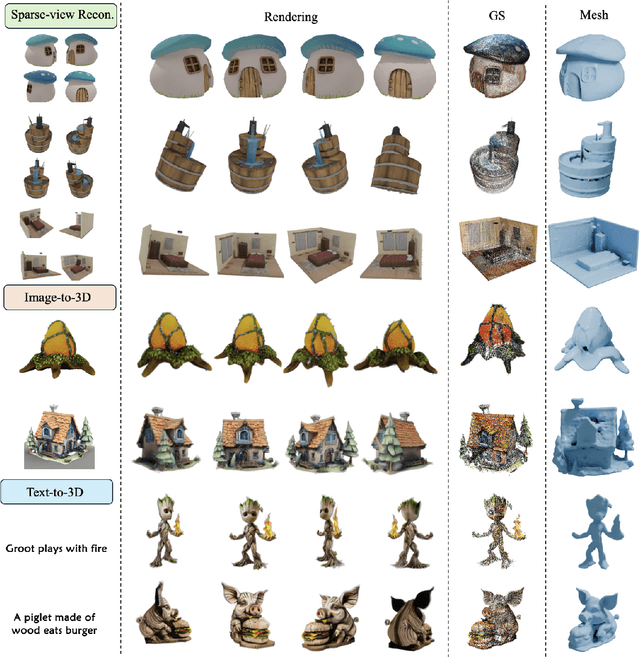
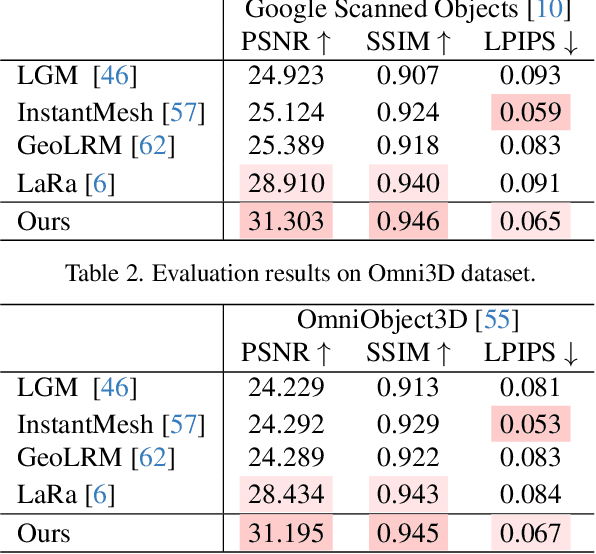
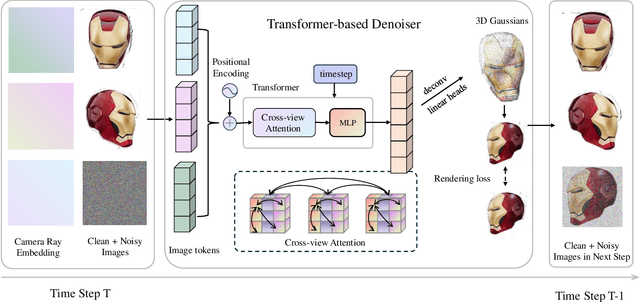
We introduce NovelGS, a diffusion model for Gaussian Splatting (GS) given sparse-view images. Recent works leverage feed-forward networks to generate pixel-aligned Gaussians, which could be fast rendered. Unfortunately, the method was unable to produce satisfactory results for areas not covered by the input images due to the formulation of these methods. In contrast, we leverage the novel view denoising through a transformer-based network to generate 3D Gaussians. Specifically, by incorporating both conditional views and noisy target views, the network predicts pixel-aligned Gaussians for each view. During training, the rendered target and some additional views of the Gaussians are supervised. During inference, the target views are iteratively rendered and denoised from pure noise. Our approach demonstrates state-of-the-art performance in addressing the multi-view image reconstruction challenge. Due to generative modeling of unseen regions, NovelGS effectively reconstructs 3D objects with consistent and sharp textures. Experimental results on publicly available datasets indicate that NovelGS substantially surpasses existing image-to-3D frameworks, both qualitatively and quantitatively. We also demonstrate the potential of NovelGS in generative tasks, such as text-to-3D and image-to-3D, by integrating it with existing multiview diffusion models. We will make the code publicly accessible.
mR$^2$AG: Multimodal Retrieval-Reflection-Augmented Generation for Knowledge-Based VQA
Nov 22, 2024

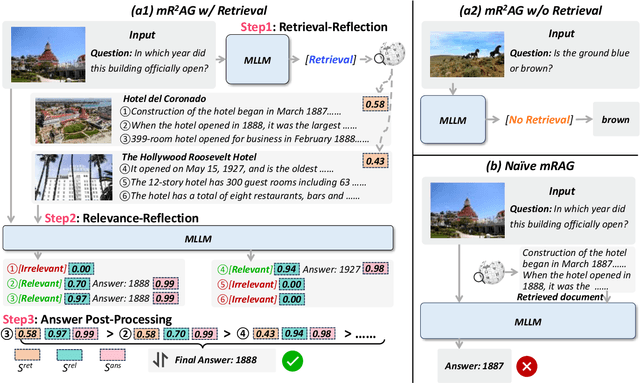
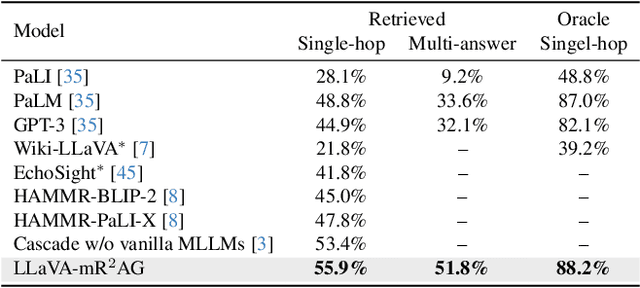
Advanced Multimodal Large Language Models (MLLMs) struggle with recent Knowledge-based VQA tasks, such as INFOSEEK and Encyclopedic-VQA, due to their limited and frozen knowledge scope, often leading to ambiguous and inaccurate responses. Thus, multimodal Retrieval-Augmented Generation (mRAG) is naturally introduced to provide MLLMs with comprehensive and up-to-date knowledge, effectively expanding the knowledge scope. However, current mRAG methods have inherent drawbacks, including: 1) Performing retrieval even when external knowledge is not needed. 2) Lacking of identification of evidence that supports the query. 3) Increasing model complexity due to additional information filtering modules or rules. To address these shortcomings, we propose a novel generalized framework called \textbf{m}ultimodal \textbf{R}etrieval-\textbf{R}eflection-\textbf{A}ugmented \textbf{G}eneration (mR$^2$AG), which achieves adaptive retrieval and useful information localization to enable answers through two easy-to-implement reflection operations, preventing high model complexity. In mR$^2$AG, Retrieval-Reflection is designed to distinguish different user queries and avoids redundant retrieval calls, and Relevance-Reflection is introduced to guide the MLLM in locating beneficial evidence of the retrieved content and generating answers accordingly. In addition, mR$^2$AG can be integrated into any well-trained MLLM with efficient fine-tuning on the proposed mR$^2$AG Instruction-Tuning dataset (mR$^2$AG-IT). mR$^2$AG significantly outperforms state-of-the-art MLLMs (e.g., GPT-4v/o) and RAG-based MLLMs on INFOSEEK and Encyclopedic-VQA, while maintaining the exceptional capabilities of base MLLMs across a wide range of Visual-dependent tasks.
Taming Rectified Flow for Inversion and Editing
Nov 07, 2024

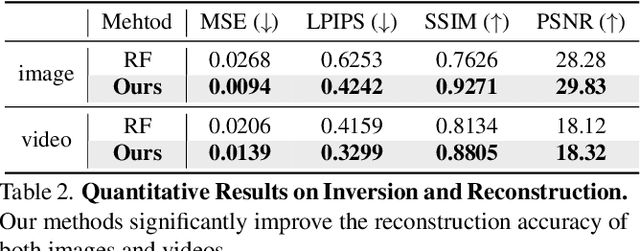

Rectified-flow-based diffusion transformers, such as FLUX and OpenSora, have demonstrated exceptional performance in the field of image and video generation. Despite their robust generative capabilities, these models often suffer from inaccurate inversion, which could further limit their effectiveness in downstream tasks such as image and video editing. To address this issue, we propose RF-Solver, a novel training-free sampler that enhances inversion precision by reducing errors in the process of solving rectified flow ODEs. Specifically, we derive the exact formulation of the rectified flow ODE and perform a high-order Taylor expansion to estimate its nonlinear components, significantly decreasing the approximation error at each timestep. Building upon RF-Solver, we further design RF-Edit, which comprises specialized sub-modules for image and video editing. By sharing self-attention layer features during the editing process, RF-Edit effectively preserves the structural information of the source image or video while achieving high-quality editing results. Our approach is compatible with any pre-trained rectified-flow-based models for image and video tasks, requiring no additional training or optimization. Extensive experiments on text-to-image generation, image & video inversion, and image & video editing demonstrate the robust performance and adaptability of our methods. Code is available at https://github.com/wangjiangshan0725/RF-Solver-Edit.
PPLLaVA: Varied Video Sequence Understanding With Prompt Guidance
Nov 05, 2024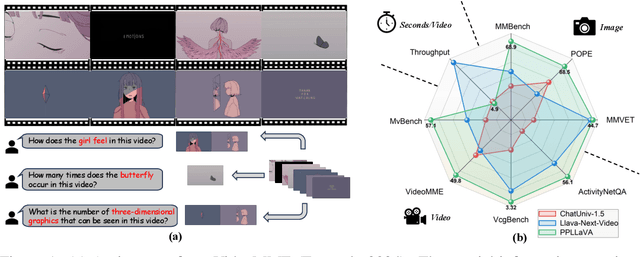
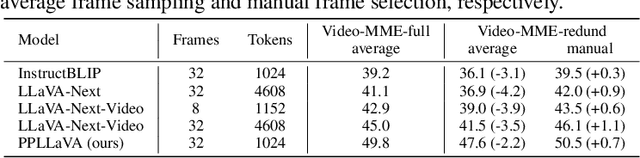

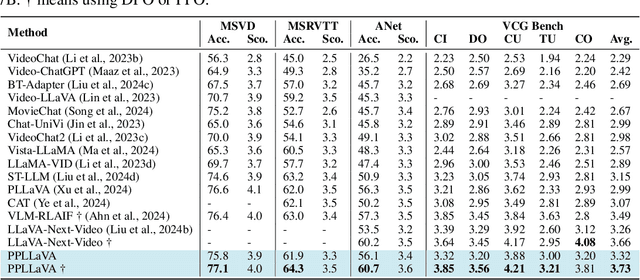
The past year has witnessed the significant advancement of video-based large language models. However, the challenge of developing a unified model for both short and long video understanding remains unresolved. Most existing video LLMs cannot handle hour-long videos, while methods custom for long videos tend to be ineffective for shorter videos and images. In this paper, we identify the key issue as the redundant content in videos. To address this, we propose a novel pooling strategy that simultaneously achieves token compression and instruction-aware visual feature aggregation. Our model is termed Prompt-guided Pooling LLaVA, or PPLLaVA for short. Specifically, PPLLaVA consists of three core components: the CLIP-based visual-prompt alignment that extracts visual information relevant to the user's instructions, the prompt-guided pooling that compresses the visual sequence to arbitrary scales using convolution-style pooling, and the clip context extension designed for lengthy prompt common in visual dialogue. Moreover, our codebase also integrates the most advanced video Direct Preference Optimization (DPO) and visual interleave training. Extensive experiments have validated the performance of our model. With superior throughput and only 1024 visual context, PPLLaVA achieves better results on image benchmarks as a video LLM, while achieving state-of-the-art performance across various video benchmarks, excelling in tasks ranging from caption generation to multiple-choice questions, and handling video lengths from seconds to hours. Codes have been available at https://github.com/farewellthree/PPLLaVA.