 Add to Chrome
 Add to Firefox
 Add to Edge
Impedance Control of Ship-Borne Manipulators via Optimization-based Task-Space Inverse Dynamics
Jul 24, 2026
Ship-borne manipulators operating in maritime environments are subject to stochastic wave-induced base motions that introduce kinematic disturbances and dynamic coupling, degrading trajectory tracking accuracy and complicating safe, contact-rich manipulation. This paper proposes a torque-level optimization-based control framework that integrates high-precision trajectory tracking with task-space impedance for ship-borne manipulators. The controller is formulated using task-space inverse dynamics (TSID) and solved via quadratic programming to explicitly compensate for the dynamic coupling introduced by base motion. To enable accurate feedforward compensation, an error-state Kalman filter (ESKF) is developed to estimate the base state by fusing inertial measurements with end-effector pose feedback. The framework is validated in simulation and real-world experiments using a 7-DOF manipulator mounted on a 6-DOF Stewart platform. The proposed method reduces real-world end-effector position tracking error by over 25.7% compared with the best baseline. Furthermore, the controller enables dynamic peg-in-hole insertion with 1~mm clearance under base motion, increasing the success rate while reducing average contact forces by 45%, demonstrating precise and compliant manipulation in contact-rich environments.

ImagineUAV: Aerial Vision-Language Navigation via World-Action Modeling and Kinodynamic Planning
May 31, 2026Vision-language navigation (VLN) for UAVs demands grounding free-form instructions into 6-DoF flight under partial observability. While Vision-Language-Action (VLA) models excel at semantic reasoning, they suffer from brittleness due to geometric inconsistency and dynamics mismatch. To address this, we propose ImagineUAV, an imagination-driven framework leveraging cascaded world-action modeling. Instead of direct regression, ImagineUAV employs a latent video diffusion model to generate instruction-conditioned future observations, explicitly imagining environmental evolution, from which 6-DoF motions are inferred via an action extractor. A kinodynamic planner then refines these estimates into collision-free trajectories. Additionally, a step-distilled inference pipeline ensures real-time execution. With only 1.3B parameters, ImagineUAV outperforms prior VLN and VLA baselines on benchmarks and real-world flights, validating the practicality of imagination-driven aerial navigation.
PPLLaVA: Varied Video Sequence Understanding With Prompt Guidance
Nov 05, 2024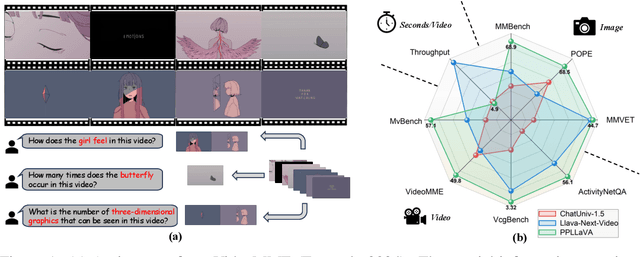
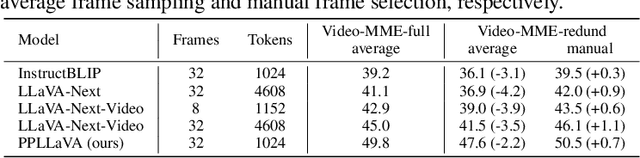

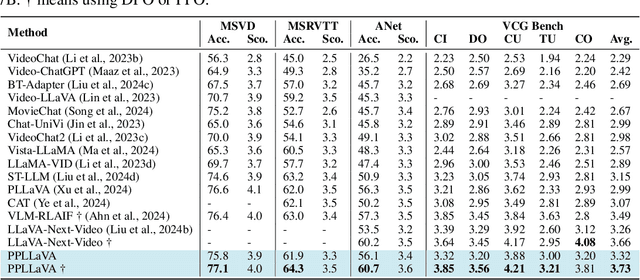
The past year has witnessed the significant advancement of video-based large language models. However, the challenge of developing a unified model for both short and long video understanding remains unresolved. Most existing video LLMs cannot handle hour-long videos, while methods custom for long videos tend to be ineffective for shorter videos and images. In this paper, we identify the key issue as the redundant content in videos. To address this, we propose a novel pooling strategy that simultaneously achieves token compression and instruction-aware visual feature aggregation. Our model is termed Prompt-guided Pooling LLaVA, or PPLLaVA for short. Specifically, PPLLaVA consists of three core components: the CLIP-based visual-prompt alignment that extracts visual information relevant to the user's instructions, the prompt-guided pooling that compresses the visual sequence to arbitrary scales using convolution-style pooling, and the clip context extension designed for lengthy prompt common in visual dialogue. Moreover, our codebase also integrates the most advanced video Direct Preference Optimization (DPO) and visual interleave training. Extensive experiments have validated the performance of our model. With superior throughput and only 1024 visual context, PPLLaVA achieves better results on image benchmarks as a video LLM, while achieving state-of-the-art performance across various video benchmarks, excelling in tasks ranging from caption generation to multiple-choice questions, and handling video lengths from seconds to hours. Codes have been available at https://github.com/farewellthree/PPLLaVA.