 Add to Chrome
 Add to Firefox
 Add to Edge
Beyond Control Points: Arcsecond Relative-Motion Estimation of Vision Measurement Platforms With Incomplete or Absent Control Fields
Aug 14, 2026
Long-range vision-based deformation monitoring is highly sensitive to motion of the camera platform. Absolute-pose differencing typically relies on dedicated control data and propagates two independent pose errors into the relative-motion estimate. We develop a control-adaptive differential framework that estimates inter-frame platform motion directly from image displacements and known 3D points. With no dedicated control point, the framework recovers platform rotation from measurement-point observations. One surveyed control point enables prior-constrained translation recovery, while two nonparallel control rays recover full 3D translation. The framework requires neither nonlinear optimization nor an initial pose estimate. Excluding control data from the rotation stage makes the rotation estimate exactly immune to contamination confined to the control field. The inherited differential formulation also cancels translational extrinsic errors exactly. We derive the rotation observability condition, a leakage bound for unmodeled translation and nonrigid point motion, and the single-point axial-prior bias law. Under 0.5-pixel image noise, attitude changes of up to 30~arcmin, and 3D point perturbations of up to 2~mm, the multi-camera estimator achieves a rotation RMSE of 2.97~arcsec and an average runtime of 0.46~ms. With one surveyed control point, its prior-constrained translation RMSE is 1.19~mm. In a bridge experiment without a stable control field, the median coordinate-wise displacement RMSE relative to total-station measurements is 0.85~mm. The estimator also maintains zero divergence under the tested 3D coordinate perturbations on public RGB-D and stereo sequences. These results establish state-of-the-art accuracy, calibration robustness, and computational efficiency among the evaluated methods.

ARAPDiffusion: ARAP Regularization for Diffusion-Based Deformable Shape Space Learning
Jun 05, 2026This paper introduces ARAPDiffusion, a latent diffusion model to learn the underlying continuous shape space of a deformation shape collection. The key innovation is in injecting the as-rigid-as-possible (ARAP) deformation model as regularization losses into latent diffusion (LD), releasing the requirement of having abundant 3D training data for learning generative models. In contrast to the standard LD, we show how the ARAP model can be used to improve both the encoder/decoder and the LD model. The training procedure alternates between using the synthetic distribution defined by the LD model to develop a regularization loss that enhances the shape encoder/decoder and using the shape decoder to develop a regularization loss to improve the LD model. We also show the benefit of the LD paradigm in combining a representation-free LD process and an implicit shape decoder that is applicable to unorganized point clouds. The experimental results of unconditional and conditional shape generation demonstrate the advantages of ARAPDiffusion over baseline approaches.
KeyframeFace: From Text to Expressive Facial Keyframes
Dec 12, 2025Generating dynamic 3D facial animation from natural language requires understanding both temporally structured semantics and fine-grained expression changes. Existing datasets and methods mainly focus on speech-driven animation or unstructured expression sequences and therefore lack the semantic grounding and temporal structures needed for expressive human performance generation. In this work, we introduce KeyframeFace, a large-scale multimodal dataset designed for text-to-animation research through keyframe-level supervision. KeyframeFace provides 2,100 expressive scripts paired with monocular videos, per-frame ARKit coefficients, contextual backgrounds, complex emotions, manually defined keyframes, and multi-perspective annotations based on ARKit coefficients and images via Large Language Models (LLMs) and Multimodal Large Language Models (MLLMs). Beyond the dataset, we propose the first text-to-animation framework that explicitly leverages LLM priors for interpretable facial motion synthesis. This design aligns the semantic understanding capabilities of LLMs with the interpretable structure of ARKit's coefficients, enabling high-fidelity expressive animation. KeyframeFace and our LLM-based framework together establish a new foundation for interpretable, keyframe-guided, and context-aware text-to-animation. Code and data are available at https://github.com/wjc12345123/KeyframeFace.
Implicit Neural Shape Optimization for 3D High-Contrast Electrical Impedance Tomography
May 22, 2025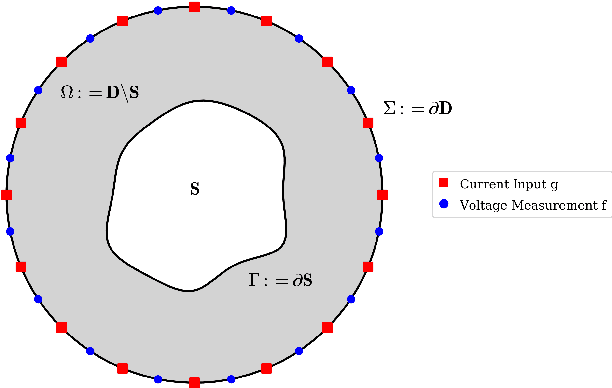
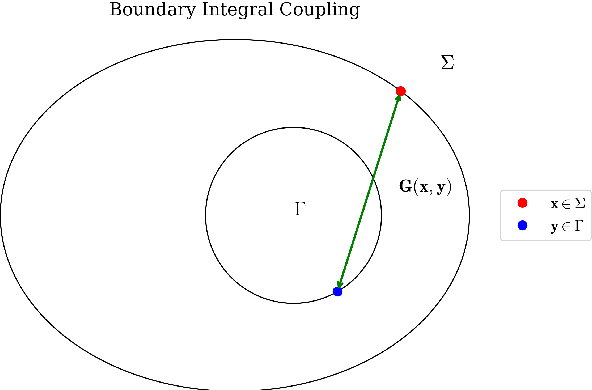
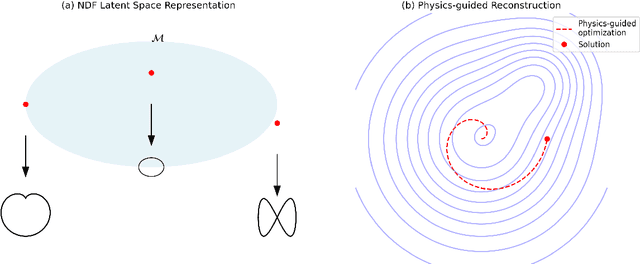
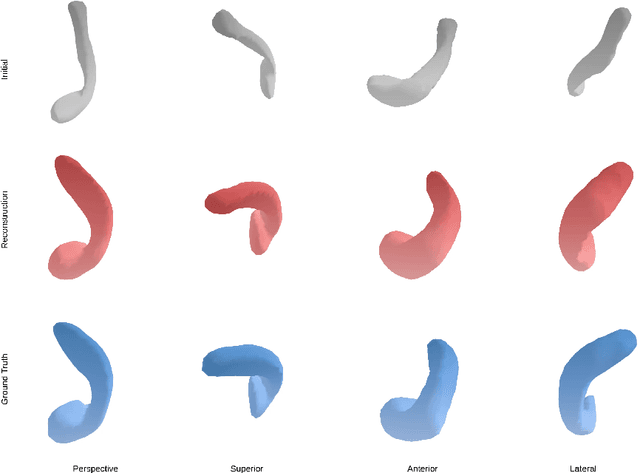
We present a novel implicit neural shape optimization framework for 3D high-contrast Electrical Impedance Tomography (EIT), addressing scenarios where conductivity exhibits sharp discontinuities across material interfaces. These high-contrast cases, prevalent in metallic implant monitoring and industrial defect detection, challenge traditional reconstruction methods due to severe ill-posedness. Our approach synergizes shape optimization with implicit neural representations, introducing key innovations including a shape derivative-based optimization scheme that explicitly incorporates high-contrast interface conditions and an efficient latent space representation that reduces variable dimensionality. Through rigorous theoretical analysis of algorithm convergence and extensive numerical experiments, we demonstrate substantial performance improvements, establishing our framework as promising for practical applications in medical imaging with metallic implants and industrial non-destructive testing.
PPLLaVA: Varied Video Sequence Understanding With Prompt Guidance
Nov 05, 2024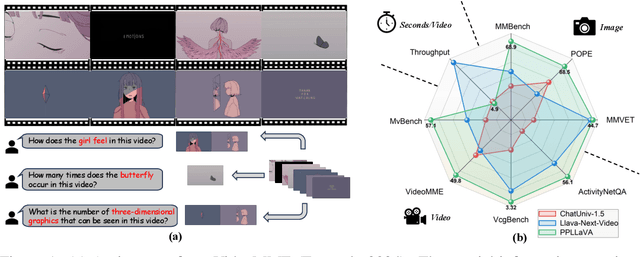
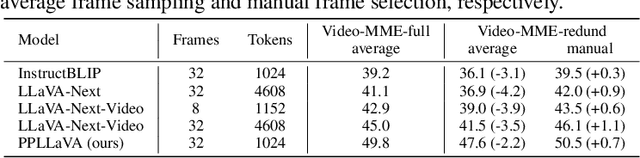

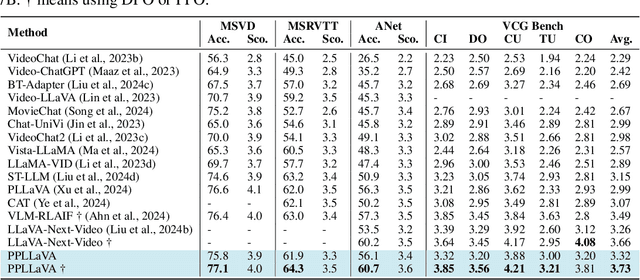
The past year has witnessed the significant advancement of video-based large language models. However, the challenge of developing a unified model for both short and long video understanding remains unresolved. Most existing video LLMs cannot handle hour-long videos, while methods custom for long videos tend to be ineffective for shorter videos and images. In this paper, we identify the key issue as the redundant content in videos. To address this, we propose a novel pooling strategy that simultaneously achieves token compression and instruction-aware visual feature aggregation. Our model is termed Prompt-guided Pooling LLaVA, or PPLLaVA for short. Specifically, PPLLaVA consists of three core components: the CLIP-based visual-prompt alignment that extracts visual information relevant to the user's instructions, the prompt-guided pooling that compresses the visual sequence to arbitrary scales using convolution-style pooling, and the clip context extension designed for lengthy prompt common in visual dialogue. Moreover, our codebase also integrates the most advanced video Direct Preference Optimization (DPO) and visual interleave training. Extensive experiments have validated the performance of our model. With superior throughput and only 1024 visual context, PPLLaVA achieves better results on image benchmarks as a video LLM, while achieving state-of-the-art performance across various video benchmarks, excelling in tasks ranging from caption generation to multiple-choice questions, and handling video lengths from seconds to hours. Codes have been available at https://github.com/farewellthree/PPLLaVA.
BER Analysis of SCMA-OFDM Systems in the Presence of Carrier Frequency Offset
Dec 02, 2023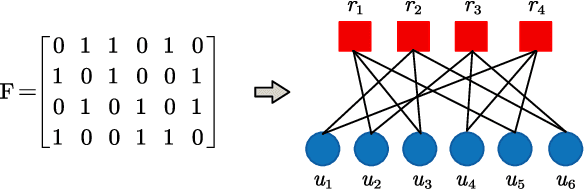
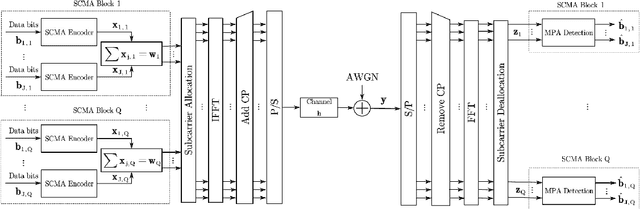
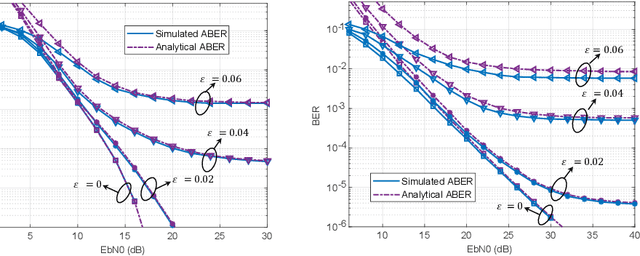
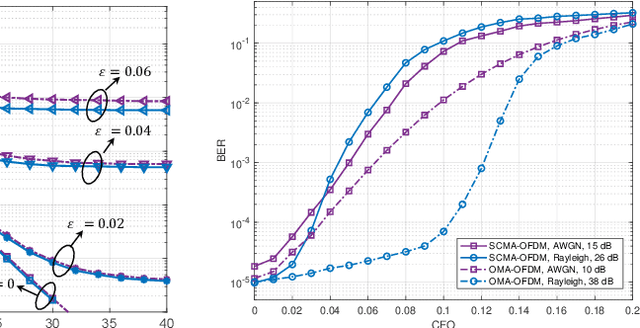
Sparse code multiple access (SCMA) building upon orthogonal frequency division multiplexing (OFDM) is a promising wireless technology for supporting massive connectivity in future machine-type communication networks. However, the sensitivity of OFDM to carrier frequency offset (CFO) poses a major challenge because it leads to orthogonality loss and incurs intercarrier interference (ICI). In this paper, we investigate the bit error rate (BER) performance of SCMA-OFDM systems in the presence of CFO over both Gaussian and multipath Rayleigh fading channels. We first model the ICI in SCMA-OFDM as Gaussian variables conditioned on a single channel realization for fading channels. The BER is then evaluated by averaging over all codeword pairs considering the fading statistics. Through simulations, we validate the accuracy of our BER analysis and reveal that there is a significant BER degradation for SCMA-OFDM systems when the normalized CFO exceeds 0.02.