 Add to Chrome
 Add to Firefox
 Add to Edge
Logit-Attention Divergence: Mitigating Position Bias in Multi-Image Retrieval via Attention-Guided Calibration
May 12, 2026
Multimodal Large Language Models (MLLMs) have shown strong performance in multi-image cross-modal retrieval, yet suffer from severe position bias, where predictions are dominated by input order rather than semantic relevance. Through empirical analysis, we identify a phenomenon termed Logit-Attention Divergence, in which output logits are heavily biased while internal attention maps remain well-aligned with relevant visual evidence. This observation reveals a fundamental limitation of existing logit-level calibration methods such as PriDe. Based on this insight, we propose a training-free, attention-guided debiasing framework that leverages intrinsic attention signals for instance-level correction at inference time, requiring only a minimal calibration set with negligible computational overhead. Experiments on MS-COCO-based benchmarks show that our method substantially improves permutation invariance and achieves state-of-the-art performance, enhancing accuracy by over 40\% compared to baselines. Code is available at https://github.com/brightXian/LAD.

TINS: Test-time ID-prototype-separated Negative Semantics Learning for OOD Detection
May 11, 2026Vision-language models enable OOD detection by comparing image alignment with ID labels and negative semantics. Existing negative-label-based methods mainly rely on static negative labels constructed before inference, limiting their ability to cover diverse and evolving OOD concepts. Although test-time expansion provides a natural solution, naively learning negative semantics from potential OOD samples may introduce hard ID contamination. To address this issue, we propose a \textbf{T}est-time \textbf{I}D-prototype-separated \textbf{N}egative \textbf{S}emantics learning method, termed \textbf{TINS}. TINS learns sample-specific negative text embeddings via image-to-text modality inversion and introduces ID-prototype-separated regularization to keep them separated from ID semantics. To further stabilize negative semantics expansion, TINS employs group-wise aggregation scoring and a buffer update strategy. Extensive experiments across Four-OOD, OpenOOD, Temporal-shift, and Various ID settings show consistent improvements over strong baselines. Notably, on the Four-OOD benchmark with ImageNet-1K as ID, TINS reduces the average FPR95 from 14.04\% to 6.72\%. Our code is available at https://github.com/zxk1212/tins.
The Curse and Blessing of Mean Bias in FP4-Quantized LLM Training
Mar 11, 2026Large language models trained on natural language exhibit pronounced anisotropy: a small number of directions concentrate disproportionate energy, while the remaining dimensions form a broad semantic tail. In low-bit training regimes, this geometry becomes numerically unstable. Because blockwise quantization scales are determined by extreme elementwise magnitudes, dominant directions stretch the dynamic range, compressing long-tail semantic variation into narrow numerical bins. We show that this instability is primarily driven by a coherent rank-one mean bias, which constitutes the dominant component of spectral anisotropy in LLM representations. This mean component emerges systematically across layers and training stages and accounts for the majority of extreme activation magnitudes, making it the principal driver of dynamic-range inflation under low precision. Crucially, because the dominant instability is rank-one, it can be eliminated through a simple source-level mean-subtraction operation. This bias-centric conditioning recovers most of the stability benefits of SVD-based spectral methods while requiring only reduction operations and standard quantization kernels. Empirical results on FP4 (W4A4G4) training show that mean removal substantially narrows the loss gap to BF16 and restores downstream performance, providing a hardware-efficient path to stable low-bit LLM training.
Multi-Head Attention as a Source of Catastrophic Forgetting in MoE Transformers
Feb 13, 2026Mixture-of-Experts (MoE) architectures are often considered a natural fit for continual learning because sparse routing should localize updates and reduce interference, yet MoE Transformers still forget substantially even with sparse, well-balanced expert utilization. We attribute this gap to a pre-routing bottleneck: multi-head attention concatenates head-specific signals into a single post-attention router input, forcing routing to act on co-occurring feature compositions rather than separable head channels. We show that this router input simultaneously encodes multiple separately decodable semantic and structural factors with uneven head support, and that different feature compositions induce weakly aligned parameter-gradient directions; as a result, routing maps many distinct compositions to the same route. We quantify this collision effect via a route-wise effective composition number $N_{eff}$ and find that higher $N_{eff}$ is associated with larger old-task loss increases after continual training. Motivated by these findings, we propose MH-MoE, which performs head-wise routing over sub-representations to increase routing granularity and reduce composition collisions. On TRACE with Qwen3-0.6B/8B, MH-MoE effectively mitigates forgetting, reducing BWT on Qwen3-0.6B from 11.2% (LoRAMoE) to 4.5%.
SD-MoE: Spectral Decomposition for Effective Expert Specialization
Feb 13, 2026Mixture-of-Experts (MoE) architectures scale Large Language Models via expert specialization induced by conditional computation. In practice, however, expert specialization often fails: some experts become functionally similar, while others functioning as de facto shared experts, limiting the effective capacity and model performance. In this work, we analysis from a spectral perspective on parameter and gradient spaces, uncover that (1) experts share highly overlapping dominant spectral components in their parameters, (2) dominant gradient subspaces are strongly aligned across experts, driven by ubiquitous low-rank structure in human corpus, and (3) gating mechanisms preferentially route inputs along these dominant directions, further limiting specialization. To address this, we propose Spectral-Decoupled MoE (SD-MoE), which decomposes both parameter and gradient in the spectral space. SD-MoE improves performance across downstream tasks, enables effective expert specialization, incurring minimal additional computation, and can be seamlessly integrated into a wide range of existing MoE architectures, including Qwen and DeepSeek.
Dispelling the Curse of Singularities in Neural Network Optimizations
Feb 01, 2026This work investigates the optimization instability of deep neural networks from a less-explored yet insightful perspective: the emergence and amplification of singularities in the parametric space. Our analysis reveals that parametric singularities inevitably grow with gradient updates and further intensify alignment with representations, leading to increased singularities in the representation space. We show that the gradient Frobenius norms are bounded by the top singular values of the weight matrices, and as training progresses, the mutually reinforcing growth of weight and representation singularities, termed the curse of singularities, relaxes these bounds, escalating the risk of sharp loss explosions. To counter this, we propose Parametric Singularity Smoothing (PSS), a lightweight, flexible, and effective method for smoothing the singular spectra of weight matrices. Extensive experiments across diverse datasets, architectures, and optimizers demonstrate that PSS mitigates instability, restores trainability even after failure, and improves both training efficiency and generalization.
InfoBound: A Provable Information-Bounds Inspired Framework for Both OoD Generalization and OoD Detection
Apr 13, 2025
In real-world scenarios, distribution shifts give rise to the importance of two problems: out-of-distribution (OoD) generalization, which focuses on models' generalization ability against covariate shifts (i.e., the changes of environments), and OoD detection, which aims to be aware of semantic shifts (i.e., test-time unseen classes). Real-world testing environments often involve a combination of both covariate and semantic shifts. While numerous methods have been proposed to address these critical issues, only a few works tackled them simultaneously. Moreover, prior works often improve one problem but sacrifice the other. To overcome these limitations, we delve into boosting OoD detection and OoD generalization from the perspective of information theory, which can be easily applied to existing models and different tasks. Building upon the theoretical bounds for mutual information and conditional entropy, we provide a unified approach, composed of Mutual Information Minimization (MI-Min) and Conditional Entropy Maximizing (CE-Max). Extensive experiments and comprehensive evaluations on multi-label image classification and object detection have demonstrated the superiority of our method. It successfully mitigates trade-offs between the two challenges compared to competitive baselines.
OODD: Test-time Out-of-Distribution Detection with Dynamic Dictionary
Mar 13, 2025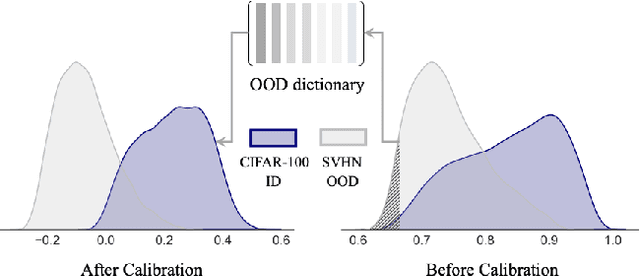
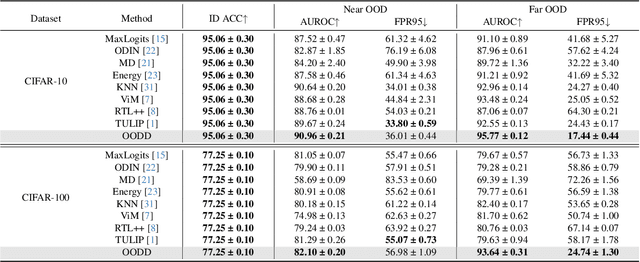
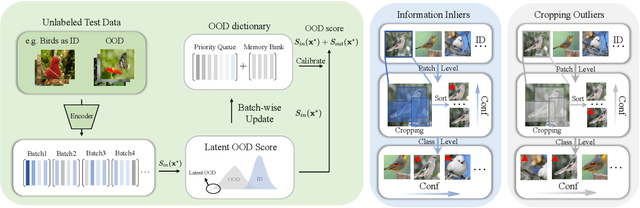
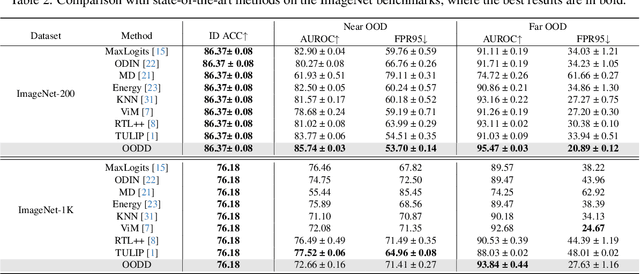
Out-of-distribution (OOD) detection remains challenging for deep learning models, particularly when test-time OOD samples differ significantly from training outliers. We propose OODD, a novel test-time OOD detection method that dynamically maintains and updates an OOD dictionary without fine-tuning. Our approach leverages a priority queue-based dictionary that accumulates representative OOD features during testing, combined with an informative inlier sampling strategy for in-distribution (ID) samples. To ensure stable performance during early testing, we propose a dual OOD stabilization mechanism that leverages strategically generated outliers derived from ID data. To our best knowledge, extensive experiments on the OpenOOD benchmark demonstrate that OODD significantly outperforms existing methods, achieving a 26.0% improvement in FPR95 on CIFAR-100 Far OOD detection compared to the state-of-the-art approach. Furthermore, we present an optimized variant of the KNN-based OOD detection framework that achieves a 3x speedup while maintaining detection performance.
ConcealGS: Concealing Invisible Copyright Information in 3D Gaussian Splatting
Jan 07, 2025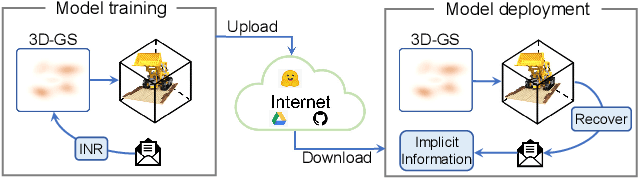
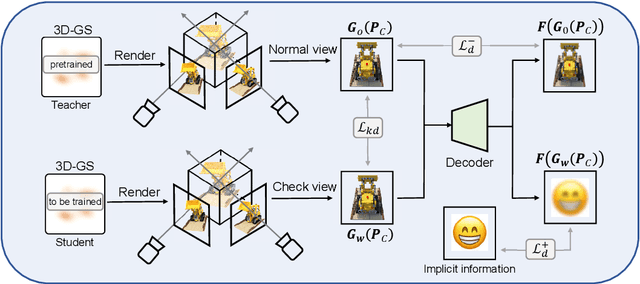
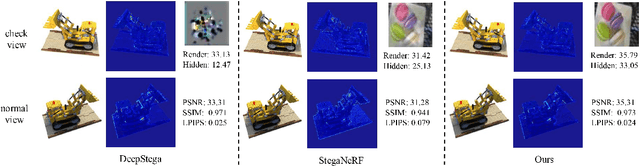
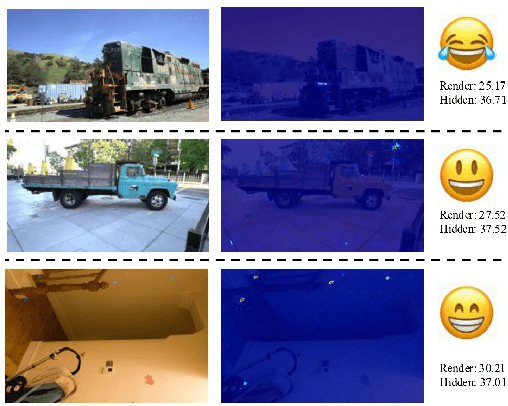
With the rapid development of 3D reconstruction technology, the widespread distribution of 3D data has become a future trend. While traditional visual data (such as images and videos) and NeRF-based formats already have mature techniques for copyright protection, steganographic techniques for the emerging 3D Gaussian Splatting (3D-GS) format have yet to be fully explored. To address this, we propose ConcealGS, an innovative method for embedding implicit information into 3D-GS. By introducing the knowledge distillation and gradient optimization strategy based on 3D-GS, ConcealGS overcomes the limitations of NeRF-based models and enhances the robustness of implicit information and the quality of 3D reconstruction. We evaluate ConcealGS in various potential application scenarios, and experimental results have demonstrated that ConcealGS not only successfully recovers implicit information but also has almost no impact on rendering quality, providing a new approach for embedding invisible and recoverable information into 3D models in the future.
Seed-Music: A Unified Framework for High Quality and Controlled Music Generation
Sep 13, 2024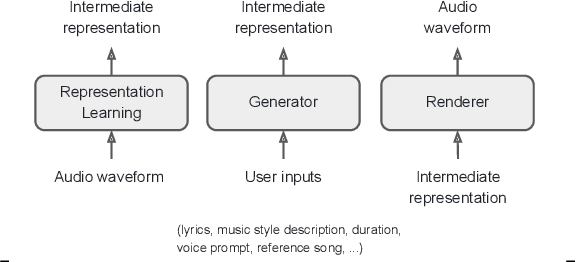

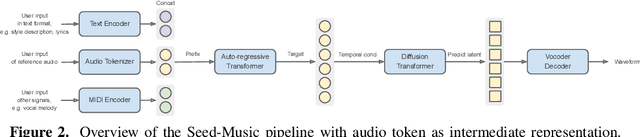

We introduce Seed-Music, a suite of music generation systems capable of producing high-quality music with fine-grained style control. Our unified framework leverages both auto-regressive language modeling and diffusion approaches to support two key music creation workflows: \textit{controlled music generation} and \textit{post-production editing}. For controlled music generation, our system enables vocal music generation with performance controls from multi-modal inputs, including style descriptions, audio references, musical scores, and voice prompts. For post-production editing, it offers interactive tools for editing lyrics and vocal melodies directly in the generated audio. We encourage readers to listen to demo audio examples at https://team.doubao.com/seed-music .