 Add to Chrome
 Add to Firefox
 Add to Edge
Expressivity Saturation: Reduced Affine Region Usage Under Increasing Task Complexity
Jun 19, 2026
Piecewise-affine neural networks (e.g., with ReLU or LeakyReLU activations) implement continuous piecewise-affine maps, and the number of affine regions provides a natural proxy for expressive capacity. However, the gap between theoretical region capacity and the affine regions realized after training remains insufficiently understood. We study this gap from two complementary perspectives. First, we give a rigorous, architecture-dependent theorem for affine line-segment probes: for multilayer perceptrons with piecewise-affine activations, the number of affine pieces realized along an affine line-segment probe is upper bounded by an explicit product of layer-wise width terms (and activation breakpoint factors). This yields a neuron-threshold lower bound for representing target functions with prescribed one-dimensional piece complexity, formalizing the minimal region budget required for complex signals. Second, we exactly enumerate affine regions realized within bounded 2D and higher-dimensional domains under controlled task complexity. Under fixed architectures and training protocols, increasing input--label complexity yields trained solutions with markedly fewer realized regions in the evaluation domain, even though worst-case architectural capacity is unchanged; we call this reduced region usage expressivity saturation. Moreover, in the most challenging regimes, 2D visualizations show that region-usage collapse often coincides with degraded decision boundaries. Finally, we visualize the training dynamics of affine-region partitions and decision boundaries, revealing a consistent refinement process during optimization.

Training-Time Batch Normalization Reshapes Local Partition Geometry in Piecewise-Affine Networks
May 06, 2026Batch normalization (BN) is central to modern deep networks, but its effect on the realized function during training remains less understood than its optimization benefits. We study training-time BN in continuous piecewise-affine (CPA) networks through the geometry of switching hyperplanes and the induced affine-region partition. Conditioned on a mini-batch, we show that BN defines for each neuron a reference hyperplane through the batch centroid, and that breakpoint-switching hyperplanes are parallel translates whose offsets are expressed in batch-standardized coordinates and are independent of the raw bias. This yields an exact criterion for when a switching hyperplane intersects a local $\ell_\infty$ window and motivates a local region-density functional based on exact affine-region counts. Under explicit sufficient conditions, we show that BN increases expected local partition refinement in ReLU and more general piecewise-affine networks, and that this mechanism transfers locally through depth inside parent affine regions where the upstream representation map is an affine embedding. These results provide a function-level geometric account of training-time BN as a batch-conditional recentering mechanism near the data.
Lifelong Imitation Learning with Multimodal Latent Replay and Incremental Adjustment
Mar 12, 2026We introduce a lifelong imitation learning framework that enables continual policy refinement across sequential tasks under realistic memory and data constraints. Our approach departs from conventional experience replay by operating entirely in a multimodal latent space, where compact representations of visual, linguistic, and robot's state information are stored and reused to support future learning. To further stabilize adaptation, we introduce an incremental feature adjustment mechanism that regularizes the evolution of task embeddings through an angular margin constraint, preserving inter-task distinctiveness. Our method establishes a new state of the art in the LIBERO benchmarks, achieving 10-17 point gains in AUC and up to 65% less forgetting compared to previous leading methods. Ablation studies confirm the effectiveness of each component, showing consistent gains over alternative strategies. The code is available at: https://github.com/yfqi/lifelong_mlr_ifa.
The Curse and Blessing of Mean Bias in FP4-Quantized LLM Training
Mar 11, 2026Large language models trained on natural language exhibit pronounced anisotropy: a small number of directions concentrate disproportionate energy, while the remaining dimensions form a broad semantic tail. In low-bit training regimes, this geometry becomes numerically unstable. Because blockwise quantization scales are determined by extreme elementwise magnitudes, dominant directions stretch the dynamic range, compressing long-tail semantic variation into narrow numerical bins. We show that this instability is primarily driven by a coherent rank-one mean bias, which constitutes the dominant component of spectral anisotropy in LLM representations. This mean component emerges systematically across layers and training stages and accounts for the majority of extreme activation magnitudes, making it the principal driver of dynamic-range inflation under low precision. Crucially, because the dominant instability is rank-one, it can be eliminated through a simple source-level mean-subtraction operation. This bias-centric conditioning recovers most of the stability benefits of SVD-based spectral methods while requiring only reduction operations and standard quantization kernels. Empirical results on FP4 (W4A4G4) training show that mean removal substantially narrows the loss gap to BF16 and restores downstream performance, providing a hardware-efficient path to stable low-bit LLM training.
GenS: Generalizable Neural Surface Reconstruction from Multi-View Images
Jun 04, 2024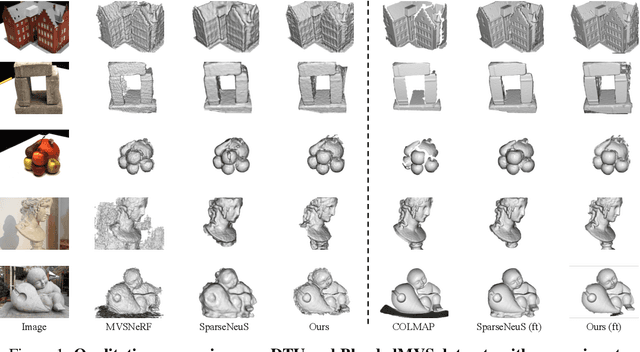

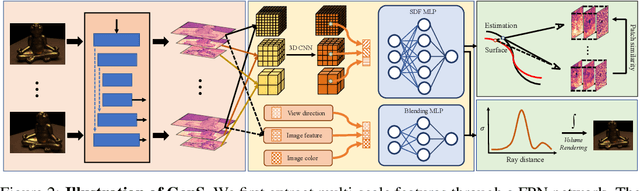

Combining the signed distance function (SDF) and differentiable volume rendering has emerged as a powerful paradigm for surface reconstruction from multi-view images without 3D supervision. However, current methods are impeded by requiring long-time per-scene optimizations and cannot generalize to new scenes. In this paper, we present GenS, an end-to-end generalizable neural surface reconstruction model. Unlike coordinate-based methods that train a separate network for each scene, we construct a generalized multi-scale volume to directly encode all scenes. Compared with existing solutions, our representation is more powerful, which can recover high-frequency details while maintaining global smoothness. Meanwhile, we introduce a multi-scale feature-metric consistency to impose the multi-view consistency in a more discriminative multi-scale feature space, which is robust to the failures of the photometric consistency. And the learnable feature can be self-enhanced to continuously improve the matching accuracy and mitigate aggregation ambiguity. Furthermore, we design a view contrast loss to force the model to be robust to those regions covered by few viewpoints through distilling the geometric prior from dense input to sparse input. Extensive experiments on popular benchmarks show that our model can generalize well to new scenes and outperform existing state-of-the-art methods even those employing ground-truth depth supervision. Code is available at https://github.com/prstrive/GenS.