 Add to Chrome
 Add to Firefox
 Add to Edge
Audio-to-Score Transcription using Pre-trained Features, Data Augmentation, and the New SheetSage-A2S Dataset
Aug 07, 2026
Existing audio-to-score (A2S) systems primarily focus on classical music, and the application to popular music remains underexplored. This paper first presents the new SheetSage-A2S Dataset, which includes 61 hours of audio with \texttt{**kern} score encodings for 9,468 clips originating from 6,066 unique songs, the first of its kind to facilitate A2S research for popular music. Additionally, we improve on existing A2S approaches by using data augmentation and MuQ, a pretrained feature-extraction model for music audio, to enhance generalisation abilities and extract meaningful audio features. Results show that the proposed A2S model achieves 4.98\% symbol error rate (SER) on the Quartets collection for classical music, which significantly outperforms the 15.3\% SER from the existing state-of-the-art \cite{alfaro-contrerasTransformer2024}. Additionally, our model achieves 20.92\% SER on the SheetSage-A2S dataset for popular music, serving as a strong benchmark for future research. The dataset, model, and code are made publicly available at: https://github.com/Multimodal-Music-Research-Lab/SheetSage2Kern_model.

Seedance 2.0: Advancing Video Generation for World Complexity
Apr 15, 2026Seedance 2.0 is a new native multi-modal audio-video generation model, officially released in China in early February 2026. Compared with its predecessors, Seedance 1.0 and 1.5 Pro, Seedance 2.0 adopts a unified, highly efficient, and large-scale architecture for multi-modal audio-video joint generation. This allows it to support four input modalities: text, image, audio, and video, by integrating one of the most comprehensive suites of multi-modal content reference and editing capabilities available in the industry to date. It delivers substantial, well-rounded improvements across all key sub-dimensions of video and audio generation. In both expert evaluations and public user tests, the model has demonstrated performance on par with the leading levels in the field. Seedance 2.0 supports direct generation of audio-video content with durations ranging from 4 to 15 seconds, with native output resolutions of 480p and 720p. For multi-modal inputs as reference, its current open platform supports up to 3 video clips, 9 images, and 3 audio clips. In addition, we provide Seedance 2.0 Fast version, an accelerated variant of Seedance 2.0 designed to boost generation speed for low-latency scenarios. Seedance 2.0 has delivered significant improvements to its foundational generation capabilities and multi-modal generation performance, bringing an enhanced creative experience for end users.
EmergentBridge: Improving Zero-Shot Cross-Modal Transfer in Unified Multimodal Embedding Models
Apr 14, 2026Unified multimodal embedding spaces underpin practical applications such as cross-modal retrieval and zero-shot recognition. In many real deployments, however, supervision is available only for a small subset of modality pairs (e.g., image--text), leaving \emph{unpaired} modality pairs (e.g., audio$\leftrightarrow$depth, infrared$\leftrightarrow$audio) weakly connected and thus performing poorly on zero-shot transfer. Addressing this sparse-pairing regime is therefore essential for scaling unified embedding systems to new tasks without curating exhaustive pairwise data. We propose \textbf{EmergentBridge}, an embedding-level bridging framework that improves performance on these unpaired pairs \emph{without requiring exhaustive pairwise supervision}. Our key observation is that naively aligning a new modality to a synthesized proxy embedding can introduce \emph{gradient interference}, degrading the anchor-alignment structure that existing retrieval/classification relies on. EmergentBridge addresses this by (i) learning a mapping that produces a \emph{noisy bridge anchor} (a proxy embedding of an already-aligned modality) from an anchor embedding, and (ii) enforcing proxy alignment only in the subspace orthogonal to the anchor-alignment direction, preserving anchor alignment while strengthening non-anchor connectivity. Across nine datasets spanning multiple modalities, EmergentBridge consistently outperforms prior binding baselines on zero-shot classification and retrieval, demonstrating strong emergent alignment.
Seedance 1.5 pro: A Native Audio-Visual Joint Generation Foundation Model
Dec 23, 2025Recent strides in video generation have paved the way for unified audio-visual generation. In this work, we present Seedance 1.5 pro, a foundational model engineered specifically for native, joint audio-video generation. Leveraging a dual-branch Diffusion Transformer architecture, the model integrates a cross-modal joint module with a specialized multi-stage data pipeline, achieving exceptional audio-visual synchronization and superior generation quality. To ensure practical utility, we implement meticulous post-training optimizations, including Supervised Fine-Tuning (SFT) on high-quality datasets and Reinforcement Learning from Human Feedback (RLHF) with multi-dimensional reward models. Furthermore, we introduce an acceleration framework that boosts inference speed by over 10X. Seedance 1.5 pro distinguishes itself through precise multilingual and dialect lip-syncing, dynamic cinematic camera control, and enhanced narrative coherence, positioning it as a robust engine for professional-grade content creation. Seedance 1.5 pro is now accessible on Volcano Engine at https://console.volcengine.com/ark/region:ark+cn-beijing/experience/vision?type=GenVideo.
Let the Model Learn to Feel: Mode-Guided Tonality Injection for Symbolic Music Emotion Recognition
Dec 15, 2025Music emotion recognition is a key task in symbolic music understanding (SMER). Recent approaches have shown promising results by fine-tuning large-scale pre-trained models (e.g., MIDIBERT, a benchmark in symbolic music understanding) to map musical semantics to emotional labels. While these models effectively capture distributional musical semantics, they often overlook tonal structures, particularly musical modes, which play a critical role in emotional perception according to music psychology. In this paper, we investigate the representational capacity of MIDIBERT and identify its limitations in capturing mode-emotion associations. To address this issue, we propose a Mode-Guided Enhancement (MoGE) strategy that incorporates psychological insights on mode into the model. Specifically, we first conduct a mode augmentation analysis, which reveals that MIDIBERT fails to effectively encode emotion-mode correlations. We then identify the least emotion-relevant layer within MIDIBERT and introduce a Mode-guided Feature-wise linear modulation injection (MoFi) framework to inject explicit mode features, thereby enhancing the model's capability in emotional representation and inference. Extensive experiments on the EMOPIA and VGMIDI datasets demonstrate that our mode injection strategy significantly improves SMER performance, achieving accuracies of 75.2% and 59.1%, respectively. These results validate the effectiveness of mode-guided modeling in symbolic music emotion recognition.
Robust Variational Model Based Tailored UNet: Leveraging Edge Detector and Mean Curvature for Improved Image Segmentation
Dec 08, 2025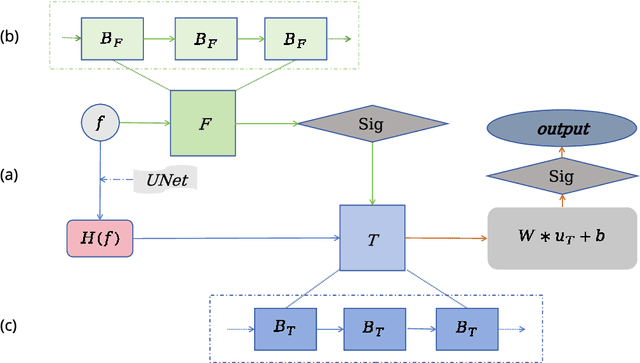

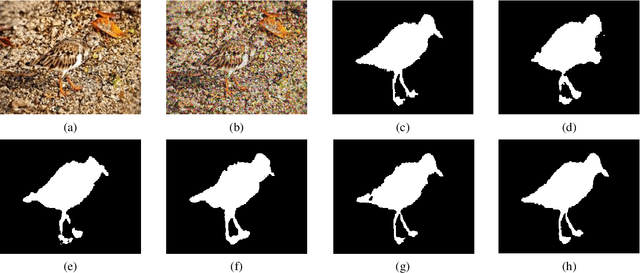

To address the challenge of segmenting noisy images with blurred or fragmented boundaries, this paper presents a robust version of Variational Model Based Tailored UNet (VM_TUNet), a hybrid framework that integrates variational methods with deep learning. The proposed approach incorporates physical priors, an edge detector and a mean curvature term, into a modified Cahn-Hilliard equation, aiming to combine the interpretability and boundary-smoothing advantages of variational partial differential equations (PDEs) with the strong representational ability of deep neural networks. The architecture consists of two collaborative modules: an F module, which conducts efficient frequency domain preprocessing to alleviate poor local minima, and a T module, which ensures accurate and stable local computations, backed by a stability estimate. Extensive experiments on three benchmark datasets indicate that the proposed method achieves a balanced trade-off between performance and computational efficiency, which yields competitive quantitative results and improved visual quality compared to pure convolutional neural network (CNN) based models, while achieving performance close to that of transformer-based method with reasonable computational expense.
The Role of Rank in Mismatched Low-Rank Symmetric Matrix Estimation
Jul 16, 2025We investigate the performance of a Bayesian statistician tasked with recovering a rank-\(k\) signal matrix \(\bS \bS^{\top} \in \mathbb{R}^{n \times n}\), corrupted by element-wise additive Gaussian noise. This problem lies at the core of numerous applications in machine learning, signal processing, and statistics. We derive an analytic expression for the asymptotic mean-square error (MSE) of the Bayesian estimator under mismatches in the assumed signal rank, signal power, and signal-to-noise ratio (SNR), considering both sphere and Gaussian signals. Additionally, we conduct a rigorous analysis of how rank mismatch influences the asymptotic MSE. Our primary technical tools include the spectrum of Gaussian orthogonal ensembles (GOE) with low-rank perturbations and asymptotic behavior of \(k\)-dimensional spherical integrals.
Decoupling Classifier for Boosting Few-shot Object Detection and Instance Segmentation
May 20, 2025This paper focus on few-shot object detection~(FSOD) and instance segmentation~(FSIS), which requires a model to quickly adapt to novel classes with a few labeled instances. The existing methods severely suffer from bias classification because of the missing label issue which naturally exists in an instance-level few-shot scenario and is first formally proposed by us. Our analysis suggests that the standard classification head of most FSOD or FSIS models needs to be decoupled to mitigate the bias classification. Therefore, we propose an embarrassingly simple but effective method that decouples the standard classifier into two heads. Then, these two individual heads are capable of independently addressing clear positive samples and noisy negative samples which are caused by the missing label. In this way, the model can effectively learn novel classes while mitigating the effects of noisy negative samples. Without bells and whistles, our model without any additional computation cost and parameters consistently outperforms its baseline and state-of-the-art by a large margin on PASCAL VOC and MS-COCO benchmarks for FSOD and FSIS tasks. The Code is available at https://csgaobb.github.io/Projects/DCFS.
Image Segmentation via Variational Model Based Tailored UNet: A Deep Variational Framework
May 09, 2025

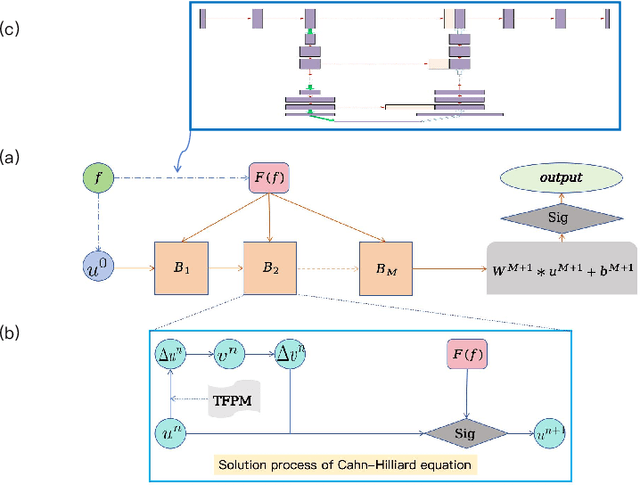

Traditional image segmentation methods, such as variational models based on partial differential equations (PDEs), offer strong mathematical interpretability and precise boundary modeling, but often suffer from sensitivity to parameter settings and high computational costs. In contrast, deep learning models such as UNet, which are relatively lightweight in parameters, excel in automatic feature extraction but lack theoretical interpretability and require extensive labeled data. To harness the complementary strengths of both paradigms, we propose Variational Model Based Tailored UNet (VM_TUNet), a novel hybrid framework that integrates the fourth-order modified Cahn-Hilliard equation with the deep learning backbone of UNet, which combines the interpretability and edge-preserving properties of variational methods with the adaptive feature learning of neural networks. Specifically, a data-driven operator is introduced to replace manual parameter tuning, and we incorporate the tailored finite point method (TFPM) to enforce high-precision boundary preservation. Experimental results on benchmark datasets demonstrate that VM_TUNet achieves superior segmentation performance compared to existing approaches, especially for fine boundary delineation.
Distributed Nonparametric Estimation: from Sparse to Dense Samples per Terminal
Jan 14, 2025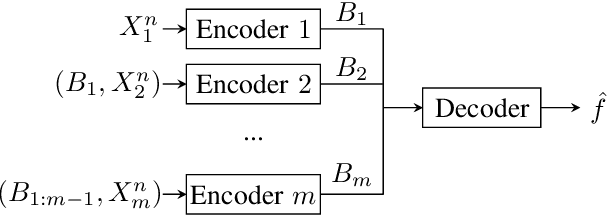
Consider the communication-constrained problem of nonparametric function estimation, in which each distributed terminal holds multiple i.i.d. samples. Under certain regularity assumptions, we characterize the minimax optimal rates for all regimes, and identify phase transitions of the optimal rates as the samples per terminal vary from sparse to dense. This fully solves the problem left open by previous works, whose scopes are limited to regimes with either dense samples or a single sample per terminal. To achieve the optimal rates, we design a layered estimation protocol by exploiting protocols for the parametric density estimation problem. We show the optimality of the protocol using information-theoretic methods and strong data processing inequalities, and incorporating the classic balls and bins model. The optimal rates are immediate for various special cases such as density estimation, Gaussian, binary, Poisson and heteroskedastic regression models.