 Add to Chrome
 Add to Firefox
 Add to Edge
Learning Permutation-invariant Macroscopic Dynamics
May 29, 2026
Accurately modeling the macroscopic dynamics of high-dimensional microscopic systems is of broad interest across the sciences. Many data-driven approaches learn a low-dimensional latent state through an autoencoder trained for pointwise input reconstruction. These methods typically assume a fixed ordering of microscopic degrees of freedom in the input. However, in many settings, such as particle systems, the microscopic state is inherently unordered. This motivates an autoencoder framework that learns permutation-invariant latent representations. To this end, we adopt a permutation-invariant encoder and design the decoder to reconstruct the mass distribution centered at the observed points rather than per-sample reconstruction. We then jointly learn the macroscopic dynamics of the observables together with the latent states. We demonstrate the effectiveness and robustness of the proposed method across a range of microscopic settings, including learning the energy dynamics in interacting particle systems, predicting mixing dynamics in Lennard-Jones fluids, and modeling the stretching dynamics from video data of polymers moving in an elongational force field.

The Curse and Blessing of Mean Bias in FP4-Quantized LLM Training
Mar 11, 2026Large language models trained on natural language exhibit pronounced anisotropy: a small number of directions concentrate disproportionate energy, while the remaining dimensions form a broad semantic tail. In low-bit training regimes, this geometry becomes numerically unstable. Because blockwise quantization scales are determined by extreme elementwise magnitudes, dominant directions stretch the dynamic range, compressing long-tail semantic variation into narrow numerical bins. We show that this instability is primarily driven by a coherent rank-one mean bias, which constitutes the dominant component of spectral anisotropy in LLM representations. This mean component emerges systematically across layers and training stages and accounts for the majority of extreme activation magnitudes, making it the principal driver of dynamic-range inflation under low precision. Crucially, because the dominant instability is rank-one, it can be eliminated through a simple source-level mean-subtraction operation. This bias-centric conditioning recovers most of the stability benefits of SVD-based spectral methods while requiring only reduction operations and standard quantization kernels. Empirical results on FP4 (W4A4G4) training show that mean removal substantially narrows the loss gap to BF16 and restores downstream performance, providing a hardware-efficient path to stable low-bit LLM training.
SD-MoE: Spectral Decomposition for Effective Expert Specialization
Feb 13, 2026Mixture-of-Experts (MoE) architectures scale Large Language Models via expert specialization induced by conditional computation. In practice, however, expert specialization often fails: some experts become functionally similar, while others functioning as de facto shared experts, limiting the effective capacity and model performance. In this work, we analysis from a spectral perspective on parameter and gradient spaces, uncover that (1) experts share highly overlapping dominant spectral components in their parameters, (2) dominant gradient subspaces are strongly aligned across experts, driven by ubiquitous low-rank structure in human corpus, and (3) gating mechanisms preferentially route inputs along these dominant directions, further limiting specialization. To address this, we propose Spectral-Decoupled MoE (SD-MoE), which decomposes both parameter and gradient in the spectral space. SD-MoE improves performance across downstream tasks, enables effective expert specialization, incurring minimal additional computation, and can be seamlessly integrated into a wide range of existing MoE architectures, including Qwen and DeepSeek.
Multi-Head Attention as a Source of Catastrophic Forgetting in MoE Transformers
Feb 13, 2026Mixture-of-Experts (MoE) architectures are often considered a natural fit for continual learning because sparse routing should localize updates and reduce interference, yet MoE Transformers still forget substantially even with sparse, well-balanced expert utilization. We attribute this gap to a pre-routing bottleneck: multi-head attention concatenates head-specific signals into a single post-attention router input, forcing routing to act on co-occurring feature compositions rather than separable head channels. We show that this router input simultaneously encodes multiple separately decodable semantic and structural factors with uneven head support, and that different feature compositions induce weakly aligned parameter-gradient directions; as a result, routing maps many distinct compositions to the same route. We quantify this collision effect via a route-wise effective composition number $N_{eff}$ and find that higher $N_{eff}$ is associated with larger old-task loss increases after continual training. Motivated by these findings, we propose MH-MoE, which performs head-wise routing over sub-representations to increase routing granularity and reduce composition collisions. On TRACE with Qwen3-0.6B/8B, MH-MoE effectively mitigates forgetting, reducing BWT on Qwen3-0.6B from 11.2% (LoRAMoE) to 4.5%.
Dispelling the Curse of Singularities in Neural Network Optimizations
Feb 01, 2026This work investigates the optimization instability of deep neural networks from a less-explored yet insightful perspective: the emergence and amplification of singularities in the parametric space. Our analysis reveals that parametric singularities inevitably grow with gradient updates and further intensify alignment with representations, leading to increased singularities in the representation space. We show that the gradient Frobenius norms are bounded by the top singular values of the weight matrices, and as training progresses, the mutually reinforcing growth of weight and representation singularities, termed the curse of singularities, relaxes these bounds, escalating the risk of sharp loss explosions. To counter this, we propose Parametric Singularity Smoothing (PSS), a lightweight, flexible, and effective method for smoothing the singular spectra of weight matrices. Extensive experiments across diverse datasets, architectures, and optimizers demonstrate that PSS mitigates instability, restores trainability even after failure, and improves both training efficiency and generalization.
Scalable learning of macroscopic stochastic dynamics
Nov 17, 2025Macroscopic dynamical descriptions of complex physical systems are crucial for understanding and controlling material behavior. With the growing availability of data and compute, machine learning has become a promising alternative to first-principles methods to build accurate macroscopic models from microscopic trajectory simulations. However, for spatially extended systems, direct simulations of sufficiently large microscopic systems that inform macroscopic behavior is prohibitive. In this work, we propose a framework that learns the macroscopic dynamics of large stochastic microscopic systems using only small-system simulations. Our framework employs a partial evolution scheme to generate training data pairs by evolving large-system snapshots within local patches. We subsequently identify the closure variables associated with the macroscopic observables and learn the macroscopic dynamics using a custom loss. Furthermore, we introduce a hierarchical upsampling scheme that enables efficient generation of large-system snapshots from small-system trajectory distributions. We empirically demonstrate the accuracy and robustness of our framework through a variety of stochastic spatially extended systems, including those described by stochastic partial differential equations, idealised lattice spin systems, and a more realistic NbMoTa alloy system.
Learning Macroscopic Dynamics from Partial Microscopic Observations
Oct 31, 2024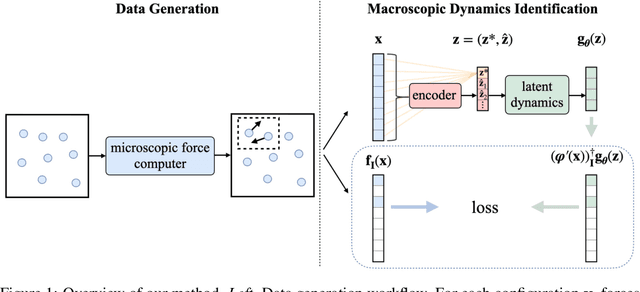
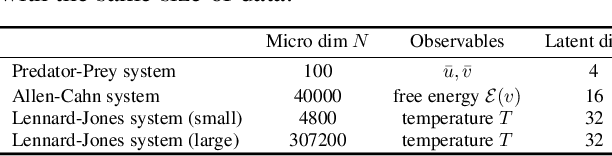
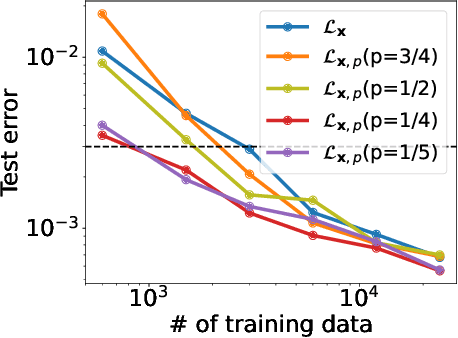

Macroscopic observables of a system are of keen interest in real applications such as the design of novel materials. Current methods rely on microscopic trajectory simulations, where the forces on all microscopic coordinates need to be computed or measured. However, this can be computationally prohibitive for realistic systems. In this paper, we propose a method to learn macroscopic dynamics requiring only force computations on a subset of the microscopic coordinates. Our method relies on a sparsity assumption: the force on each microscopic coordinate relies only on a small number of other coordinates. The main idea of our approach is to map the training procedure on the macroscopic coordinates back to the microscopic coordinates, on which partial force computations can be used as stochastic estimation to update model parameters. We provide a theoretical justification of this under suitable conditions. We demonstrate the accuracy, force computation efficiency, and robustness of our method on learning macroscopic closure models from a variety of microscopic systems, including those modeled by partial differential equations or molecular dynamics simulations.
BAMBOO: a predictive and transferable machine learning force field framework for liquid electrolyte development
Apr 12, 2024Despite the widespread applications of machine learning force field (MLFF) on solids and small molecules, there is a notable gap in applying MLFF to complex liquid electrolytes. In this work, we introduce BAMBOO (ByteDance AI Molecular Simulation Booster), a novel framework for molecular dynamics (MD) simulations, with a demonstration of its capabilities in the context of liquid electrolytes for lithium batteries. We design a physics-inspired graph equivariant transformer architecture as the backbone of BAMBOO to learn from quantum mechanical simulations. Additionally, we pioneer an ensemble knowledge distillation approach and apply it on MLFFs to improve the stability of MD simulations. Finally, we propose the density alignment algorithm to align BAMBOO with experimental measurements. BAMBOO demonstrates state-of-the-art accuracy in predicting key electrolyte properties such as density, viscosity, and ionic conductivity across various solvents and salt combinations. Our current model, trained on more than 15 chemical species, achieves the average density error of 0.01 g/cm$^3$ on various compositions compared with experimental data. Moreover, our model demonstrates transferability to molecules not included in the quantum mechanical dataset. We envision this work as paving the way to a "universal MLFF" capable of simulating properties of common organic liquids.