 Add to Chrome
 Add to Firefox
 Add to Edge
The Curse and Blessing of Mean Bias in FP4-Quantized LLM Training
Mar 11, 2026
Large language models trained on natural language exhibit pronounced anisotropy: a small number of directions concentrate disproportionate energy, while the remaining dimensions form a broad semantic tail. In low-bit training regimes, this geometry becomes numerically unstable. Because blockwise quantization scales are determined by extreme elementwise magnitudes, dominant directions stretch the dynamic range, compressing long-tail semantic variation into narrow numerical bins. We show that this instability is primarily driven by a coherent rank-one mean bias, which constitutes the dominant component of spectral anisotropy in LLM representations. This mean component emerges systematically across layers and training stages and accounts for the majority of extreme activation magnitudes, making it the principal driver of dynamic-range inflation under low precision. Crucially, because the dominant instability is rank-one, it can be eliminated through a simple source-level mean-subtraction operation. This bias-centric conditioning recovers most of the stability benefits of SVD-based spectral methods while requiring only reduction operations and standard quantization kernels. Empirical results on FP4 (W4A4G4) training show that mean removal substantially narrows the loss gap to BF16 and restores downstream performance, providing a hardware-efficient path to stable low-bit LLM training.

Multi-Head Attention as a Source of Catastrophic Forgetting in MoE Transformers
Feb 13, 2026Mixture-of-Experts (MoE) architectures are often considered a natural fit for continual learning because sparse routing should localize updates and reduce interference, yet MoE Transformers still forget substantially even with sparse, well-balanced expert utilization. We attribute this gap to a pre-routing bottleneck: multi-head attention concatenates head-specific signals into a single post-attention router input, forcing routing to act on co-occurring feature compositions rather than separable head channels. We show that this router input simultaneously encodes multiple separately decodable semantic and structural factors with uneven head support, and that different feature compositions induce weakly aligned parameter-gradient directions; as a result, routing maps many distinct compositions to the same route. We quantify this collision effect via a route-wise effective composition number $N_{eff}$ and find that higher $N_{eff}$ is associated with larger old-task loss increases after continual training. Motivated by these findings, we propose MH-MoE, which performs head-wise routing over sub-representations to increase routing granularity and reduce composition collisions. On TRACE with Qwen3-0.6B/8B, MH-MoE effectively mitigates forgetting, reducing BWT on Qwen3-0.6B from 11.2% (LoRAMoE) to 4.5%.
SD-MoE: Spectral Decomposition for Effective Expert Specialization
Feb 13, 2026Mixture-of-Experts (MoE) architectures scale Large Language Models via expert specialization induced by conditional computation. In practice, however, expert specialization often fails: some experts become functionally similar, while others functioning as de facto shared experts, limiting the effective capacity and model performance. In this work, we analysis from a spectral perspective on parameter and gradient spaces, uncover that (1) experts share highly overlapping dominant spectral components in their parameters, (2) dominant gradient subspaces are strongly aligned across experts, driven by ubiquitous low-rank structure in human corpus, and (3) gating mechanisms preferentially route inputs along these dominant directions, further limiting specialization. To address this, we propose Spectral-Decoupled MoE (SD-MoE), which decomposes both parameter and gradient in the spectral space. SD-MoE improves performance across downstream tasks, enables effective expert specialization, incurring minimal additional computation, and can be seamlessly integrated into a wide range of existing MoE architectures, including Qwen and DeepSeek.
Dispelling the Curse of Singularities in Neural Network Optimizations
Feb 01, 2026This work investigates the optimization instability of deep neural networks from a less-explored yet insightful perspective: the emergence and amplification of singularities in the parametric space. Our analysis reveals that parametric singularities inevitably grow with gradient updates and further intensify alignment with representations, leading to increased singularities in the representation space. We show that the gradient Frobenius norms are bounded by the top singular values of the weight matrices, and as training progresses, the mutually reinforcing growth of weight and representation singularities, termed the curse of singularities, relaxes these bounds, escalating the risk of sharp loss explosions. To counter this, we propose Parametric Singularity Smoothing (PSS), a lightweight, flexible, and effective method for smoothing the singular spectra of weight matrices. Extensive experiments across diverse datasets, architectures, and optimizers demonstrate that PSS mitigates instability, restores trainability even after failure, and improves both training efficiency and generalization.
ML-Bench: Large Language Models Leverage Open-source Libraries for Machine Learning Tasks
Nov 16, 2023

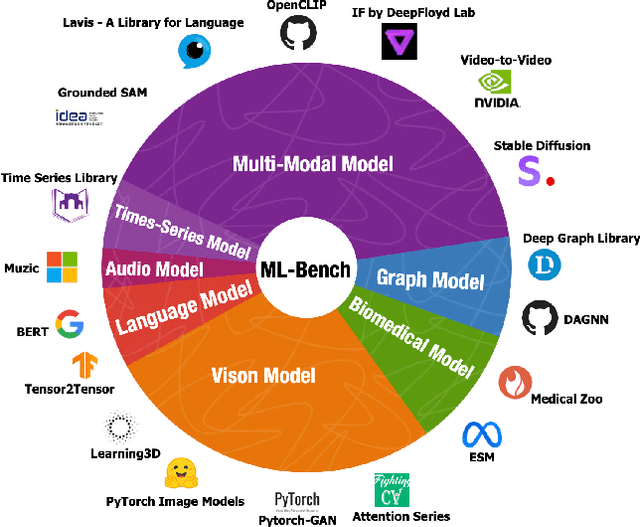
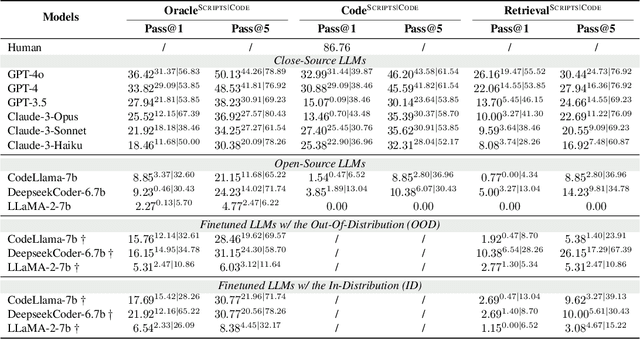
Large language models have shown promising performance in code generation benchmarks. However, a considerable divide exists between these benchmark achievements and their practical applicability, primarily attributed to real-world programming's reliance on pre-existing libraries. Instead of evaluating LLMs to code from scratch, this work aims to propose a new evaluation setup where LLMs use open-source libraries to finish machine learning tasks. Therefore, we propose ML-Bench, an expansive benchmark developed to assess the effectiveness of LLMs in leveraging existing functions in open-source libraries. Consisting of 10044 samples spanning 130 tasks over 14 notable machine learning GitHub repositories. In this setting, given a specific machine learning task instruction and the accompanying README in a codebase, an LLM is tasked to generate code to accomplish the task. This necessitates the comprehension of long and language-code interleaved documents, as well as the understanding of complex cross-file code structures, introducing new challenges. Notably, while GPT-4 exhibits remarkable improvement over other LLMs, it manages to accomplish only 39.73\% of the tasks, leaving a huge space for improvement. We address these challenges by proposing ML-Agent, designed to effectively navigate the codebase, locate documentation, retrieve code, and generate executable code. Empirical results demonstrate that ML-Agent, built upon GPT-4, results in further improvements. Code, data, and models are available at \url{https://ml-bench.github.io/}.