 Add to Chrome
 Add to Firefox
 Add to Edge
Continuous Latent Diffusion Language Model
May 07, 2026
Large language models have achieved remarkable success under the autoregressive paradigm, yet high-quality text generation need not be tied to a fixed left-to-right order. Existing alternatives still struggle to jointly achieve generation efficiency, scalable representation learning, and effective global semantic modeling. We propose Cola DLM, a hierarchical latent diffusion language model that frames text generation through hierarchical information decomposition. Cola DLM first learns a stable text-to-latent mapping with a Text VAE, then models a global semantic prior in continuous latent space with a block-causal DiT, and finally generates text through conditional decoding. From a unified Markov-path perspective, its diffusion process performs latent prior transport rather than token-level observation recovery, thereby separating global semantic organization from local textual realization. This design yields a more flexible non-autoregressive inductive bias, supports semantic compression and prior fitting in continuous space, and naturally extends to other continuous modalities. Through experiments spanning 4 research questions, 8 benchmarks, strictly matched ~2B-parameter autoregressive and LLaDA baselines, and scaling curves up to about 2000 EFLOPs, we identify an effective overall configuration of Cola DLM and verify its strong scaling behavior for text generation. Taken together, the results establish hierarchical continuous latent prior modeling as a principled alternative to strictly token-level language modeling, where generation quality and scaling behavior may better reflect model capability than likelihood, while also suggesting a concrete path toward unified modeling across discrete text and continuous modalities.

Video Generation with Predictive Latents
May 04, 2026Video Variational Autoencoder (VAE) enables latent video generative modeling by mapping the visual world into compact spatiotemporal latent spaces, improving training efficiency and stability. While existing video VAEs achieve commendable reconstruction quality, continued optimization of reconstruction does not necessarily translate into improved generative performance. How to enhance the diffusability of video latents remains a critical and unresolved challenge. In this work, inspired by principles of predictive world modeling, we investigate the potential of predictive learning to improve the video generative modeling. To this end, we introduce a simple and effective predictive reconstruction objective that unifies predictive learning with video reconstruction. Specifically, we randomly discard future frames and encode only partial past observations, while training the decoder to reconstruct the observed frames and predict future ones simultaneously. This design encourages the latent space to encode temporally predictive structures and build a more coherent understanding of video dynamics, thereby improving generation quality. Our model, termed Predictive Video VAE (PV-VAE), achieves superior performance on video generation, with 52% faster convergence and a 34.42 FVD improvement over the Wan2.2 VAE on UCF101. Furthermore, comprehensive analyses demonstrate that PV-VAE not only exhibits favorable scalability, with generative performance improving alongside VAE training, but also yields consistent gains in downstream video understanding, underscoring a latent space that effectively captures temporal coherence and motion priors.
Seedance 2.0: Advancing Video Generation for World Complexity
Apr 15, 2026Seedance 2.0 is a new native multi-modal audio-video generation model, officially released in China in early February 2026. Compared with its predecessors, Seedance 1.0 and 1.5 Pro, Seedance 2.0 adopts a unified, highly efficient, and large-scale architecture for multi-modal audio-video joint generation. This allows it to support four input modalities: text, image, audio, and video, by integrating one of the most comprehensive suites of multi-modal content reference and editing capabilities available in the industry to date. It delivers substantial, well-rounded improvements across all key sub-dimensions of video and audio generation. In both expert evaluations and public user tests, the model has demonstrated performance on par with the leading levels in the field. Seedance 2.0 supports direct generation of audio-video content with durations ranging from 4 to 15 seconds, with native output resolutions of 480p and 720p. For multi-modal inputs as reference, its current open platform supports up to 3 video clips, 9 images, and 3 audio clips. In addition, we provide Seedance 2.0 Fast version, an accelerated variant of Seedance 2.0 designed to boost generation speed for low-latency scenarios. Seedance 2.0 has delivered significant improvements to its foundational generation capabilities and multi-modal generation performance, bringing an enhanced creative experience for end users.
Tune-Your-Style: Intensity-tunable 3D Style Transfer with Gaussian Splatting
Jan 31, 20263D style transfer refers to the artistic stylization of 3D assets based on reference style images. Recently, 3DGS-based stylization methods have drawn considerable attention, primarily due to their markedly enhanced training and rendering speeds. However, a vital challenge for 3D style transfer is to strike a balance between the content and the patterns and colors of the style. Although the existing methods strive to achieve relatively balanced outcomes, the fixed-output paradigm struggles to adapt to the diverse content-style balance requirements from different users. In this work, we introduce a creative intensity-tunable 3D style transfer paradigm, dubbed \textbf{Tune-Your-Style}, which allows users to flexibly adjust the style intensity injected into the scene to match their desired content-style balance, thus enhancing the customizability of 3D style transfer. To achieve this goal, we first introduce Gaussian neurons to explicitly model the style intensity and parameterize a learnable style tuner to achieve intensity-tunable style injection. To facilitate the learning of tunable stylization, we further propose the tunable stylization guidance, which obtains multi-view consistent stylized views from diffusion models through cross-view style alignment, and then employs a two-stage optimization strategy to provide stable and efficient guidance by modulating the balance between full-style guidance from the stylized views and zero-style guidance from the initial rendering. Extensive experiments demonstrate that our method not only delivers visually appealing results, but also exhibits flexible customizability for 3D style transfer. Project page is available at https://zhao-yian.github.io/TuneStyle.
SPAN: Spatial-Projection Alignment for Monocular 3D Object Detection
Nov 10, 2025Existing monocular 3D detectors typically tame the pronounced nonlinear regression of 3D bounding box through decoupled prediction paradigm, which employs multiple branches to estimate geometric center, depth, dimensions, and rotation angle separately. Although this decoupling strategy simplifies the learning process, it inherently ignores the geometric collaborative constraints between different attributes, resulting in the lack of geometric consistency prior, thereby leading to suboptimal performance. To address this issue, we propose novel Spatial-Projection Alignment (SPAN) with two pivotal components: (i). Spatial Point Alignment enforces an explicit global spatial constraint between the predicted and ground-truth 3D bounding boxes, thereby rectifying spatial drift caused by decoupled attribute regression. (ii). 3D-2D Projection Alignment ensures that the projected 3D box is aligned tightly within its corresponding 2D detection bounding box on the image plane, mitigating projection misalignment overlooked in previous works. To ensure training stability, we further introduce a Hierarchical Task Learning strategy that progressively incorporates spatial-projection alignment as 3D attribute predictions refine, preventing early stage error propagation across attributes. Extensive experiments demonstrate that the proposed method can be easily integrated into any established monocular 3D detector and delivers significant performance improvements.
E-4DGS: High-Fidelity Dynamic Reconstruction from the Multi-view Event Cameras
Aug 13, 2025Novel view synthesis and 4D reconstruction techniques predominantly rely on RGB cameras, thereby inheriting inherent limitations such as the dependence on adequate lighting, susceptibility to motion blur, and a limited dynamic range. Event cameras, offering advantages of low power, high temporal resolution and high dynamic range, have brought a new perspective to addressing the scene reconstruction challenges in high-speed motion and low-light scenes. To this end, we propose E-4DGS, the first event-driven dynamic Gaussian Splatting approach, for novel view synthesis from multi-view event streams with fast-moving cameras. Specifically, we introduce an event-based initialization scheme to ensure stable training and propose event-adaptive slicing splatting for time-aware reconstruction. Additionally, we employ intensity importance pruning to eliminate floating artifacts and enhance 3D consistency, while incorporating an adaptive contrast threshold for more precise optimization. We design a synthetic multi-view camera setup with six moving event cameras surrounding the object in a 360-degree configuration and provide a benchmark multi-view event stream dataset that captures challenging motion scenarios. Our approach outperforms both event-only and event-RGB fusion baselines and paves the way for the exploration of multi-view event-based reconstruction as a novel approach for rapid scene capture.
iSegMan: Interactive Segment-and-Manipulate 3D Gaussians
May 17, 2025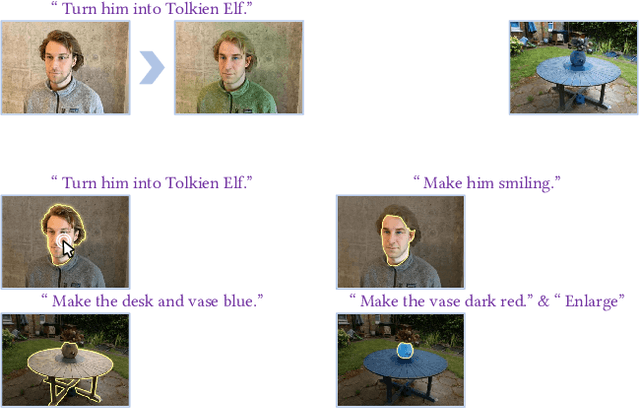
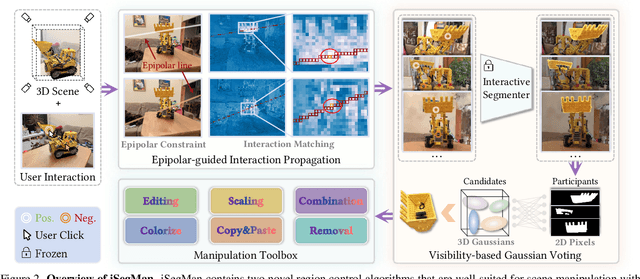

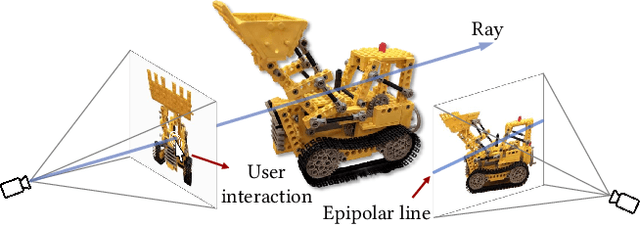
The efficient rendering and explicit nature of 3DGS promote the advancement of 3D scene manipulation. However, existing methods typically encounter challenges in controlling the manipulation region and are unable to furnish the user with interactive feedback, which inevitably leads to unexpected results. Intuitively, incorporating interactive 3D segmentation tools can compensate for this deficiency. Nevertheless, existing segmentation frameworks impose a pre-processing step of scene-specific parameter training, which limits the efficiency and flexibility of scene manipulation. To deliver a 3D region control module that is well-suited for scene manipulation with reliable efficiency, we propose interactive Segment-and-Manipulate 3D Gaussians (iSegMan), an interactive segmentation and manipulation framework that only requires simple 2D user interactions in any view. To propagate user interactions to other views, we propose Epipolar-guided Interaction Propagation (EIP), which innovatively exploits epipolar constraint for efficient and robust interaction matching. To avoid scene-specific training to maintain efficiency, we further propose the novel Visibility-based Gaussian Voting (VGV), which obtains 2D segmentations from SAM and models the region extraction as a voting game between 2D Pixels and 3D Gaussians based on Gaussian visibility. Taking advantage of the efficient and precise region control of EIP and VGV, we put forth a Manipulation Toolbox to implement various functions on selected regions, enhancing the controllability, flexibility and practicality of scene manipulation. Extensive results on 3D scene manipulation and segmentation tasks fully demonstrate the significant advantages of iSegMan. Project page is available at https://zhao-yian.github.io/iSegMan.
Kongzi: A Historical Large Language Model with Fact Enhancement
Apr 13, 2025The capabilities of the latest large language models (LLMs) have been extended from pure natural language understanding to complex reasoning tasks. However, current reasoning models often exhibit factual inaccuracies in longer reasoning chains, which poses challenges for historical reasoning and limits the potential of LLMs in complex, knowledge-intensive tasks. Historical studies require not only the accurate presentation of factual information but also the ability to establish cross-temporal correlations and derive coherent conclusions from fragmentary and often ambiguous sources. To address these challenges, we propose Kongzi, a large language model specifically designed for historical analysis. Through the integration of curated, high-quality historical data and a novel fact-reinforcement learning strategy, Kongzi demonstrates strong factual alignment and sophisticated reasoning depth. Extensive experiments on tasks such as historical question answering and narrative generation demonstrate that Kongzi outperforms existing models in both factual accuracy and reasoning depth. By effectively addressing the unique challenges inherent in historical texts, Kongzi sets a new standard for the development of accurate and reliable LLMs in professional domains.
MagicComp: Training-free Dual-Phase Refinement for Compositional Video Generation
Mar 18, 2025Text-to-video (T2V) generation has made significant strides with diffusion models. However, existing methods still struggle with accurately binding attributes, determining spatial relationships, and capturing complex action interactions between multiple subjects. To address these limitations, we propose MagicComp, a training-free method that enhances compositional T2V generation through dual-phase refinement. Specifically, (1) During the Conditioning Stage: We introduce the Semantic Anchor Disambiguation to reinforces subject-specific semantics and resolve inter-subject ambiguity by progressively injecting the directional vectors of semantic anchors into original text embedding; (2) During the Denoising Stage: We propose Dynamic Layout Fusion Attention, which integrates grounding priors and model-adaptive spatial perception to flexibly bind subjects to their spatiotemporal regions through masked attention modulation. Furthermore, MagicComp is a model-agnostic and versatile approach, which can be seamlessly integrated into existing T2V architectures. Extensive experiments on T2V-CompBench and VBench demonstrate that MagicComp outperforms state-of-the-art methods, highlighting its potential for applications such as complex prompt-based and trajectory-controllable video generation. Project page: https://hong-yu-zhang.github.io/MagicComp-Page/.
ProGDF: Progressive Gaussian Differential Field for Controllable and Flexible 3D Editing
Dec 11, 2024


3D editing plays a crucial role in editing and reusing existing 3D assets, thereby enhancing productivity. Recently, 3DGS-based methods have gained increasing attention due to their efficient rendering and flexibility. However, achieving desired 3D editing results often requires multiple adjustments in an iterative loop, resulting in tens of minutes of training time cost for each attempt and a cumbersome trial-and-error cycle for users. This in-the-loop training paradigm results in a poor user experience. To address this issue, we introduce the concept of process-oriented modelling for 3D editing and propose the Progressive Gaussian Differential Field (ProGDF), an out-of-loop training approach that requires only a single training session to provide users with controllable editing capability and variable editing results through a user-friendly interface in real-time. ProGDF consists of two key components: Progressive Gaussian Splatting (PGS) and Gaussian Differential Field (GDF). PGS introduces the progressive constraint to extract the diverse intermediate results of the editing process and employs rendering quality regularization to improve the quality of these results. Based on these intermediate results, GDF leverages a lightweight neural network to model the editing process. Extensive results on two novel applications, namely controllable 3D editing and flexible fine-grained 3D manipulation, demonstrate the effectiveness, practicality and flexibility of the proposed ProGDF.