 Add to Chrome
 Add to Firefox
 Add to Edge
UniWorld-View: Large-Baseline View Synthesis via Video Diffusion Models
Aug 05, 2026
The abundance of casually captured monocular videos and images on social media provides a valuable source for immersive content creation, where generating novel views from such sparse observations can greatly enhance user experiences. However, producing photorealistic and geometrically consistent views with precise camera control remains challenging when input coverage is extremely limited. Reconstruction-based approaches such as NeRF and 3D Gaussian Splatting (3DGS) deteriorate severely under sparse inputs and fail to explicitly handle occlusions. Generative methods ease data requirements but still struggle with large-baseline view synthesis due to inaccurate or implicit geometric guidance. To overcome these limitations, we introduce UniWorld-View, a unified framework for controllable large-baseline novel view synthesis from monocular inputs. UniWorld-View integrates explicit 3D guidance with generative diffusion modeling to enable precise camera control and geometrically consistent view generation. The geometric guidance is obtained through an occlusion-aware point cloud rendering strategy that resolves visibility ambiguities and provides accurate priors for diffusion-based synthesis. By coupling this rendering strategy with powerful video diffusion backbones, UniWorld-View achieves high-fidelity novel view generation even under extreme camera motions and wide-baseline changes, and can further provide multi-view videos for downstream dynamic 3DGS reconstruction. Experiments on the WorldScore benchmark and zero-shot NVS benchmarks demonstrate the effectiveness of UniWorld-View in controllability, geometric consistency, and visual fidelity.

Scaling Mixture-of-Experts Video Pretraining for Embodied Intelligence
Jul 08, 2026Despite the recent promise in robot control, video generative models suffer from a domain mismatch due to their primary focus on content creation. For example, their design inherently prioritizes visual fidelity and creativity over computational efficiency and physical realism. In this work, we present LingBot-Video, a DiT-based video pretraining paradigm specifically tailored for embodied intelligence. From the architecture perspective, we adopt the Mixture-of-Experts (MoE), instead of dense, framework to achieve a better trade-off between modeling capacity and inference efficiency, and manage to scale it up from scratch. From the data perspective, we construct a data profiling engine that augments standard internet videos with extensive robot-oriented footage, encompassing manipulation, navigation, and egocentric perspectives, to equip the base model with an intrinsic understanding of actions and world dynamics. From the training perspective, we develop a multi-dimensional reward system to enforce the alignment regarding physical rationality and task completion, going beyond standard criteria such as aesthetics, prompt-following, and motion consistency. Comprehensive evaluations validate its performance and efficiency as a video foundation model. We contribute LingBot-Video as the inaugural large-scale, open-source MoE video foundation model to the community, in a pioneering effort to bridge digital creativity and physical actuation.
DeblurNVS: Geometric Latent Diffusion for Novel View Synthesis from Sparse Motion-Blurred Images
May 31, 2026Novel view synthesis (NVS) is a fundamental problem in computer vision and graphics. Recent advances in neural radiance fields (NeRF), 3D Gaussian Splatting (3DGS), and generative view synthesis have substantially improved its quality. Yet most methods still rely on clean observations, where image structures and cross-view geometric cues are well preserved. Motion blur breaks this assumption by corrupting local details and weakening multi-view correspondences. Such blur commonly arises from camera shake, scene motion, or finite exposure in practical capture. Blur-aware NVS methods address this degradation by modeling image formation, but their reliance on costly per-scene optimization limits efficient and generalizable sparse-view synthesis. To address this, we propose DeblurNVS, a novel framework for synthesizing high-fidelity novel views directly from sparse motion-blurred images, without requiring per-scene optimization. DeblurNVS restores the intermediate geometric representations needed for multi-view reasoning, enabling blurred inputs to recover reliable structure and correspondence cues. The restored representations are then combined with target camera information to synthesize the target-view representation and reconstruct a sharp RGB novel view. To enable the large-scale training, we construct a motion-blurred NVS dataset from DL3DV-10K using interpolation-based finite-exposure blur synthesis. Extensive experiments demonstrate that DeblurNVS outperforms existing baselines on synthetic motion-blur benchmarks and generalizes to real motion-blurred scenes, producing perceptually sharper and structurally more stable novel views while avoiding costly per-scene optimization. Project page: https://github.com/PKU-YuanGroup/DeblurNVS.
Enhancing Spatial Understanding in Image Generation via Reward Modeling
Feb 27, 2026Recent progress in text-to-image generation has greatly advanced visual fidelity and creativity, but it has also imposed higher demands on prompt complexity-particularly in encoding intricate spatial relationships. In such cases, achieving satisfactory results often requires multiple sampling attempts. To address this challenge, we introduce a novel method that strengthens the spatial understanding of current image generation models. We first construct the SpatialReward-Dataset with over 80k preference pairs. Building on this dataset, we build SpatialScore, a reward model designed to evaluate the accuracy of spatial relationships in text-to-image generation, achieving performance that even surpasses leading proprietary models on spatial evaluation. We further demonstrate that this reward model effectively enables online reinforcement learning for the complex spatial generation. Extensive experiments across multiple benchmarks show that our specialized reward model yields significant and consistent gains in spatial understanding for image generation.
Tune-Your-Style: Intensity-tunable 3D Style Transfer with Gaussian Splatting
Jan 31, 20263D style transfer refers to the artistic stylization of 3D assets based on reference style images. Recently, 3DGS-based stylization methods have drawn considerable attention, primarily due to their markedly enhanced training and rendering speeds. However, a vital challenge for 3D style transfer is to strike a balance between the content and the patterns and colors of the style. Although the existing methods strive to achieve relatively balanced outcomes, the fixed-output paradigm struggles to adapt to the diverse content-style balance requirements from different users. In this work, we introduce a creative intensity-tunable 3D style transfer paradigm, dubbed \textbf{Tune-Your-Style}, which allows users to flexibly adjust the style intensity injected into the scene to match their desired content-style balance, thus enhancing the customizability of 3D style transfer. To achieve this goal, we first introduce Gaussian neurons to explicitly model the style intensity and parameterize a learnable style tuner to achieve intensity-tunable style injection. To facilitate the learning of tunable stylization, we further propose the tunable stylization guidance, which obtains multi-view consistent stylized views from diffusion models through cross-view style alignment, and then employs a two-stage optimization strategy to provide stable and efficient guidance by modulating the balance between full-style guidance from the stylized views and zero-style guidance from the initial rendering. Extensive experiments demonstrate that our method not only delivers visually appealing results, but also exhibits flexible customizability for 3D style transfer. Project page is available at https://zhao-yian.github.io/TuneStyle.
Breaking the Vicious Cycle: Coherent 3D Gaussian Splatting from Sparse and Motion-Blurred Views
Dec 11, 20253D Gaussian Splatting (3DGS) has emerged as a state-of-the-art method for novel view synthesis. However, its performance heavily relies on dense, high-quality input imagery, an assumption that is often violated in real-world applications, where data is typically sparse and motion-blurred. These two issues create a vicious cycle: sparse views ignore the multi-view constraints necessary to resolve motion blur, while motion blur erases high-frequency details crucial for aligning the limited views. Thus, reconstruction often fails catastrophically, with fragmented views and a low-frequency bias. To break this cycle, we introduce CoherentGS, a novel framework for high-fidelity 3D reconstruction from sparse and blurry images. Our key insight is to address these compound degradations using a dual-prior strategy. Specifically, we combine two pre-trained generative models: a specialized deblurring network for restoring sharp details and providing photometric guidance, and a diffusion model that offers geometric priors to fill in unobserved regions of the scene. This dual-prior strategy is supported by several key techniques, including a consistency-guided camera exploration module that adaptively guides the generative process, and a depth regularization loss that ensures geometric plausibility. We evaluate CoherentGS through both quantitative and qualitative experiments on synthetic and real-world scenes, using as few as 3, 6, and 9 input views. Our results demonstrate that CoherentGS significantly outperforms existing methods, setting a new state-of-the-art for this challenging task. The code and video demos are available at https://potatobigroom.github.io/CoherentGS/.
E-4DGS: High-Fidelity Dynamic Reconstruction from the Multi-view Event Cameras
Aug 13, 2025Novel view synthesis and 4D reconstruction techniques predominantly rely on RGB cameras, thereby inheriting inherent limitations such as the dependence on adequate lighting, susceptibility to motion blur, and a limited dynamic range. Event cameras, offering advantages of low power, high temporal resolution and high dynamic range, have brought a new perspective to addressing the scene reconstruction challenges in high-speed motion and low-light scenes. To this end, we propose E-4DGS, the first event-driven dynamic Gaussian Splatting approach, for novel view synthesis from multi-view event streams with fast-moving cameras. Specifically, we introduce an event-based initialization scheme to ensure stable training and propose event-adaptive slicing splatting for time-aware reconstruction. Additionally, we employ intensity importance pruning to eliminate floating artifacts and enhance 3D consistency, while incorporating an adaptive contrast threshold for more precise optimization. We design a synthetic multi-view camera setup with six moving event cameras surrounding the object in a 360-degree configuration and provide a benchmark multi-view event stream dataset that captures challenging motion scenarios. Our approach outperforms both event-only and event-RGB fusion baselines and paves the way for the exploration of multi-view event-based reconstruction as a novel approach for rapid scene capture.
GS2E: Gaussian Splatting is an Effective Data Generator for Event Stream Generation
May 21, 2025We introduce GS2E (Gaussian Splatting to Event), a large-scale synthetic event dataset for high-fidelity event vision tasks, captured from real-world sparse multi-view RGB images. Existing event datasets are often synthesized from dense RGB videos, which typically lack viewpoint diversity and geometric consistency, or depend on expensive, difficult-to-scale hardware setups. GS2E overcomes these limitations by first reconstructing photorealistic static scenes using 3D Gaussian Splatting, and subsequently employing a novel, physically-informed event simulation pipeline. This pipeline generally integrates adaptive trajectory interpolation with physically-consistent event contrast threshold modeling. Such an approach yields temporally dense and geometrically consistent event streams under diverse motion and lighting conditions, while ensuring strong alignment with underlying scene structures. Experimental results on event-based 3D reconstruction demonstrate GS2E's superior generalization capabilities and its practical value as a benchmark for advancing event vision research.
Kongzi: A Historical Large Language Model with Fact Enhancement
Apr 13, 2025The capabilities of the latest large language models (LLMs) have been extended from pure natural language understanding to complex reasoning tasks. However, current reasoning models often exhibit factual inaccuracies in longer reasoning chains, which poses challenges for historical reasoning and limits the potential of LLMs in complex, knowledge-intensive tasks. Historical studies require not only the accurate presentation of factual information but also the ability to establish cross-temporal correlations and derive coherent conclusions from fragmentary and often ambiguous sources. To address these challenges, we propose Kongzi, a large language model specifically designed for historical analysis. Through the integration of curated, high-quality historical data and a novel fact-reinforcement learning strategy, Kongzi demonstrates strong factual alignment and sophisticated reasoning depth. Extensive experiments on tasks such as historical question answering and narrative generation demonstrate that Kongzi outperforms existing models in both factual accuracy and reasoning depth. By effectively addressing the unique challenges inherent in historical texts, Kongzi sets a new standard for the development of accurate and reliable LLMs in professional domains.
NeuralGS: Bridging Neural Fields and 3D Gaussian Splatting for Compact 3D Representations
Mar 29, 2025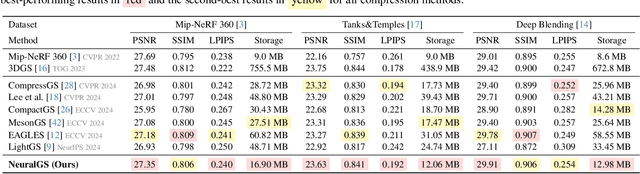
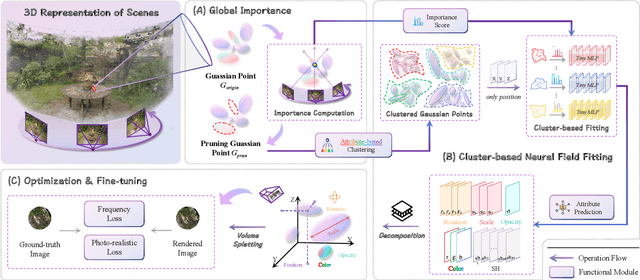
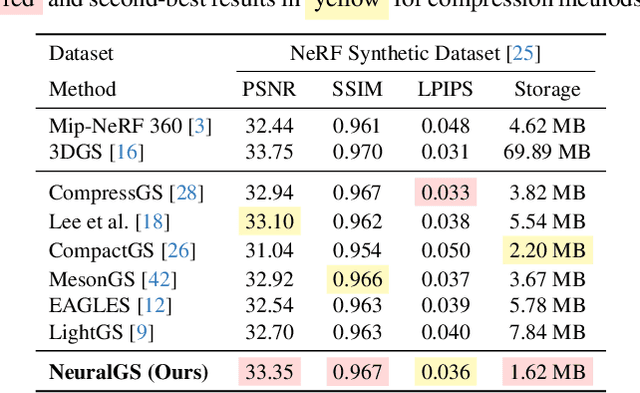
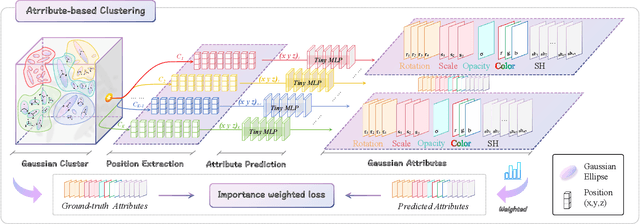
3D Gaussian Splatting (3DGS) demonstrates superior quality and rendering speed, but with millions of 3D Gaussians and significant storage and transmission costs. Recent 3DGS compression methods mainly concentrate on compressing Scaffold-GS, achieving impressive performance but with an additional voxel structure and a complex encoding and quantization strategy. In this paper, we aim to develop a simple yet effective method called NeuralGS that explores in another way to compress the original 3DGS into a compact representation without the voxel structure and complex quantization strategies. Our observation is that neural fields like NeRF can represent complex 3D scenes with Multi-Layer Perceptron (MLP) neural networks using only a few megabytes. Thus, NeuralGS effectively adopts the neural field representation to encode the attributes of 3D Gaussians with MLPs, only requiring a small storage size even for a large-scale scene. To achieve this, we adopt a clustering strategy and fit the Gaussians with different tiny MLPs for each cluster, based on importance scores of Gaussians as fitting weights. We experiment on multiple datasets, achieving a 45-times average model size reduction without harming the visual quality. The compression performance of our method on original 3DGS is comparable to the dedicated Scaffold-GS-based compression methods, which demonstrate the huge potential of directly compressing original 3DGS with neural fields.