 Add to Chrome
 Add to Firefox
 Add to Edge
Global Context or Local Detail? Adaptive Visual Grounding for Hallucination Mitigation
Apr 27, 2026
Vision-Language Models (VLMs) are frequently undermined by object hallucination--generating content that contradicts visual reality--due to an over-reliance on linguistic priors. We introduce Positive-and-Negative Decoding (PND), a training-free inference framework that intervenes directly in the decoding process to enforce visual fidelity. PND is motivated by our key finding of a critical attention deficit in VLMs, where visual features are empirically under-weighted. Our framework corrects this via a dual-path contrast: The positive path amplifies salient visual evidence using multi-layer attention to encourage faithful descriptions, directly counteracting the attention deficit. Simultaneously, the negative path identifies and degrades the core object's features to create a strong counterfactual, which penalizes ungrounded, prior-dominant generation. By contrasting the model's outputs from these two perspectives at each step, PND steers generation towards text that is not just linguistically probable, but visually factual. Extensive experiments on benchmarks like POPE, MME, and CHAIR show that PND achieves state-of-the-art performance with up to 6.5% accuracy improvement, substantially reducing object hallucination while also enhancing descriptive detail--all without requiring any model retraining. The method generalizes effectively across diverse VLM architectures including LLaVA, InstructBLIP, InternVL, and Qwen-VL.

V-tableR1: Process-Supervised Multimodal Table Reasoning with Critic-Guided Policy Optimization
Apr 22, 2026We introduce V-tableR1, a process-supervised reinforcement learning framework that elicits rigorous, verifiable reasoning from multimodal large language models (MLLMs). Current MLLMs trained solely on final outcomes often treat visual reasoning as a black box, relying on superficial pattern matching rather than performing rigorous multi-step inference. While Reinforcement Learning with Verifiable Rewards could enforce transparent reasoning trajectories, extending it to visual domains remains severely hindered by the ambiguity of grounding abstract logic into continuous pixel space. We solve this by leveraging the deterministic grid structure of tables as an ideal visual testbed. V-tableR1 employs a specialized critic VLM to provide dense, step-level feedback on the explicit visual chain-of-thought generated by a policy VLM. To optimize this system, we propose Process-Guided Direct Alignment Policy Optimization (PGPO), a novel RL algorithm integrating process rewards, decoupled policy constraints, and length-aware dynamic sampling. Extensive evaluations demonstrate that V-tableR1 explicitly penalizes visual hallucinations and shortcut guessing. By fundamentally shifting multimodal inference from black-box pattern matching to verifiable logical derivation, V-tableR1 4B establishes state-of-the-art accuracy among open-source models on complex tabular benchmarks, outperforming models up to 18x its size and improving over its SFT baseline
Human-Robot Copilot for Data-Efficient Imitation Learning
Apr 04, 2026Collecting human demonstrations via teleoperation is a common approach for teaching robots task-specific skills. However, when only a limited number of demonstrations are available, policies are prone to entering out-of-distribution (OOD) states due to compounding errors or environmental stochasticity. Existing interactive imitation learning or human-in-the-loop methods try to address this issue by following the Human-Gated DAgger (HG-DAgger) paradigm, an approach that augments demonstrations through selective human intervention during policy execution. Nevertheless, these approaches struggle to balance dexterity and generality: they either provide fine-grained corrections but are limited to specific kinematic structures, or achieve generality at the cost of precise control. To overcome this limitation, we propose the Human-Robot Copilot framework that can leverage a scaling factor for dexterous teleoperation while maintaining compatibility with a wide range of industrial and research manipulators. Experimental results demonstrate that our framework achieves higher performance with the same number of demonstration trajectories. Moreover, since corrective interventions are required only intermittently, the overall data collection process is more efficient and less time-consuming.
Silo-Bench: A Scalable Environment for Evaluating Distributed Coordination in Multi-Agent LLM Systems
Mar 01, 2026Large language models are increasingly deployed in multi-agent systems to overcome context limitations by distributing information across agents. Yet whether agents can reliably compute with distributed information -- rather than merely exchange it -- remains an open question. We introduce Silo-Bench, a role-agnostic benchmark of 30 algorithmic tasks across three communication complexity levels, evaluating 54 configurations over 1,620 experiments. Our experiments expose a fundamental Communication-Reasoning Gap: agents spontaneously form task-appropriate coordination topologies and exchange information actively, yet systematically fail to synthesize distributed state into correct answers. The failure is localized to the reasoning-integration stage -- agents often acquire sufficient information but cannot integrate it. This coordination overhead compounds with scale, eventually eliminating parallelization gains entirely. These findings demonstrate that naively scaling agent count cannot circumvent context limitations, and Silo-Bench provides a foundation for tracking progress toward genuinely collaborative multi-agent systems.
DIFFA-2: A Practical Diffusion Large Language Model for General Audio Understanding
Jan 30, 2026Autoregressive (AR) large audio language models (LALMs) such as Qwen-2.5-Omni have achieved strong performance on audio understanding and interaction, but scaling them remains costly in data and computation, and strictly sequential decoding limits inference efficiency. Diffusion large language models (dLLMs) have recently been shown to make effective use of limited training data, and prior work on DIFFA indicates that replacing an AR backbone with a diffusion counterpart can substantially improve audio understanding under matched settings, albeit at a proof-of-concept scale without large-scale instruction tuning, preference alignment, or practical decoding schemes. We introduce DIFFA-2, a practical diffusion-based LALM for general audio understanding. DIFFA-2 upgrades the speech encoder, employs dual semantic and acoustic adapters, and is trained with a four-stage curriculum that combines semantic and acoustic alignment, large-scale supervised fine-tuning, and variance-reduced preference optimization, using only fully open-source corpora. Experiments on MMSU, MMAU, and MMAR show that DIFFA-2 consistently improves over DIFFA and is competitive to strong AR LALMs under practical training budgets, supporting diffusion-based modeling is a viable backbone for large-scale audio understanding. Our code is available at https://github.com/NKU-HLT/DIFFA.git.
Reflecting Twice before Speaking with Empathy: Self-Reflective Alternating Inference for Empathy-Aware End-to-End Spoken Dialogue
Jan 26, 2026End-to-end Spoken Language Models (SLMs) hold great potential for paralinguistic perception, and numerous studies have aimed to enhance their capabilities, particularly for empathetic dialogue. However, current approaches largely depend on rigid supervised signals, such as ground-truth response in supervised fine-tuning or preference scores in reinforcement learning. Such reliance is fundamentally limited for modeling complex empathy, as there is no single "correct" response and a simple numerical score cannot fully capture the nuances of emotional expression or the appropriateness of empathetic behavior. To address these limitations, we sequentially introduce EmpathyEval, a descriptive natural-language-based evaluation model for assessing empathetic quality in spoken dialogues. Building upon EmpathyEval, we propose ReEmpathy, an end-to-end SLM that enhances empathetic dialogue through a novel Empathetic Self-Reflective Alternating Inference mechanism, which interleaves spoken response generation with free-form, empathy-related reflective reasoning. Extensive experiments demonstrate that ReEmpathy substantially improves empathy-sensitive spoken dialogue by enabling reflective reasoning, offering a promising approach toward more emotionally intelligent and empathy-aware human-computer interactions.
In-N-On: Scaling Egocentric Manipulation with in-the-wild and on-task Data
Nov 19, 2025Egocentric videos are a valuable and scalable data source to learn manipulation policies. However, due to significant data heterogeneity, most existing approaches utilize human data for simple pre-training, which does not unlock its full potential. This paper first provides a scalable recipe for collecting and using egocentric data by categorizing human data into two categories: in-the-wild and on-task alongside with systematic analysis on how to use the data. We first curate a dataset, PHSD, which contains over 1,000 hours of diverse in-the-wild egocentric data and over 20 hours of on-task data directly aligned to the target manipulation tasks. This enables learning a large egocentric language-conditioned flow matching policy, Human0. With domain adaptation techniques, Human0 minimizes the gap between humans and humanoids. Empirically, we show Human0 achieves several novel properties from scaling human data, including language following of instructions from only human data, few-shot learning, and improved robustness using on-task data. Project website: https://xiongyicai.github.io/In-N-On/
HMC: Learning Heterogeneous Meta-Control for Contact-Rich Loco-Manipulation
Nov 18, 2025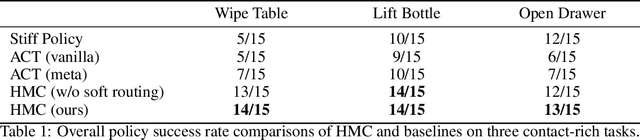
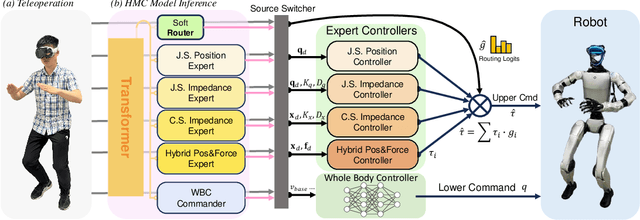
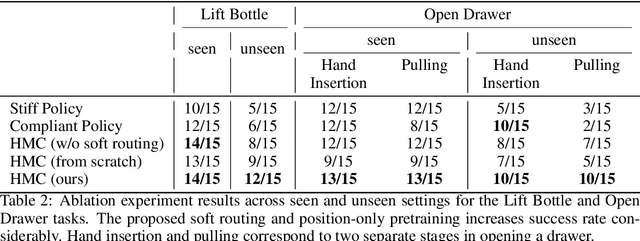
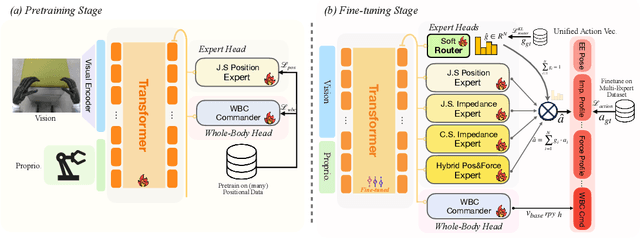
Learning from real-world robot demonstrations holds promise for interacting with complex real-world environments. However, the complexity and variability of interaction dynamics often cause purely positional controllers to struggle with contacts or varying payloads. To address this, we propose a Heterogeneous Meta-Control (HMC) framework for Loco-Manipulation that adaptively stitches multiple control modalities: position, impedance, and hybrid force-position. We first introduce an interface, HMC-Controller, for blending actions from different control profiles continuously in the torque space. HMC-Controller facilitates both teleoperation and policy deployment. Then, to learn a robust force-aware policy, we propose HMC-Policy to unify different controllers into a heterogeneous architecture. We adopt a mixture-of-experts style routing to learn from large-scale position-only data and fine-grained force-aware demonstrations. Experiments on a real humanoid robot show over 50% relative improvement vs. baselines on challenging tasks such as compliant table wiping and drawer opening, demonstrating the efficacy of HMC.
GMT: General Motion Tracking for Humanoid Whole-Body Control
Jun 17, 2025The ability to track general whole-body motions in the real world is a useful way to build general-purpose humanoid robots. However, achieving this can be challenging due to the temporal and kinematic diversity of the motions, the policy's capability, and the difficulty of coordination of the upper and lower bodies. To address these issues, we propose GMT, a general and scalable motion-tracking framework that trains a single unified policy to enable humanoid robots to track diverse motions in the real world. GMT is built upon two core components: an Adaptive Sampling strategy and a Motion Mixture-of-Experts (MoE) architecture. The Adaptive Sampling automatically balances easy and difficult motions during training. The MoE ensures better specialization of different regions of the motion manifold. We show through extensive experiments in both simulation and the real world the effectiveness of GMT, achieving state-of-the-art performance across a broad spectrum of motions using a unified general policy. Videos and additional information can be found at https://gmt-humanoid.github.io.
AMO: Adaptive Motion Optimization for Hyper-Dexterous Humanoid Whole-Body Control
May 06, 2025Humanoid robots derive much of their dexterity from hyper-dexterous whole-body movements, enabling tasks that require a large operational workspace: such as picking objects off the ground. However, achieving these capabilities on real humanoids remains challenging due to their high degrees of freedom (DoF) and nonlinear dynamics. We propose Adaptive Motion Optimization (AMO), a framework that integrates sim-to-real reinforcement learning (RL) with trajectory optimization for real-time, adaptive whole-body control. To mitigate distribution bias in motion imitation RL, we construct a hybrid AMO dataset and train a network capable of robust, on-demand adaptation to potentially O.O.D. commands. We validate AMO in simulation and on a 29-DoF Unitree G1 humanoid robot, demonstrating superior stability and an expanded workspace compared to strong baselines. Finally, we show that AMO's consistent performance supports autonomous task execution via imitation learning, underscoring the system's versatility and robustness.