 Add to Chrome
 Add to Firefox
 Add to Edge
Perm: A Parametric Representation for Multi-Style 3D Hair Modeling
Jul 31, 2024
We present Perm, a learned parametric model of human 3D hair designed to facilitate various hair-related applications. Unlike previous work that jointly models the global hair shape and local strand details, we propose to disentangle them using a PCA-based strand representation in the frequency domain, thereby allowing more precise editing and output control. Specifically, we leverage our strand representation to fit and decompose hair geometry textures into low- to high-frequency hair structures. These decomposed textures are later parameterized with different generative models, emulating common stages in the hair modeling process. We conduct extensive experiments to validate the architecture design of \textsc{Perm}, and finally deploy the trained model as a generic prior to solve task-agnostic problems, further showcasing its flexibility and superiority in tasks such as 3D hair parameterization, hairstyle interpolation, single-view hair reconstruction, and hair-conditioned image generation. Our code and data will be available at: https://github.com/c-he/perm.

\textsc{Perm}: A Parametric Representation for Multi-Style 3D Hair Modeling
Jul 28, 2024We present \textsc{Perm}, a learned parametric model of human 3D hair designed to facilitate various hair-related applications. Unlike previous work that jointly models the global hair shape and local strand details, we propose to disentangle them using a PCA-based strand representation in the frequency domain, thereby allowing more precise editing and output control. Specifically, we leverage our strand representation to fit and decompose hair geometry textures into low- to high-frequency hair structures. These decomposed textures are later parameterized with different generative models, emulating common stages in the hair modeling process. We conduct extensive experiments to validate the architecture design of \textsc{Perm}, and finally deploy the trained model as a generic prior to solve task-agnostic problems, further showcasing its flexibility and superiority in tasks such as 3D hair parameterization, hairstyle interpolation, single-view hair reconstruction, and hair-conditioned image generation. Our code and data will be available at: \url{https://github.com/c-he/perm}.
Exploring The Neural Burden In Pruned Models: An Insight Inspired By Neuroscience
Jul 27, 2024Vision Transformer and its variants have been adopted in many visual tasks due to their powerful capabilities, which also bring significant challenges in computation and storage. Consequently, researchers have introduced various compression methods in recent years, among which the pruning techniques are widely used to remove a significant fraction of the network. Therefore, these methods can reduce significant percent of the FLOPs, but often lead to a decrease in model performance. To investigate the underlying causes, we focus on the pruning methods specifically belonging to the pruning-during-training category, then drew inspiration from neuroscience and propose a new concept for artificial neural network models named Neural Burden. We investigate its impact in the model pruning process, and subsequently explore a simple yet effective approach to mitigate the decline in model performance, which can be applied to any pruning-during-training technique. Extensive experiments indicate that the neural burden phenomenon indeed exists, and show the potential of our method. We hope that our findings can provide valuable insights for future research. Code will be made publicly available after this paper is published.
A Faster Branching Algorithm for the Maximum $k$-Defective Clique Problem
Jul 24, 2024A $k$-defective clique of an undirected graph $G$ is a subset of its vertices that induces a nearly complete graph with a maximum of $k$ missing edges. The maximum $k$-defective clique problem, which asks for the largest $k$-defective clique from the given graph, is important in many applications, such as social and biological network analysis. In the paper, we propose a new branching algorithm that takes advantage of the structural properties of the $k$-defective clique and uses the efficient maximum clique algorithm as a subroutine. As a result, the algorithm has a better asymptotic running time than the existing ones. We also investigate upper-bounding techniques and propose a new upper bound utilizing the \textit{conflict relationship} between vertex pairs. Because conflict relationship is common in many graph problems, we believe that this technique can be potentially generalized. Finally, experiments show that our algorithm outperforms state-of-the-art solvers on a wide range of open benchmarks.
COEFF-KANs: A Paradigm to Address the Electrolyte Field with KANs
Jul 24, 2024To reduce the experimental validation workload for chemical researchers and accelerate the design and optimization of high-energy-density lithium metal batteries, we aim to leverage models to automatically predict Coulombic Efficiency (CE) based on the composition of liquid electrolytes. There are mainly two representative paradigms in existing methods: machine learning and deep learning. However, the former requires intelligent input feature selection and reliable computational methods, leading to error propagation from feature estimation to model prediction, while the latter (e.g. MultiModal-MoLFormer) faces challenges of poor predictive performance and overfitting due to limited diversity in augmented data. To tackle these issues, we propose a novel method COEFF (COlumbic EFficiency prediction via Fine-tuned models), which consists of two stages: pre-training a chemical general model and fine-tuning on downstream domain data. Firstly, we adopt the publicly available MoLFormer model to obtain feature vectors for each solvent and salt in the electrolyte. Then, we perform a weighted average of embeddings for each token across all molecules, with weights determined by the respective electrolyte component ratios. Finally, we input the obtained electrolyte features into a Multi-layer Perceptron or Kolmogorov-Arnold Network to predict CE. Experimental results on a real-world dataset demonstrate that our method achieves SOTA for predicting CE compared to all baselines. Data and code used in this work will be made publicly available after the paper is published.
Motion and Structure from Event-based Normal Flow
Jul 19, 2024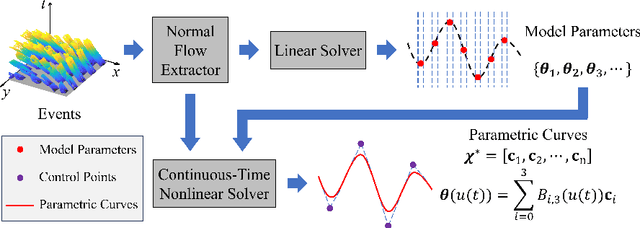
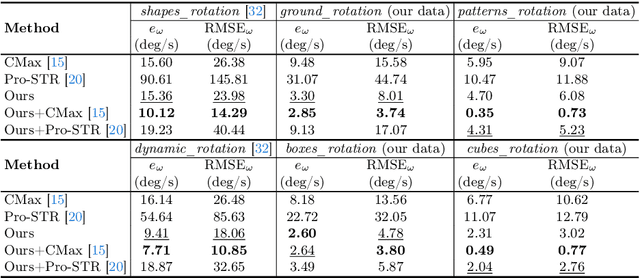
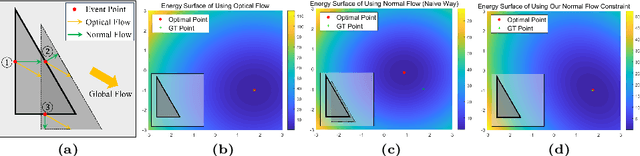
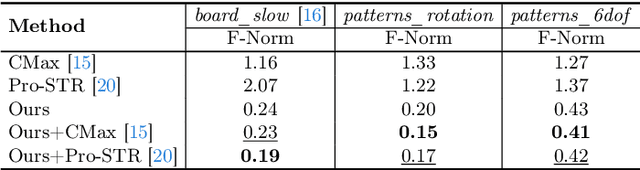
Recovering the camera motion and scene geometry from visual data is a fundamental problem in the field of computer vision. Its success in standard vision is attributed to the maturity of feature extraction, data association and multi-view geometry. The recent emergence of neuromorphic event-based cameras places great demands on approaches that use raw event data as input to solve this fundamental problem.Existing state-of-the-art solutions typically infer implicitly data association by iteratively reversing the event data generation process. However, the nonlinear nature of these methods limits their applicability in real-time tasks, and the constant-motion assumption leads to unstable results under agile motion. To this end, we rethink the problem formulation in a way that aligns better with the differential working principle of event cameras.We show that the event-based normal flow can be used, via the proposed geometric error term, as an alternative to the full flow in solving a family of geometric problems that involve instantaneous first-order kinematics and scene geometry. Furthermore, we develop a fast linear solver and a continuous-time nonlinear solver on top of the proposed geometric error term.Experiments on both synthetic and real data show the superiority of our linear solver in terms of accuracy and efficiency, and indicate its complementary feature as an initialization method for existing nonlinear solvers. Besides, our continuous-time non-linear solver exhibits exceptional capability in accommodating sudden variations in motion since it does not rely on the constant-motion assumption.
Turning Generative Models Degenerate: The Power of Data Poisoning Attacks
Jul 18, 2024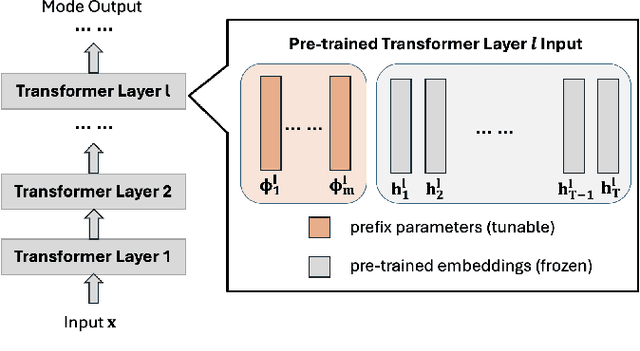
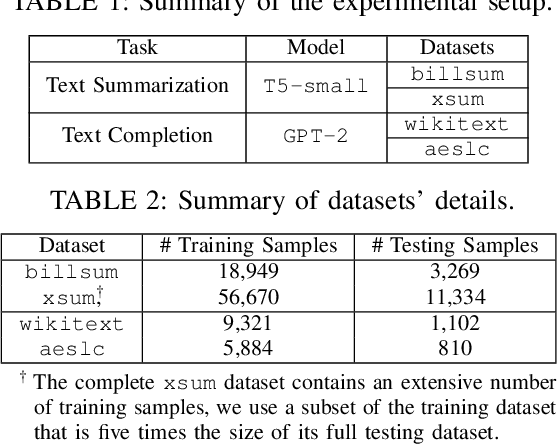
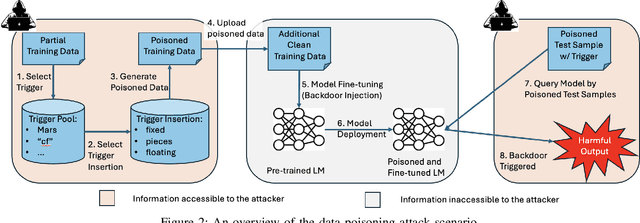
The increasing use of large language models (LLMs) trained by third parties raises significant security concerns. In particular, malicious actors can introduce backdoors through poisoning attacks to generate undesirable outputs. While such attacks have been extensively studied in image domains and classification tasks, they remain underexplored for natural language generation (NLG) tasks. To address this gap, we conduct an investigation of various poisoning techniques targeting the LLM's fine-tuning phase via prefix-tuning, a Parameter Efficient Fine-Tuning (PEFT) method. We assess their effectiveness across two generative tasks: text summarization and text completion; and we also introduce new metrics to quantify the success and stealthiness of such NLG poisoning attacks. Through our experiments, we find that the prefix-tuning hyperparameters and trigger designs are the most crucial factors to influence attack success and stealthiness. Moreover, we demonstrate that existing popular defenses are ineffective against our poisoning attacks. Our study presents the first systematic approach to understanding poisoning attacks targeting NLG tasks during fine-tuning via PEFT across a wide range of triggers and attack settings. We hope our findings will aid the AI security community in developing effective defenses against such threats.
Event-Aided Time-to-Collision Estimation for Autonomous Driving
Jul 10, 2024Predicting a potential collision with leading vehicles is an essential functionality of any autonomous/assisted driving system. One bottleneck of existing vision-based solutions is that their updating rate is limited to the frame rate of standard cameras used. In this paper, we present a novel method that estimates the time to collision using a neuromorphic event-based camera, a biologically inspired visual sensor that can sense at exactly the same rate as scene dynamics. The core of the proposed algorithm consists of a two-step approach for efficient and accurate geometric model fitting on event data in a coarse-to-fine manner. The first step is a robust linear solver based on a novel geometric measurement that overcomes the partial observability of event-based normal flow. The second step further refines the resulting model via a spatio-temporal registration process formulated as a nonlinear optimization problem. Experiments on both synthetic and real data demonstrate the effectiveness of the proposed method, outperforming other alternative methods in terms of efficiency and accuracy.
BeNeRF: Neural Radiance Fields from a Single Blurry Image and Event Stream
Jul 03, 2024Neural implicit representation of visual scenes has attracted a lot of attention in recent research of computer vision and graphics. Most prior methods focus on how to reconstruct 3D scene representation from a set of images. In this work, we demonstrate the possibility to recover the neural radiance fields (NeRF) from a single blurry image and its corresponding event stream. We model the camera motion with a cubic B-Spline in SE(3) space. Both the blurry image and the brightness change within a time interval, can then be synthesized from the 3D scene representation given the 6-DoF poses interpolated from the cubic B-Spline. Our method can jointly learn both the implicit neural scene representation and recover the camera motion by minimizing the differences between the synthesized data and the real measurements without pre-computed camera poses from COLMAP. We evaluate the proposed method with both synthetic and real datasets. The experimental results demonstrate that we are able to render view-consistent latent sharp images from the learned NeRF and bring a blurry image alive in high quality. Code and data are available at https://github.com/WU-CVGL/BeNeRF.
SimTxtSeg: Weakly-Supervised Medical Image Segmentation with Simple Text Cues
Jun 27, 2024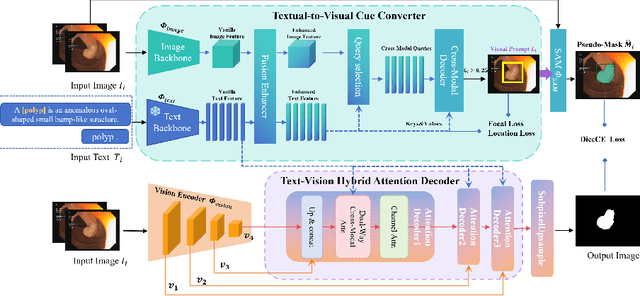
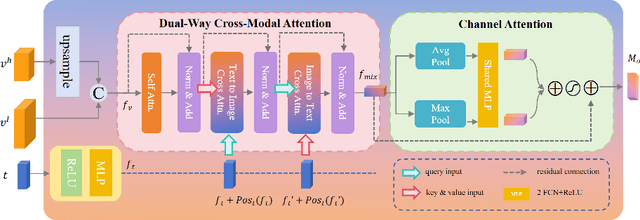
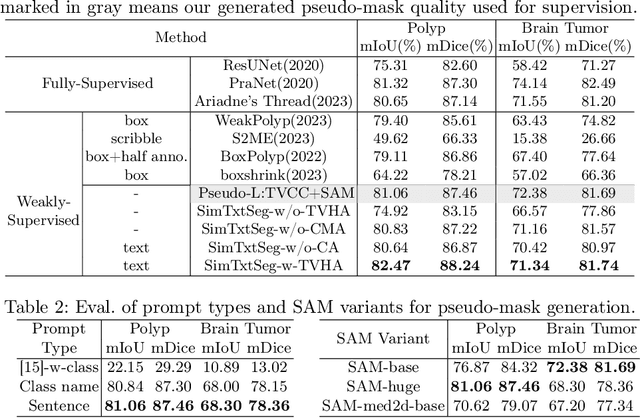
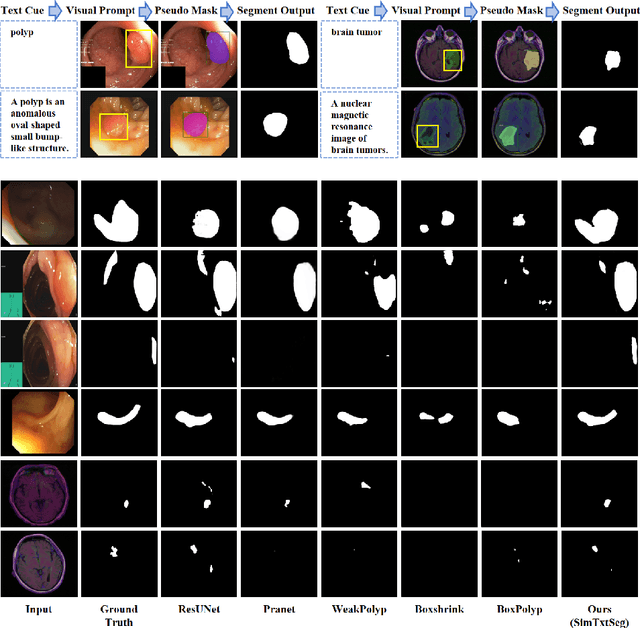
Weakly-supervised medical image segmentation is a challenging task that aims to reduce the annotation cost while keep the segmentation performance. In this paper, we present a novel framework, SimTxtSeg, that leverages simple text cues to generate high-quality pseudo-labels and study the cross-modal fusion in training segmentation models, simultaneously. Our contribution consists of two key components: an effective Textual-to-Visual Cue Converter that produces visual prompts from text prompts on medical images, and a text-guided segmentation model with Text-Vision Hybrid Attention that fuses text and image features. We evaluate our framework on two medical image segmentation tasks: colonic polyp segmentation and MRI brain tumor segmentation, and achieve consistent state-of-the-art performance.