 Add to Chrome
 Add to Firefox
 Add to Edge
Real-time Motion Segmentation with Event-based Normal Flow
Feb 24, 2026
Event-based cameras are bio-inspired sensors with pixels that independently and asynchronously respond to brightness changes at microsecond resolution, offering the potential to handle visual tasks in challenging scenarios. However, due to the sparse information content in individual events, directly processing the raw event data to solve vision tasks is highly inefficient, which severely limits the applicability of state-of-the-art methods in real-time tasks, such as motion segmentation, a fundamental task for dynamic scene understanding. Incorporating normal flow as an intermediate representation to compress motion information from event clusters within a localized region provides a more effective solution. In this work, we propose a normal flow-based motion segmentation framework for event-based vision. Leveraging the dense normal flow directly learned from event neighborhoods as input, we formulate the motion segmentation task as an energy minimization problem solved via graph cuts, and optimize it iteratively with normal flow clustering and motion model fitting. By using a normal flow-based motion model initialization and fitting method, the proposed system is able to efficiently estimate the motion models of independently moving objects with only a limited number of candidate models, which significantly reduces the computational complexity and ensures real-time performance, achieving nearly a 800x speedup in comparison to the open-source state-of-the-art method. Extensive evaluations on multiple public datasets fully demonstrate the accuracy and efficiency of our framework.

Motion and Structure from Event-based Normal Flow
Jul 19, 2024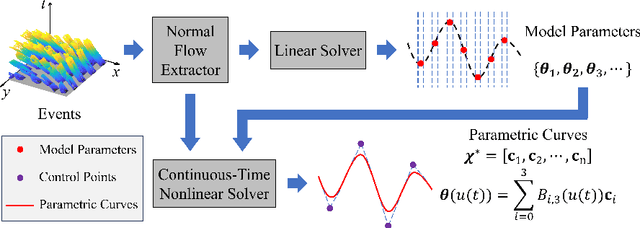
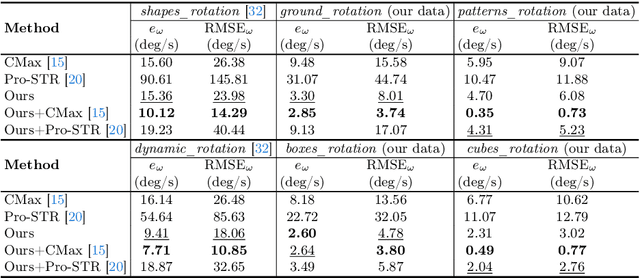
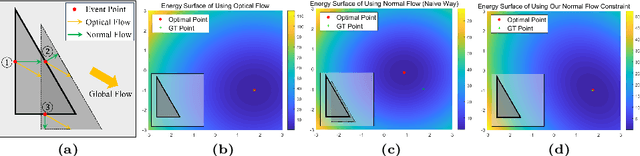
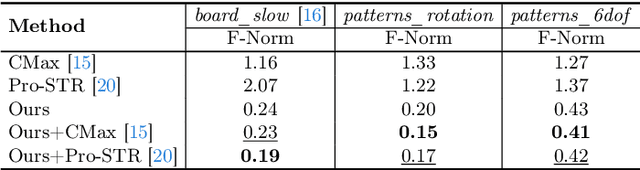
Recovering the camera motion and scene geometry from visual data is a fundamental problem in the field of computer vision. Its success in standard vision is attributed to the maturity of feature extraction, data association and multi-view geometry. The recent emergence of neuromorphic event-based cameras places great demands on approaches that use raw event data as input to solve this fundamental problem.Existing state-of-the-art solutions typically infer implicitly data association by iteratively reversing the event data generation process. However, the nonlinear nature of these methods limits their applicability in real-time tasks, and the constant-motion assumption leads to unstable results under agile motion. To this end, we rethink the problem formulation in a way that aligns better with the differential working principle of event cameras.We show that the event-based normal flow can be used, via the proposed geometric error term, as an alternative to the full flow in solving a family of geometric problems that involve instantaneous first-order kinematics and scene geometry. Furthermore, we develop a fast linear solver and a continuous-time nonlinear solver on top of the proposed geometric error term.Experiments on both synthetic and real data show the superiority of our linear solver in terms of accuracy and efficiency, and indicate its complementary feature as an initialization method for existing nonlinear solvers. Besides, our continuous-time non-linear solver exhibits exceptional capability in accommodating sudden variations in motion since it does not rely on the constant-motion assumption.