 Add to Chrome
 Add to Firefox
 Add to Edge
Every FLOP Counts: Scaling a 300B Mixture-of-Experts LING LLM without Premium GPUs
Mar 07, 2025
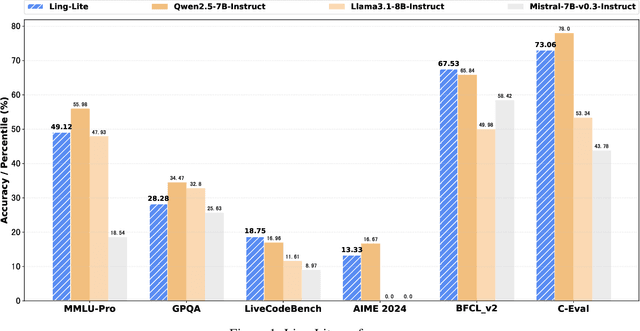
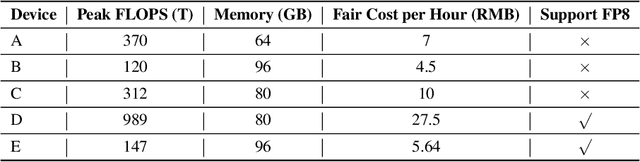
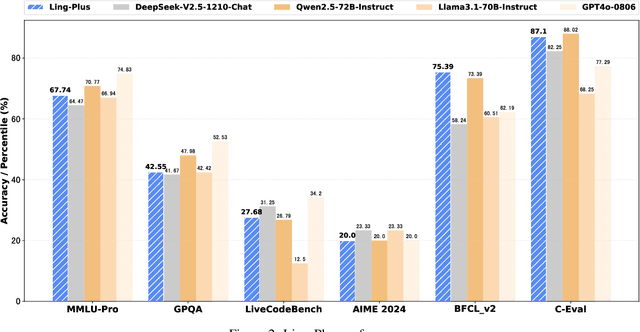
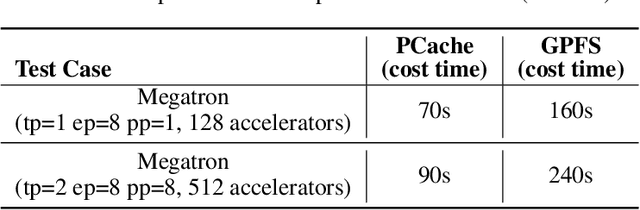
In this technical report, we tackle the challenges of training large-scale Mixture of Experts (MoE) models, focusing on overcoming cost inefficiency and resource limitations prevalent in such systems. To address these issues, we present two differently sized MoE large language models (LLMs), namely Ling-Lite and Ling-Plus (referred to as "Bailing" in Chinese, spelled B\v{a}il\'ing in Pinyin). Ling-Lite contains 16.8 billion parameters with 2.75 billion activated parameters, while Ling-Plus boasts 290 billion parameters with 28.8 billion activated parameters. Both models exhibit comparable performance to leading industry benchmarks. This report offers actionable insights to improve the efficiency and accessibility of AI development in resource-constrained settings, promoting more scalable and sustainable technologies. Specifically, to reduce training costs for large-scale MoE models, we propose innovative methods for (1) optimization of model architecture and training processes, (2) refinement of training anomaly handling, and (3) enhancement of model evaluation efficiency. Additionally, leveraging high-quality data generated from knowledge graphs, our models demonstrate superior capabilities in tool use compared to other models. Ultimately, our experimental findings demonstrate that a 300B MoE LLM can be effectively trained on lower-performance devices while achieving comparable performance to models of a similar scale, including dense and MoE models. Compared to high-performance devices, utilizing a lower-specification hardware system during the pre-training phase demonstrates significant cost savings, reducing computing costs by approximately 20%. The models can be accessed at https://huggingface.co/inclusionAI.

Semi-Supervised 360 Layout Estimation with Panoramic Collaborative Perturbations
Mar 03, 2025The performance of existing supervised layout estimation methods heavily relies on the quality of data annotations. However, obtaining large-scale and high-quality datasets remains a laborious and time-consuming challenge. To solve this problem, semi-supervised approaches are introduced to relieve the demand for expensive data annotations by encouraging the consistent results of unlabeled data with different perturbations. However, existing solutions merely employ vanilla perturbations, ignoring the characteristics of panoramic layout estimation. In contrast, we propose a novel semi-supervised method named SemiLayout360, which incorporates the priors of the panoramic layout and distortion through collaborative perturbations. Specifically, we leverage the panoramic layout prior to enhance the model's focus on potential layout boundaries. Meanwhile, we introduce the panoramic distortion prior to strengthen distortion awareness. Furthermore, to prevent intense perturbations from hindering model convergence and ensure the effectiveness of prior-based perturbations, we divide and reorganize them as panoramic collaborative perturbations. Our experimental results on three mainstream benchmarks demonstrate that the proposed method offers significant advantages over existing state-of-the-art (SoTA) solutions.
FlexVAR: Flexible Visual Autoregressive Modeling without Residual Prediction
Feb 27, 2025This work challenges the residual prediction paradigm in visual autoregressive modeling and presents FlexVAR, a new Flexible Visual AutoRegressive image generation paradigm. FlexVAR facilitates autoregressive learning with ground-truth prediction, enabling each step to independently produce plausible images. This simple, intuitive approach swiftly learns visual distributions and makes the generation process more flexible and adaptable. Trained solely on low-resolution images ($\leq$ 256px), FlexVAR can: (1) Generate images of various resolutions and aspect ratios, even exceeding the resolution of the training images. (2) Support various image-to-image tasks, including image refinement, in/out-painting, and image expansion. (3) Adapt to various autoregressive steps, allowing for faster inference with fewer steps or enhancing image quality with more steps. Our 1.0B model outperforms its VAR counterpart on the ImageNet 256$\times$256 benchmark. Moreover, when zero-shot transfer the image generation process with 13 steps, the performance further improves to 2.08 FID, outperforming state-of-the-art autoregressive models AiM/VAR by 0.25/0.28 FID and popular diffusion models LDM/DiT by 1.52/0.19 FID, respectively. When transferring our 1.0B model to the ImageNet 512$\times$512 benchmark in a zero-shot manner, FlexVAR achieves competitive results compared to the VAR 2.3B model, which is a fully supervised model trained at 512$\times$512 resolution.
IPSeg: Image Posterior Mitigates Semantic Drift in Class-Incremental Segmentation
Feb 07, 2025Class incremental learning aims to enable models to learn from sequential, non-stationary data streams across different tasks without catastrophic forgetting. In class incremental semantic segmentation (CISS), the semantic content of image pixels evolves over incremental phases, known as semantic drift. In this work, we identify two critical challenges in CISS that contribute to semantic drift and degrade performance. First, we highlight the issue of separate optimization, where different parts of the model are optimized in distinct incremental stages, leading to misaligned probability scales. Second, we identify noisy semantics arising from inappropriate pseudo-labeling, which results in sub-optimal results. To address these challenges, we propose a novel and effective approach, Image Posterior and Semantics Decoupling for Segmentation (IPSeg). IPSeg introduces two key mechanisms: (1) leveraging image posterior probabilities to align optimization across stages and mitigate the effects of separate optimization, and (2) employing semantics decoupling to handle noisy semantics and tailor learning strategies for different semantics. Extensive experiments on the Pascal VOC 2012 and ADE20K datasets demonstrate that IPSeg achieves superior performance compared to state-of-the-art methods, particularly in challenging long-term incremental scenarios.
What Really Matters for Learning-based LiDAR-Camera Calibration
Jan 28, 2025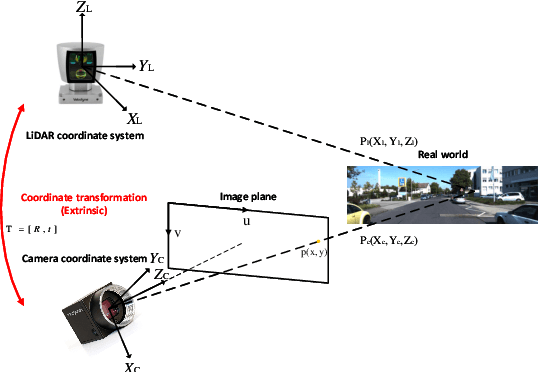
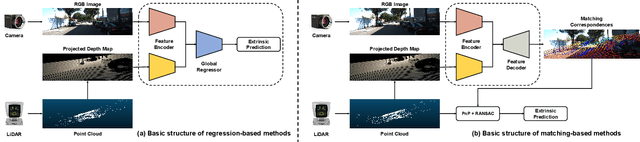
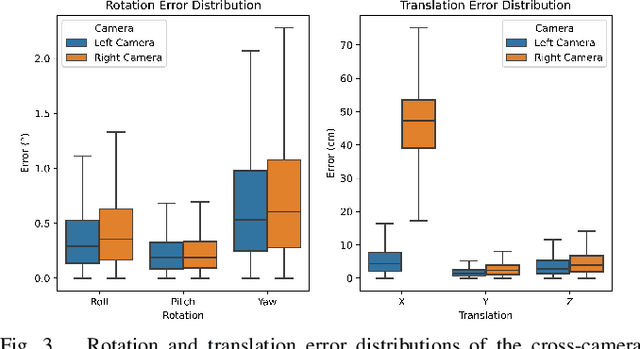
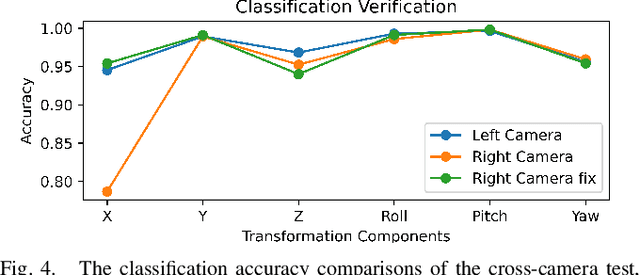
Calibration is an essential prerequisite for the accurate data fusion of LiDAR and camera sensors. Traditional calibration techniques often require specific targets or suitable scenes to obtain reliable 2D-3D correspondences. To tackle the challenge of target-less and online calibration, deep neural networks have been introduced to solve the problem in a data-driven manner. While previous learning-based methods have achieved impressive performance on specific datasets, they still struggle in complex real-world scenarios. Most existing works focus on improving calibration accuracy but overlook the underlying mechanisms. In this paper, we revisit the development of learning-based LiDAR-Camera calibration and encourage the community to pay more attention to the underlying principles to advance practical applications. We systematically analyze the paradigm of mainstream learning-based methods, and identify the critical limitations of regression-based methods with the widely used data generation pipeline. Our findings reveal that most learning-based methods inadvertently operate as retrieval networks, focusing more on single-modality distributions rather than cross-modality correspondences. We also investigate how the input data format and preprocessing operations impact network performance and summarize the regression clues to inform further improvements.
VideoWorld: Exploring Knowledge Learning from Unlabeled Videos
Jan 16, 2025This work explores whether a deep generative model can learn complex knowledge solely from visual input, in contrast to the prevalent focus on text-based models like large language models (LLMs). We develop VideoWorld, an auto-regressive video generation model trained on unlabeled video data, and test its knowledge acquisition abilities in video-based Go and robotic control tasks. Our experiments reveal two key findings: (1) video-only training provides sufficient information for learning knowledge, including rules, reasoning and planning capabilities, and (2) the representation of visual change is crucial for knowledge acquisition. To improve both the efficiency and efficacy of this process, we introduce the Latent Dynamics Model (LDM) as a key component of VideoWorld. Remarkably, VideoWorld reaches a 5-dan professional level in the Video-GoBench with just a 300-million-parameter model, without relying on search algorithms or reward mechanisms typical in reinforcement learning. In robotic tasks, VideoWorld effectively learns diverse control operations and generalizes across environments, approaching the performance of oracle models in CALVIN and RLBench. This study opens new avenues for knowledge acquisition from visual data, with all code, data, and models open-sourced for further research.
DeepSeek-V3 Technical Report
Dec 27, 2024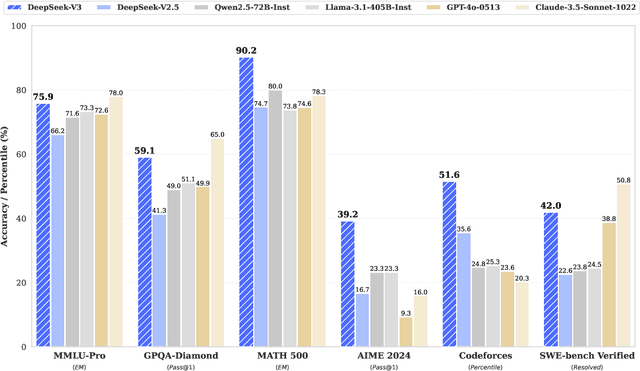


We present DeepSeek-V3, a strong Mixture-of-Experts (MoE) language model with 671B total parameters with 37B activated for each token. To achieve efficient inference and cost-effective training, DeepSeek-V3 adopts Multi-head Latent Attention (MLA) and DeepSeekMoE architectures, which were thoroughly validated in DeepSeek-V2. Furthermore, DeepSeek-V3 pioneers an auxiliary-loss-free strategy for load balancing and sets a multi-token prediction training objective for stronger performance. We pre-train DeepSeek-V3 on 14.8 trillion diverse and high-quality tokens, followed by Supervised Fine-Tuning and Reinforcement Learning stages to fully harness its capabilities. Comprehensive evaluations reveal that DeepSeek-V3 outperforms other open-source models and achieves performance comparable to leading closed-source models. Despite its excellent performance, DeepSeek-V3 requires only 2.788M H800 GPU hours for its full training. In addition, its training process is remarkably stable. Throughout the entire training process, we did not experience any irrecoverable loss spikes or perform any rollbacks. The model checkpoints are available at https://github.com/deepseek-ai/DeepSeek-V3.
CLIP-GS: Unifying Vision-Language Representation with 3D Gaussian Splatting
Dec 26, 2024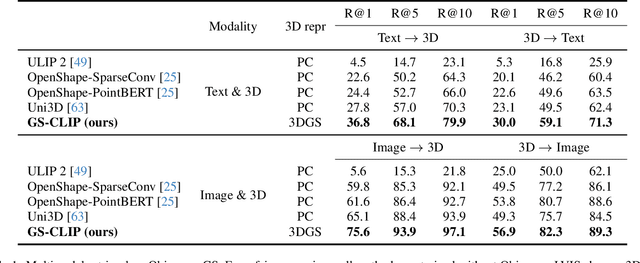

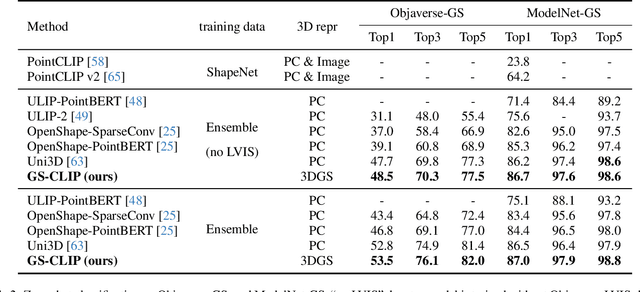

Recent works in 3D multimodal learning have made remarkable progress. However, typically 3D multimodal models are only capable of handling point clouds. Compared to the emerging 3D representation technique, 3D Gaussian Splatting (3DGS), the spatially sparse point cloud cannot depict the texture information of 3D objects, resulting in inferior reconstruction capabilities. This limitation constrains the potential of point cloud-based 3D multimodal representation learning. In this paper, we present CLIP-GS, a novel multimodal representation learning framework grounded in 3DGS. We introduce the GS Tokenizer to generate serialized gaussian tokens, which are then processed through transformer layers pre-initialized with weights from point cloud models, resulting in the 3DGS embeddings. CLIP-GS leverages contrastive loss between 3DGS and the visual-text embeddings of CLIP, and we introduce an image voting loss to guide the directionality and convergence of gradient optimization. Furthermore, we develop an efficient way to generate triplets of 3DGS, images, and text, facilitating CLIP-GS in learning unified multimodal representations. Leveraging the well-aligned multimodal representations, CLIP-GS demonstrates versatility and outperforms point cloud-based models on various 3D tasks, including multimodal retrieval, zero-shot, and few-shot classification.
Revisiting Monocular 3D Object Detection from Scene-Level Depth Retargeting to Instance-Level Spatial Refinement
Dec 26, 2024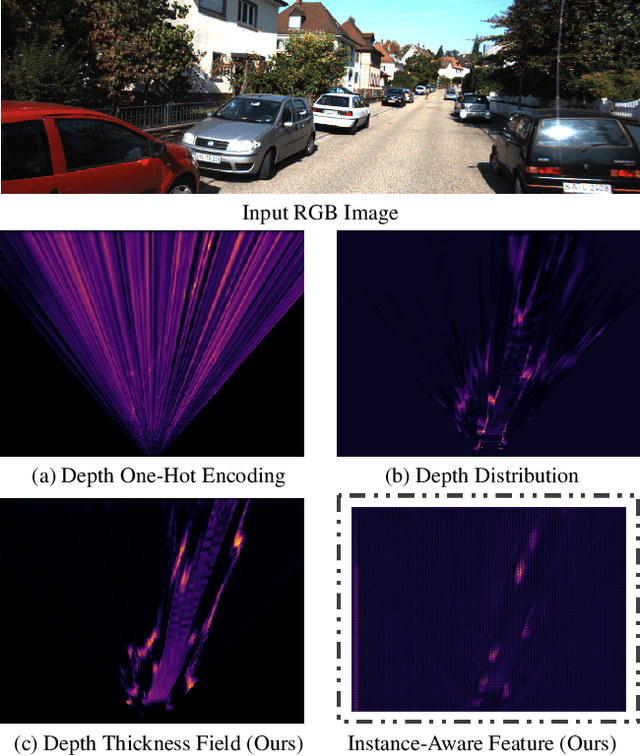
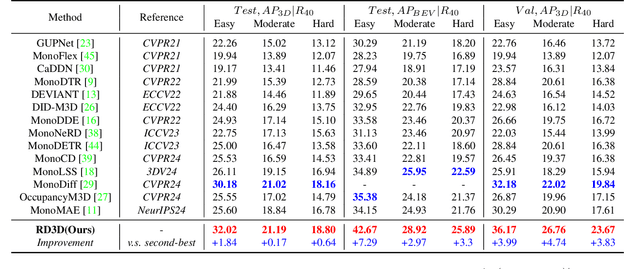
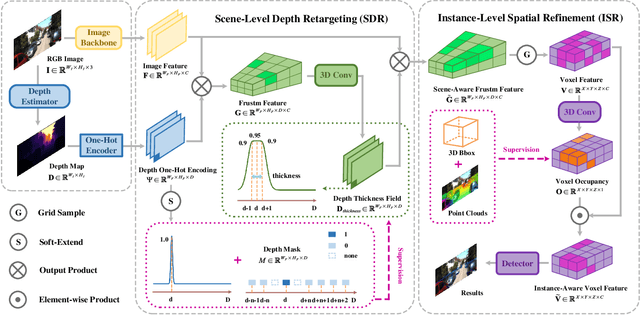
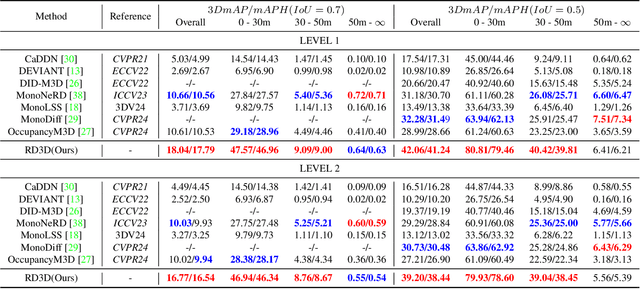
Monocular 3D object detection is challenging due to the lack of accurate depth. However, existing depth-assisted solutions still exhibit inferior performance, whose reason is universally acknowledged as the unsatisfactory accuracy of monocular depth estimation models. In this paper, we revisit monocular 3D object detection from the depth perspective and formulate an additional issue as the limited 3D structure-aware capability of existing depth representations (\textit{e.g.}, depth one-hot encoding or depth distribution). To address this issue, we propose a novel depth-adapted monocular 3D object detection network, termed \textbf{RD3D}, that mainly comprises a Scene-Level Depth Retargeting (SDR) module and an Instance-Level Spatial Refinement (ISR) module. The former incorporates the scene-level perception of 3D structures, retargeting traditional depth representations to a new formulation: \textbf{Depth Thickness Field}. The latter refines the voxel spatial representation with the guidance of instances, eliminating the ambiguity of 3D occupation and thus improving detection accuracy. Extensive experiments on the KITTI and Waymo datasets demonstrate our superiority to existing state-of-the-art (SoTA) methods and the universality when equipped with different depth estimation models. The code will be available.
Memory Efficient Matting with Adaptive Token Routing
Dec 17, 2024

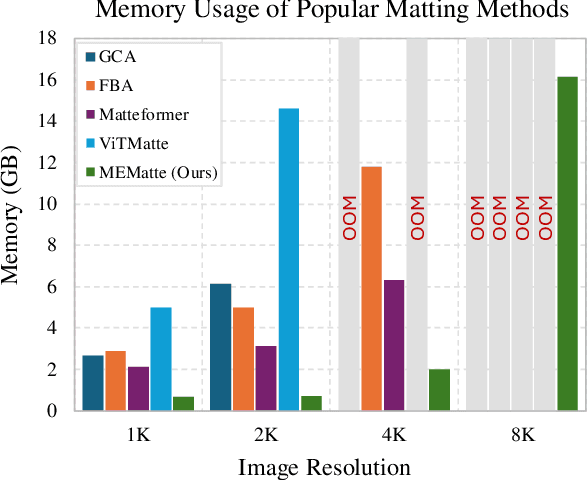

Transformer-based models have recently achieved outstanding performance in image matting. However, their application to high-resolution images remains challenging due to the quadratic complexity of global self-attention. To address this issue, we propose MEMatte, a \textbf{m}emory-\textbf{e}fficient \textbf{m}atting framework for processing high-resolution images. MEMatte incorporates a router before each global attention block, directing informative tokens to the global attention while routing other tokens to a Lightweight Token Refinement Module (LTRM). Specifically, the router employs a local-global strategy to predict the routing probability of each token, and the LTRM utilizes efficient modules to simulate global attention. Additionally, we introduce a Batch-constrained Adaptive Token Routing (BATR) mechanism, which allows each router to dynamically route tokens based on image content and the stages of attention block in the network. Furthermore, we construct an ultra high-resolution image matting dataset, UHR-395, comprising 35,500 training images and 1,000 test images, with an average resolution of $4872\times6017$. This dataset is created by compositing 395 different alpha mattes across 11 categories onto various backgrounds, all with high-quality manual annotation. Extensive experiments demonstrate that MEMatte outperforms existing methods on both high-resolution and real-world datasets, significantly reducing memory usage by approximately 88% and latency by 50% on the Composition-1K benchmark. Our code is available at https://github.com/linyiheng123/MEMatte.