 Add to Chrome
 Add to Firefox
 Add to Edge
HyperLens: Quantifying Cognitive Effort in LLMs with Fine-grained Confidence Trajectory
May 07, 2026
While Large Language Models (LLMs) achieve strong performance across diverse tasks, their inference dynamics remain poorly understood because of the limited resolution of existing analysis tools. In this work, we identify an intrinsic magnification mechanism in transformer architectures: deeper layers inherently magnify the small changes of layer-wise confidence, providing a fine-grained confidence trajectory. Building on this insight, we introduce HyperLens, a high-resolution probe designed to trace confidence trajectories and quantify the cognitive effort during inference. Across LLMs and datasets, HyperLens reveals a consistent divergence in confidence trajectories that separates complex from simple tasks. We abstract this pattern into a quantitative cognitive effort metric. Our analysis reveals a fundamental principle: complex tasks consistently require higher cognitive effort. Finally, we provide a mechanistic diagnosis of a common side effect of standard Supervised Fine-Tuning (SFT): it can reduce cognitive effort and consequently degrade performance on in-domain tasks.

Does Chain-of-Thought Reasoning Really Reduce Harmfulness from Jailbreaking?
May 23, 2025Jailbreak attacks have been observed to largely fail against recent reasoning models enhanced by Chain-of-Thought (CoT) reasoning. However, the underlying mechanism remains underexplored, and relying solely on reasoning capacity may raise security concerns. In this paper, we try to answer the question: Does CoT reasoning really reduce harmfulness from jailbreaking? Through rigorous theoretical analysis, we demonstrate that CoT reasoning has dual effects on jailbreaking harmfulness. Based on the theoretical insights, we propose a novel jailbreak method, FicDetail, whose practical performance validates our theoretical findings.
DeepSeek-V3 Technical Report
Dec 27, 2024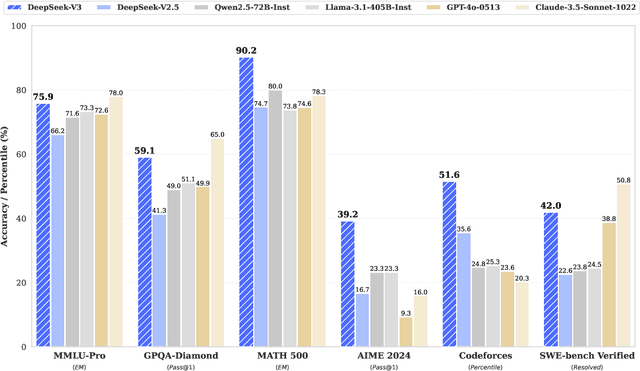


We present DeepSeek-V3, a strong Mixture-of-Experts (MoE) language model with 671B total parameters with 37B activated for each token. To achieve efficient inference and cost-effective training, DeepSeek-V3 adopts Multi-head Latent Attention (MLA) and DeepSeekMoE architectures, which were thoroughly validated in DeepSeek-V2. Furthermore, DeepSeek-V3 pioneers an auxiliary-loss-free strategy for load balancing and sets a multi-token prediction training objective for stronger performance. We pre-train DeepSeek-V3 on 14.8 trillion diverse and high-quality tokens, followed by Supervised Fine-Tuning and Reinforcement Learning stages to fully harness its capabilities. Comprehensive evaluations reveal that DeepSeek-V3 outperforms other open-source models and achieves performance comparable to leading closed-source models. Despite its excellent performance, DeepSeek-V3 requires only 2.788M H800 GPU hours for its full training. In addition, its training process is remarkably stable. Throughout the entire training process, we did not experience any irrecoverable loss spikes or perform any rollbacks. The model checkpoints are available at https://github.com/deepseek-ai/DeepSeek-V3.