 Add to Chrome
 Add to Firefox
 Add to Edge
VideoZeroBench: Probing the Limits of Video MLLMs with Spatio-Temporal Evidence Verification
Apr 02, 2026
Recent video multimodal large language models achieve impressive results across various benchmarks. However, current evaluations suffer from two critical limitations: (1) inflated scores can mask deficiencies in fine-grained visual understanding and reasoning, and (2) answer correctness is often measured without verifying whether models identify the precise spatio-temporal evidence supporting their predictions. To address this, we present VideoZeroBench, a hierarchical benchmark designed for challenging long-video question answering that rigorously verifies spatio-temporal evidence. It comprises 500 manually annotated questions across 13 domains, paired with temporal intervals and spatial bounding boxes as evidence. To disentangle answering generation, temporal grounding, and spatial grounding, we introduce a five-level evaluation protocol that progressively tightens evidence requirements. Experiments show that even Gemini-3-Pro correctly answers fewer than 17% of questions under the standard end-to-end QA setting (Level-3). When grounding constraints are imposed, performance drops sharply: No model exceeds 1% accuracy when both correct answering and accurate spatio-temporal localization are required (Level-5), with most failing to achieve any correct grounded predictions. These results expose a significant gap between surface-level answer correctness and genuine evidence-based reasoning, revealing that grounded video understanding remains a bottleneck for long-video QA. We further analyze performance across minimal evidence spans, atomic abilities, and inference paradigms, providing insights for future research in grounded video reasoning. The benchmark and code will be made publicly available.

VideoWorld 2: Learning Transferable Knowledge from Real-world Videos
Feb 10, 2026Learning transferable knowledge from unlabeled video data and applying it in new environments is a fundamental capability of intelligent agents. This work presents VideoWorld 2, which extends VideoWorld and offers the first investigation into learning transferable knowledge directly from raw real-world videos. At its core, VideoWorld 2 introduces a dynamic-enhanced Latent Dynamics Model (dLDM) that decouples action dynamics from visual appearance: a pretrained video diffusion model handles visual appearance modeling, enabling the dLDM to learn latent codes that focus on compact and meaningful task-related dynamics. These latent codes are then modeled autoregressively to learn task policies and support long-horizon reasoning. We evaluate VideoWorld 2 on challenging real-world handcraft making tasks, where prior video generation and latent-dynamics models struggle to operate reliably. Remarkably, VideoWorld 2 achieves up to 70% improvement in task success rate and produces coherent long execution videos. In robotics, we show that VideoWorld 2 can acquire effective manipulation knowledge from the Open-X dataset, which substantially improves task performance on CALVIN. This study reveals the potential of learning transferable world knowledge directly from raw videos, with all code, data, and models to be open-sourced for further research.
VideoWorld: Exploring Knowledge Learning from Unlabeled Videos
Jan 16, 2025This work explores whether a deep generative model can learn complex knowledge solely from visual input, in contrast to the prevalent focus on text-based models like large language models (LLMs). We develop VideoWorld, an auto-regressive video generation model trained on unlabeled video data, and test its knowledge acquisition abilities in video-based Go and robotic control tasks. Our experiments reveal two key findings: (1) video-only training provides sufficient information for learning knowledge, including rules, reasoning and planning capabilities, and (2) the representation of visual change is crucial for knowledge acquisition. To improve both the efficiency and efficacy of this process, we introduce the Latent Dynamics Model (LDM) as a key component of VideoWorld. Remarkably, VideoWorld reaches a 5-dan professional level in the Video-GoBench with just a 300-million-parameter model, without relying on search algorithms or reward mechanisms typical in reinforcement learning. In robotic tasks, VideoWorld effectively learns diverse control operations and generalizes across environments, approaching the performance of oracle models in CALVIN and RLBench. This study opens new avenues for knowledge acquisition from visual data, with all code, data, and models open-sourced for further research.
PixelLM: Pixel Reasoning with Large Multimodal Model
Dec 04, 2023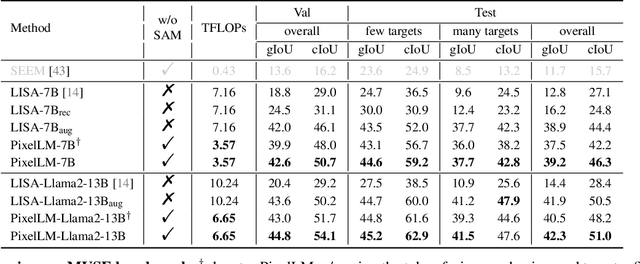
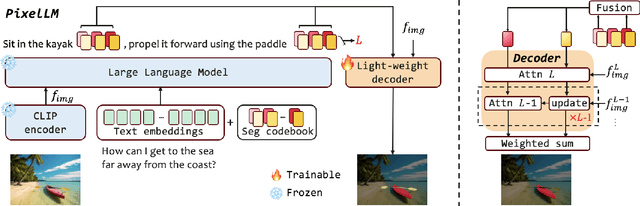
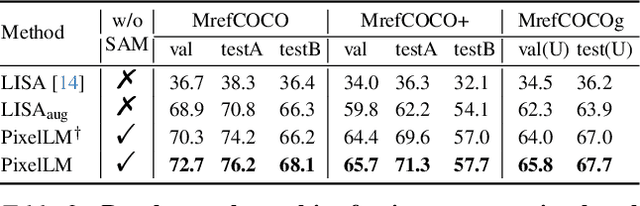
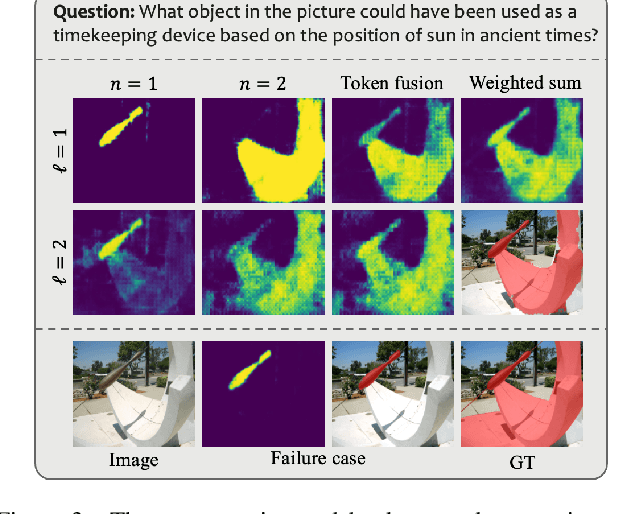
While large multimodal models (LMMs) have achieved remarkable progress, generating pixel-level masks for image reasoning tasks involving multiple open-world targets remains a challenge. To bridge this gap, we introduce PixelLM, an effective and efficient LMM for pixel-level reasoning and understanding. Central to PixelLM is a novel, lightweight pixel decoder and a comprehensive segmentation codebook. The decoder efficiently produces masks from the hidden embeddings of the codebook tokens, which encode detailed target-relevant information. With this design, PixelLM harmonizes with the structure of popular LMMs and avoids the need for additional costly segmentation models. Furthermore, we propose a target refinement loss to enhance the model's ability to differentiate between multiple targets, leading to substantially improved mask quality. To advance research in this area, we construct MUSE, a high-quality multi-target reasoning segmentation benchmark. PixelLM excels across various pixel-level image reasoning and understanding tasks, outperforming well-established methods in multiple benchmarks, including MUSE, single- and multi-referring segmentation. Comprehensive ablations confirm the efficacy of each proposed component. All code, models, and datasets will be publicly available.