 Add to Chrome
 Add to Firefox
 Add to Edge
The Third Monocular Depth Estimation Challenge
Apr 27, 2024


This paper discusses the results of the third edition of the Monocular Depth Estimation Challenge (MDEC). The challenge focuses on zero-shot generalization to the challenging SYNS-Patches dataset, featuring complex scenes in natural and indoor settings. As with the previous edition, methods can use any form of supervision, i.e. supervised or self-supervised. The challenge received a total of 19 submissions outperforming the baseline on the test set: 10 among them submitted a report describing their approach, highlighting a diffused use of foundational models such as Depth Anything at the core of their method. The challenge winners drastically improved 3D F-Score performance, from 17.51% to 23.72%.

Bracketing Image Restoration and Enhancement with High-Low Frequency Decomposition
Apr 24, 2024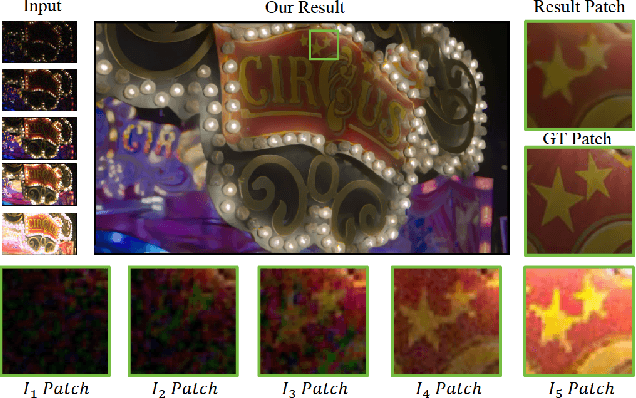

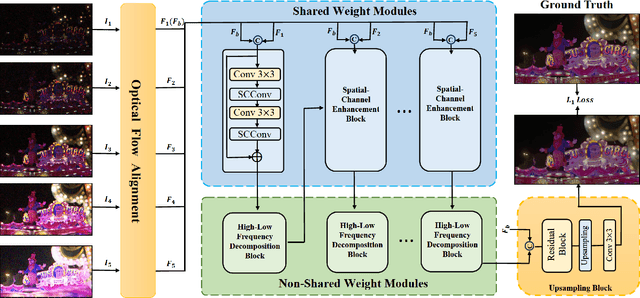

In real-world scenarios, due to a series of image degradations, obtaining high-quality, clear content photos is challenging. While significant progress has been made in synthesizing high-quality images, previous methods for image restoration and enhancement often overlooked the characteristics of different degradations. They applied the same structure to address various types of degradation, resulting in less-than-ideal restoration outcomes. Inspired by the notion that high/low frequency information is applicable to different degradations, we introduce HLNet, a Bracketing Image Restoration and Enhancement method based on high-low frequency decomposition. Specifically, we employ two modules for feature extraction: shared weight modules and non-shared weight modules. In the shared weight modules, we use SCConv to extract common features from different degradations. In the non-shared weight modules, we introduce the High-Low Frequency Decomposition Block (HLFDB), which employs different methods to handle high-low frequency information, enabling the model to address different degradations more effectively. Compared to other networks, our method takes into account the characteristics of different degradations, thus achieving higher-quality image restoration.
CRNet: A Detail-Preserving Network for Unified Image Restoration and Enhancement Task
Apr 22, 2024
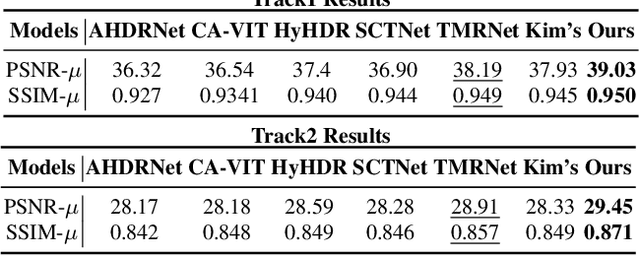


In real-world scenarios, images captured often suffer from blurring, noise, and other forms of image degradation, and due to sensor limitations, people usually can only obtain low dynamic range images. To achieve high-quality images, researchers have attempted various image restoration and enhancement operations on photographs, including denoising, deblurring, and high dynamic range imaging. However, merely performing a single type of image enhancement still cannot yield satisfactory images. In this paper, to deal with the challenge above, we propose the Composite Refinement Network (CRNet) to address this issue using multiple exposure images. By fully integrating information-rich multiple exposure inputs, CRNet can perform unified image restoration and enhancement. To improve the quality of image details, CRNet explicitly separates and strengthens high and low-frequency information through pooling layers, using specially designed Multi-Branch Blocks for effective fusion of these frequencies. To increase the receptive field and fully integrate input features, CRNet employs the High-Frequency Enhancement Module, which includes large kernel convolutions and an inverted bottleneck ConvFFN. Our model secured third place in the first track of the Bracketing Image Restoration and Enhancement Challenge, surpassing previous SOTA models in both testing metrics and visual quality.
NTIRE 2024 Challenge on Low Light Image Enhancement: Methods and Results
Apr 22, 2024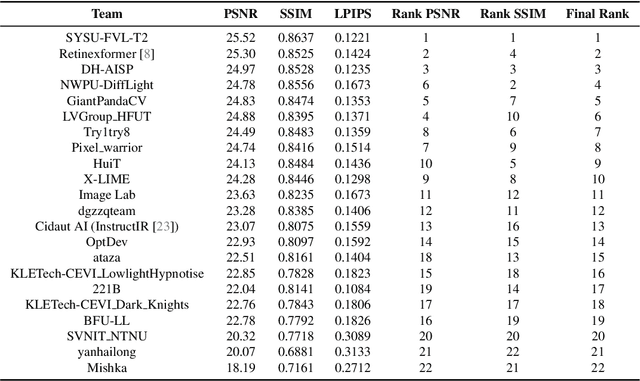
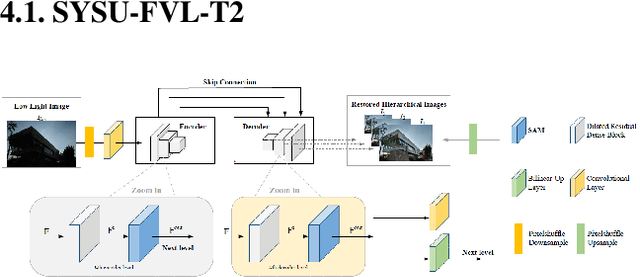
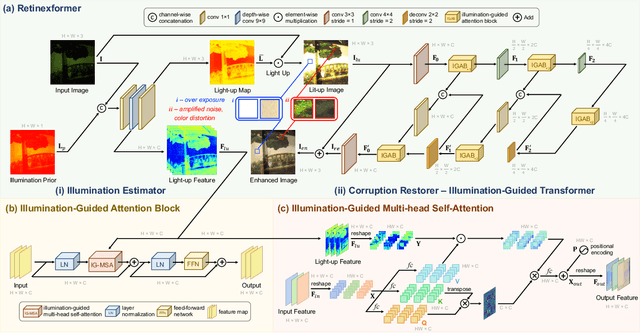
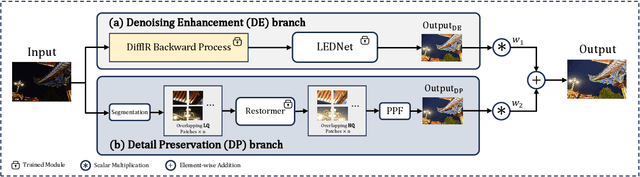
This paper reviews the NTIRE 2024 low light image enhancement challenge, highlighting the proposed solutions and results. The aim of this challenge is to discover an effective network design or solution capable of generating brighter, clearer, and visually appealing results when dealing with a variety of conditions, including ultra-high resolution (4K and beyond), non-uniform illumination, backlighting, extreme darkness, and night scenes. A notable total of 428 participants registered for the challenge, with 22 teams ultimately making valid submissions. This paper meticulously evaluates the state-of-the-art advancements in enhancing low-light images, reflecting the significant progress and creativity in this field.
GoMVS: Geometrically Consistent Cost Aggregation for Multi-View Stereo
Apr 11, 2024
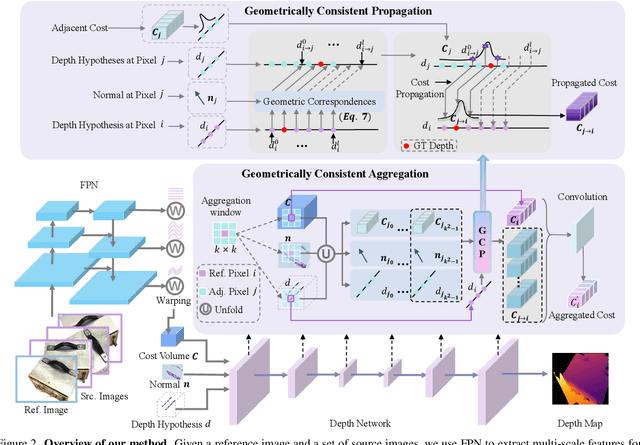

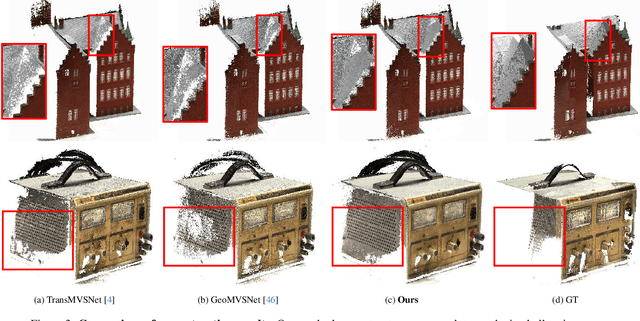
Matching cost aggregation plays a fundamental role in learning-based multi-view stereo networks. However, directly aggregating adjacent costs can lead to suboptimal results due to local geometric inconsistency. Related methods either seek selective aggregation or improve aggregated depth in the 2D space, both are unable to handle geometric inconsistency in the cost volume effectively. In this paper, we propose GoMVS to aggregate geometrically consistent costs, yielding better utilization of adjacent geometries. More specifically, we correspond and propagate adjacent costs to the reference pixel by leveraging the local geometric smoothness in conjunction with surface normals. We achieve this by the geometric consistent propagation (GCP) module. It computes the correspondence from the adjacent depth hypothesis space to the reference depth space using surface normals, then uses the correspondence to propagate adjacent costs to the reference geometry, followed by a convolution for aggregation. Our method achieves new state-of-the-art performance on DTU, Tanks & Temple, and ETH3D datasets. Notably, our method ranks 1st on the Tanks & Temple Advanced benchmark.
Generating Content for HDR Deghosting from Frequency View
Apr 01, 2024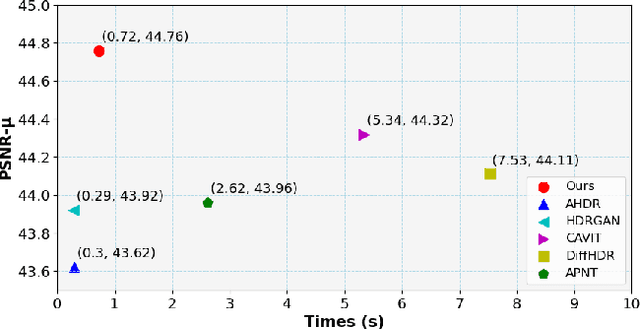
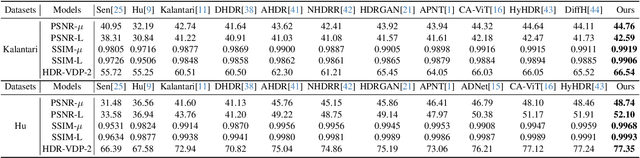
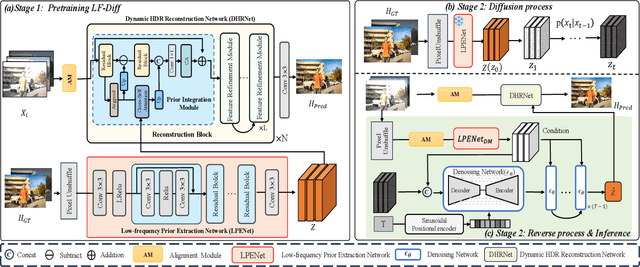

Recovering ghost-free High Dynamic Range (HDR) images from multiple Low Dynamic Range (LDR) images becomes challenging when the LDR images exhibit saturation and significant motion. Recent Diffusion Models (DMs) have been introduced in HDR imaging field, demonstrating promising performance, particularly in achieving visually perceptible results compared to previous DNN-based methods. However, DMs require extensive iterations with large models to estimate entire images, resulting in inefficiency that hinders their practical application. To address this challenge, we propose the Low-Frequency aware Diffusion (LF-Diff) model for ghost-free HDR imaging. The key idea of LF-Diff is implementing the DMs in a highly compacted latent space and integrating it into a regression-based model to enhance the details of reconstructed images. Specifically, as low-frequency information is closely related to human visual perception we propose to utilize DMs to create compact low-frequency priors for the reconstruction process. In addition, to take full advantage of the above low-frequency priors, the Dynamic HDR Reconstruction Network (DHRNet) is carried out in a regression-based manner to obtain final HDR images. Extensive experiments conducted on synthetic and real-world benchmark datasets demonstrate that our LF-Diff performs favorably against several state-of-the-art methods and is 10$\times$ faster than previous DM-based methods.
A self-supervised CNN for image watermark removal
Mar 09, 2024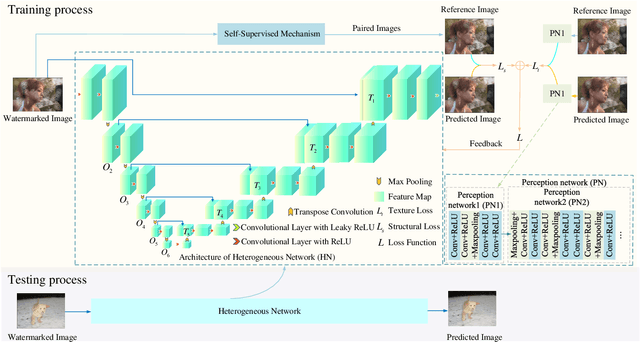
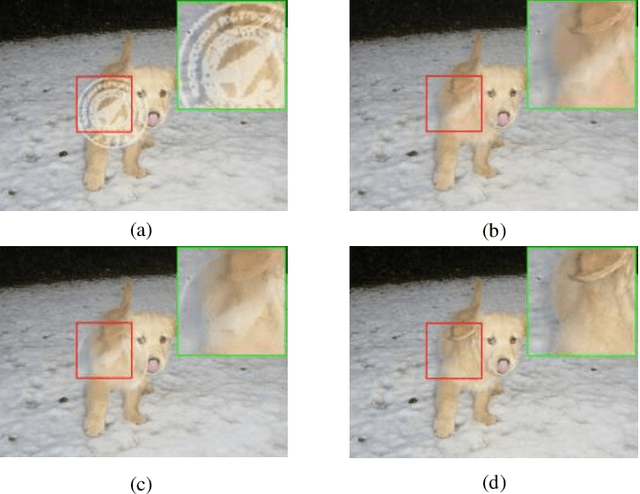

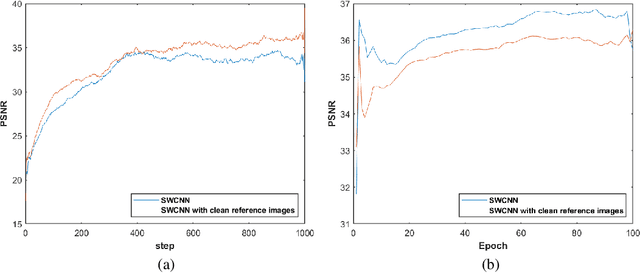
Popular convolutional neural networks mainly use paired images in a supervised way for image watermark removal. However, watermarked images do not have reference images in the real world, which results in poor robustness of image watermark removal techniques. In this paper, we propose a self-supervised convolutional neural network (CNN) in image watermark removal (SWCNN). SWCNN uses a self-supervised way to construct reference watermarked images rather than given paired training samples, according to watermark distribution. A heterogeneous U-Net architecture is used to extract more complementary structural information via simple components for image watermark removal. Taking into account texture information, a mixed loss is exploited to improve visual effects of image watermark removal. Besides, a watermark dataset is conducted. Experimental results show that the proposed SWCNN is superior to popular CNNs in image watermark removal.
Semi-Supervised Semantic Segmentation Based on Pseudo-Labels: A Survey
Mar 04, 2024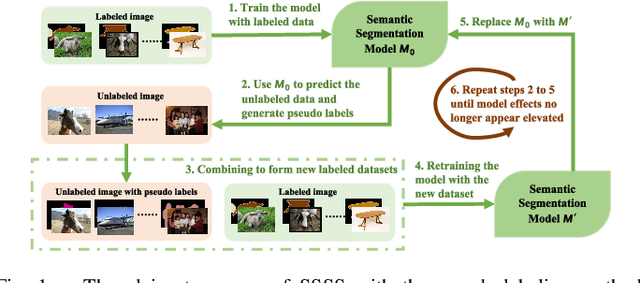
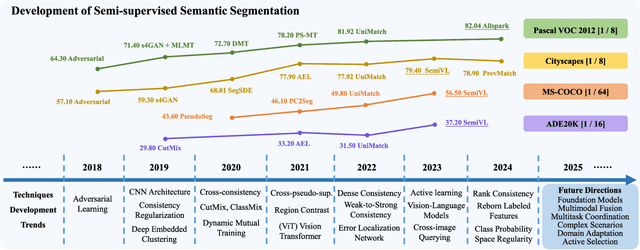
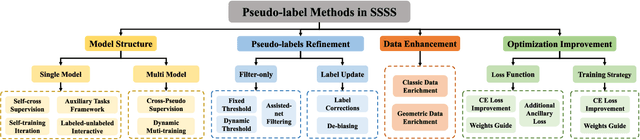
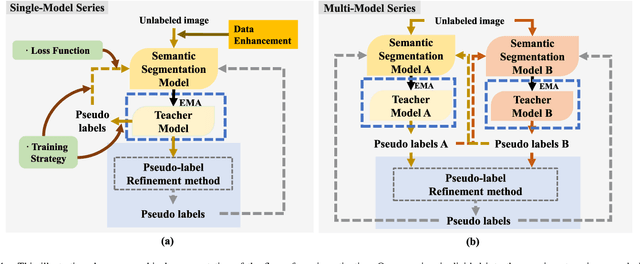
Semantic segmentation is an important and popular research area in computer vision that focuses on classifying pixels in an image based on their semantics. However, supervised deep learning requires large amounts of data to train models and the process of labeling images pixel by pixel is time-consuming and laborious. This review aims to provide a first comprehensive and organized overview of the state-of-the-art research results on pseudo-label methods in the field of semi-supervised semantic segmentation, which we categorize from different perspectives and present specific methods for specific application areas. In addition, we explore the application of pseudo-label technology in medical and remote-sensing image segmentation. Finally, we also propose some feasible future research directions to address the existing challenges.
Perceptive self-supervised learning network for noisy image watermark removal
Mar 04, 2024Popular methods usually use a degradation model in a supervised way to learn a watermark removal model. However, it is true that reference images are difficult to obtain in the real world, as well as collected images by cameras suffer from noise. To overcome these drawbacks, we propose a perceptive self-supervised learning network for noisy image watermark removal (PSLNet) in this paper. PSLNet depends on a parallel network to remove noise and watermarks. The upper network uses task decomposition ideas to remove noise and watermarks in sequence. The lower network utilizes the degradation model idea to simultaneously remove noise and watermarks. Specifically, mentioned paired watermark images are obtained in a self supervised way, and paired noisy images (i.e., noisy and reference images) are obtained in a supervised way. To enhance the clarity of obtained images, interacting two sub-networks and fusing obtained clean images are used to improve the effects of image watermark removal in terms of structural information and pixel enhancement. Taking into texture information account, a mixed loss uses obtained images and features to achieve a robust model of noisy image watermark removal. Comprehensive experiments show that our proposed method is very effective in comparison with popular convolutional neural networks (CNNs) for noisy image watermark removal. Codes can be obtained at https://github.com/hellloxiaotian/PSLNet.
A Heterogeneous Dynamic Convolutional Neural Network for Image Super-resolution
Feb 24, 2024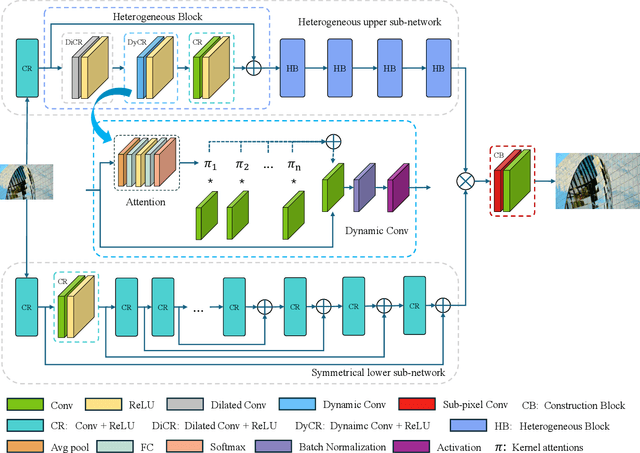
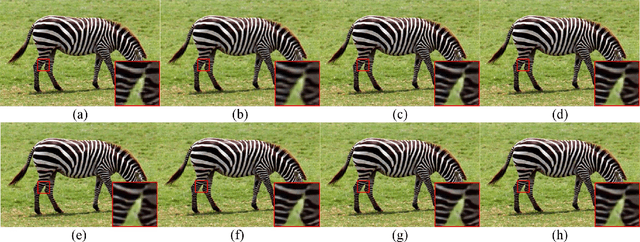
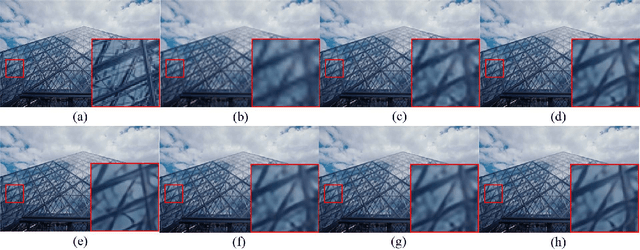
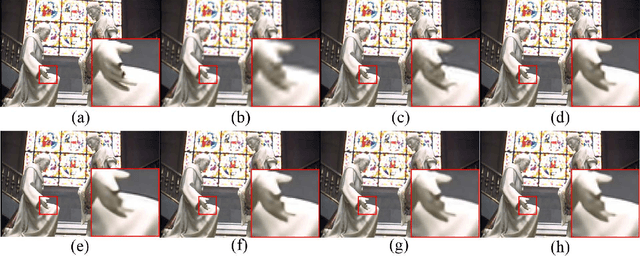
Convolutional neural networks can automatically learn features via deep network architectures and given input samples. However, robustness of obtained models may have challenges in varying scenes. Bigger differences of a network architecture are beneficial to extract more complementary structural information to enhance robustness of an obtained super-resolution model. In this paper, we present a heterogeneous dynamic convolutional network in image super-resolution (HDSRNet). To capture more information, HDSRNet is implemented by a heterogeneous parallel network. The upper network can facilitate more contexture information via stacked heterogeneous blocks to improve effects of image super-resolution. Each heterogeneous block is composed of a combination of a dilated, dynamic, common convolutional layers, ReLU and residual learning operation. It can not only adaptively adjust parameters, according to different inputs, but also prevent long-term dependency problem. The lower network utilizes a symmetric architecture to enhance relations of different layers to mine more structural information, which is complementary with a upper network for image super-resolution. The relevant experimental results show that the proposed HDSRNet is effective to deal with image resolving. The code of HDSRNet can be obtained at https://github.com/hellloxiaotian/HDSRNet.