 Add to Chrome
 Add to Firefox
 Add to Edge
LSRIF: Logic-Structured Reinforcement Learning for Instruction Following
Jan 10, 2026
Instruction-following is critical for large language models, but real-world instructions often contain logical structures such as sequential dependencies and conditional branching. Existing methods typically construct datasets with parallel constraints and optimize average rewards, ignoring logical dependencies and yielding noisy signals. We propose a logic-structured training framework LSRIF that explicitly models instruction logic. We first construct a dataset LSRInstruct with constraint structures such as parallel, sequential, and conditional types, and then design structure-aware rewarding method LSRIF including average aggregation for parallel structures, failure-penalty propagation for sequential structures, and selective rewards for conditional branches. Experiments show LSRIF brings significant improvements in instruction-following (in-domain and out-of-domain) and general reasoning. Analysis reveals that learning with explicit logic structures brings parameter updates in attention layers and sharpens token-level attention to constraints and logical operators.

Logics-STEM: Empowering LLM Reasoning via Failure-Driven Post-Training and Document Knowledge Enhancement
Jan 08, 2026We present Logics-STEM, a state-of-the-art reasoning model fine-tuned on Logics-STEM-SFT-Dataset, a high-quality and diverse dataset at 10M scale that represents one of the largest-scale open-source long chain-of-thought corpora. Logics-STEM targets reasoning tasks in the domains of Science, Technology, Engineering, and Mathematics (STEM), and exhibits exceptional performance on STEM-related benchmarks with an average improvement of 4.68% over the next-best model at 8B scale. We attribute the gains to our data-algorithm co-design engine, where they are jointly optimized to fit a gold-standard distribution behind reasoning. Data-wise, the Logics-STEM-SFT-Dataset is constructed from a meticulously designed data curation engine with 5 stages to ensure the quality, diversity, and scalability, including annotation, deduplication, decontamination, distillation, and stratified sampling. Algorithm-wise, our failure-driven post-training framework leverages targeted knowledge retrieval and data synthesis around model failure regions in the Supervised Fine-tuning (SFT) stage to effectively guide the second-stage SFT or the reinforcement learning (RL) for better fitting the target distribution. The superior empirical performance of Logics-STEM reveals the vast potential of combining large-scale open-source data with carefully designed synthetic data, underscoring the critical role of data-algorithm co-design in enhancing reasoning capabilities through post-training. We make both the Logics-STEM models (8B and 32B) and the Logics-STEM-SFT-Dataset (10M and downsampled 2.2M versions) publicly available to support future research in the open-source community.
Why Did Apple Fall To The Ground: Evaluating Curiosity In Large Language Model
Oct 23, 2025Curiosity serves as a pivotal conduit for human beings to discover and learn new knowledge. Recent advancements of large language models (LLMs) in natural language processing have sparked discussions regarding whether these models possess capability of curiosity-driven learning akin to humans. In this paper, starting from the human curiosity assessment questionnaire Five-Dimensional Curiosity scale Revised (5DCR), we design a comprehensive evaluation framework that covers dimensions such as Information Seeking, Thrill Seeking, and Social Curiosity to assess the extent of curiosity exhibited by LLMs. The results demonstrate that LLMs exhibit a stronger thirst for knowledge than humans but still tend to make conservative choices when faced with uncertain environments. We further investigated the relationship between curiosity and thinking of LLMs, confirming that curious behaviors can enhance the model's reasoning and active learning abilities. These findings suggest that LLMs have the potential to exhibit curiosity similar to that of humans, providing experimental support for the future development of learning capabilities and innovative research in LLMs.
Instructions are all you need: Self-supervised Reinforcement Learning for Instruction Following
Oct 16, 2025Language models often struggle to follow multi-constraint instructions that are crucial for real-world applications. Existing reinforcement learning (RL) approaches suffer from dependency on external supervision and sparse reward signals from multi-constraint tasks. We propose a label-free self-supervised RL framework that eliminates dependency on external supervision by deriving reward signals directly from instructions and generating pseudo-labels for reward model training. Our approach introduces constraint decomposition strategies and efficient constraint-wise binary classification to address sparse reward challenges while maintaining computational efficiency. Experiments show that our approach generalizes well, achieving strong improvements across 3 in-domain and 5 out-of-domain datasets, including challenging agentic and multi-turn instruction following. The data and code are publicly available at https://github.com/Rainier-rq/verl-if
HINT: Helping Ineffective Rollouts Navigate Towards Effectiveness
Oct 10, 2025Reinforcement Learning (RL) has become a key driver for enhancing the long chain-of-thought (CoT) reasoning capabilities of Large Language Models (LLMs). However, prevalent methods like GRPO often fail when task difficulty exceeds the model's capacity, leading to reward sparsity and inefficient training. While prior work attempts to mitigate this using off-policy data, such as mixing RL with Supervised Fine-Tuning (SFT) or using hints, they often misguide policy updates In this work, we identify a core issue underlying these failures, which we term low training affinity. This condition arises from a large distributional mismatch between external guidance and the model's policy. To diagnose this, we introduce Affinity, the first quantitative metric for monitoring exploration efficiency and training stability. To improve Affinity, we propose HINT: Helping Ineffective rollouts Navigate Towards effectiveness, an adaptive hinting framework. Instead of providing direct answers, HINT supplies heuristic hints that guide the model to discover solutions on its own, preserving its autonomous reasoning capabilities. Extensive experiments on mathematical reasoning tasks show that HINT consistently outperforms existing methods, achieving state-of-the-art results with models of various scales, while also demonstrating significantly more stable learning and greater data efficiency.Code is available on Github.
Accelerated Evolving Set Processes for Local PageRank Computation
Oct 09, 2025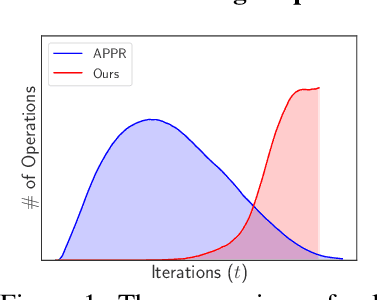
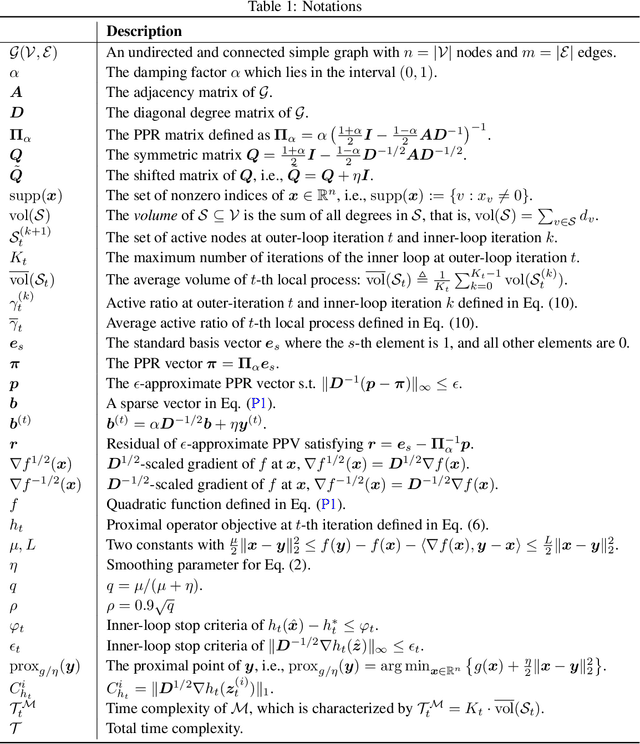
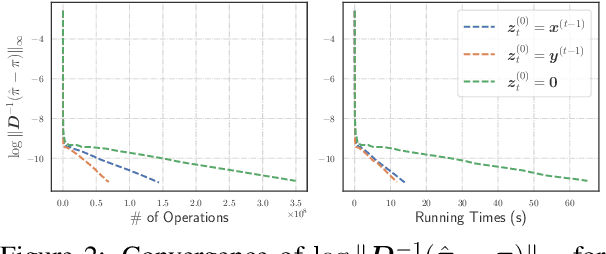

This work proposes a novel framework based on nested evolving set processes to accelerate Personalized PageRank (PPR) computation. At each stage of the process, we employ a localized inexact proximal point iteration to solve a simplified linear system. We show that the time complexity of such localized methods is upper bounded by $\min\{\tilde{\mathcal{O}}(R^2/\epsilon^2), \tilde{\mathcal{O}}(m)\}$ to obtain an $\epsilon$-approximation of the PPR vector, where $m$ denotes the number of edges in the graph and $R$ is a constant defined via nested evolving set processes. Furthermore, the algorithms induced by our framework require solving only $\tilde{\mathcal{O}}(1/\sqrt{\alpha})$ such linear systems, where $\alpha$ is the damping factor. When $1/\epsilon^2\ll m$, this implies the existence of an algorithm that computes an $\ epsilon $-approximation of the PPR vector with an overall time complexity of $\tilde{\mathcal{O}}\left(R^2 / (\sqrt{\alpha}\epsilon^2)\right)$, independent of the underlying graph size. Our result resolves an open conjecture from existing literature. Experimental results on real-world graphs validate the efficiency of our methods, demonstrating significant convergence in the early stages.
CultureScope: A Dimensional Lens for Probing Cultural Understanding in LLMs
Sep 19, 2025As large language models (LLMs) are increasingly deployed in diverse cultural environments, evaluating their cultural understanding capability has become essential for ensuring trustworthy and culturally aligned applications. However, most existing benchmarks lack comprehensiveness and are challenging to scale and adapt across different cultural contexts, because their frameworks often lack guidance from well-established cultural theories and tend to rely on expert-driven manual annotations. To address these issues, we propose CultureScope, the most comprehensive evaluation framework to date for assessing cultural understanding in LLMs. Inspired by the cultural iceberg theory, we design a novel dimensional schema for cultural knowledge classification, comprising 3 layers and 140 dimensions, which guides the automated construction of culture-specific knowledge bases and corresponding evaluation datasets for any given languages and cultures. Experimental results demonstrate that our method can effectively evaluate cultural understanding. They also reveal that existing large language models lack comprehensive cultural competence, and merely incorporating multilingual data does not necessarily enhance cultural understanding. All code and data files are available at https://github.com/HoganZinger/Culture
Curse of Knowledge: When Complex Evaluation Context Benefits yet Biases LLM Judges
Sep 03, 2025As large language models (LLMs) grow more capable, they face increasingly diverse and complex tasks, making reliable evaluation challenging. The paradigm of LLMs as judges has emerged as a scalable solution, yet prior work primarily focuses on simple settings. Their reliability in complex tasks--where multi-faceted rubrics, unstructured reference answers, and nuanced criteria are critical--remains understudied. In this paper, we constructed ComplexEval, a challenge benchmark designed to systematically expose and quantify Auxiliary Information Induced Biases. We systematically investigated and validated 6 previously unexplored biases across 12 basic and 3 advanced scenarios. Key findings reveal: (1) all evaluated models exhibit significant susceptibility to these biases, with bias magnitude scaling with task complexity; (2) notably, Large Reasoning Models (LRMs) show paradoxical vulnerability. Our in-depth analysis offers crucial insights for improving the accuracy and verifiability of evaluation signals, paving the way for more general and robust evaluation models.
AgentGroupChat-V2: Divide-and-Conquer Is What LLM-Based Multi-Agent System Need
Jun 18, 2025Large language model based multi-agent systems have demonstrated significant potential in social simulation and complex task resolution domains. However, current frameworks face critical challenges in system architecture design, cross-domain generalizability, and performance guarantees, particularly as task complexity and number of agents increases. We introduces AgentGroupChat-V2, a novel framework addressing these challenges through three core innovations: (1) a divide-and-conquer fully parallel architecture that decomposes user queries into hierarchical task forest structures enabling dependency management and distributed concurrent processing. (2) an adaptive collaboration engine that dynamically selects heterogeneous LLM combinations and interaction modes based on task characteristics. (3) agent organization optimization strategies combining divide-and-conquer approaches for efficient problem decomposition. Extensive experiments demonstrate AgentGroupChat-V2's superior performance across diverse domains, achieving 91.50% accuracy on GSM8K (exceeding the best baseline by 5.6 percentage points), 30.4% accuracy on competition-level AIME (nearly doubling other methods), and 79.20% pass@1 on HumanEval. Performance advantages become increasingly pronounced with higher task difficulty, particularly on Level 5 MATH problems where improvements exceed 11 percentage points compared to state-of-the-art baselines. These results confirm that AgentGroupChat-V2 provides a comprehensive solution for building efficient, general-purpose LLM multi-agent systems with significant advantages in complex reasoning scenarios. Code is available at https://github.com/MikeGu721/AgentGroupChat-V2.
Logical Consistency is Vital: Neural-Symbolic Information Retrieval for Negative-Constraint Queries
May 29, 2025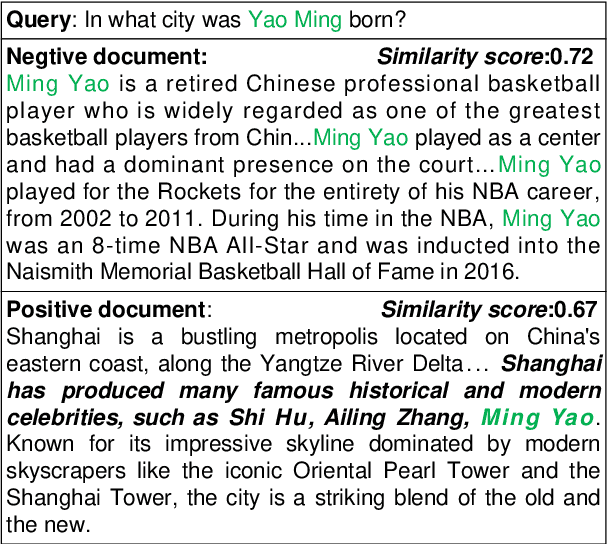
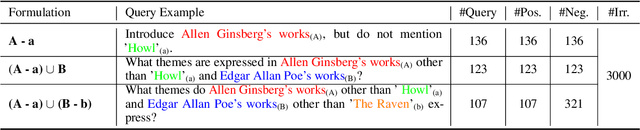
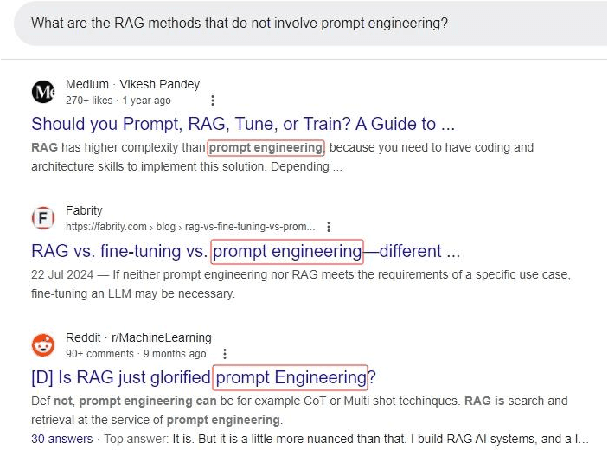
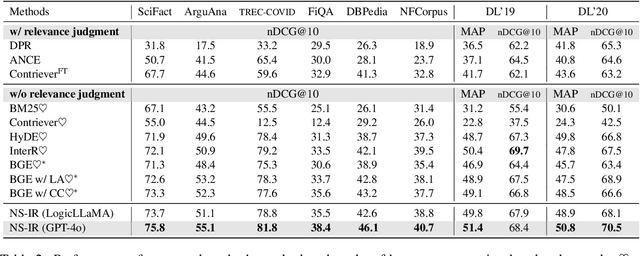
Information retrieval plays a crucial role in resource localization. Current dense retrievers retrieve the relevant documents within a corpus via embedding similarities, which compute similarities between dense vectors mainly depending on word co-occurrence between queries and documents, but overlook the real query intents. Thus, they often retrieve numerous irrelevant documents. Particularly in the scenarios of complex queries such as \emph{negative-constraint queries}, their retrieval performance could be catastrophic. To address the issue, we propose a neuro-symbolic information retrieval method, namely \textbf{NS-IR}, that leverages first-order logic (FOL) to optimize the embeddings of naive natural language by considering the \emph{logical consistency} between queries and documents. Specifically, we introduce two novel techniques, \emph{logic alignment} and \emph{connective constraint}, to rerank candidate documents, thereby enhancing retrieval relevance. Furthermore, we construct a new dataset \textbf{NegConstraint} including negative-constraint queries to evaluate our NS-IR's performance on such complex IR scenarios. Our extensive experiments demonstrate that NS-IR not only achieves superior zero-shot retrieval performance on web search and low-resource retrieval tasks, but also performs better on negative-constraint queries. Our scource code and dataset are available at https://github.com/xgl-git/NS-IR-main.