 Add to Chrome
 Add to Firefox
 Add to Edge
Deep Research as Rubric for Reinforcement Learning
May 31, 2026
Open-ended reasoning and long-form generation tasks lack reliable automatic verification signals for reward-based policy optimization. Rubrics offer a promising alternative, but existing approaches treat them as given artifacts -- either hand-crafted or prompt-generated -- and often miss the task-specific, knowledge-intensive dimensions that matter most, distorting the reward signal. Our key observation is that rubric construction is itself a research problem: identifying what makes a response correct or insightful requires discovering and synthesizing external knowledge. We propose Deep Research as Rubric (DR-rubric), a two-stage framework for constructing such rubrics. Stage I elicits domain facts, structural constraints, and failure modes through iterative multi-turn agentic search; Stage II distills this evidence into atomic, independently verifiable constraints for GRPO-based policy optimization. Because the model under training can serve as its own rubric generator, DR-rubric-8B supports bootstrap rubric generation without frontier-model assistance. We evaluate on 6 benchmarks spanning agentic research and expert reasoning. Experiments show that DR-Rubric achieves strong competitive performance with only 1K -- 3K training instances, where GPT-5-generated rubrics particularly benefit breadth coverage on agentic tasks, Gemini-generated rubrics yield the most balanced performance across agentic and expert reasoning tasks, and bootstrap rubrics exhibit a specialization-to-rebalancing evolution achieving the best overall performance at the third iteration. Results demonstrate that reframing rubric construction from static evaluation templates into an evidence-driven research process yields more scalable, fine-grained reward signals for open-ended tasks.

Logical Consistency is Vital: Neural-Symbolic Information Retrieval for Negative-Constraint Queries
May 29, 2025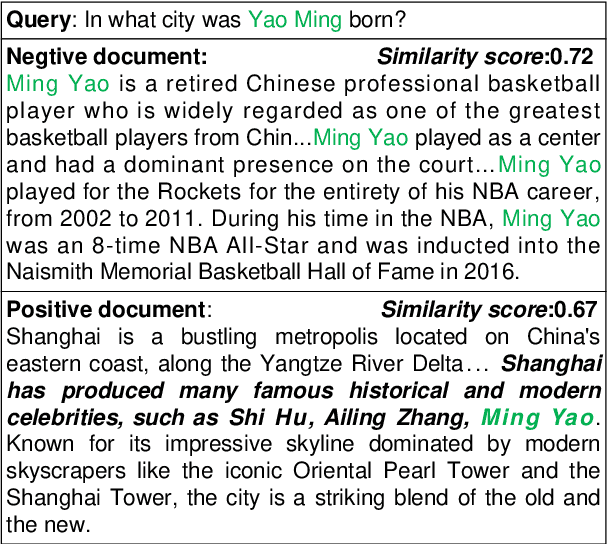
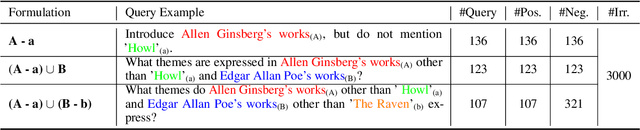
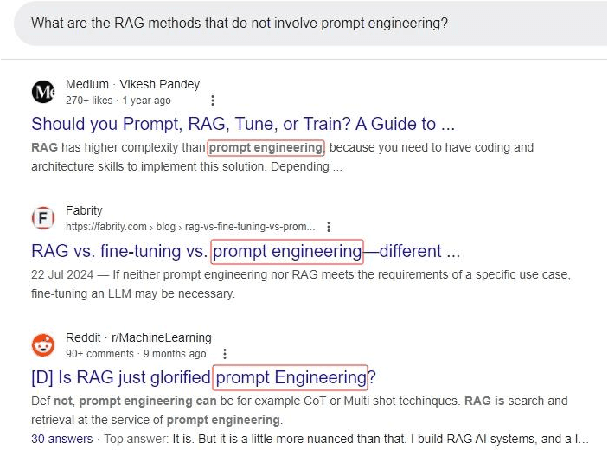
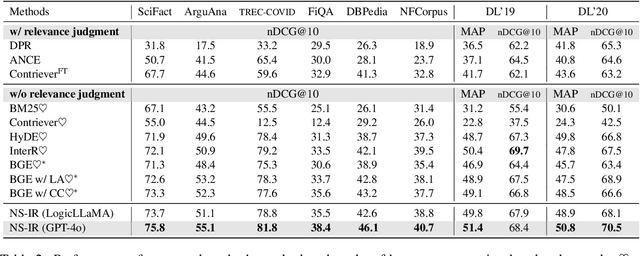
Information retrieval plays a crucial role in resource localization. Current dense retrievers retrieve the relevant documents within a corpus via embedding similarities, which compute similarities between dense vectors mainly depending on word co-occurrence between queries and documents, but overlook the real query intents. Thus, they often retrieve numerous irrelevant documents. Particularly in the scenarios of complex queries such as \emph{negative-constraint queries}, their retrieval performance could be catastrophic. To address the issue, we propose a neuro-symbolic information retrieval method, namely \textbf{NS-IR}, that leverages first-order logic (FOL) to optimize the embeddings of naive natural language by considering the \emph{logical consistency} between queries and documents. Specifically, we introduce two novel techniques, \emph{logic alignment} and \emph{connective constraint}, to rerank candidate documents, thereby enhancing retrieval relevance. Furthermore, we construct a new dataset \textbf{NegConstraint} including negative-constraint queries to evaluate our NS-IR's performance on such complex IR scenarios. Our extensive experiments demonstrate that NS-IR not only achieves superior zero-shot retrieval performance on web search and low-resource retrieval tasks, but also performs better on negative-constraint queries. Our scource code and dataset are available at https://github.com/xgl-git/NS-IR-main.