 Add to Chrome
 Add to Firefox
 Add to Edge
When RAG Meets Query Planning: Logical Query Trees for Resolving Exploratory Reasoning Problems
Jul 01, 2026
Retrieval-Augmented Generation (RAG) effectively grounds large language models (LLMs) in external knowledge but struggles with \textbf{exploratory reasoning problems (ERPs)} that are the complex queries involving high uncertainty and ambiguity. Resolving ERPs requires complex reasoning with unclear paths, tending to result in retrieval noise and error accumulation. Furthermore, the absence of an end-to-end planning mechanism makes it difficult to generate effective trajectories for ERPs. Motivated by database query planning, we introduce \emph{PlanRAG}, an RAG framework that models ERPs of natural language as \textbf{logical query trees (LQTs)}. However, translating ERPs into LQTs is non-trivial due to representation and optimization gaps between structured SQL and unstructured natural language, making it highly challenging to construct high-quality LQTs. To address these problems, we first decompose ERPs into atomic queries and then organize them into LQTs using dynamic programming guided by a cost model involving multiple complementary dimensions. Finally, we execute iterative aggregation, rewriting, retrieval, and generation over LQTs, processing nodes concurrently and propagating intermediate results upward, with further parallelization across multiple threads for efficiency. Our experimental results show that PlanRAG outperforms state-of-the-art iteration-based and graph-based RAG systems on our newly constructed dataset, \textbf{WikiWeb-ERP}, thereby providing a new formulation for optimizing natural language queries. Our source code and dataset are available at https://anonymous.4open.science/r/PlanRAG-main-B2C8/.

ComLQ: Benchmarking Complex Logical Queries in Information Retrieval
Nov 15, 2025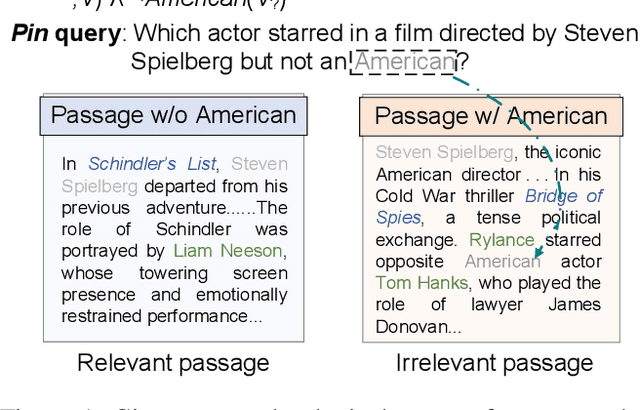

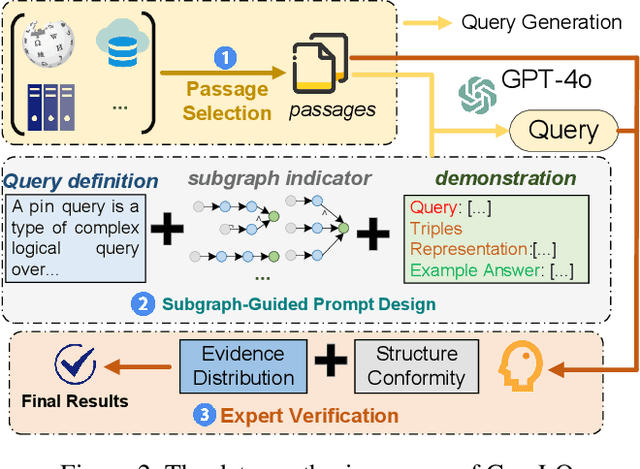
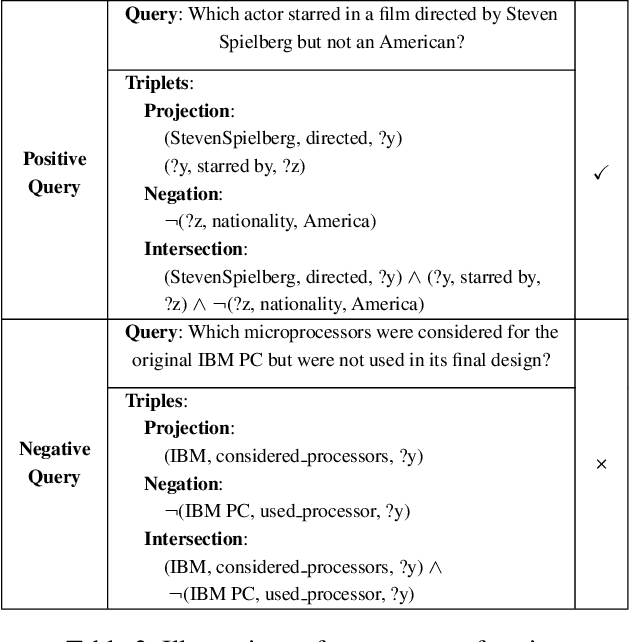
Information retrieval (IR) systems play a critical role in navigating information overload across various applications. Existing IR benchmarks primarily focus on simple queries that are semantically analogous to single- and multi-hop relations, overlooking \emph{complex logical queries} involving first-order logic operations such as conjunction ($\land$), disjunction ($\lor$), and negation ($\lnot$). Thus, these benchmarks can not be used to sufficiently evaluate the performance of IR models on complex queries in real-world scenarios. To address this problem, we propose a novel method leveraging large language models (LLMs) to construct a new IR dataset \textbf{ComLQ} for \textbf{Com}plex \textbf{L}ogical \textbf{Q}ueries, which comprises 2,909 queries and 11,251 candidate passages. A key challenge in constructing the dataset lies in capturing the underlying logical structures within unstructured text. Therefore, by designing the subgraph-guided prompt with the subgraph indicator, an LLM (such as GPT-4o) is guided to generate queries with specific logical structures based on selected passages. All query-passage pairs in ComLQ are ensured \emph{structure conformity} and \emph{evidence distribution} through expert annotation. To better evaluate whether retrievers can handle queries with negation, we further propose a new evaluation metric, \textbf{Log-Scaled Negation Consistency} (\textbf{LSNC@$K$}). As a supplement to standard relevance-based metrics (such as nDCG and mAP), LSNC@$K$ measures whether top-$K$ retrieved passages violate negation conditions in queries. Our experimental results under zero-shot settings demonstrate existing retrieval models' limited performance on complex logical queries, especially on queries with negation, exposing their inferior capabilities of modeling exclusion.
Logical Consistency is Vital: Neural-Symbolic Information Retrieval for Negative-Constraint Queries
May 29, 2025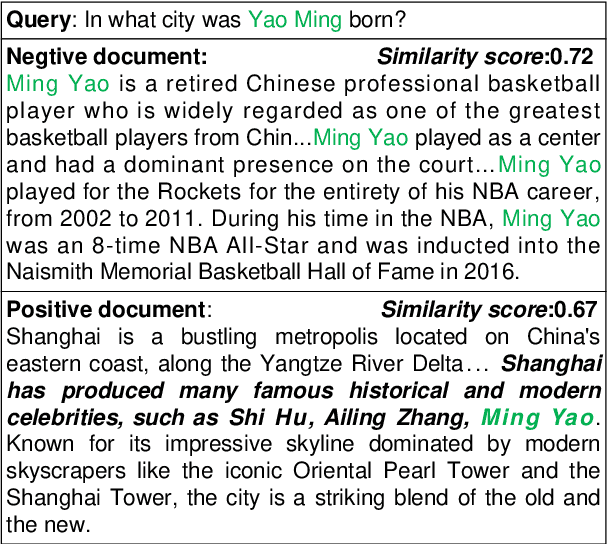
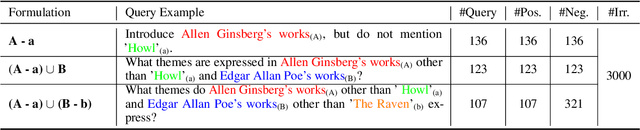
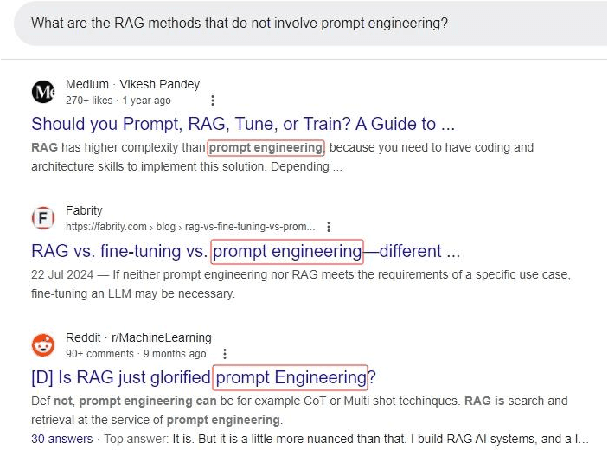
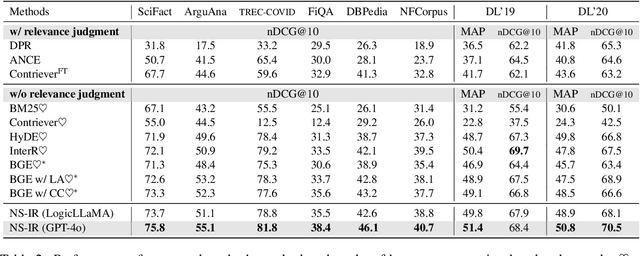
Information retrieval plays a crucial role in resource localization. Current dense retrievers retrieve the relevant documents within a corpus via embedding similarities, which compute similarities between dense vectors mainly depending on word co-occurrence between queries and documents, but overlook the real query intents. Thus, they often retrieve numerous irrelevant documents. Particularly in the scenarios of complex queries such as \emph{negative-constraint queries}, their retrieval performance could be catastrophic. To address the issue, we propose a neuro-symbolic information retrieval method, namely \textbf{NS-IR}, that leverages first-order logic (FOL) to optimize the embeddings of naive natural language by considering the \emph{logical consistency} between queries and documents. Specifically, we introduce two novel techniques, \emph{logic alignment} and \emph{connective constraint}, to rerank candidate documents, thereby enhancing retrieval relevance. Furthermore, we construct a new dataset \textbf{NegConstraint} including negative-constraint queries to evaluate our NS-IR's performance on such complex IR scenarios. Our extensive experiments demonstrate that NS-IR not only achieves superior zero-shot retrieval performance on web search and low-resource retrieval tasks, but also performs better on negative-constraint queries. Our scource code and dataset are available at https://github.com/xgl-git/NS-IR-main.