 Add to Chrome
 Add to Firefox
 Add to Edge
BRIGHT-VO: Brightness-Guided Hybrid Transformer for Visual Odometry with Multi-modality Refinement Module
Jan 16, 2025

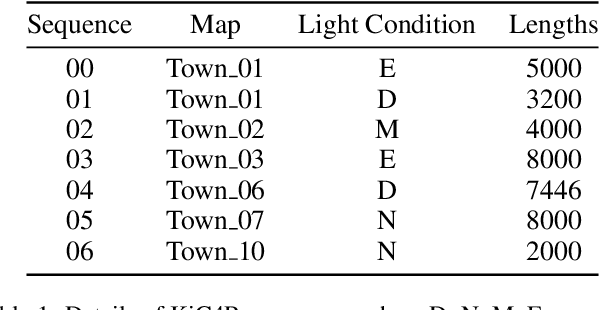
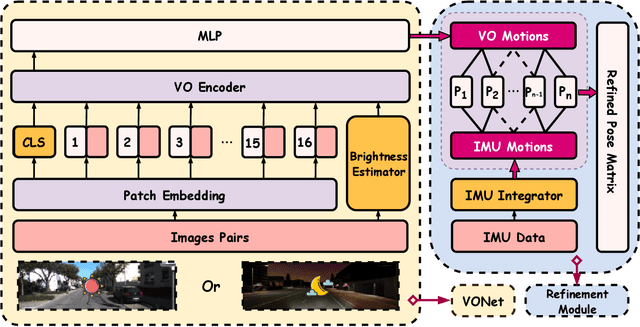
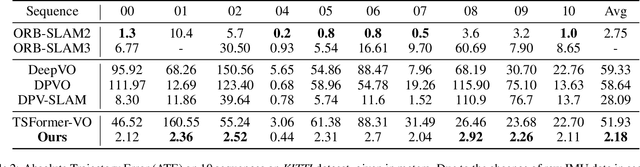
Visual odometry (VO) plays a crucial role in autonomous driving, robotic navigation, and other related tasks by estimating the position and orientation of a camera based on visual input. Significant progress has been made in data-driven VO methods, particularly those leveraging deep learning techniques to extract image features and estimate camera poses. However, these methods often struggle in low-light conditions because of the reduced visibility of features and the increased difficulty of matching keypoints. To address this limitation, we introduce BrightVO, a novel VO model based on Transformer architecture, which not only performs front-end visual feature extraction, but also incorporates a multi-modality refinement module in the back-end that integrates Inertial Measurement Unit (IMU) data. Using pose graph optimization, this module iteratively refines pose estimates to reduce errors and improve both accuracy and robustness. Furthermore, we create a synthetic low-light dataset, KiC4R, which includes a variety of lighting conditions to facilitate the training and evaluation of VO frameworks in challenging environments. Experimental results demonstrate that BrightVO achieves state-of-the-art performance on both the KiC4R dataset and the KITTI benchmarks. Specifically, it provides an average improvement of 20% in pose estimation accuracy in normal outdoor environments and 259% in low-light conditions, outperforming existing methods. For widespread use and further development, the research work is fully open-source at https://github.com/Anastasiawd/BrightVO.

CoreNet: Conflict Resolution Network for Point-Pixel Misalignment and Sub-Task Suppression of 3D LiDAR-Camera Object Detection
Jan 11, 2025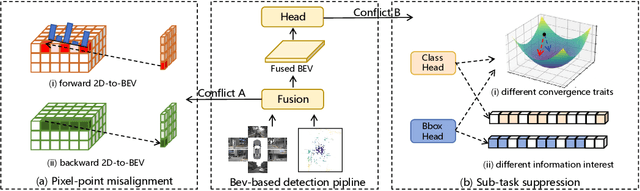
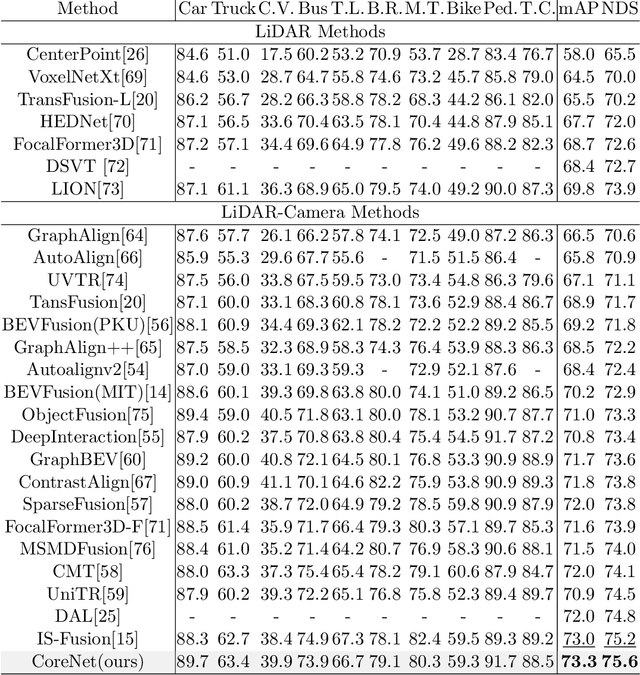
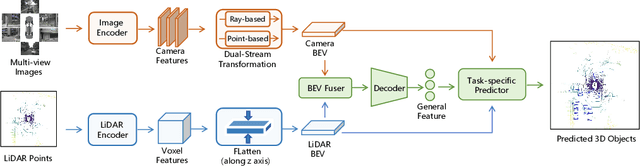
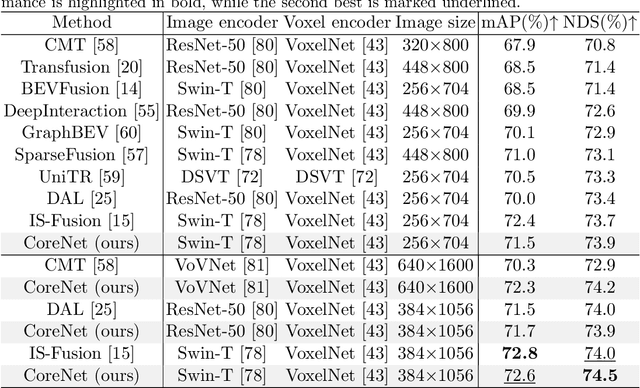
Fusing multi-modality inputs from different sensors is an effective way to improve the performance of 3D object detection. However, current methods overlook two important conflicts: point-pixel misalignment and sub-task suppression. The former means a pixel feature from the opaque object is projected to multiple point features of the same ray in the world space, and the latter means the classification prediction and bounding box regression may cause mutual suppression. In this paper, we propose a novel method named Conflict Resolution Network (CoreNet) to address the aforementioned issues. Specifically, we first propose a dual-stream transformation module to tackle point-pixel misalignment. It consists of ray-based and point-based 2D-to-BEV transformations. Both of them achieve approximately unique mapping from the image space to the world space. Moreover, we introduce a task-specific predictor to tackle sub-task suppression. It uses the dual-branch structure which adopts class-specific query and Bbox-specific query to corresponding sub-tasks. Each task-specific query is constructed of task-specific feature and general feature, which allows the heads to adaptively select information of interest based on different sub-tasks. Experiments on the large-scale nuScenes dataset demonstrate the superiority of our proposed CoreNet, by achieving 75.6\% NDS and 73.3\% mAP on the nuScenes test set without test-time augmentation and model ensemble techniques. The ample ablation study also demonstrates the effectiveness of each component. The code is released on https://github.com/liyih/CoreNet.
Binary Event-Driven Spiking Transformer
Jan 10, 2025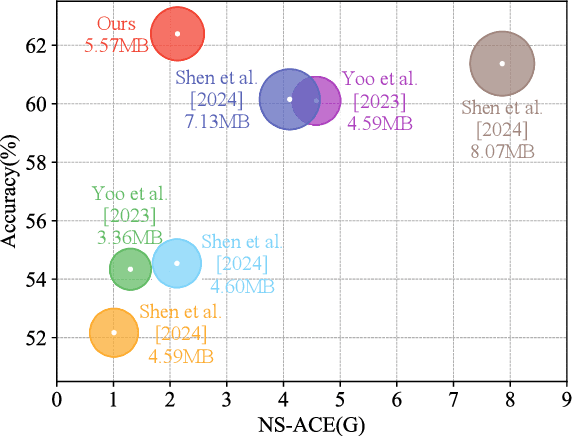
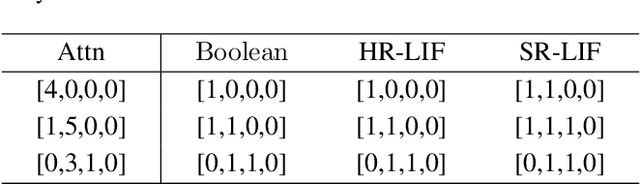
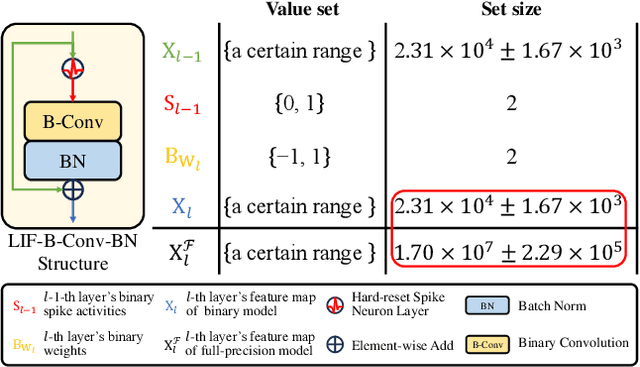
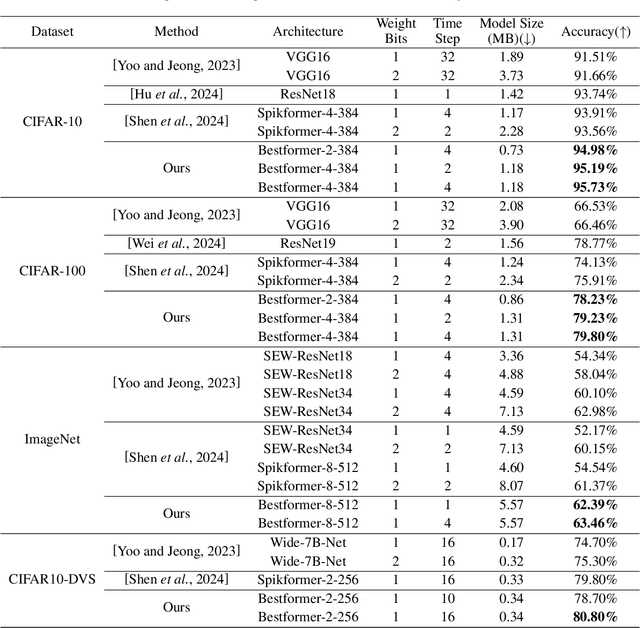
Transformer-based Spiking Neural Networks (SNNs) introduce a novel event-driven self-attention paradigm that combines the high performance of Transformers with the energy efficiency of SNNs. However, the larger model size and increased computational demands of the Transformer structure limit their practicality in resource-constrained scenarios. In this paper, we integrate binarization techniques into Transformer-based SNNs and propose the Binary Event-Driven Spiking Transformer, i.e. BESTformer. The proposed BESTformer can significantly reduce storage and computational demands by representing weights and attention maps with a mere 1-bit. However, BESTformer suffers from a severe performance drop from its full-precision counterpart due to the limited representation capability of binarization. To address this issue, we propose a Coupled Information Enhancement (CIE) method, which consists of a reversible framework and information enhancement distillation. By maximizing the mutual information between the binary model and its full-precision counterpart, the CIE method effectively mitigates the performance degradation of the BESTformer. Extensive experiments on static and neuromorphic datasets demonstrate that our method achieves superior performance to other binary SNNs, showcasing its potential as a compact yet high-performance model for resource-limited edge devices.
Separate Source Channel Coding Is Still What You Need: An LLM-based Rethinking
Jan 08, 2025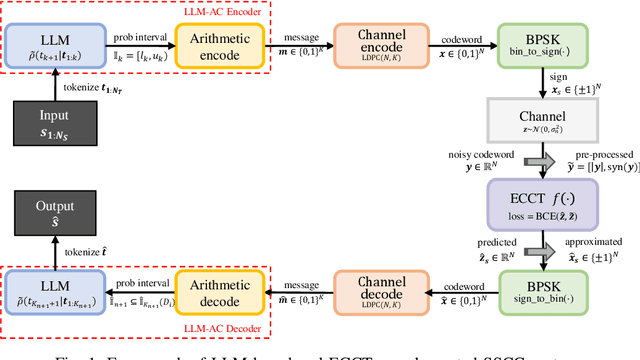
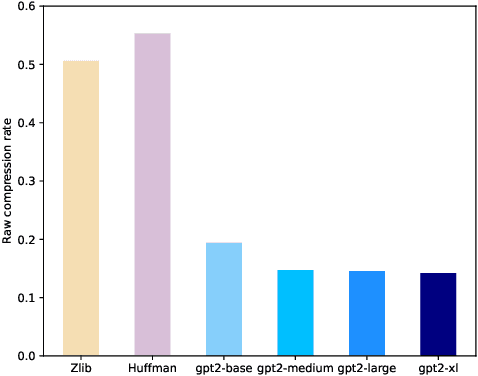

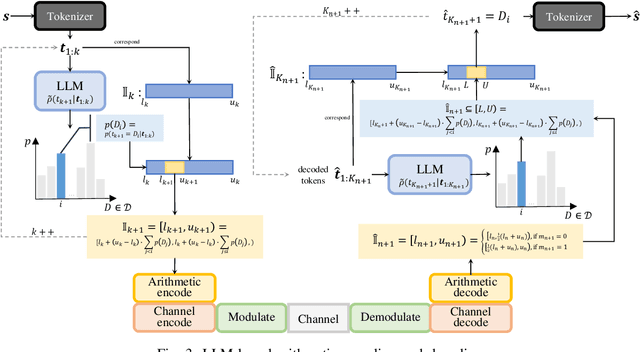
Along with the proliferating research interest in Semantic Communication (SemCom), Joint Source Channel Coding (JSCC) has dominated the attention due to the widely assumed existence in efficiently delivering information semantics. %has emerged as a pivotal area of research, aiming to enhance the efficiency and reliability of information transmission through deep learning-based methods. Nevertheless, this paper challenges the conventional JSCC paradigm, and advocates for adoption of Separate Source Channel Coding (SSCC) to enjoy the underlying more degree of freedom for optimization. We demonstrate that SSCC, after leveraging the strengths of Large Language Model (LLM) for source coding and Error Correction Code Transformer (ECCT) complemented for channel decoding, offers superior performance over JSCC. Our proposed framework also effectively highlights the compatibility challenges between SemCom approaches and digital communication systems, particularly concerning the resource costs associated with the transmission of high precision floating point numbers. Through comprehensive evaluations, we establish that empowered by LLM-based compression and ECCT-enhanced error correction, SSCC remains a viable and effective solution for modern communication systems. In other words, separate source and channel coding is still what we need!
RadGPT: Constructing 3D Image-Text Tumor Datasets
Jan 08, 2025With over 85 million CT scans performed annually in the United States, creating tumor-related reports is a challenging and time-consuming task for radiologists. To address this need, we present RadGPT, an Anatomy-Aware Vision-Language AI Agent for generating detailed reports from CT scans. RadGPT first segments tumors, including benign cysts and malignant tumors, and their surrounding anatomical structures, then transforms this information into both structured reports and narrative reports. These reports provide tumor size, shape, location, attenuation, volume, and interactions with surrounding blood vessels and organs. Extensive evaluation on unseen hospitals shows that RadGPT can produce accurate reports, with high sensitivity/specificity for small tumor (<2 cm) detection: 80/73% for liver tumors, 92/78% for kidney tumors, and 77/77% for pancreatic tumors. For large tumors, sensitivity ranges from 89% to 97%. The results significantly surpass the state-of-the-art in abdominal CT report generation. RadGPT generated reports for 17 public datasets. Through radiologist review and refinement, we have ensured the reports' accuracy, and created the first publicly available image-text 3D medical dataset, comprising over 1.8 million text tokens and 2.7 million images from 9,262 CT scans, including 2,947 tumor scans/reports of 8,562 tumor instances. Our reports can: (1) localize tumors in eight liver sub-segments and three pancreatic sub-segments annotated per-voxel; (2) determine pancreatic tumor stage (T1-T4) in 260 reports; and (3) present individual analyses of multiple tumors--rare in human-made reports. Importantly, 948 of the reports are for early-stage tumors.
ScaleMAI: Accelerating the Development of Trusted Datasets and AI Models
Jan 06, 2025


Building trusted datasets is critical for transparent and responsible Medical AI (MAI) research, but creating even small, high-quality datasets can take years of effort from multidisciplinary teams. This process often delays AI benefits, as human-centric data creation and AI-centric model development are treated as separate, sequential steps. To overcome this, we propose ScaleMAI, an agent of AI-integrated data curation and annotation, allowing data quality and AI performance to improve in a self-reinforcing cycle and reducing development time from years to months. We adopt pancreatic tumor detection as an example. First, ScaleMAI progressively creates a dataset of 25,362 CT scans, including per-voxel annotations for benign/malignant tumors and 24 anatomical structures. Second, through progressive human-in-the-loop iterations, ScaleMAI provides Flagship AI Model that can approach the proficiency of expert annotators (30-year experience) in detecting pancreatic tumors. Flagship Model significantly outperforms models developed from smaller, fixed-quality datasets, with substantial gains in tumor detection (+14%), segmentation (+5%), and classification (72%) on three prestigious benchmarks. In summary, ScaleMAI transforms the speed, scale, and reliability of medical dataset creation, paving the way for a variety of impactful, data-driven applications.
Attribute-Based Robotic Grasping with Data-Efficient Adaptation
Jan 04, 2025
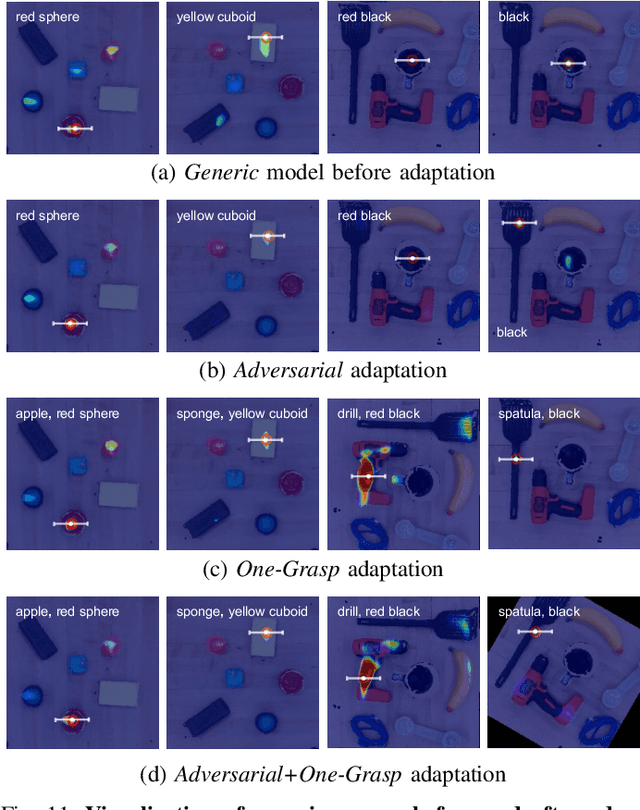


Robotic grasping is one of the most fundamental robotic manipulation tasks and has been the subject of extensive research. However, swiftly teaching a robot to grasp a novel target object in clutter remains challenging. This paper attempts to address the challenge by leveraging object attributes that facilitate recognition, grasping, and rapid adaptation to new domains. In this work, we present an end-to-end encoder-decoder network to learn attribute-based robotic grasping with data-efficient adaptation capability. We first pre-train the end-to-end model with a variety of basic objects to learn generic attribute representation for recognition and grasping. Our approach fuses the embeddings of a workspace image and a query text using a gated-attention mechanism and learns to predict instance grasping affordances. To train the joint embedding space of visual and textual attributes, the robot utilizes object persistence before and after grasping. Our model is self-supervised in a simulation that only uses basic objects of various colors and shapes but generalizes to novel objects in new environments. To further facilitate generalization, we propose two adaptation methods, adversarial adaption and one-grasp adaptation. Adversarial adaptation regulates the image encoder using augmented data of unlabeled images, whereas one-grasp adaptation updates the overall end-to-end model using augmented data from one grasp trial. Both adaptation methods are data-efficient and considerably improve instance grasping performance. Experimental results in both simulation and the real world demonstrate that our approach achieves over 81% instance grasping success rate on unknown objects, which outperforms several baselines by large margins.
* Project page: https://z.umn.edu/attr-grasp. arXiv admin note: substantial text overlap with arXiv:2104.02271
Enhanced coarsening of charge density waves induced by electron correlation: Machine-learning enabled large-scale dynamical simulations
Dec 30, 2024The phase ordering kinetics of emergent orders in correlated electron systems is a fundamental topic in non-equilibrium physics, yet it remains largely unexplored. The intricate interplay between quasiparticles and emergent order-parameter fields could lead to unusual coarsening dynamics that is beyond the standard theories. However, accurate treatment of both quasiparticles and collective degrees of freedom is a multi-scale challenge in dynamical simulations of correlated electrons. Here we leverage modern machine learning (ML) methods to achieve a linear-scaling algorithm for simulating the coarsening of charge density waves (CDWs), one of the fundamental symmetry breaking phases in functional electron materials. We demonstrate our approach on the square-lattice Hubbard-Holstein model and uncover an intriguing enhancement of CDW coarsening which is related to the screening of on-site potential by electron-electron interactions. Our study provides fresh insights into the role of electron correlations in non-equilibrium dynamics and underscores the promise of ML force-field approaches for advancing multi-scale dynamical modeling of correlated electron systems.
Text-Driven Tumor Synthesis
Dec 24, 2024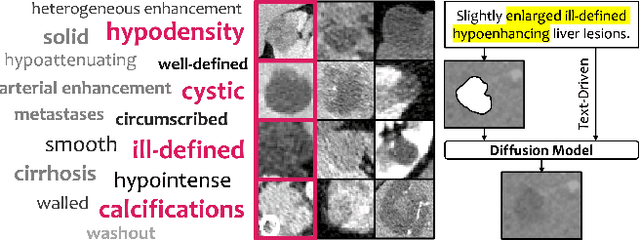

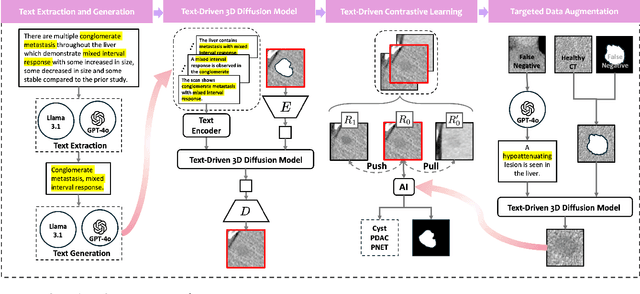
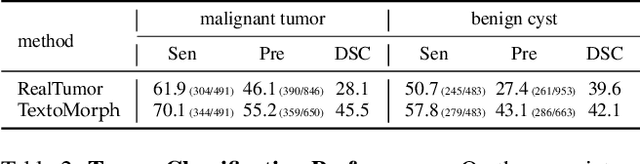
Tumor synthesis can generate examples that AI often misses or over-detects, improving AI performance by training on these challenging cases. However, existing synthesis methods, which are typically unconditional -- generating images from random variables -- or conditioned only by tumor shapes, lack controllability over specific tumor characteristics such as texture, heterogeneity, boundaries, and pathology type. As a result, the generated tumors may be overly similar or duplicates of existing training data, failing to effectively address AI's weaknesses. We propose a new text-driven tumor synthesis approach, termed TextoMorph, that provides textual control over tumor characteristics. This is particularly beneficial for examples that confuse the AI the most, such as early tumor detection (increasing Sensitivity by +8.5%), tumor segmentation for precise radiotherapy (increasing DSC by +6.3%), and classification between benign and malignant tumors (improving Sensitivity by +8.2%). By incorporating text mined from radiology reports into the synthesis process, we increase the variability and controllability of the synthetic tumors to target AI's failure cases more precisely. Moreover, TextoMorph uses contrastive learning across different texts and CT scans, significantly reducing dependence on scarce image-report pairs (only 141 pairs used in this study) by leveraging a large corpus of 34,035 radiology reports. Finally, we have developed rigorous tests to evaluate synthetic tumors, including Text-Driven Visual Turing Test and Radiomics Pattern Analysis, showing that our synthetic tumors is realistic and diverse in texture, heterogeneity, boundaries, and pathology.
Ultra-Low Complexity On-Orbit Compression for Remote Sensing Imagery via Block Modulated Imaging
Dec 24, 2024The growing field of remote sensing faces a challenge: the ever-increasing size and volume of imagery data are exceeding the storage and transmission capabilities of satellite platforms. Efficient compression of remote sensing imagery is a critical solution to alleviate these burdens on satellites. However, existing compression methods are often too computationally expensive for satellites. With the continued advancement of compressed sensing theory, single-pixel imaging emerges as a powerful tool that brings new possibilities for on-orbit image compression. However, it still suffers from prolonged imaging times and the inability to perform high-resolution imaging, hindering its practical application. This paper advances the study of compressed sensing in remote sensing image compression, proposing Block Modulated Imaging (BMI). By requiring only a single exposure, BMI significantly enhances imaging acquisition speeds. Additionally, BMI obviates the need for digital micromirror devices and surpasses limitations in image resolution. Furthermore, we propose a novel decoding network specifically designed to reconstruct images compressed under the BMI framework. Leveraging the gated 3D convolutions and promoting efficient information flow across stages through a Two-Way Cross-Attention module, our decoding network exhibits demonstrably superior reconstruction performance. Extensive experiments conducted on multiple renowned remote sensing datasets unequivocally demonstrate the efficacy of our proposed method. To further validate its practical applicability, we developed and tested a prototype of the BMI-based camera, which has shown promising potential for on-orbit image compression. The code is available at https://github.com/Johnathan218/BMNet.