 Add to Chrome
 Add to Firefox
 Add to Edge
Kimi K3: Open Frontier Intelligence
Jul 27, 2026
We introduce Kimi K3, a 2.8T parameter Mixture-of-Experts model with 104 billion activated parameters, native vision capabilities, and a 1-million-token context window. Kimi K3 is built on Kimi Delta Attention and Attention Residuals, which improve information flow across sequence length and model depth. Together with Stable LatentMoE, which effectively activates 16 of 896 routed experts per token, and refined training and data recipes, these advances yield an approximately 2.5x improvement in overall scaling efficiency over Kimi K2. Post-training highlights reinforcement learning across general, agentic, and coding domains and multiple reasoning-effort levels, enabling compositional generalization and robust long-horizon execution. At 2.8T scale, Kimi K3 is supported by infrastructure advances in multiple areas: algorithm-system co-design for KDA, perfectly balanced expert-parallel training with efficient memory management, million-token agentic RL with persistent rollout and sandbox states, and deployment innovations. Extensive evaluations show that Kimi K3 achieves frontier-level performance across long-horizon coding, agentic, knowledge, reasoning, and vision tasks. While its overall performance still trails the most powerful proprietary models, namely Claude Fable 5 and GPT-5.6 Sol, Kimi K3 consistently outperforms other open and proprietary models evaluated in our suite. We release the full Kimi K3 model weights to facilitate future research and accelerate the broader deployment and adoption of frontier intelligence.

TP-Spikformer: Token Pruned Spiking Transformer
Feb 28, 2026Spiking neural networks (SNNs) offer an energy-efficient alternative to traditional neural networks due to their event-driven computing paradigm. However, recent advancements in spiking transformers have focused on improving accuracy with large-scale architectures, which require significant computational resources and limit deployment on resource-constrained devices. In this paper, we propose a simple yet effective token pruning method for spiking transformers, termed TP-Spikformer, that reduces storage and computational overhead while maintaining competitive performance. Specifically, we first introduce a heuristic spatiotemporal information-retaining criterion that comprehensively evaluates tokens' importance, assigning higher scores to informative tokens for retention and lower scores to uninformative ones for pruning. Based on this criterion, we propose an information-retaining token pruning framework that employs a block-level early stopping strategy for uninformative tokens, instead of removing them outright. This also helps preserve more information during token pruning. We demonstrate the effectiveness, efficiency and scalability of TP-Spikformer through extensive experiments across diverse architectures, including Spikformer, QKFormer and Spike-driven Transformer V1 and V3, and a range of tasks such as image classification, object detection, semantic segmentation and event-based object tracking. Particularly, TP-Spikformer performs well in a training-free manner. These results reveal its potential as an efficient and practical solution for deploying SNNs in real-world applications with limited computational resources.
Robust Spiking Neural Networks Against Adversarial Attacks
Feb 24, 2026Spiking Neural Networks (SNNs) represent a promising paradigm for energy-efficient neuromorphic computing due to their bio-plausible and spike-driven characteristics. However, the robustness of SNNs in complex adversarial environments remains significantly constrained. In this study, we theoretically demonstrate that those threshold-neighboring spiking neurons are the key factors limiting the robustness of directly trained SNNs. We find that these neurons set the upper limits for the maximum potential strength of adversarial attacks and are prone to state-flipping under minor disturbances. To address this challenge, we propose a Threshold Guarding Optimization (TGO) method, which comprises two key aspects. First, we incorporate additional constraints into the loss function to move neurons' membrane potentials away from their thresholds. It increases SNNs' gradient sparsity, thereby reducing the theoretical upper bound of adversarial attacks. Second, we introduce noisy spiking neurons to transition the neuronal firing mechanism from deterministic to probabilistic, decreasing their state-flipping probability due to minor disturbances. Extensive experiments conducted in standard adversarial scenarios prove that our method significantly enhances the robustness of directly trained SNNs. These findings pave the way for advancing more reliable and secure neuromorphic computing in real-world applications.
Kimi K2.5: Visual Agentic Intelligence
Feb 02, 2026We introduce Kimi K2.5, an open-source multimodal agentic model designed to advance general agentic intelligence. K2.5 emphasizes the joint optimization of text and vision so that two modalities enhance each other. This includes a series of techniques such as joint text-vision pre-training, zero-vision SFT, and joint text-vision reinforcement learning. Building on this multimodal foundation, K2.5 introduces Agent Swarm, a self-directed parallel agent orchestration framework that dynamically decomposes complex tasks into heterogeneous sub-problems and executes them concurrently. Extensive evaluations show that Kimi K2.5 achieves state-of-the-art results across various domains including coding, vision, reasoning, and agentic tasks. Agent Swarm also reduces latency by up to $4.5\times$ over single-agent baselines. We release the post-trained Kimi K2.5 model checkpoint to facilitate future research and real-world applications of agentic intelligence.
Kimi Linear: An Expressive, Efficient Attention Architecture
Oct 30, 2025We introduce Kimi Linear, a hybrid linear attention architecture that, for the first time, outperforms full attention under fair comparisons across various scenarios -- including short-context, long-context, and reinforcement learning (RL) scaling regimes. At its core lies Kimi Delta Attention (KDA), an expressive linear attention module that extends Gated DeltaNet with a finer-grained gating mechanism, enabling more effective use of limited finite-state RNN memory. Our bespoke chunkwise algorithm achieves high hardware efficiency through a specialized variant of the Diagonal-Plus-Low-Rank (DPLR) transition matrices, which substantially reduces computation compared to the general DPLR formulation while remaining more consistent with the classical delta rule. We pretrain a Kimi Linear model with 3B activated parameters and 48B total parameters, based on a layerwise hybrid of KDA and Multi-Head Latent Attention (MLA). Our experiments show that with an identical training recipe, Kimi Linear outperforms full MLA with a sizeable margin across all evaluated tasks, while reducing KV cache usage by up to 75% and achieving up to 6 times decoding throughput for a 1M context. These results demonstrate that Kimi Linear can be a drop-in replacement for full attention architectures with superior performance and efficiency, including tasks with longer input and output lengths. To support further research, we open-source the KDA kernel and vLLM implementations, and release the pre-trained and instruction-tuned model checkpoints.
Training-Free ANN-to-SNN Conversion for High-Performance Spiking Transformer
Aug 11, 2025Leveraging the event-driven paradigm, Spiking Neural Networks (SNNs) offer a promising approach for constructing energy-efficient Transformer architectures. Compared to directly trained Spiking Transformers, ANN-to-SNN conversion methods bypass the high training costs. However, existing methods still suffer from notable limitations, failing to effectively handle nonlinear operations in Transformer architectures and requiring additional fine-tuning processes for pre-trained ANNs. To address these issues, we propose a high-performance and training-free ANN-to-SNN conversion framework tailored for Transformer architectures. Specifically, we introduce a Multi-basis Exponential Decay (MBE) neuron, which employs an exponential decay strategy and multi-basis encoding method to efficiently approximate various nonlinear operations. It removes the requirement for weight modifications in pre-trained ANNs. Extensive experiments across diverse tasks (CV, NLU, NLG) and mainstream Transformer architectures (ViT, RoBERTa, GPT-2) demonstrate that our method achieves near-lossless conversion accuracy with significantly lower latency. This provides a promising pathway for the efficient and scalable deployment of Spiking Transformers in real-world applications.
Kimi K2: Open Agentic Intelligence
Jul 28, 2025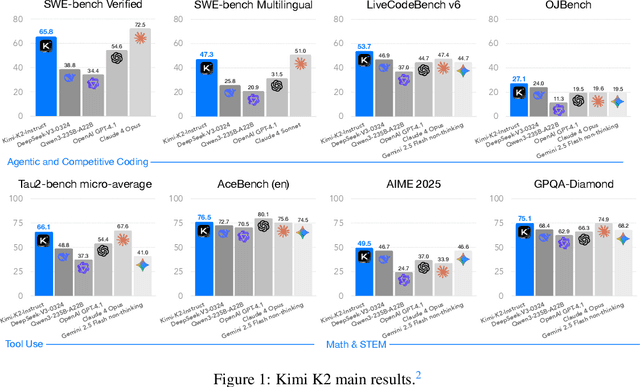
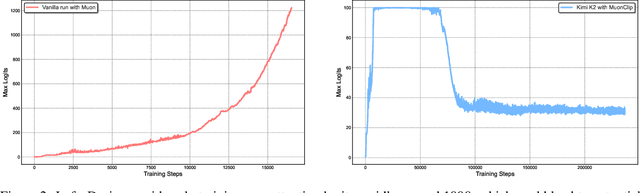
We introduce Kimi K2, a Mixture-of-Experts (MoE) large language model with 32 billion activated parameters and 1 trillion total parameters. We propose the MuonClip optimizer, which improves upon Muon with a novel QK-clip technique to address training instability while enjoying the advanced token efficiency of Muon. Based on MuonClip, K2 was pre-trained on 15.5 trillion tokens with zero loss spike. During post-training, K2 undergoes a multi-stage post-training process, highlighted by a large-scale agentic data synthesis pipeline and a joint reinforcement learning (RL) stage, where the model improves its capabilities through interactions with real and synthetic environments. Kimi K2 achieves state-of-the-art performance among open-source non-thinking models, with strengths in agentic capabilities. Notably, K2 obtains 66.1 on Tau2-Bench, 76.5 on ACEBench (En), 65.8 on SWE-Bench Verified, and 47.3 on SWE-Bench Multilingual -- surpassing most open and closed-sourced baselines in non-thinking settings. It also exhibits strong capabilities in coding, mathematics, and reasoning tasks, with a score of 53.7 on LiveCodeBench v6, 49.5 on AIME 2025, 75.1 on GPQA-Diamond, and 27.1 on OJBench, all without extended thinking. These results position Kimi K2 as one of the most capable open-source large language models to date, particularly in software engineering and agentic tasks. We release our base and post-trained model checkpoints to facilitate future research and applications of agentic intelligence.
Kimina-Prover Preview: Towards Large Formal Reasoning Models with Reinforcement Learning
Apr 15, 2025We introduce Kimina-Prover Preview, a large language model that pioneers a novel reasoning-driven exploration paradigm for formal theorem proving, as showcased in this preview release. Trained with a large-scale reinforcement learning pipeline from Qwen2.5-72B, Kimina-Prover demonstrates strong performance in Lean 4 proof generation by employing a structured reasoning pattern we term \textit{formal reasoning pattern}. This approach allows the model to emulate human problem-solving strategies in Lean, iteratively generating and refining proof steps. Kimina-Prover sets a new state-of-the-art on the miniF2F benchmark, reaching 80.7% with pass@8192. Beyond improved benchmark performance, our work yields several key insights: (1) Kimina-Prover exhibits high sample efficiency, delivering strong results even with minimal sampling (pass@1) and scaling effectively with computational budget, stemming from its unique reasoning pattern and RL training; (2) we demonstrate clear performance scaling with model size, a trend previously unobserved for neural theorem provers in formal mathematics; (3) the learned reasoning style, distinct from traditional search algorithms, shows potential to bridge the gap between formal verification and informal mathematical intuition. We open source distilled versions with 1.5B and 7B parameters of Kimina-Prover
Kimi-VL Technical Report
Apr 10, 2025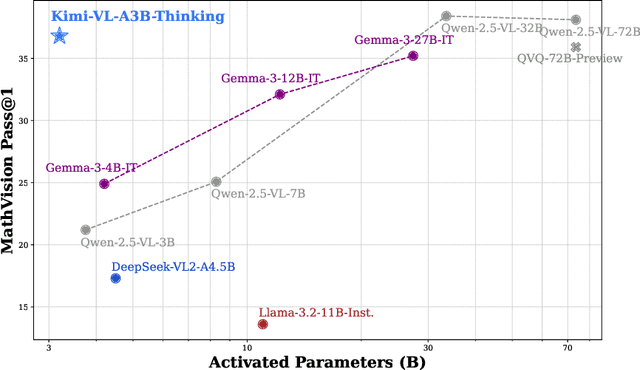
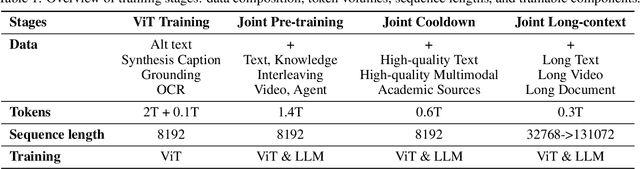
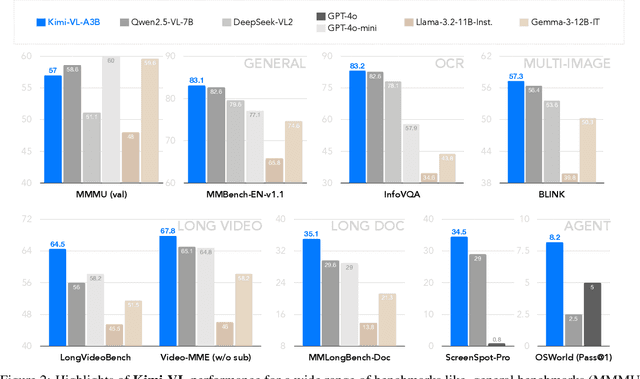

We present Kimi-VL, an efficient open-source Mixture-of-Experts (MoE) vision-language model (VLM) that offers advanced multimodal reasoning, long-context understanding, and strong agent capabilities - all while activating only 2.8B parameters in its language decoder (Kimi-VL-A3B). Kimi-VL demonstrates strong performance across challenging domains: as a general-purpose VLM, Kimi-VL excels in multi-turn agent tasks (e.g., OSWorld), matching flagship models. Furthermore, it exhibits remarkable capabilities across diverse challenging vision language tasks, including college-level image and video comprehension, OCR, mathematical reasoning, and multi-image understanding. In comparative evaluations, it effectively competes with cutting-edge efficient VLMs such as GPT-4o-mini, Qwen2.5-VL-7B, and Gemma-3-12B-IT, while surpassing GPT-4o in several key domains. Kimi-VL also advances in processing long contexts and perceiving clearly. With a 128K extended context window, Kimi-VL can process diverse long inputs, achieving impressive scores of 64.5 on LongVideoBench and 35.1 on MMLongBench-Doc. Its native-resolution vision encoder, MoonViT, further allows it to see and understand ultra-high-resolution visual inputs, achieving 83.2 on InfoVQA and 34.5 on ScreenSpot-Pro, while maintaining lower computational cost for common tasks. Building upon Kimi-VL, we introduce an advanced long-thinking variant: Kimi-VL-Thinking. Developed through long chain-of-thought (CoT) supervised fine-tuning (SFT) and reinforcement learning (RL), this model exhibits strong long-horizon reasoning capabilities. It achieves scores of 61.7 on MMMU, 36.8 on MathVision, and 71.3 on MathVista while maintaining the compact 2.8B activated LLM parameters, setting a new standard for efficient multimodal thinking models. Code and models are publicly accessible at https://github.com/MoonshotAI/Kimi-VL.
Spiking Vision Transformer with Saccadic Attention
Feb 18, 2025
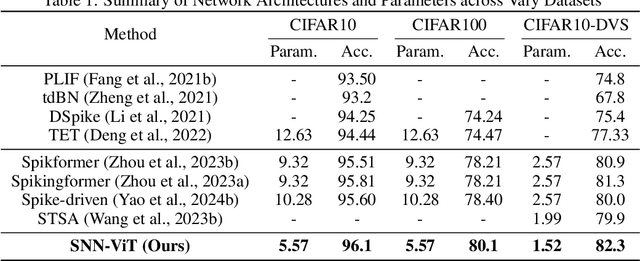
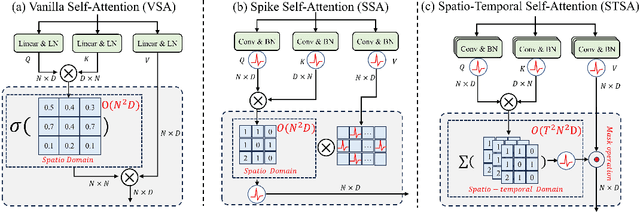
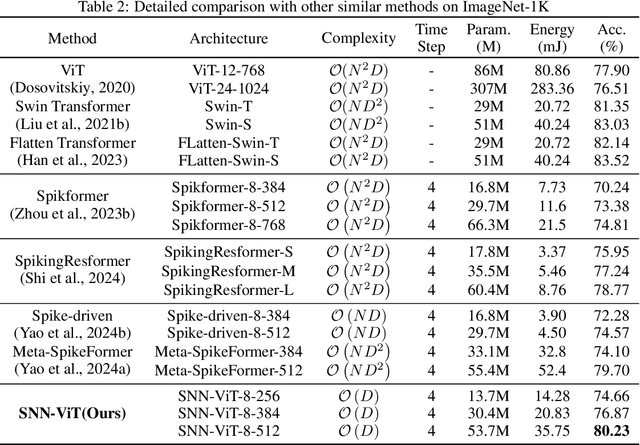
The combination of Spiking Neural Networks (SNNs) and Vision Transformers (ViTs) holds potential for achieving both energy efficiency and high performance, particularly suitable for edge vision applications. However, a significant performance gap still exists between SNN-based ViTs and their ANN counterparts. Here, we first analyze why SNN-based ViTs suffer from limited performance and identify a mismatch between the vanilla self-attention mechanism and spatio-temporal spike trains. This mismatch results in degraded spatial relevance and limited temporal interactions. To address these issues, we draw inspiration from biological saccadic attention mechanisms and introduce an innovative Saccadic Spike Self-Attention (SSSA) method. Specifically, in the spatial domain, SSSA employs a novel spike distribution-based method to effectively assess the relevance between Query and Key pairs in SNN-based ViTs. Temporally, SSSA employs a saccadic interaction module that dynamically focuses on selected visual areas at each timestep and significantly enhances whole scene understanding through temporal interactions. Building on the SSSA mechanism, we develop a SNN-based Vision Transformer (SNN-ViT). Extensive experiments across various visual tasks demonstrate that SNN-ViT achieves state-of-the-art performance with linear computational complexity. The effectiveness and efficiency of the SNN-ViT highlight its potential for power-critical edge vision applications.