 Add to Chrome
 Add to Firefox
 Add to Edge
Dual Fluid Antenna-Assisted UAV MU-MIMO Networks
Jul 06, 2026
Fluid Antennas (FAs)-assisted Unmanned Aerial Vehicle (UAV) networks leverage the FA position adaptivity and flexible beamforming to overcome the limitations of Fixed-Positioned Antennas (FPAs) in dynamic UAV channels and Multi-User (MU) interference. This letter investigates a dual FA-assisted UAV network for MU-Multiple-Input-Multiple-Output (MIMO) downlink communications, aiming to maximize the average achievable rate through the joint optimization of UAV trajectory, the transmit/receive FA positions, and beamforming. The formulated problem is highly coupled and non-convex. Accordingly, an efficient Alternating Optimization (AO)-based algorithm is developed for decomposed subproblems, yielding a suboptimal solution. Numerical results demonstrate significant performance gains of 120% and 110% over conventional FPA-based and existing FA-based baselines, respectively.

Adapting Diffusion Language Models for Lossless Pixel-Level Image Transmission
Jun 04, 2026Lossless pixel-level image transmission is a fundamental regime beyond semantic communications, because exact recovery requires both accurate symbol probability modeling and reliable delivery over noisy channels. This paper proposes DDM-SSCC, a discrete-diffusion-model-based separate source-channel coding framework for lossless image transmission. Different from raster-order autoregressive coding, the proposed source codec adapts a diffusion language model to pixel-token restoration and performs synchronized reverse arithmetic coding under bidirectional attention, allowing multiple masked tokens to be coded within one reverse denoising step. This progressive restoration process also yields a more favorable source representation for noisy transmission, since newly restored tokens can serve as bidirectional context in subsequent denoising steps. To bridge the gap between generation-oriented masked denoising and lossless arithmetic coding, we further introduce a Halton-guided denoising order, a mask-ratio-aware cosine schedule, and a lightweight temperature calibration module. These designs respectively improve spatial coverage, adapt the denoising pace to context reliability, and calibrate the probability tables used by arithmetic coding. Experiments on CIFAR10, DIV2K-LR-X4, and Kodak over additive white Gaussian noise and Rayleigh fading channels show that DDM-SSCC achieves better exact-recovery performance than representative lossless and semantic communication baselines, while ablation studies verify the effectiveness of the proposed denoising order, schedule, and calibration modules.
Separate Source Channel Coding Is Still What You Need: An LLM-based Rethinking
Jan 08, 2025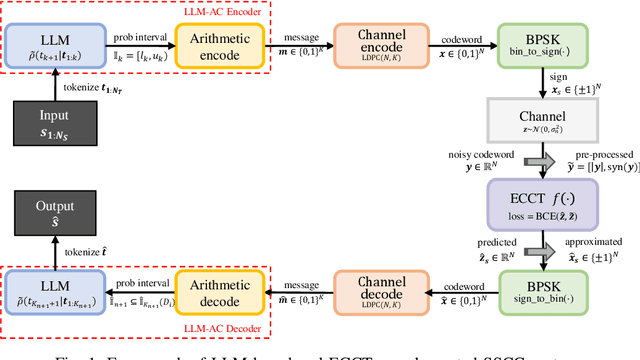
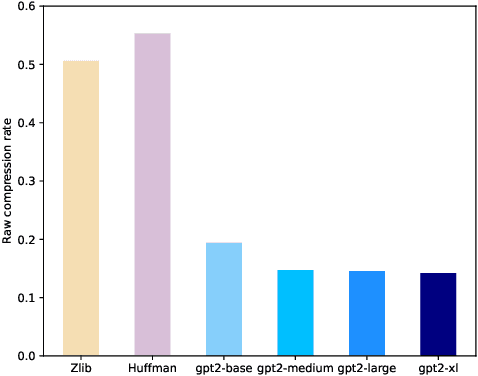

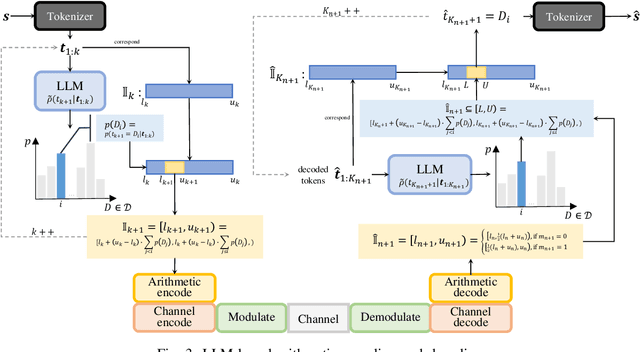
Along with the proliferating research interest in Semantic Communication (SemCom), Joint Source Channel Coding (JSCC) has dominated the attention due to the widely assumed existence in efficiently delivering information semantics. %has emerged as a pivotal area of research, aiming to enhance the efficiency and reliability of information transmission through deep learning-based methods. Nevertheless, this paper challenges the conventional JSCC paradigm, and advocates for adoption of Separate Source Channel Coding (SSCC) to enjoy the underlying more degree of freedom for optimization. We demonstrate that SSCC, after leveraging the strengths of Large Language Model (LLM) for source coding and Error Correction Code Transformer (ECCT) complemented for channel decoding, offers superior performance over JSCC. Our proposed framework also effectively highlights the compatibility challenges between SemCom approaches and digital communication systems, particularly concerning the resource costs associated with the transmission of high precision floating point numbers. Through comprehensive evaluations, we establish that empowered by LLM-based compression and ECCT-enhanced error correction, SSCC remains a viable and effective solution for modern communication systems. In other words, separate source and channel coding is still what we need!
Communication and Control Co-Design in 6G: Sequential Decision-Making with LLMs
Jul 06, 2024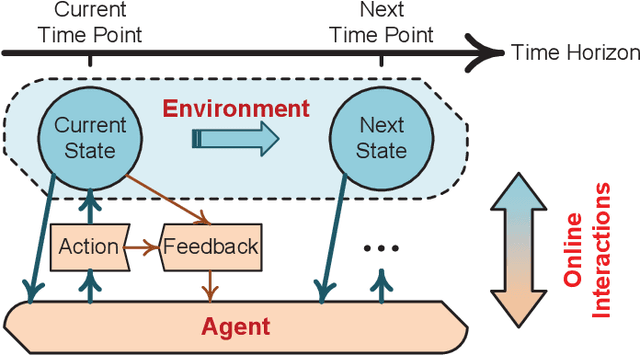
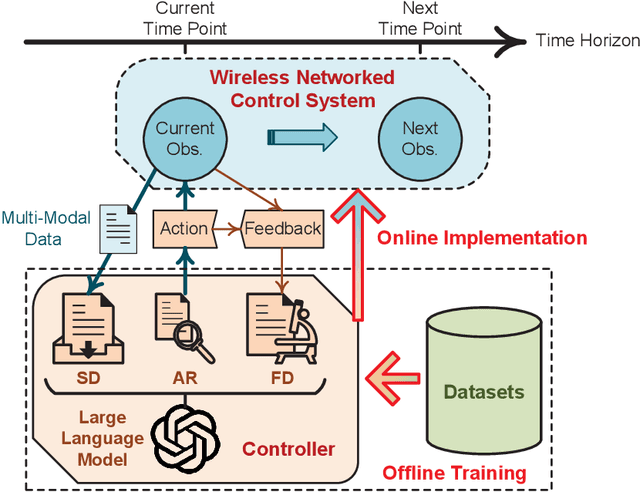
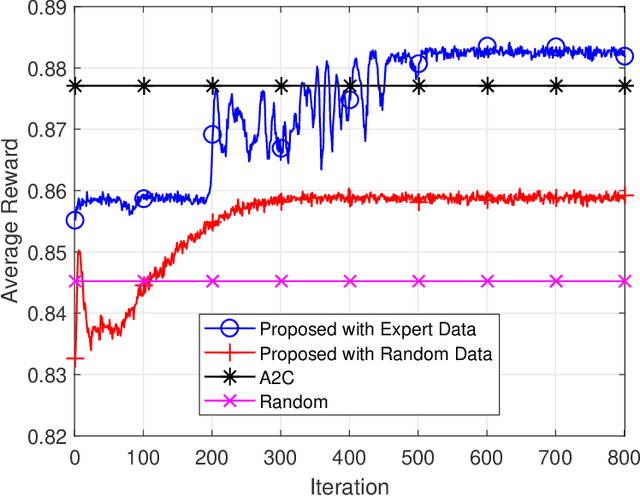
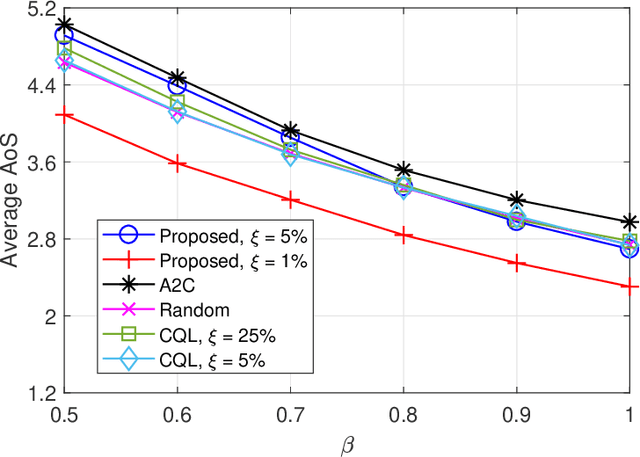
This article investigates a control system within the context of six-generation wireless networks. The control performance optimization confronts the technical challenges that arise from the intricate interactions between communication and control sub-systems, asking for a co-design. Accounting for the system dynamics, we formulate the sequential co-design decision-makings of communication and control over the discrete time horizon as a Markov decision process, for which a practical offline learning framework is proposed. Our proposed framework integrates large language models into the elements of reinforcement learning. We present a case study on the age of semantics-aware communication and control co-design to showcase the potentials from our proposed learning framework. Furthermore, we discuss the open issues remaining to make our proposed offline learning framework feasible for real-world implementations, and highlight the research directions for future explorations.
Rethinking Collaborative Perception from the Spatial-Temporal Importance of Semantic Information
Jul 31, 2023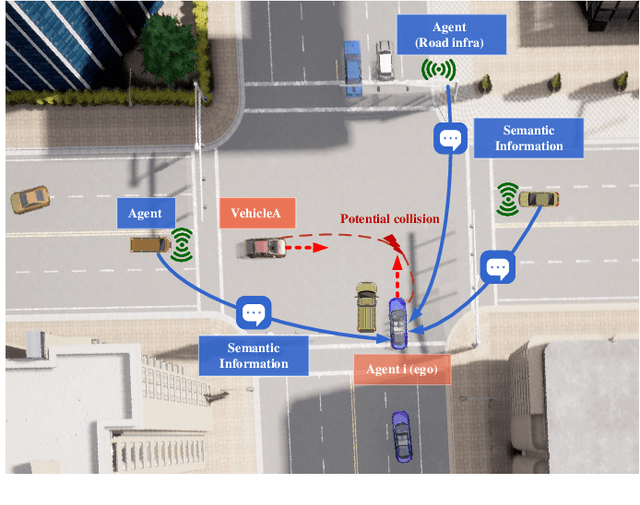
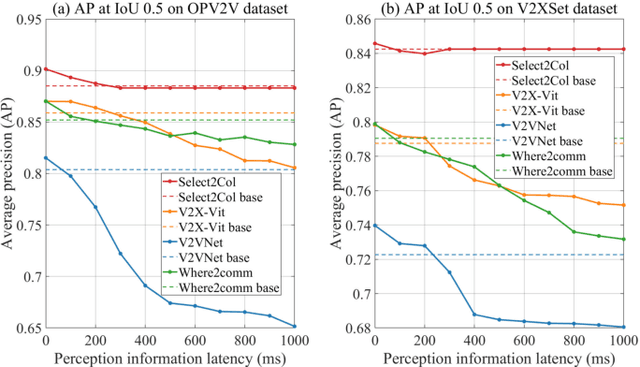
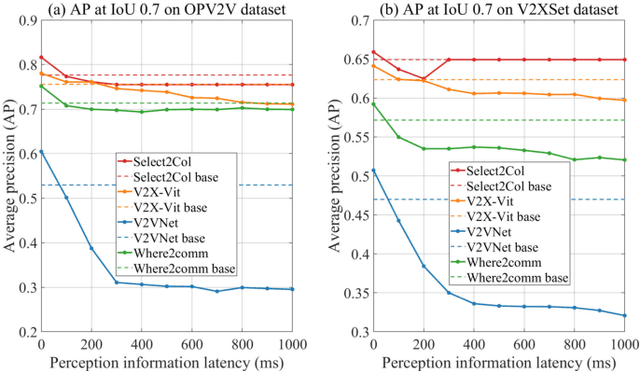
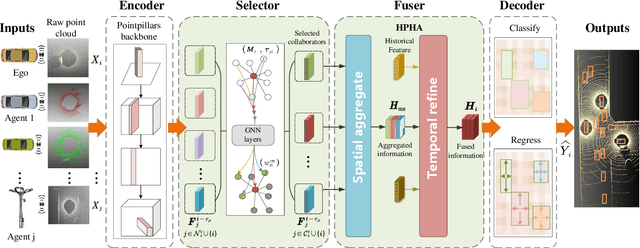
Collaboration by the sharing of semantic information is crucial to enable the enhancement of perception capabilities. However, existing collaborative perception methods tend to focus solely on the spatial features of semantic information, while neglecting the importance of the temporal dimension in collaborator selection and semantic information fusion, which instigates performance degradation. In this article, we propose a novel collaborative perception framework, IoSI-CP, which takes into account the importance of semantic information (IoSI) from both temporal and spatial dimensions. Specifically, we develop an IoSI-based collaborator selection method that effectively identifies advantageous collaborators but excludes those that bring negative benefits. Moreover, we present a semantic information fusion algorithm called HPHA (historical prior hybrid attention), which integrates a multi-scale transformer module and a short-term attention module to capture IoSI from spatial and temporal dimensions, and assigns varying weights for efficient aggregation. Extensive experiments on two open datasets demonstrate that our proposed IoSI-CP significantly improves the perception performance compared to state-of-the-art approaches. The code associated with this research is publicly available at https://github.com/huangqzj/IoSI-CP/.
Semantics-enhanced Temporal Graph Networks for Content Caching and Energy Saving
Feb 02, 2023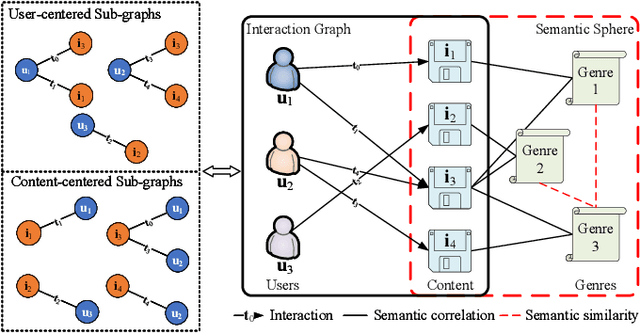
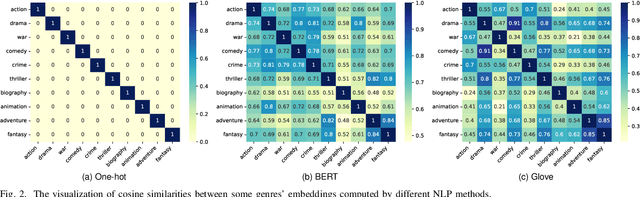
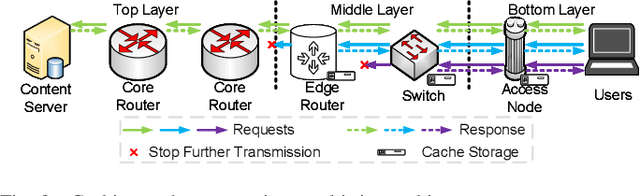
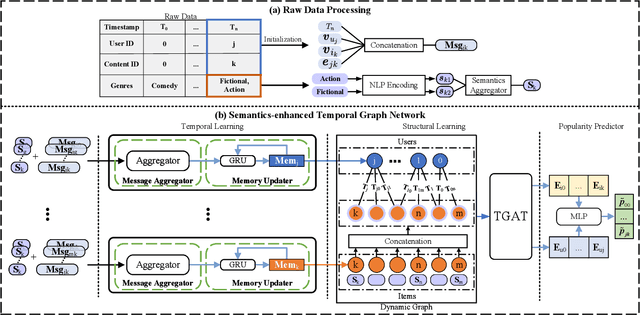
The enormous amount of network equipment and users implies a tremendous growth of Internet traffic for multimedia services. To mitigate the traffic pressure, architectures with in-network storage are proposed to cache popular content at nodes in close proximity to users to shorten the backhaul links. Meanwhile, the reduction of transmission distance also contributes to the energy saving. However, due to limited storage, only a fraction of the content can be cached, while caching the most popular content is cost-effective. Correspondingly, it becomes essential to devise an effective popularity prediction method. In this regard, existing efforts adopt dynamic graph neural network (DGNN) models, but it remains challenging to tackle sparse datasets. In this paper, we first propose a reformative temporal graph network, which is named STGN, that utilizes extra semantic messages to enhance the temporal and structural learning of a DGNN model, since the consideration of semantics can help establish implicit paths within the sparse interaction graph and hence improve the prediction performance. Furthermore, we propose a user-specific attention mechanism to fine-grainedly aggregate various semantics. Finally, extensive simulations verify the superiority of our STGN models and demonstrate their high potential in energy-saving.
Adversarial Learning for Implicit Semantic-Aware Communications
Jan 27, 2023Semantic communication is a novel communication paradigm that focuses on recognizing and delivering the desired meaning of messages to the destination users. Most existing works in this area focus on delivering explicit semantics, labels or signal features that can be directly identified from the source signals. In this paper, we consider the implicit semantic communication problem in which hidden relations and closely related semantic terms that cannot be recognized from the source signals need to also be delivered to the destination user. We develop a novel adversarial learning-based implicit semantic-aware communication (iSAC) architecture in which the source user, instead of maximizing the total amount of information transmitted to the channel, aims to help the recipient learn an inference rule that can automatically generate implicit semantics based on limited clue information. We prove that by applying iSAC, the destination user can always learn an inference rule that matches the true inference rule of the source messages. Experimental results show that the proposed iSAC can offer up to a 19.69 dB improvement over existing non-inferential communication solutions, in terms of symbol error rate at the destination user.
Semantics-Empowered Communication: A Tutorial-cum-Survey
Dec 21, 2022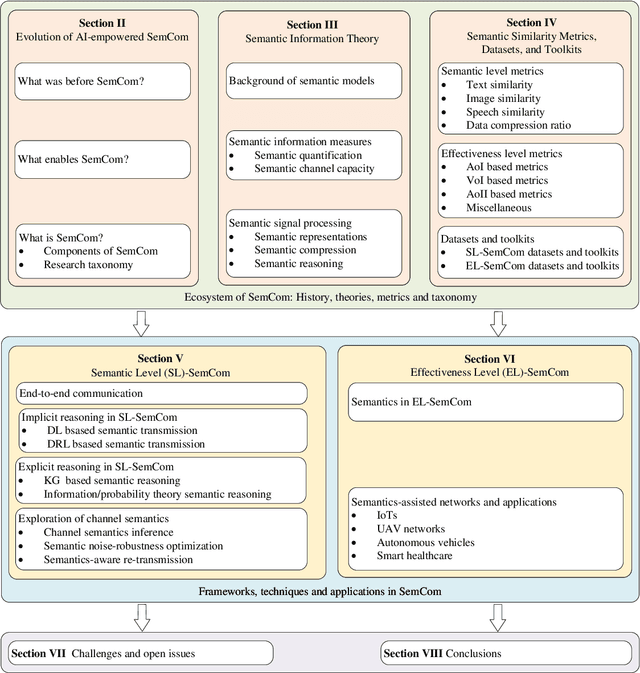


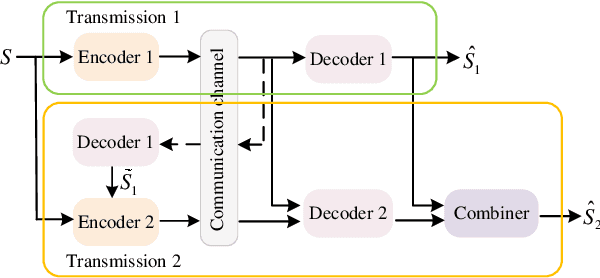
Along with the springing up of semantics-empowered communication (SemCom) researches, it is now witnessing an unprecedentedly growing interest towards a wide range of aspects (e.g., theories, applications, metrics and implementations) in both academia and industry. In this work, we primarily aim to provide a comprehensive survey on both the background and research taxonomy, as well as a detailed technical tutorial. Specifically, we start by reviewing the literature and answering the "what" and "why" questions in semantic transmissions. Afterwards, we present corresponding ecosystems, including theories, metrics, datasets and toolkits, on top of which the taxonomy for research directions is presented. Furthermore, we propose to categorize the critical enabling techniques by explicit and implicit reasoning-based methods, and elaborate on how they evolve and contribute to modern content \& channel semantics-empowered communications. Besides reviewing and summarizing the latest efforts in SemCom, we discuss the relations with other communication levels (e.g., reliable and goal-oriented communications) from a holistic and unified viewpoint. Subsequently, in order to facilitate the future developments and industrial applications, we also highlight advanced practical techniques for boosting semantic accuracy, robustness, and large-scale scalability, just to mention a few. Finally, we discuss the technical challenges that shed light on future research opportunities.
Age of Semantics in Cooperative Communications: To Expedite Simulation Towards Real via Offline Reinforcement Learning
Sep 19, 2022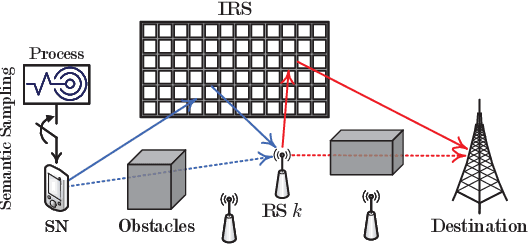
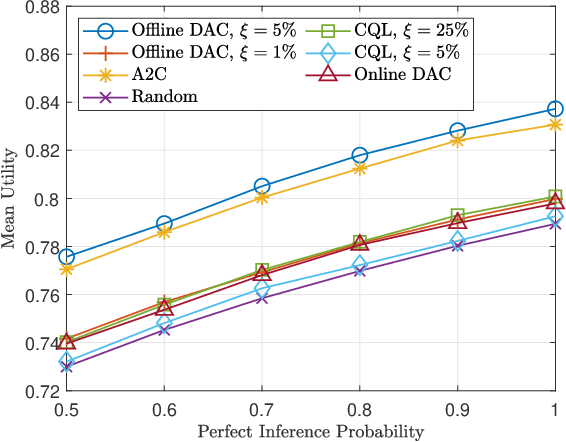
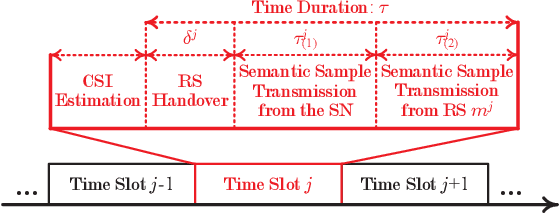
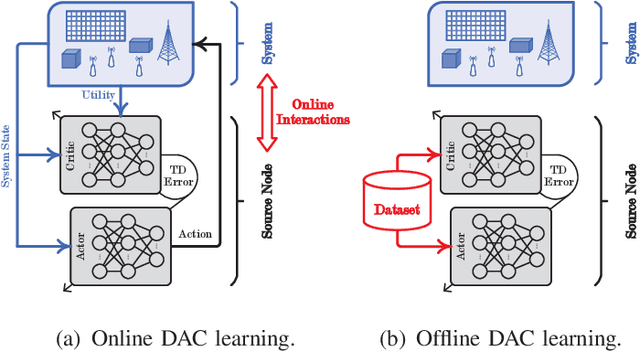
The age of information metric fails to correctly describe the intrinsic semantics of a status update. In an intelligent reflecting surface-aided cooperative relay communication system, we propose the age of semantics (AoS) for measuring semantics freshness of the status updates. Specifically, we focus on the status updating from a source node (SN) to the destination, which is formulated as a Markov decision process (MDP). The objective of the SN is to maximize the expected satisfaction of AoS and energy consumption under the maximum transmit power constraint. To seek the optimal control policy, we first derive an online deep actor-critic (DAC) learning scheme under the on-policy temporal difference learning framework. However, implementing the online DAC in practice poses the key challenge in infinitely repeated interactions between the SN and the system, which can be dangerous particularly during the exploration. We then put forward a novel offline DAC scheme, which estimates the optimal control policy from a previously collected dataset without any further interactions with the system. Numerical experiments verify the theoretical results and show that our offline DAC scheme significantly outperforms the online DAC scheme and the most representative baselines in terms of mean utility, demonstrating strong robustness to dataset quality.
Time-Critical Tasks Implementation in MEC based Multi-Robot Cooperation Systems
Nov 22, 2021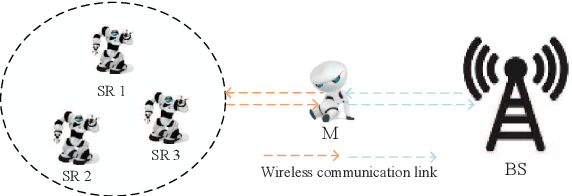
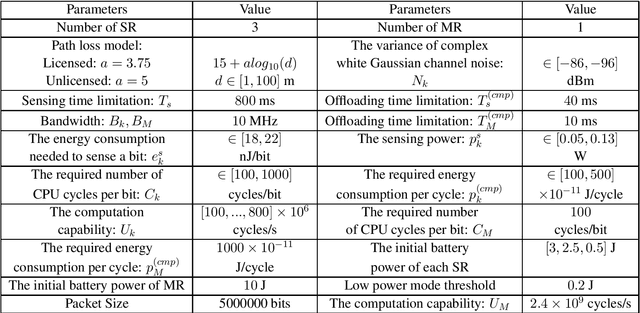
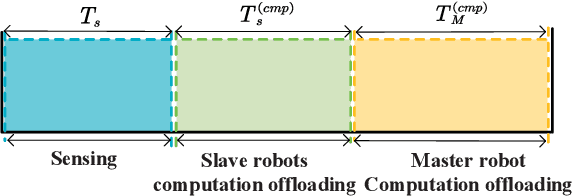
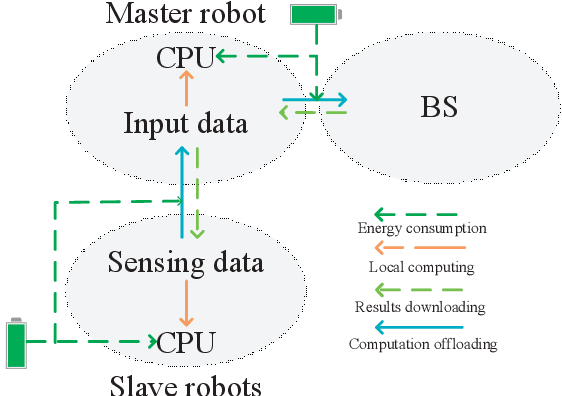
Mobile edge computing (MEC) deployment in a multi-robot cooperation (MRC) system is an effective way to accomplish the tasks in terms of energy consumption and implementation latency. However, the computation and communication resources need to be considered jointly to fully exploit the advantages brought by the MEC technology. In this paper, the scenario where multi robots cooperate to accomplish the time-critical tasks is studied, where an intelligent master robot (MR) acts as an edge server to provide services to multiple slave robots (SRs) and the SRs are responsible for the environment sensing and data collection. To save energy and prolong the function time of the system, two schemes are proposed to optimize the computation and communication resources, respectively. In the first scheme, the energy consumption of SRs is minimized and balanced while guaranteeing that the tasks are accomplished under a time constraint. In the second scheme, not only the energy consumption, but also the remaining energies of the SRs are considered to enhance the robustness of the system. Through the analysis and numerical simulations, we demonstrate that even though the first policy may guarantee the minimization on the total SRs' energy consumption, the function time of MRC system by the second scheme is longer than that by the first one.