 Add to Chrome
 Add to Firefox
 Add to Edge
Imagine the Unseen: Occluded Pedestrian Detection via Adversarial Feature Completion
May 02, 2024
Pedestrian detection has significantly progressed in recent years, thanks to the development of DNNs. However, detection performance at occluded scenes is still far from satisfactory, as occlusion increases the intra-class variance of pedestrians, hindering the model from finding an accurate classification boundary between pedestrians and background clutters. From the perspective of reducing intra-class variance, we propose to complete features for occluded regions so as to align the features of pedestrians across different occlusion patterns. An important premise for feature completion is to locate occluded regions. From our analysis, channel features of different pedestrian proposals only show high correlation values at visible parts and thus feature correlations can be used to model occlusion patterns. In order to narrow down the gap between completed features and real fully visible ones, we propose an adversarial learning method, which completes occluded features with a generator such that they can hardly be distinguished by the discriminator from real fully visible features. We report experimental results on the CityPersons, Caltech and CrowdHuman datasets. On CityPersons, we show significant improvements over five different baseline detectors, especially on the heavy occlusion subset. Furthermore, we show that our proposed method FeatComp++ achieves state-of-the-art results on all the above three datasets without relying on extra cues.

Probing Unlearned Diffusion Models: A Transferable Adversarial Attack Perspective
Apr 30, 2024


Advanced text-to-image diffusion models raise safety concerns regarding identity privacy violation, copyright infringement, and Not Safe For Work content generation. Towards this, unlearning methods have been developed to erase these involved concepts from diffusion models. However, these unlearning methods only shift the text-to-image mapping and preserve the visual content within the generative space of diffusion models, leaving a fatal flaw for restoring these erased concepts. This erasure trustworthiness problem needs probe, but previous methods are sub-optimal from two perspectives: (1) Lack of transferability: Some methods operate within a white-box setting, requiring access to the unlearned model. And the learned adversarial input often fails to transfer to other unlearned models for concept restoration; (2) Limited attack: The prompt-level methods struggle to restore narrow concepts from unlearned models, such as celebrity identity. Therefore, this paper aims to leverage the transferability of the adversarial attack to probe the unlearning robustness under a black-box setting. This challenging scenario assumes that the unlearning method is unknown and the unlearned model is inaccessible for optimization, requiring the attack to be capable of transferring across different unlearned models. Specifically, we employ an adversarial search strategy to search for the adversarial embedding which can transfer across different unlearned models. This strategy adopts the original Stable Diffusion model as a surrogate model to iteratively erase and search for embeddings, enabling it to find the embedding that can restore the target concept for different unlearning methods. Extensive experiments demonstrate the transferability of the searched adversarial embedding across several state-of-the-art unlearning methods and its effectiveness for different levels of concepts.
LLM-Enhanced Causal Discovery in Temporal Domain from Interventional Data
Apr 23, 2024In the field of Artificial Intelligence for Information Technology Operations, causal discovery is pivotal for operation and maintenance of graph construction, facilitating downstream industrial tasks such as root cause analysis. Temporal causal discovery, as an emerging method, aims to identify temporal causal relationships between variables directly from observations by utilizing interventional data. However, existing methods mainly focus on synthetic datasets with heavy reliance on intervention targets and ignore the textual information hidden in real-world systems, failing to conduct causal discovery for real industrial scenarios. To tackle this problem, in this paper we propose to investigate temporal causal discovery in industrial scenarios, which faces two critical challenges: 1) how to discover causal relationships without the interventional targets that are costly to obtain in practice, and 2) how to discover causal relations via leveraging the textual information in systems which can be complex yet abundant in industrial contexts. To address these challenges, we propose the RealTCD framework, which is able to leverage domain knowledge to discover temporal causal relationships without interventional targets. Specifically, we first develop a score-based temporal causal discovery method capable of discovering causal relations for root cause analysis without relying on interventional targets through strategic masking and regularization. Furthermore, by employing Large Language Models (LLMs) to handle texts and integrate domain knowledge, we introduce LLM-guided meta-initialization to extract the meta-knowledge from textual information hidden in systems to boost the quality of discovery. We conduct extensive experiments on simulation and real-world datasets to show the superiority of our proposed RealTCD framework over existing baselines in discovering temporal causal structures.
TextSquare: Scaling up Text-Centric Visual Instruction Tuning
Apr 19, 2024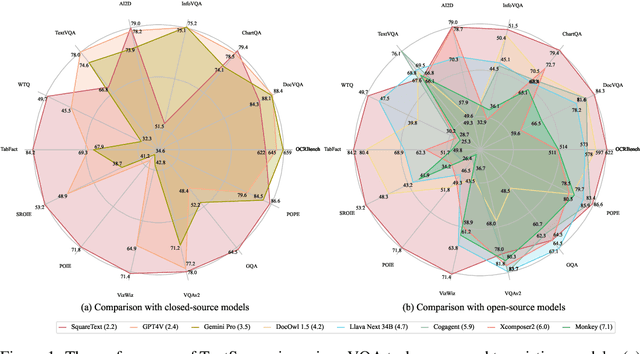
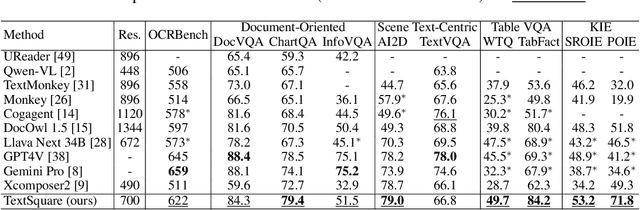
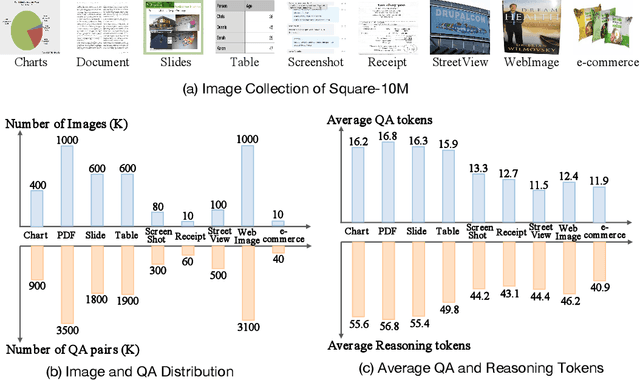
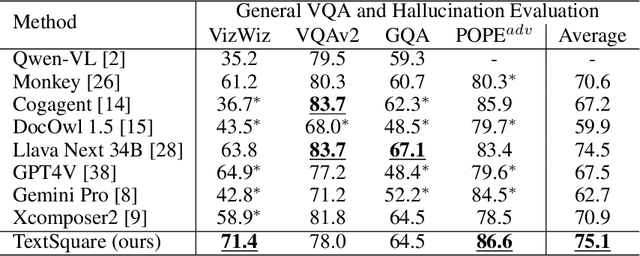
Text-centric visual question answering (VQA) has made great strides with the development of Multimodal Large Language Models (MLLMs), yet open-source models still fall short of leading models like GPT4V and Gemini, partly due to a lack of extensive, high-quality instruction tuning data. To this end, we introduce a new approach for creating a massive, high-quality instruction-tuning dataset, Square-10M, which is generated using closed-source MLLMs. The data construction process, termed Square, consists of four steps: Self-Questioning, Answering, Reasoning, and Evaluation. Our experiments with Square-10M led to three key findings: 1) Our model, TextSquare, considerably surpasses open-source previous state-of-the-art Text-centric MLLMs and sets a new standard on OCRBench(62.2%). It even outperforms top-tier models like GPT4V and Gemini in 6 of 10 text-centric benchmarks. 2) Additionally, we demonstrate the critical role of VQA reasoning data in offering comprehensive contextual insights for specific questions. This not only improves accuracy but also significantly mitigates hallucinations. Specifically, TextSquare scores an average of 75.1% across four general VQA and hallucination evaluation datasets, outperforming previous state-of-the-art models. 3) Notably, the phenomenon observed in scaling text-centric VQA datasets reveals a vivid pattern: the exponential increase of instruction tuning data volume is directly proportional to the improvement in model performance, thereby validating the necessity of the dataset scale and the high quality of Square-10M.
Counterfactual Explanations for Face Forgery Detection via Adversarial Removal of Artifacts
Apr 12, 2024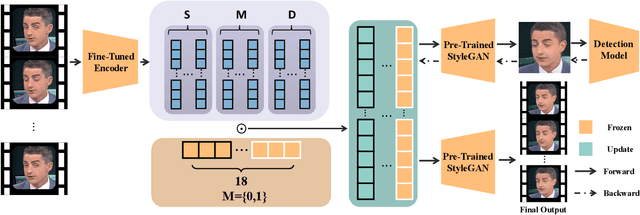
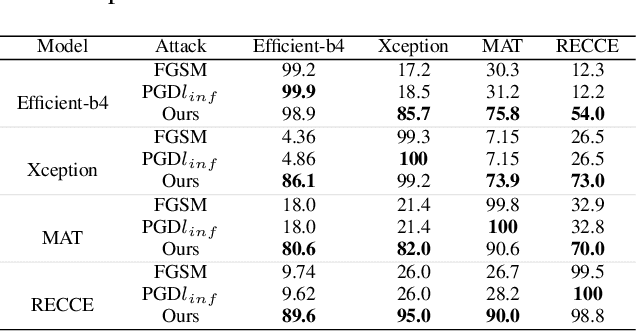
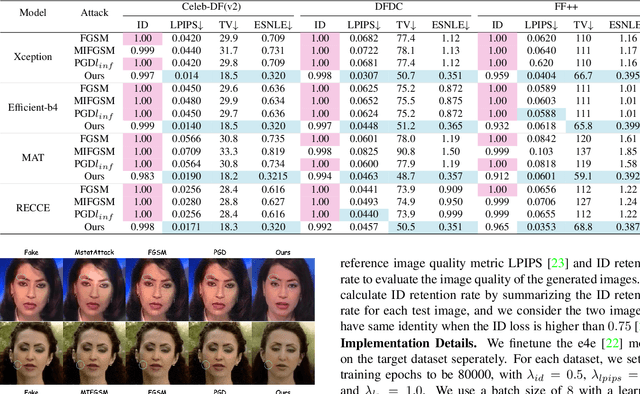
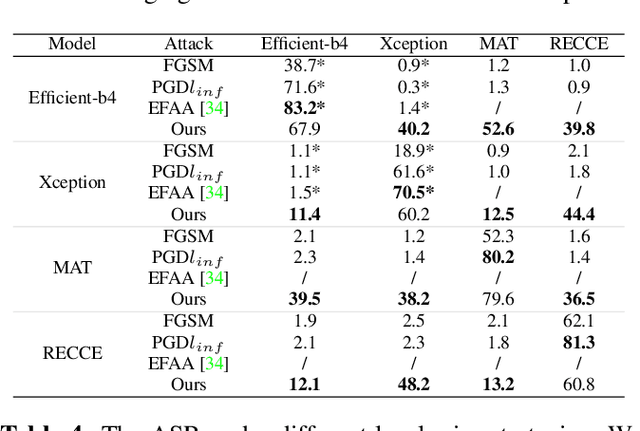
Highly realistic AI generated face forgeries known as deepfakes have raised serious social concerns. Although DNN-based face forgery detection models have achieved good performance, they are vulnerable to latest generative methods that have less forgery traces and adversarial attacks. This limitation of generalization and robustness hinders the credibility of detection results and requires more explanations. In this work, we provide counterfactual explanations for face forgery detection from an artifact removal perspective. Specifically, we first invert the forgery images into the StyleGAN latent space, and then adversarially optimize their latent representations with the discrimination supervision from the target detection model. We verify the effectiveness of the proposed explanations from two aspects: (1) Counterfactual Trace Visualization: the enhanced forgery images are useful to reveal artifacts by visually contrasting the original images and two different visualization methods; (2) Transferable Adversarial Attacks: the adversarial forgery images generated by attacking the detection model are able to mislead other detection models, implying the removed artifacts are general. Extensive experiments demonstrate that our method achieves over 90% attack success rate and superior attack transferability. Compared with naive adversarial noise methods, our method adopts both generative and discriminative model priors, and optimize the latent representations in a synthesis-by-analysis way, which forces the search of counterfactual explanations on the natural face manifold. Thus, more general counterfactual traces can be found and better adversarial attack transferability can be achieved.
PagPassGPT: Pattern Guided Password Guessing via Generative Pretrained Transformer
Apr 07, 2024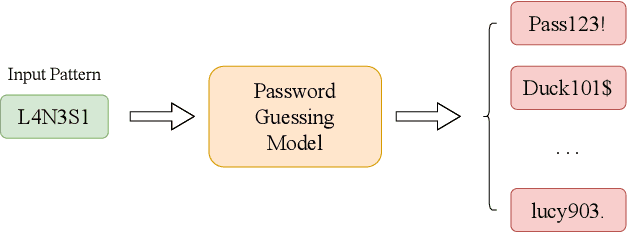
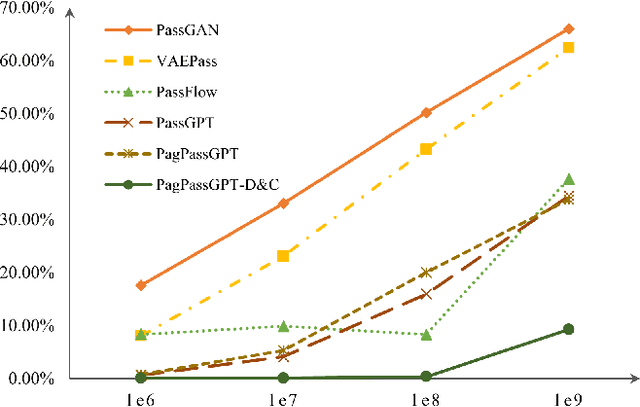
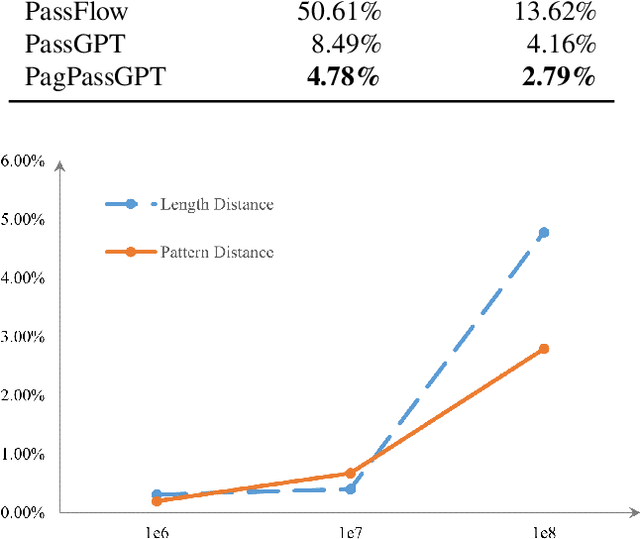
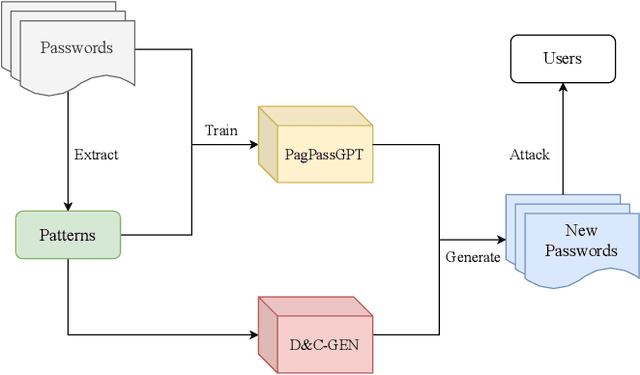
Amidst the surge in deep learning-based password guessing models, challenges of generating high-quality passwords and reducing duplicate passwords persist. To address these challenges, we present PagPassGPT, a password guessing model constructed on Generative Pretrained Transformer (GPT). It can perform pattern guided guessing by incorporating pattern structure information as background knowledge, resulting in a significant increase in the hit rate. Furthermore, we propose D&C-GEN to reduce the repeat rate of generated passwords, which adopts the concept of a divide-and-conquer approach. The primary task of guessing passwords is recursively divided into non-overlapping subtasks. Each subtask inherits the knowledge from the parent task and predicts succeeding tokens. In comparison to the state-of-the-art model, our proposed scheme exhibits the capability to correctly guess 12% more passwords while producing 25% fewer duplicates.
FusionINN: Invertible Image Fusion for Brain Tumor Monitoring
Apr 02, 2024Image fusion typically employs non-invertible neural networks to merge multiple source images into a single fused image. However, for clinical experts, solely relying on fused images may be insufficient for making diagnostic decisions, as the fusion mechanism blends features from source images, thereby making it difficult to interpret the underlying tumor pathology. We introduce FusionINN, a novel invertible image fusion framework, capable of efficiently generating fused images and also decomposing them back to the source images by solving the inverse of the fusion process. FusionINN guarantees lossless one-to-one pixel mapping by integrating a normally distributed latent image alongside the fused image to facilitate the generative modeling of the decomposition process. To the best of our knowledge, we are the first to investigate the decomposability of fused images, which is particularly crucial for life-sensitive applications such as medical image fusion compared to other tasks like multi-focus or multi-exposure image fusion. Our extensive experimentation validates FusionINN over existing discriminative and generative fusion methods, both subjectively and objectively. Moreover, compared to a recent denoising diffusion-based fusion model, our approach offers faster and qualitatively better fusion results. We also exhibit the clinical utility of our results in aiding disease prognosis.
TableLLM: Enabling Tabular Data Manipulation by LLMs in Real Office Usage Scenarios
Apr 01, 2024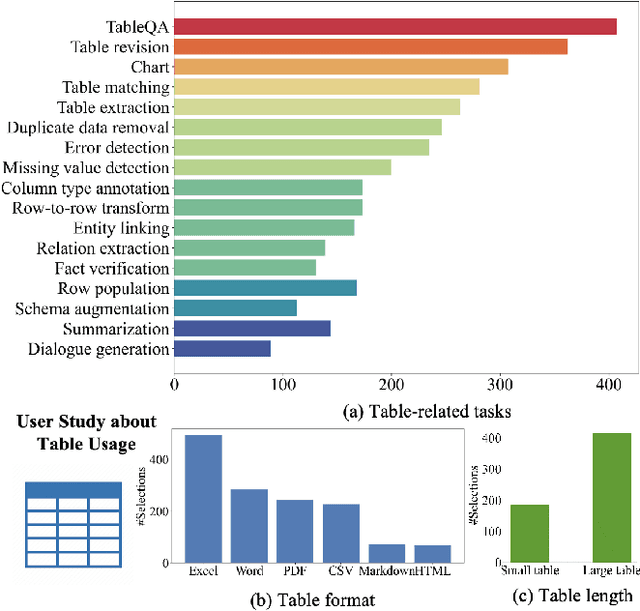
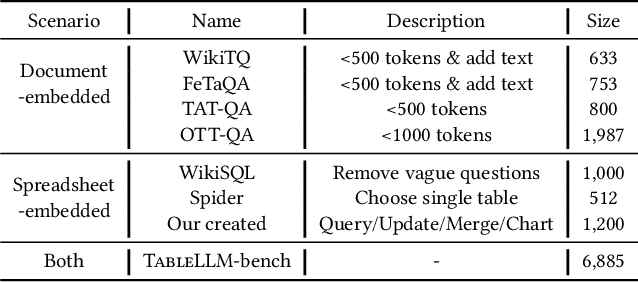
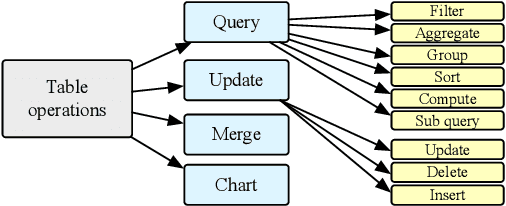
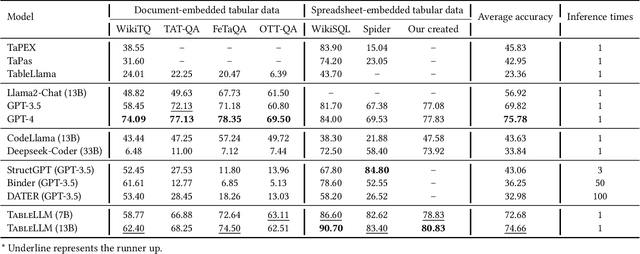
We introduce TableLLM, a robust large language model (LLM) with 13 billion parameters, purpose-built for proficiently handling tabular data manipulation tasks, whether they are embedded within documents or spreadsheets, catering to real-world office scenarios. We propose a distant supervision method for training, which comprises a reasoning process extension strategy, aiding in training LLMs to understand reasoning patterns more effectively as well as a cross-way validation strategy, ensuring the quality of the automatically generated data. To evaluate the performance of TableLLM, we have crafted a benchmark tailored to address both document and spreadsheet formats as well as constructed a well-organized evaluation pipeline capable of handling both scenarios. Thorough evaluations underscore the advantages of TableLLM when compared to various existing general-purpose and tabular data-focused LLMs. We have publicly released the model checkpoint, source code, benchmarks, and a web application for user interaction.Our codes and data are publicly available at https://github.com/TableLLM/TableLLM.
NeuSDFusion: A Spatial-Aware Generative Model for 3D Shape Completion, Reconstruction, and Generation
Mar 27, 2024


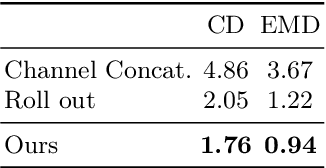
3D shape generation aims to produce innovative 3D content adhering to specific conditions and constraints. Existing methods often decompose 3D shapes into a sequence of localized components, treating each element in isolation without considering spatial consistency. As a result, these approaches exhibit limited versatility in 3D data representation and shape generation, hindering their ability to generate highly diverse 3D shapes that comply with the specified constraints. In this paper, we introduce a novel spatial-aware 3D shape generation framework that leverages 2D plane representations for enhanced 3D shape modeling. To ensure spatial coherence and reduce memory usage, we incorporate a hybrid shape representation technique that directly learns a continuous signed distance field representation of the 3D shape using orthogonal 2D planes. Additionally, we meticulously enforce spatial correspondences across distinct planes using a transformer-based autoencoder structure, promoting the preservation of spatial relationships in the generated 3D shapes. This yields an algorithm that consistently outperforms state-of-the-art 3D shape generation methods on various tasks, including unconditional shape generation, multi-modal shape completion, single-view reconstruction, and text-to-shape synthesis.
Frankenstein: Generating Semantic-Compositional 3D Scenes in One Tri-Plane
Mar 24, 2024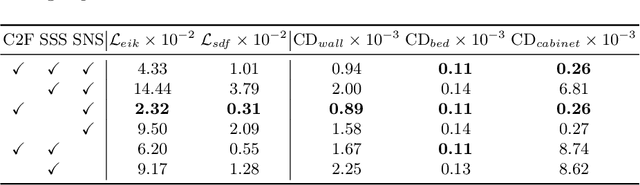
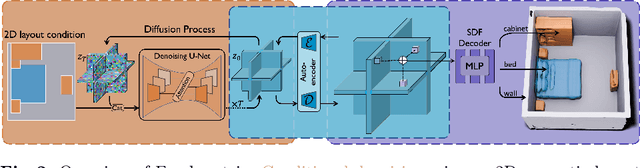


We present Frankenstein, a diffusion-based framework that can generate semantic-compositional 3D scenes in a single pass. Unlike existing methods that output a single, unified 3D shape, Frankenstein simultaneously generates multiple separated shapes, each corresponding to a semantically meaningful part. The 3D scene information is encoded in one single tri-plane tensor, from which multiple Singed Distance Function (SDF) fields can be decoded to represent the compositional shapes. During training, an auto-encoder compresses tri-planes into a latent space, and then the denoising diffusion process is employed to approximate the distribution of the compositional scenes. Frankenstein demonstrates promising results in generating room interiors as well as human avatars with automatically separated parts. The generated scenes facilitate many downstream applications, such as part-wise re-texturing, object rearrangement in the room or avatar cloth re-targeting.