 Add to Chrome
 Add to Firefox
 Add to Edge
Forgetting to Witness: Efficient Federated Unlearning and Its Visible Evaluation
Apr 06, 2026
With the increasing importance of data privacy and security, federated unlearning has emerged as a novel research field dedicated to ensuring that federated learning models no longer retain or leak relevant information once specific data has been deleted. In this paper, to the best of our knowledge, we propose the first complete pipeline for federated unlearning, which includes a federated unlearning approach and an evaluation framework. Our proposed federated unlearning approach ensures high efficiency and model accuracy without the need to store historical data.It effectively leverages the knowledge distillation model alongside various optimization mechanisms. Moreover, we propose a framework named Skyeye to visualize the forgetting capacity of federated unlearning models. It utilizes the federated unlearning model as the classifier integrated into a Generative Adversarial Network (GAN). Afterward, both the classifier and discriminator guide the generator in generating samples. Throughout this process, the generator learns from the classifier's knowledge. The generator then visualizes this knowledge through sample generation. Finally, the model's forgetting capability is evaluated based on the relevance between the deleted data and the generated samples. Comprehensive experiments are conducted to illustrate the effectiveness of the proposed federated unlearning approach and the corresponding evaluation framework.

Jellyfish: Zero-Shot Federated Unlearning Scheme with Knowledge Disentanglement
Apr 05, 2026With the increasing importance of data privacy and security, federated unlearning emerges as a new research field dedicated to ensuring that once specific data is deleted, federated learning models no longer retain or disclose related information. In this paper, we propose a zero-shot federated unlearning scheme, named Jellyfish. It distinguishes itself from conventional federated unlearning frameworks in four key aspects: synthetic data generation, knowledge disentanglement, loss function design, and model repair. To preserve the privacy of forgotten data, we design a zero-shot unlearning mechanism that generates error-minimization noise as proxy data for the data to be forgotten. To maintain model utility, we first propose a knowledge disentanglement mechanism that regularises the output of the final convolutional layer by restricting the number of activated channels for the data to be forgotten and encouraging activation sparsity. Next, we construct a comprehensive loss function that incorporates multiple components, including hard loss, confusion loss, distillation loss, model weight drift loss, gradient harmonization, and gradient masking, to effectively align the learning trajectories of the objectives of ``forgetting" and ``retaining". Finally, we propose a zero-shot repair mechanism that leverages proxy data to restore model accuracy within acceptable bounds without accessing users' local data. To evaluate the performance of the proposed zero-shot federated unlearning scheme, we conducted comprehensive experiments across diverse settings. The results validate the effectiveness and robustness of the scheme.
General Information Metrics for Improving AI Model Training Efficiency
Jan 02, 2025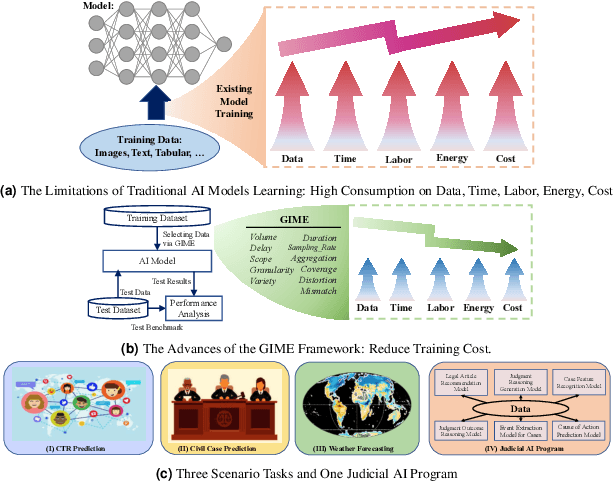
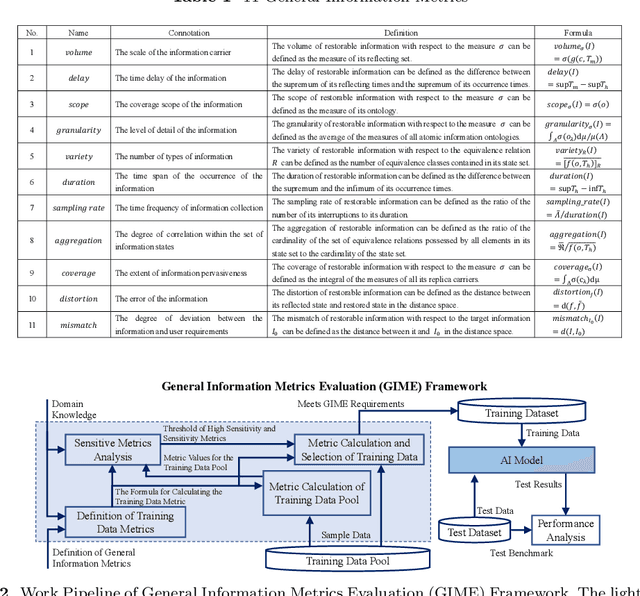
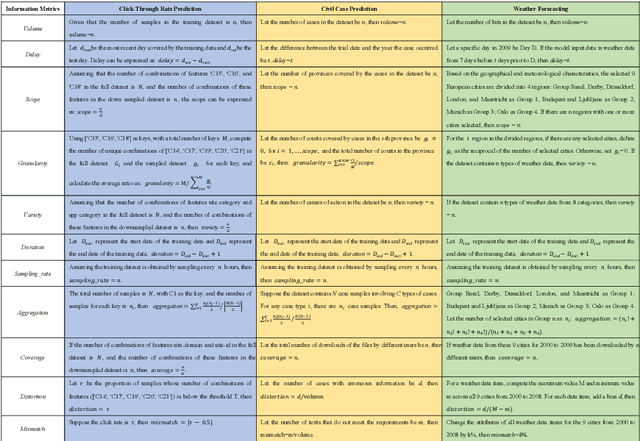
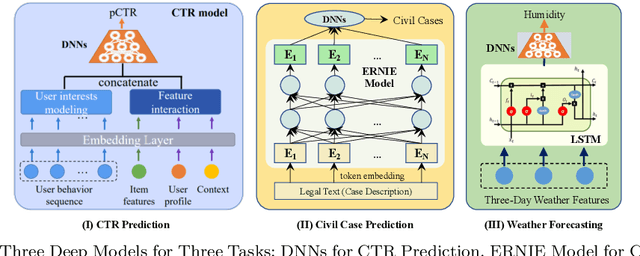
To address the growing size of AI model training data and the lack of a universal data selection methodology-factors that significantly drive up training costs -- this paper presents the General Information Metrics Evaluation (GIME) method. GIME leverages general information metrics from Objective Information Theory (OIT), including volume, delay, scope, granularity, variety, duration, sampling rate, aggregation, coverage, distortion, and mismatch to optimize dataset selection for training purposes. Comprehensive experiments conducted across diverse domains, such as CTR Prediction, Civil Case Prediction, and Weather Forecasting, demonstrate that GIME effectively preserves model performance while substantially reducing both training time and costs. Additionally, applying GIME within the Judicial AI Program led to a remarkable 39.56% reduction in total model training expenses, underscoring its potential to support efficient and sustainable AI development.
PagPassGPT: Pattern Guided Password Guessing via Generative Pretrained Transformer
Apr 07, 2024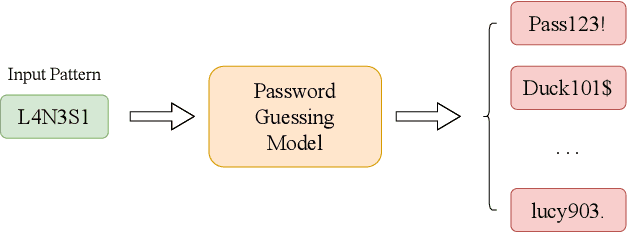
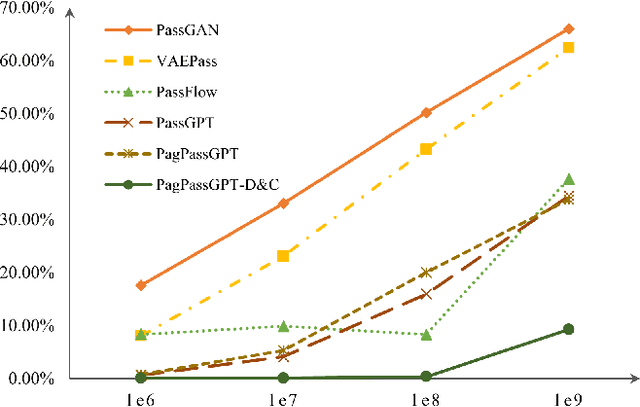
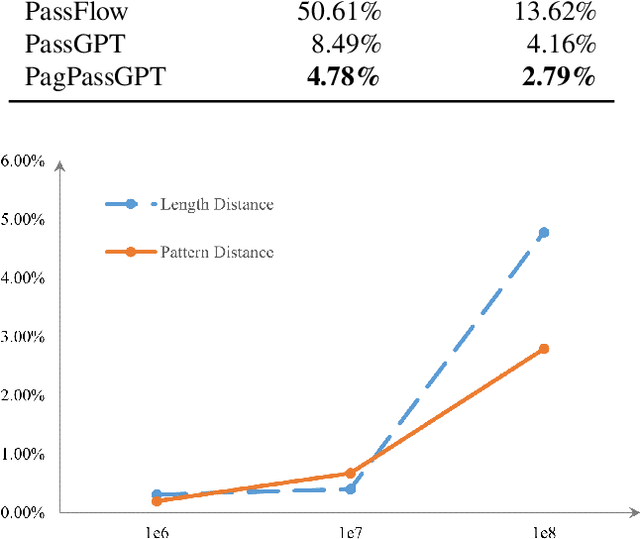
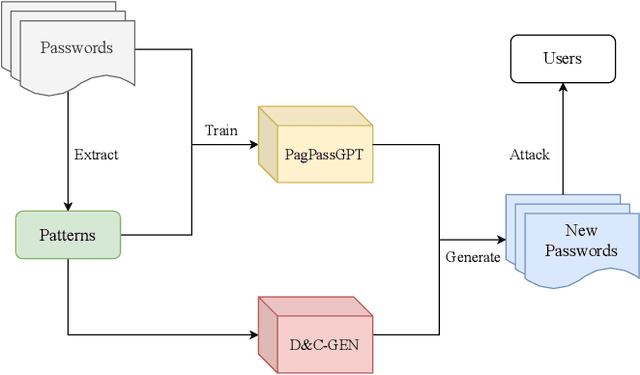
Amidst the surge in deep learning-based password guessing models, challenges of generating high-quality passwords and reducing duplicate passwords persist. To address these challenges, we present PagPassGPT, a password guessing model constructed on Generative Pretrained Transformer (GPT). It can perform pattern guided guessing by incorporating pattern structure information as background knowledge, resulting in a significant increase in the hit rate. Furthermore, we propose D&C-GEN to reduce the repeat rate of generated passwords, which adopts the concept of a divide-and-conquer approach. The primary task of guessing passwords is recursively divided into non-overlapping subtasks. Each subtask inherits the knowledge from the parent task and predicts succeeding tokens. In comparison to the state-of-the-art model, our proposed scheme exhibits the capability to correctly guess 12% more passwords while producing 25% fewer duplicates.
Goldfish: An Efficient Federated Unlearning Framework
Apr 04, 2024With recent legislation on the right to be forgotten, machine unlearning has emerged as a crucial research area. It facilitates the removal of a user's data from federated trained machine learning models without the necessity for retraining from scratch. However, current machine unlearning algorithms are confronted with challenges of efficiency and validity.To address the above issues, we propose a new framework, named Goldfish. It comprises four modules: basic model, loss function, optimization, and extension. To address the challenge of low validity in existing machine unlearning algorithms, we propose a novel loss function. It takes into account the loss arising from the discrepancy between predictions and actual labels in the remaining dataset. Simultaneously, it takes into consideration the bias of predicted results on the removed dataset. Moreover, it accounts for the confidence level of predicted results. Additionally, to enhance efficiency, we adopt knowledge distillation technique in basic model and introduce an optimization module that encompasses the early termination mechanism guided by empirical risk and the data partition mechanism. Furthermore, to bolster the robustness of the aggregated model, we propose an extension module that incorporates a mechanism using adaptive distillation temperature to address the heterogeneity of user local data and a mechanism using adaptive weight to handle the variety in the quality of uploaded models. Finally, we conduct comprehensive experiments to illustrate the effectiveness of proposed approach.