 Add to Chrome
 Add to Firefox
 Add to Edge
Toward a Stable and Deployable Adaptive Chirplet Transform: Residual Projection, Hybrid GPU Acceleration, and Multi-Channel Scalability
Jul 18, 2026
The Adaptive Chirplet Transform is a flexible framework that can decompose non-stationary signals into sparse chirplets; it has been applied to signals such as electroencephalography, electromyography and radar. However, the practical deployment of this transform has been hindered by two challenges: algorithmic instability in prior implementations, which can lead to divergent decompositions, and the computational cost of searching over a high-dimensional parameter space. This paper addresses both by a sequence of contributions. Firstly, unit normalization and residual-based projection are introduced to align the decomposition with Matching Pursuit Theory, thereby eliminating divergence and substantially reducing residual error across all signal domains, as demonstrated on three representative signal types. A hybrid CPU-GPU architecture offloads chirplet family generation to the CPU while parallelizing the search on the GPU, removing bottlenecks in CPU-only search and GPU-only generation, achieving speedups of 6.6-7.38 on desktop hardware, with consistent gains observed across laptop and embedded platforms. Multichannel batching enabled simultaneous multi-signal processing, amplifying the speedup, which scaled from 3.94 for a single channel to 8.22 at 10 channels. Finally, a hierarchical coarse-to-fine search, inspired by Logon Expectation Maximization, is introduced. This reduced peak memory usage below 1 GB while maintaining similar reconstruction quality, at the cost of longer runtime. Together, these contributions establish a correct, stable and practically deployable foundation for chirplet-based signal decomposition. Index Terms: Chirplet Transform, GPU Computing, Matching Pursuit, Signal Decomposition, Sparse Representation, Time-Frequency Analysis

Zero Collapse: A Failure Mode of Policy Gradient Methods in Discontinuous Reward Environments
May 29, 2026Bidding in repeated auctions is a central challenge for reinforcement learning (RL), combining continuous control with the strategic complexities of digital advertising. While policy gradient and value-based methods seem well-suited for these settings, they often struggle with the discontinuous, "cliff-like" nature of auction reward landscapes. In a first-price auction, for example, a bidder receives zero reward until they cross a specific threshold, after which the reward decreases as the bid increases. This creates a landscape of flat, zero-reward regions separated by sharp boundaries. We identify a fundamental failure mode in this setting termed "zero collapse." We show that stochastic exploration and gradient-based updates can cause policies to overshoot optimal high-reward regions and enter flat, zero-reward regimes. Once there, the lack of an informative gradient signal makes recovery extremely sample-inefficient, effectively trapping the agent. We find that actor-critic methods are particularly susceptible, as biased value estimates can accelerate this movement toward unstable regions. Our contributions include: (1) a mechanistic explanation of how discontinuous rewards lead to vanishing signals and zero collapse; (2) an analysis of the interaction between policy stochasticity and step size; and (3) an empirical demonstration of this phenomenon across REINFORCE and actor-critic variants. We propose practical mitigation strategies involving initialization and architectural choices to improve stability. Finally, we introduce a formal RL framework for auction environments highlighting their unique structural properties.
End-to-end data-driven prediction of urban airflow and pollutant dispersion
Mar 18, 2026Climate change and the rapid growth of urban populations are intensifying environmental stresses within cities, making the behavior of urban atmospheric flows a critical factor in public health, energy use, and overall livability. This study targets to develop fast and accurate models of urban pollutant dispersion to support decision-makers, enabling them to implement mitigation measures in a timely and cost-effective manner. To reach this goal, an end-to-end data-driven approach is proposed to model and predict the airflow and pollutant dispersion in a street canyon in skimming flow regime. A series of time-resolved snapshots obtained from large eddy simulation (LES) serves as the database. The proposed framework is based on four fundamental steps. Firstly, a reduced basis is obtained by spectral proper orthogonal decomposition (SPOD) of the database. The projection of the time series snapshot data onto the SPOD modes (time-domain approach) provides the temporal coefficients of the dynamics. Secondly, a nonlinear compression of the temporal coefficients is performed by autoencoder to reduce further the dimensionality of the problem. Thirdly, a reduced-order model (ROM) is learned in the latent space using Long Short-Term Memory (LSTM) netowrks. Finally, the pollutant dispersion is estimated from the predicted velocity field through convolutional neural network that maps both fields. The results demonstrate the efficacy of the model in predicting the instantaneous as well as statistically stationary fields over long time horizon.
FusionINN: Invertible Image Fusion for Brain Tumor Monitoring
Apr 02, 2024Image fusion typically employs non-invertible neural networks to merge multiple source images into a single fused image. However, for clinical experts, solely relying on fused images may be insufficient for making diagnostic decisions, as the fusion mechanism blends features from source images, thereby making it difficult to interpret the underlying tumor pathology. We introduce FusionINN, a novel invertible image fusion framework, capable of efficiently generating fused images and also decomposing them back to the source images by solving the inverse of the fusion process. FusionINN guarantees lossless one-to-one pixel mapping by integrating a normally distributed latent image alongside the fused image to facilitate the generative modeling of the decomposition process. To the best of our knowledge, we are the first to investigate the decomposability of fused images, which is particularly crucial for life-sensitive applications such as medical image fusion compared to other tasks like multi-focus or multi-exposure image fusion. Our extensive experimentation validates FusionINN over existing discriminative and generative fusion methods, both subjectively and objectively. Moreover, compared to a recent denoising diffusion-based fusion model, our approach offers faster and qualitatively better fusion results. We also exhibit the clinical utility of our results in aiding disease prognosis.
Uncertainty Quantification for Image-based Traffic Prediction across Cities
Aug 11, 2023Despite the strong predictive performance of deep learning models for traffic prediction, their widespread deployment in real-world intelligent transportation systems has been restrained by a lack of interpretability. Uncertainty quantification (UQ) methods provide an approach to induce probabilistic reasoning, improve decision-making and enhance model deployment potential. To gain a comprehensive picture of the usefulness of existing UQ methods for traffic prediction and the relation between obtained uncertainties and city-wide traffic dynamics, we investigate their application to a large-scale image-based traffic dataset spanning multiple cities and time periods. We compare two epistemic and two aleatoric UQ methods on both temporal and spatio-temporal transfer tasks, and find that meaningful uncertainty estimates can be recovered. We further demonstrate how uncertainty estimates can be employed for unsupervised outlier detection on changes in city traffic dynamics. We find that our approach can capture both temporal and spatial effects on traffic behaviour in a representative case study for the city of Moscow. Our work presents a further step towards boosting uncertainty awareness in traffic prediction tasks, and aims to highlight the value contribution of UQ methods to a better understanding of city traffic dynamics.
Learning to reconstruct the bubble distribution with conductivity maps using Invertible Neural Networks and Error Diffusion
Jul 04, 2023Electrolysis is crucial for eco-friendly hydrogen production, but gas bubbles generated during the process hinder reactions, reduce cell efficiency, and increase energy consumption. Additionally, these gas bubbles cause changes in the conductivity inside the cell, resulting in corresponding variations in the induced magnetic field around the cell. Therefore, measuring these gas bubble-induced magnetic field fluctuations using external magnetic sensors and solving the inverse problem of Biot-Savart Law allows for estimating the conductivity in the cell and, thus, bubble size and location. However, determining high-resolution conductivity maps from only a few induced magnetic field measurements is an ill-posed inverse problem. To overcome this, we exploit Invertible Neural Networks (INNs) to reconstruct the conductivity field. Our qualitative results and quantitative evaluation using random error diffusion show that INN achieves far superior performance compared to Tikhonov regularization.
Computational Performance Aware Benchmarking of Unsupervised Concept Drift Detection
Apr 17, 2023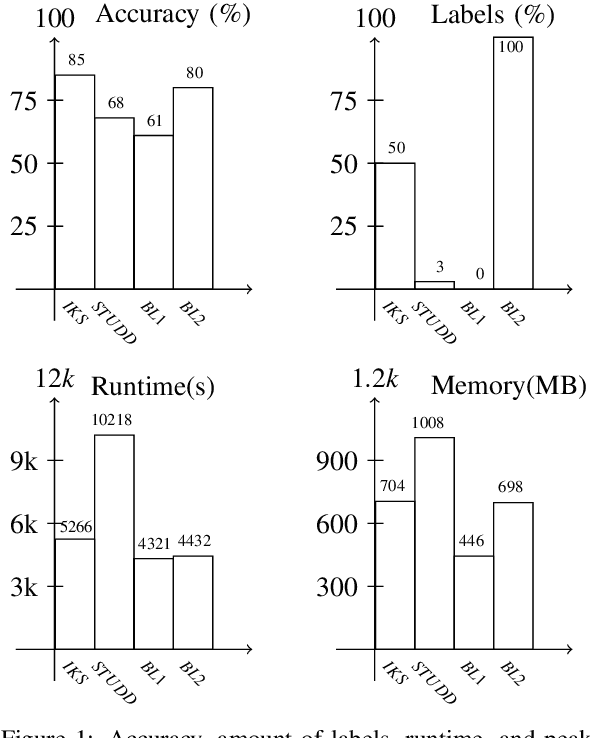
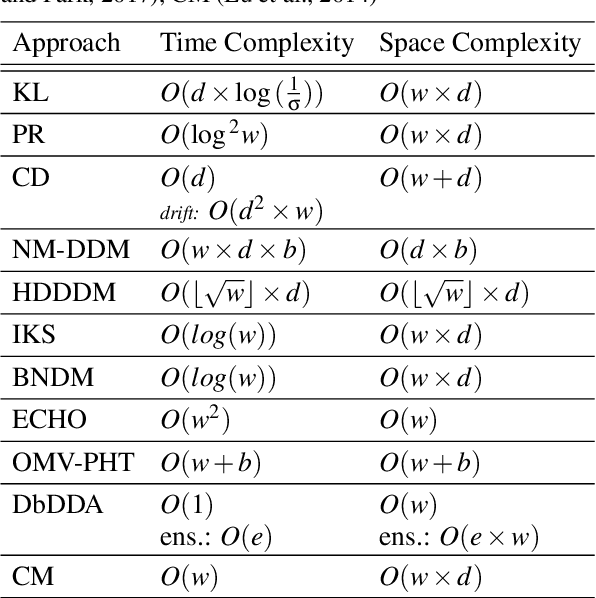
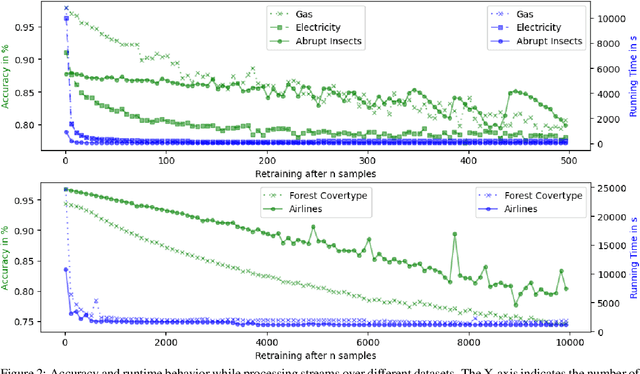
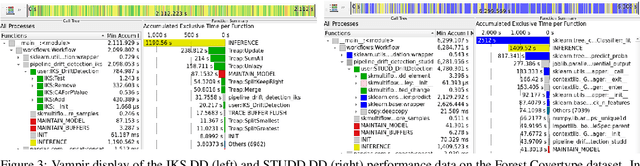
For many AI systems, concept drift detection is crucial to ensure the systems reliability. These systems often have to deal with large amounts of data or react in real time. Thus, drift detectors must meet computational requirements or constraints with a comprehensive performance evaluation. However, so far, the focus of developing drift detectors is on detection quality, e.g.~accuracy, but not on computational performance, such as running time. We show that the previous works consider computational performance only as a secondary objective and do not have a benchmark for such evaluation. Hence, we propose a novel benchmark suite for drift detectors that accounts both detection quality and computational performance to ensure a detector's applicability in various AI systems. In this work, we focus on unsupervised drift detectors that are not restricted to the availability of labeled data and thus being widely applicable. Our benchmark suite supports configurable synthetic and real world data streams. Moreover, it provides means for simulating a machine learning model's output to unify the performance evaluation across different drift detectors. This allows a fair and comprehensive comparison of drift detectors proposed in related work. Our benchmark suite is integrated in the existing framework, Massive Online Analysis (MOA). To evaluate our benchmark suite's capability, we integrate two representative unsupervised drift detectors. Our work enables the scientific community to achieve a baseline for unsupervised drift detectors with respect to both detection quality and computational performance.
Normalizing Flow based Feature Synthesis for Outlier-Aware Object Detection
Feb 01, 2023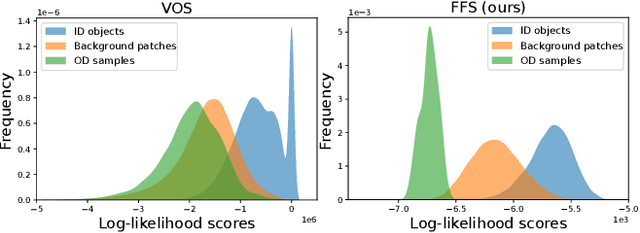
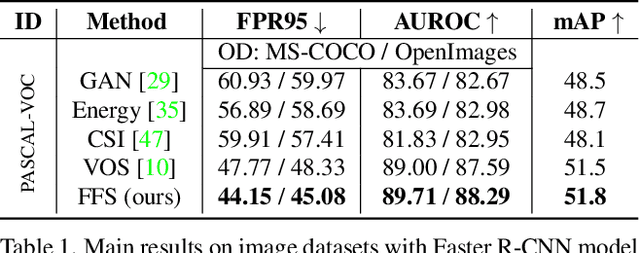
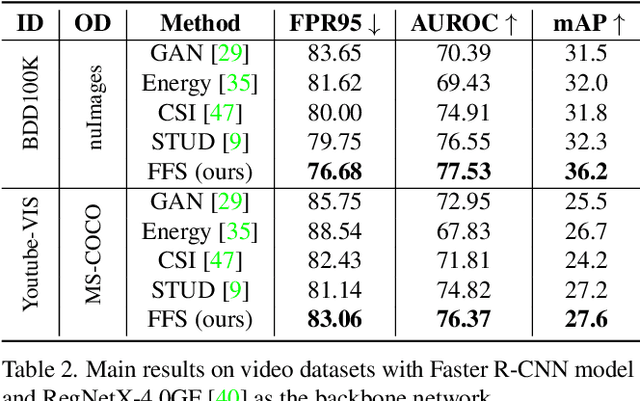
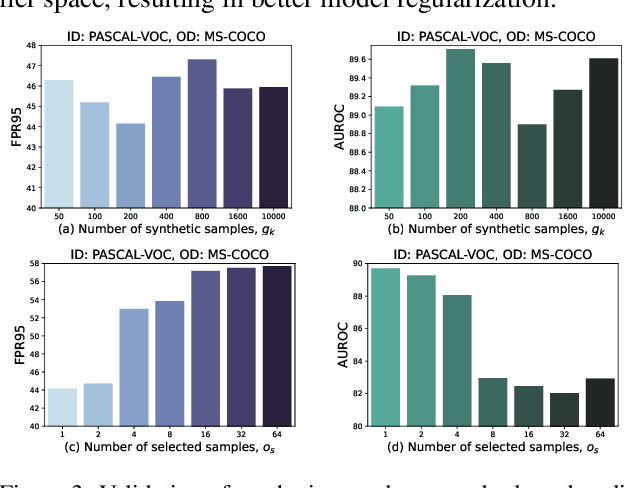
Real-world deployment of reliable object detectors is crucial for applications such as autonomous driving. However, general-purpose object detectors like Faster R-CNN are prone to providing overconfident predictions for outlier objects. Recent outlier-aware object detection approaches estimate the density of instance-wide features with class-conditional Gaussians and train on synthesized outlier features from their low-likelihood regions. However, this strategy does not guarantee that the synthesized outlier features will have a low likelihood according to the other class-conditional Gaussians. We propose a novel outlier-aware object detection framework that learns to distinguish outliers from inlier objects by learning the joint data distribution of all inlier classes with an invertible normalizing flow. The flow model ensures that the synthesized outliers have a lower likelihood than inliers of all object classes, thereby modeling a better decision boundary between inlier and outlier objects. Our approach significantly outperforms the state-of-the-art for outlier-aware object detection on both image and video datasets.
Enhancing Fairness of Visual Attribute Predictors
Jul 14, 2022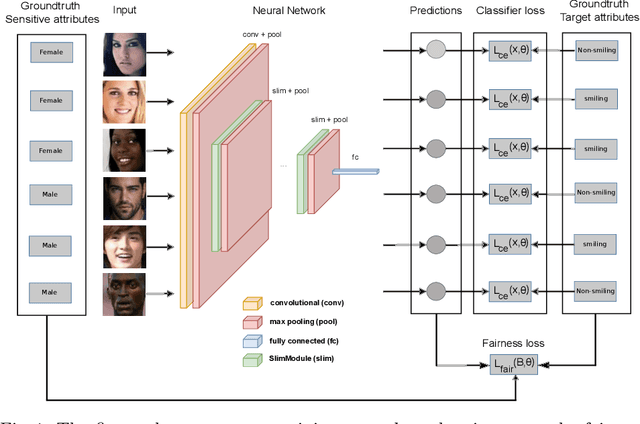
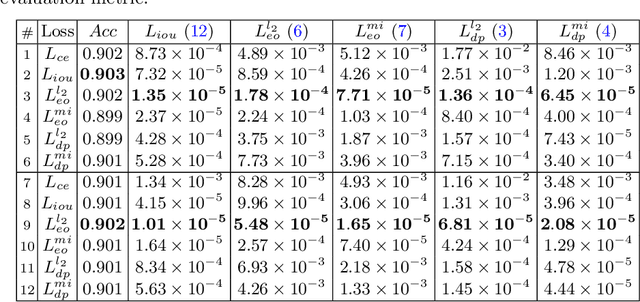
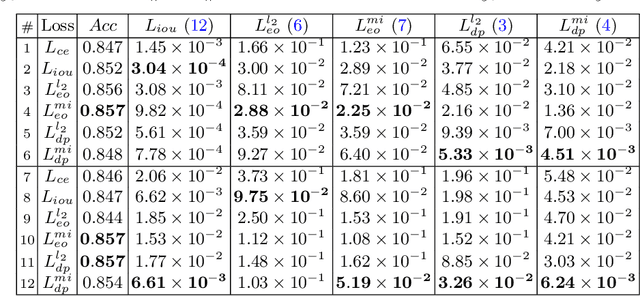
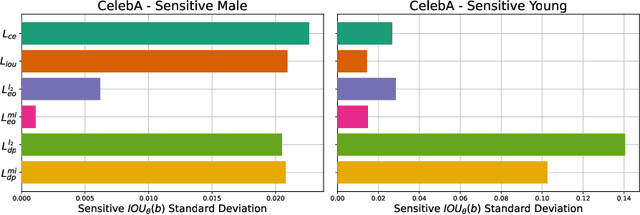
The performance of deep neural networks for image recognition tasks such as predicting a smiling face is known to degrade with under-represented classes of sensitive attributes. We address this problem by introducing fairness-aware regularization losses based on batch estimates of Demographic Parity, Equalized Odds, and a novel Intersection-over-Union measure. The experiments performed on facial and medical images from CelebA, UTKFace, and the SIIM-ISIC melanoma classification challenge show the effectiveness of our proposed fairness losses for bias mitigation as they improve model fairness while maintaining high classification performance. To the best of our knowledge, our work is the first attempt to incorporate these types of losses in an end-to-end training scheme for mitigating biases of visual attribute predictors. Our code is available at https://github.com/nish03/FVAP.
TransDrift: Modeling Word-Embedding Drift using Transformer
Jun 16, 2022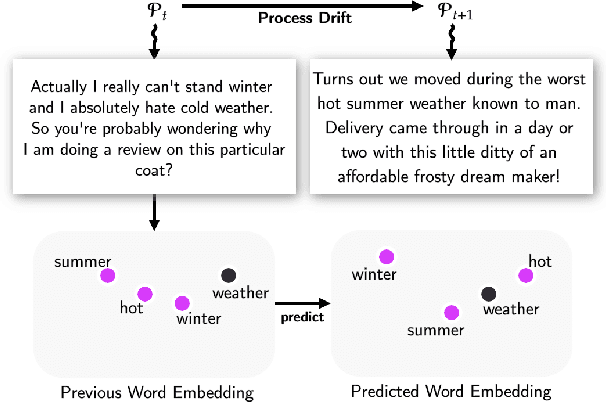
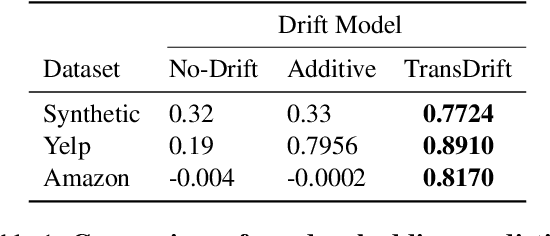
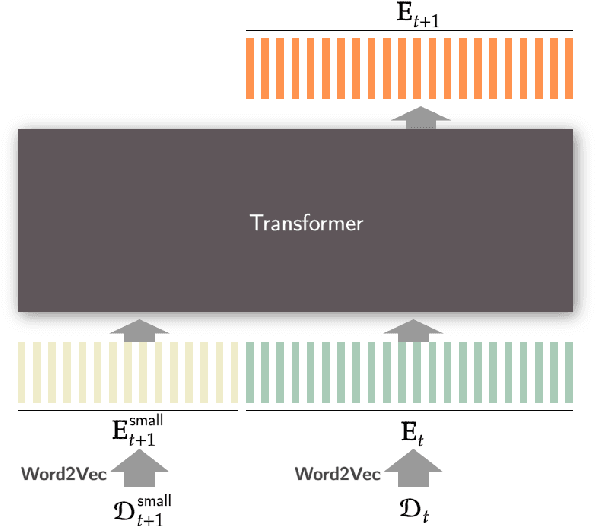
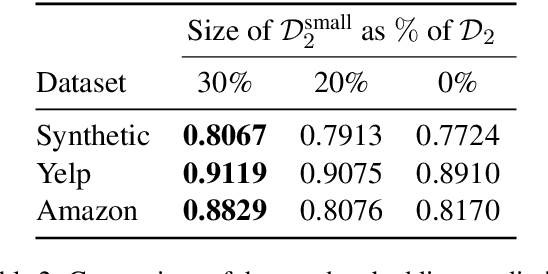
In modern NLP applications, word embeddings are a crucial backbone that can be readily shared across a number of tasks. However as the text distributions change and word semantics evolve over time, the downstream applications using the embeddings can suffer if the word representations do not conform to the data drift. Thus, maintaining word embeddings to be consistent with the underlying data distribution is a key problem. In this work, we tackle this problem and propose TransDrift, a transformer-based prediction model for word embeddings. Leveraging the flexibility of transformer, our model accurately learns the dynamics of the embedding drift and predicts the future embedding. In experiments, we compare with existing methods and show that our model makes significantly more accurate predictions of the word embedding than the baselines. Crucially, by applying the predicted embeddings as a backbone for downstream classification tasks, we show that our embeddings lead to superior performance compared to the previous methods.