 Add to Chrome
 Add to Firefox
 Add to Edge
Quantitative Susceptibility Mapping through Model-based Deep Image Prior (MoDIP)
Aug 18, 2023
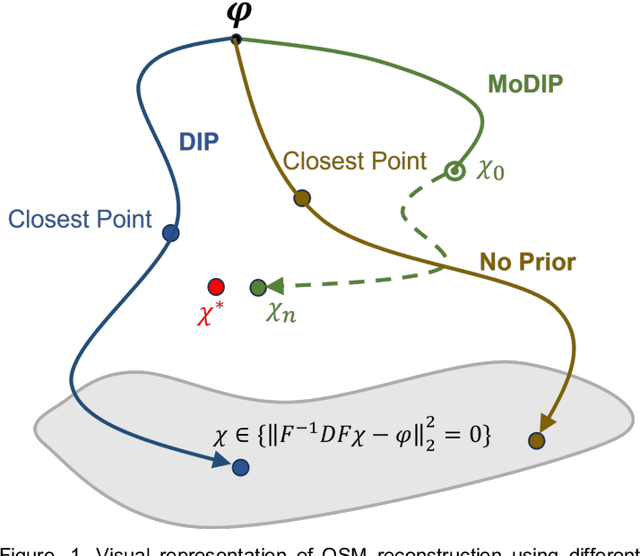
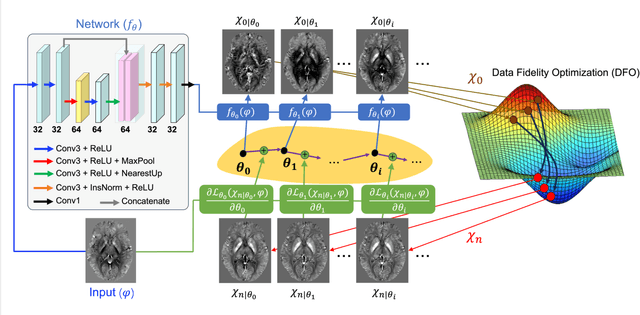

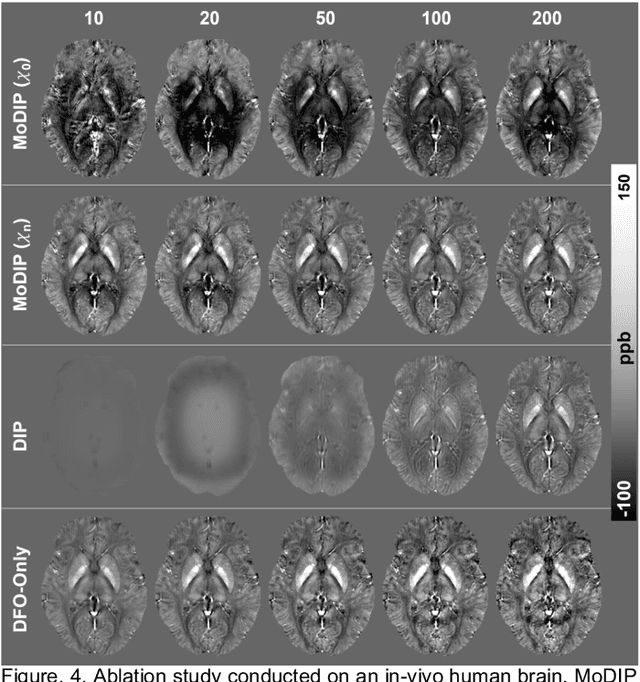
The data-driven approach of supervised learning methods has limited applicability in solving dipole inversion in Quantitative Susceptibility Mapping (QSM) with varying scan parameters across different objects. To address this generalization issue in supervised QSM methods, we propose a novel training-free model-based unsupervised method called MoDIP (Model-based Deep Image Prior). MoDIP comprises a small, untrained network and a Data Fidelity Optimization (DFO) module. The network converges to an interim state, acting as an implicit prior for image regularization, while the optimization process enforces the physical model of QSM dipole inversion. Experimental results demonstrate MoDIP's excellent generalizability in solving QSM dipole inversion across different scan parameters. It exhibits robustness against pathological brain QSM, achieving over 32% accuracy improvement than supervised deep learning and traditional iterative methods. It is also 33% more computationally efficient and runs 4 times faster than conventional DIP-based approaches, enabling 3D high-resolution image reconstruction in under 4.5 minutes.

Where and How: Mitigating Confusion in Neural Radiance Fields from Sparse Inputs
Aug 05, 2023Neural Radiance Fields from Sparse input} (NeRF-S) have shown great potential in synthesizing novel views with a limited number of observed viewpoints. However, due to the inherent limitations of sparse inputs and the gap between non-adjacent views, rendering results often suffer from over-fitting and foggy surfaces, a phenomenon we refer to as "CONFUSION" during volume rendering. In this paper, we analyze the root cause of this confusion and attribute it to two fundamental questions: "WHERE" and "HOW". To this end, we present a novel learning framework, WaH-NeRF, which effectively mitigates confusion by tackling the following challenges: (i)"WHERE" to Sample? in NeRF-S -- we introduce a Deformable Sampling strategy and a Weight-based Mutual Information Loss to address sample-position confusion arising from the limited number of viewpoints; and (ii) "HOW" to Predict? in NeRF-S -- we propose a Semi-Supervised NeRF learning Paradigm based on pose perturbation and a Pixel-Patch Correspondence Loss to alleviate prediction confusion caused by the disparity between training and testing viewpoints. By integrating our proposed modules and loss functions, WaH-NeRF outperforms previous methods under the NeRF-S setting. Code is available https://github.com/bbbbby-99/WaH-NeRF.
3D Medical Image Segmentation with Sparse Annotation via Cross-Teaching between 3D and 2D Networks
Jul 30, 2023
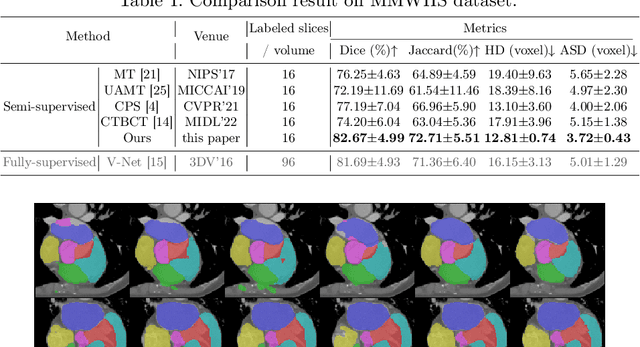


Medical image segmentation typically necessitates a large and precisely annotated dataset. However, obtaining pixel-wise annotation is a labor-intensive task that requires significant effort from domain experts, making it challenging to obtain in practical clinical scenarios. In such situations, reducing the amount of annotation required is a more practical approach. One feasible direction is sparse annotation, which involves annotating only a few slices, and has several advantages over traditional weak annotation methods such as bounding boxes and scribbles, as it preserves exact boundaries. However, learning from sparse annotation is challenging due to the scarcity of supervision signals. To address this issue, we propose a framework that can robustly learn from sparse annotation using the cross-teaching of both 3D and 2D networks. Considering the characteristic of these networks, we develop two pseudo label selection strategies, which are hard-soft confidence threshold and consistent label fusion. Our experimental results on the MMWHS dataset demonstrate that our method outperforms the state-of-the-art (SOTA) semi-supervised segmentation methods. Moreover, our approach achieves results that are comparable to the fully-supervised upper bound result.
DNA-Rendering: A Diverse Neural Actor Repository for High-Fidelity Human-centric Rendering
Jul 19, 2023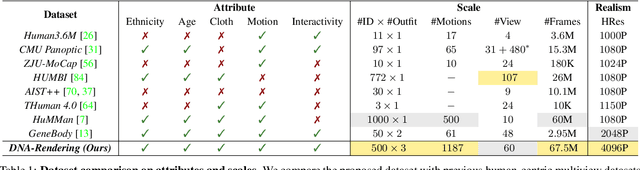

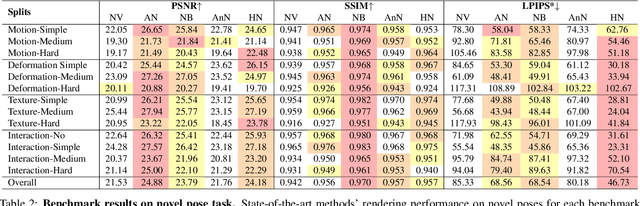

Realistic human-centric rendering plays a key role in both computer vision and computer graphics. Rapid progress has been made in the algorithm aspect over the years, yet existing human-centric rendering datasets and benchmarks are rather impoverished in terms of diversity, which are crucial for rendering effect. Researchers are usually constrained to explore and evaluate a small set of rendering problems on current datasets, while real-world applications require methods to be robust across different scenarios. In this work, we present DNA-Rendering, a large-scale, high-fidelity repository of human performance data for neural actor rendering. DNA-Rendering presents several alluring attributes. First, our dataset contains over 1500 human subjects, 5000 motion sequences, and 67.5M frames' data volume. Second, we provide rich assets for each subject -- 2D/3D human body keypoints, foreground masks, SMPLX models, cloth/accessory materials, multi-view images, and videos. These assets boost the current method's accuracy on downstream rendering tasks. Third, we construct a professional multi-view system to capture data, which contains 60 synchronous cameras with max 4096 x 3000 resolution, 15 fps speed, and stern camera calibration steps, ensuring high-quality resources for task training and evaluation. Along with the dataset, we provide a large-scale and quantitative benchmark in full-scale, with multiple tasks to evaluate the existing progress of novel view synthesis, novel pose animation synthesis, and novel identity rendering methods. In this manuscript, we describe our DNA-Rendering effort as a revealing of new observations, challenges, and future directions to human-centric rendering. The dataset, code, and benchmarks will be publicly available at https://dna-rendering.github.io/
Policy Contrastive Imitation Learning
Jul 06, 2023
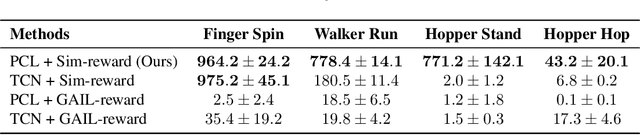

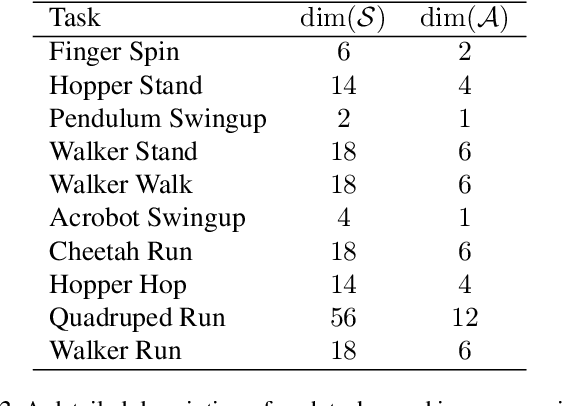
Adversarial imitation learning (AIL) is a popular method that has recently achieved much success. However, the performance of AIL is still unsatisfactory on the more challenging tasks. We find that one of the major reasons is due to the low quality of AIL discriminator representation. Since the AIL discriminator is trained via binary classification that does not necessarily discriminate the policy from the expert in a meaningful way, the resulting reward might not be meaningful either. We propose a new method called Policy Contrastive Imitation Learning (PCIL) to resolve this issue. PCIL learns a contrastive representation space by anchoring on different policies and generates a smooth cosine-similarity-based reward. Our proposed representation learning objective can be viewed as a stronger version of the AIL objective and provide a more meaningful comparison between the agent and the policy. From a theoretical perspective, we show the validity of our method using the apprenticeship learning framework. Furthermore, our empirical evaluation on the DeepMind Control suite demonstrates that PCIL can achieve state-of-the-art performance. Finally, qualitative results suggest that PCIL builds a smoother and more meaningful representation space for imitation learning.
Towards Explainable Evaluation Metrics for Machine Translation
Jun 22, 2023
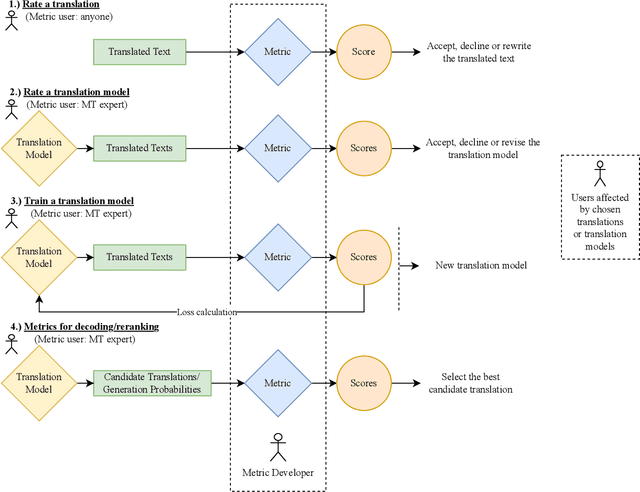
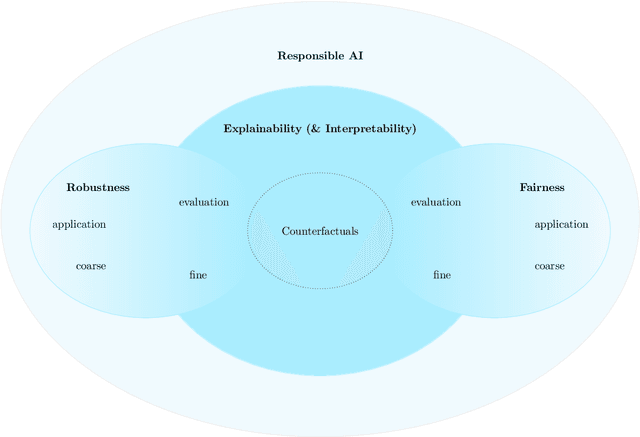

Unlike classical lexical overlap metrics such as BLEU, most current evaluation metrics for machine translation (for example, COMET or BERTScore) are based on black-box large language models. They often achieve strong correlations with human judgments, but recent research indicates that the lower-quality classical metrics remain dominant, one of the potential reasons being that their decision processes are more transparent. To foster more widespread acceptance of novel high-quality metrics, explainability thus becomes crucial. In this concept paper, we identify key properties as well as key goals of explainable machine translation metrics and provide a comprehensive synthesis of recent techniques, relating them to our established goals and properties. In this context, we also discuss the latest state-of-the-art approaches to explainable metrics based on generative models such as ChatGPT and GPT4. Finally, we contribute a vision of next-generation approaches, including natural language explanations. We hope that our work can help catalyze and guide future research on explainable evaluation metrics and, mediately, also contribute to better and more transparent machine translation systems.
A Universal Semantic-Geometric Representation for Robotic Manipulation
Jun 18, 2023
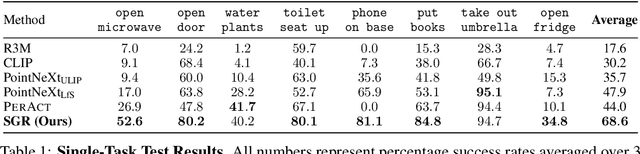
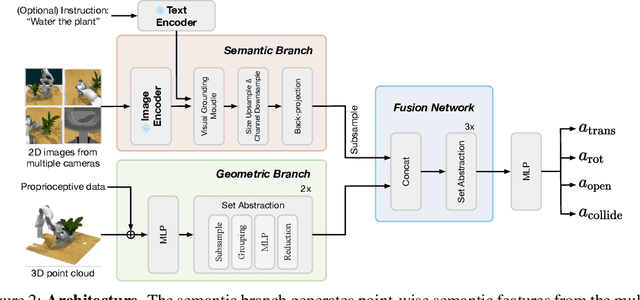
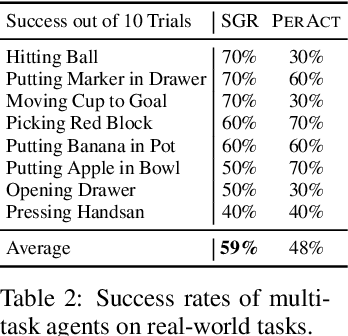
Robots rely heavily on sensors, especially RGB and depth cameras, to perceive and interact with the world. RGB cameras record 2D images with rich semantic information while missing precise spatial information. On the other side, depth cameras offer critical 3D geometry data but capture limited semantics. Therefore, integrating both modalities is crucial for learning representations for robotic perception and control. However, current research predominantly focuses on only one of these modalities, neglecting the benefits of incorporating both. To this end, we present Semantic-Geometric Representation (SGR), a universal perception module for robotics that leverages the rich semantic information of large-scale pre-trained 2D models and inherits the merits of 3D spatial reasoning. Our experiments demonstrate that SGR empowers the agent to successfully complete a diverse range of simulated and real-world robotic manipulation tasks, outperforming state-of-the-art methods significantly in both single-task and multi-task settings. Furthermore, SGR possesses the unique capability to generalize to novel semantic attributes, setting it apart from the other methods.
Programmatically Grounded, Compositionally Generalizable Robotic Manipulation
Apr 26, 2023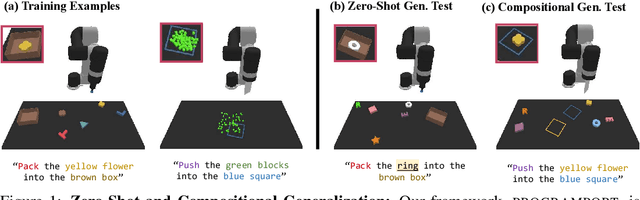
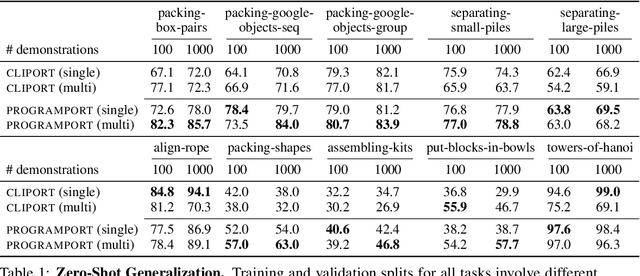
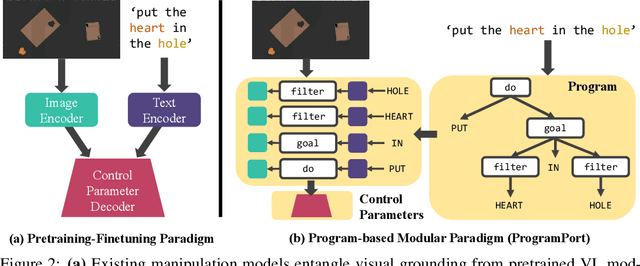
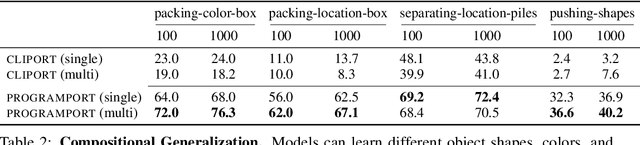
Robots operating in the real world require both rich manipulation skills as well as the ability to semantically reason about when to apply those skills. Towards this goal, recent works have integrated semantic representations from large-scale pretrained vision-language (VL) models into manipulation models, imparting them with more general reasoning capabilities. However, we show that the conventional pretraining-finetuning pipeline for integrating such representations entangles the learning of domain-specific action information and domain-general visual information, leading to less data-efficient training and poor generalization to unseen objects and tasks. To this end, we propose ProgramPort, a modular approach to better leverage pretrained VL models by exploiting the syntactic and semantic structures of language instructions. Our framework uses a semantic parser to recover an executable program, composed of functional modules grounded on vision and action across different modalities. Each functional module is realized as a combination of deterministic computation and learnable neural networks. Program execution produces parameters to general manipulation primitives for a robotic end-effector. The entire modular network can be trained with end-to-end imitation learning objectives. Experiments show that our model successfully disentangles action and perception, translating to improved zero-shot and compositional generalization in a variety of manipulation behaviors. Project webpage at: \url{https://progport.github.io}.
Shades of meaning: Uncovering the geometry of ambiguous word representations through contextualised language models
Apr 26, 2023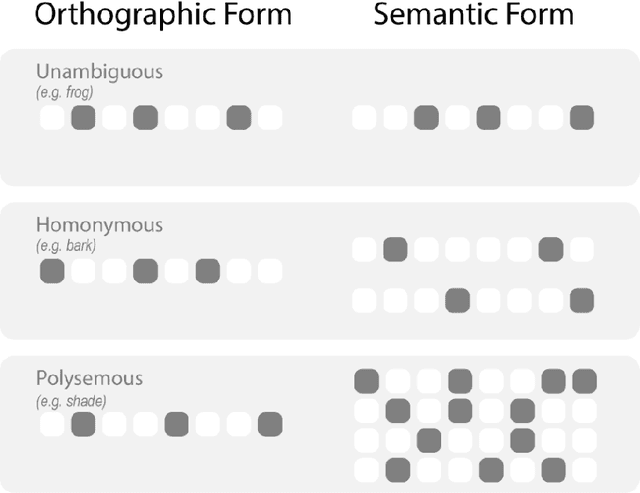


Lexical ambiguity presents a profound and enduring challenge to the language sciences. Researchers for decades have grappled with the problem of how language users learn, represent and process words with more than one meaning. Our work offers new insight into psychological understanding of lexical ambiguity through a series of simulations that capitalise on recent advances in contextual language models. These models have no grounded understanding of the meanings of words at all; they simply learn to predict words based on the surrounding context provided by other words. Yet, our analyses show that their representations capture fine-grained meaningful distinctions between unambiguous, homonymous, and polysemous words that align with lexicographic classifications and psychological theorising. These findings provide quantitative support for modern psychological conceptualisations of lexical ambiguity and raise new challenges for understanding of the way that contextual information shapes the meanings of words across different timescales.
Seer: Language Instructed Video Prediction with Latent Diffusion Models
Apr 12, 2023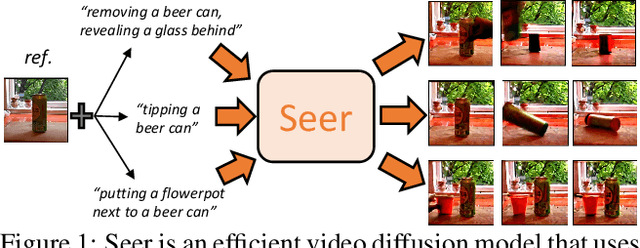
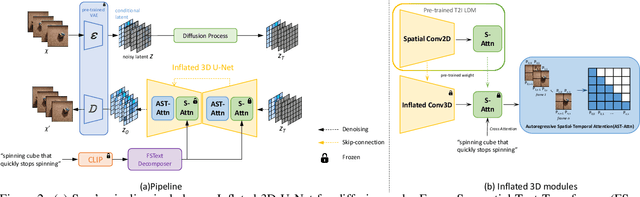
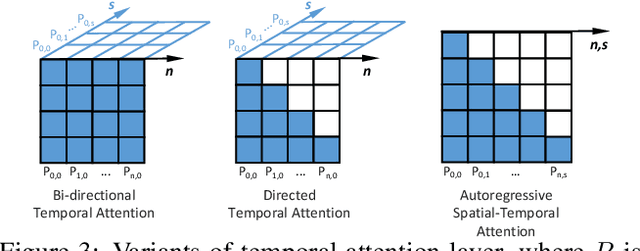
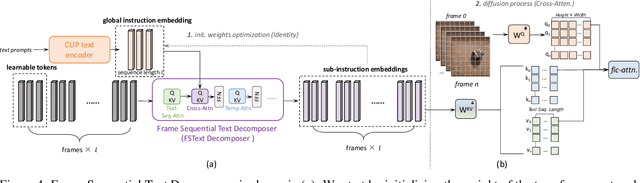
Imagining the future trajectory is the key for robots to make sound planning and successfully reach their goals. Therefore, text-conditioned video prediction (TVP) is an essential task to facilitate general robot policy learning, i.e., predicting future video frames with a given language instruction and reference frames. It is a highly challenging task to ground task-level goals specified by instructions and high-fidelity frames together, requiring large-scale data and computation. To tackle this task and empower robots with the ability to foresee the future, we propose a sample and computation-efficient model, named \textbf{Seer}, by inflating the pretrained text-to-image (T2I) stable diffusion models along the temporal axis. We inflate the denoising U-Net and language conditioning model with two novel techniques, Autoregressive Spatial-Temporal Attention and Frame Sequential Text Decomposer, to propagate the rich prior knowledge in the pretrained T2I models across the frames. With the well-designed architecture, Seer makes it possible to generate high-fidelity, coherent, and instruction-aligned video frames by fine-tuning a few layers on a small amount of data. The experimental results on Something Something V2 (SSv2) and Bridgedata datasets demonstrate our superior video prediction performance with around 210-hour training on 4 RTX 3090 GPUs: decreasing the FVD of the current SOTA model from 290 to 200 on SSv2 and achieving at least 70\% preference in the human evaluation.