 Add to Chrome
 Add to Firefox
 Add to Edge
Always-OnAgents:A Survey of Persistent Memory, State, and Governance in LLMAgents
Jun 29, 2026
Always-on agents are systems whose future behavior depends on durable state accumulated across earlier interactions. We treat them as persistent-state systems: the operative system includes retrievable memories, but also task ledgers, permissions, credentials, commitments, provenance and audit records, shared state, trigger conditions, and externally committed effects linked to those records. The survey reads the literature through six diagnostic axes for each state item, authority, scope, mutability, provenance, recoverability, and actionability, and through a lifecycle in which state is written, validated, organized, retrieved, acted upon, updated, forgotten, audited, and sometimes rolled back. Across a 435-work coded corpus, treated as a scoped map rather than an exhaustive census, the literature concentrates more heavily on accumulating and retrieving state than on governing, recovering, or relinquishing it. We therefore introduce the Always-On Evaluation Protocol (AOEP-v0), a pilot evaluation contract that makes these governance requirements concrete by scoring state mutation and recovery obligations rather than answer quality alone. The resulting agenda connects always-on agents to databases, distributed systems, formal methods, capability security, and machine unlearning.

Do LLM Attribution Metrics Transfer? Auditing Retrieval-Augmented Generation Evaluation Across Datasets and Constructs
Jun 22, 2026Practice often treats automatic metrics for attribution in LLM retrieval-augmented generation as interchangeable. We audit eight automatic scorers -- lexical, embedding, and BERTScore baselines alongside entailment/grounding-trained models (clean and FEVER NLI, the checker MiniCheck) -- across three evaluation constructs (provenance/topicality, generated-answer attribution, and fact-check entailment), asking whether any scorer transfers: stays within the 95% confidence interval of the best audited scorer on every dataset of a multi-dataset construct. In the construct with the most multi-dataset human-labeled coverage -- generated-answer attribution (AttributionBench's four source datasets, n = 1,610, with independent HAGRID, n = 2,150) -- none does: the per-dataset metric rankings invert (Kendall tau = -0.64, p = 0.031 on AttributedQA vs. LFQA), and an off-the-shelf NLI scorer that is best on short-claim AttributedQA (AUROC 0.90) collapses to AUROC 0.53 (chance) on long-form LFQA, where BERTScore wins (0.91); the flip is not a length or truncation artifact. This instability has a concrete decision cost: a naive "best-on-average" rule for choosing an evaluator fails leave-one-dataset-out (mean held-out regret 0.172 AUROC, worse than fixing one scorer), so metric choice must be validated on the target dataset rather than learned from others. A prompt-based LLM judge avoids the chance-level collapses the automatic scorers suffer (no LFQA collapse) but is not uniformly best, ~100x costlier, and non-deterministic -- relocating, not removing, the validation burden.
When Retrieval Metrics Mislead: Measuring Policy Signal in Long-Horizon Tool-Use Agents
Jun 22, 2026Exact-match retrieval recall is often used as a proxy for whether a retriever supplies useful policy context to a downstream decision model. We test this proxy for pre-action policy classification in tau-bench using Qwen2.5-3B/7B classifiers. Under gold-policy conditioning, a compact structured state improves macro-F1 over raw trajectories by 0.13-0.17 after tuning. We then replace the benchmark-designated policy clause with the top-ranked clause retrieved from decision-time context. Although the exact governing clause is retrieved at rank 1 for only 7% of airline states, the primary 3B classifier obtains macro-F1 0.58 with retrieved clauses versus 0.60 with gold clauses (Delta=-0.02, task-cluster 95% CI [-0.23,+0.21]); mismatched-policy and no-policy controls score 0.32 and 0.21. We do not detect a macro-F1 difference between retrieved and gold clauses in this configuration, although the interval remains too wide to establish non-inferiority. The same qualitative pattern appears with a second retriever and at 7B, while varying across fine-tuning configurations. These results indicate that exact-match clause recall can underestimate downstream policy utility in this benchmark setting, motivating evaluation with retrieved policies in the classification loop rather than recall alone.
Keep Policy Gradient in Charge: Sibling-Guided Credit Distillation for Long-Horizon Tool-Use Agents
Jun 10, 2026Long-horizon tool-use reinforcement learning can learn from outcome verification, but its trajectory-level advantage is broadcast across many reasoning, API, and answer tokens. Self-distillation promises a denser signal by reusing a policy's own rollouts or a privileged teacher. We show, however, that direct token-level self-distillation can silently destroy tool use: it rehearses teacher behavior without knowing which actions the verifier rewards, so useful skills and harmful shortcuts are amplified together. We introduce Sibling-Guided Credit Distillation (SGCD), which uses distillation for credit assignment rather than as a competing actor loss. Dynamic sampling produces mixed successful and failed sibling rollouts; an external LLM summarizes their contrast into a training-only stepwise credit reference; dense teacher/student divergence drives credit reassignment; and bounded detached credit weights reshape GRPO token advantages. The deployed student sees no external LLM, sibling evidence, or oracle. Across AppWorld and $τ^3$-airline, SGCD improves over matched GRPO comparators: AppWorld TGC $42.9 \to 45.6$ on test_normal and $24.7 \to 27.0$ on test_challenge, and $τ^3$-airline pass@1 $0.583 \to 0.602$.
DeltaEvolve: Accelerating Scientific Discovery through Momentum-Driven Evolution
Feb 02, 2026LLM-driven evolutionary systems have shown promise for automated science discovery, yet existing approaches such as AlphaEvolve rely on full-code histories that are context-inefficient and potentially provide weak evolutionary guidance. In this work, we first formalize the evolutionary agents as a general Expectation-Maximization framework, where the language model samples candidate programs (E-step) and the system updates the control context based on evaluation feedback (M-step). Under this view, constructing context via full-code snapshots constitutes a suboptimal M-step, as redundant implement details dilutes core algorithmic ideas, making it difficult to provide clear inspirations for evolution. To address this, we propose DeltaEvolve, a momentum-driven evolutionary framework that replaces full-code history with structured semantic delta capturing how and why modifications between successive nodes affect performance. As programs are often decomposable, semantic delta usually contains many effective components which are transferable and more informative to drive improvement. By organizing semantic delta through multi-level database and progressive disclosure mechanism, input tokens are further reduced. Empirical evaluations on tasks across diverse scientific domains show that our framework can discover better solution with less token consumption over full-code-based evolutionary agents.
ProCrop: Learning Aesthetic Image Cropping from Professional Compositions
May 28, 2025Image cropping is crucial for enhancing the visual appeal and narrative impact of photographs, yet existing rule-based and data-driven approaches often lack diversity or require annotated training data. We introduce ProCrop, a retrieval-based method that leverages professional photography to guide cropping decisions. By fusing features from professional photographs with those of the query image, ProCrop learns from professional compositions, significantly boosting performance. Additionally, we present a large-scale dataset of 242K weakly-annotated images, generated by out-painting professional images and iteratively refining diverse crop proposals. This composition-aware dataset generation offers diverse high-quality crop proposals guided by aesthetic principles and becomes the largest publicly available dataset for image cropping. Extensive experiments show that ProCrop significantly outperforms existing methods in both supervised and weakly-supervised settings. Notably, when trained on the new dataset, our ProCrop surpasses previous weakly-supervised methods and even matches fully supervised approaches. Both the code and dataset will be made publicly available to advance research in image aesthetics and composition analysis.
Robust Dataset Distillation by Matching Adversarial Trajectories
Mar 15, 2025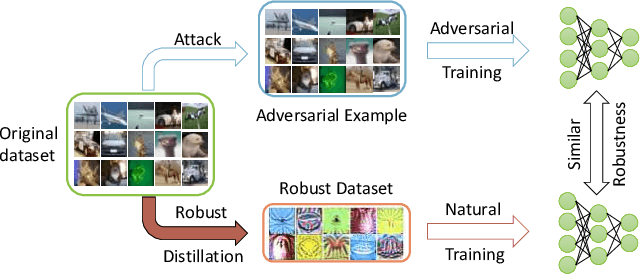
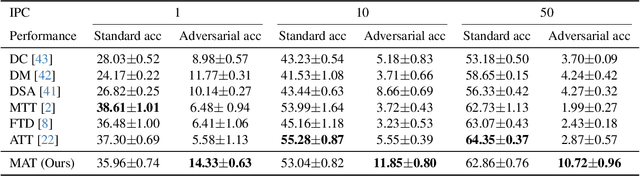
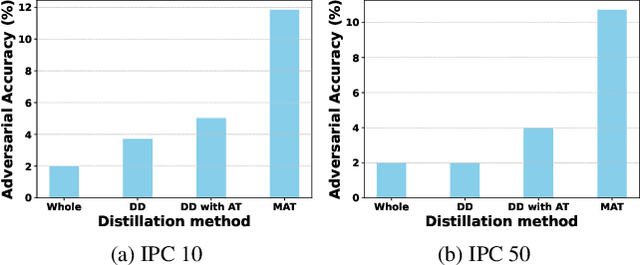
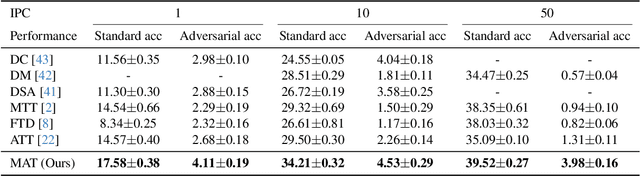
Dataset distillation synthesizes compact datasets that enable models to achieve performance comparable to training on the original large-scale datasets. However, existing distillation methods overlook the robustness of the model, resulting in models that are vulnerable to adversarial attacks when trained on distilled data. To address this limitation, we introduce the task of ``robust dataset distillation", a novel paradigm that embeds adversarial robustness into the synthetic datasets during the distillation process. We propose Matching Adversarial Trajectories (MAT), a method that integrates adversarial training into trajectory-based dataset distillation. MAT incorporates adversarial samples during trajectory generation to obtain robust training trajectories, which are then used to guide the distillation process. As experimentally demonstrated, even through natural training on our distilled dataset, models can achieve enhanced adversarial robustness while maintaining competitive accuracy compared to existing distillation methods. Our work highlights robust dataset distillation as a new and important research direction and provides a strong baseline for future research to bridge the gap between efficient training and adversarial robustness.
DistiLLM-2: A Contrastive Approach Boosts the Distillation of LLMs
Mar 10, 2025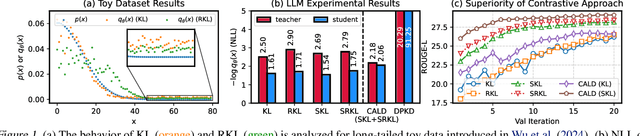
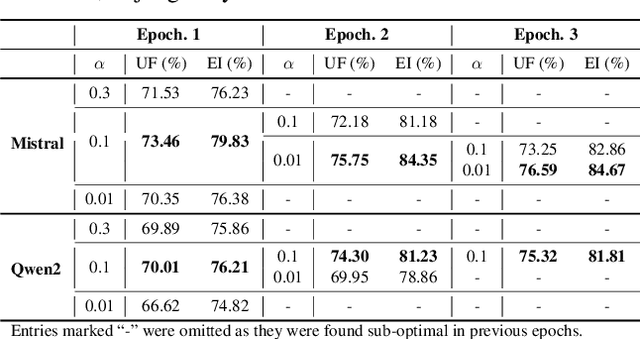
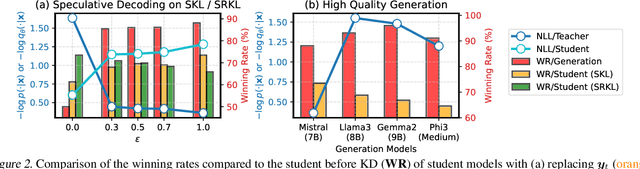
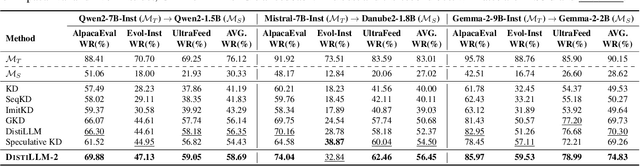
Despite the success of distillation in large language models (LLMs), most prior work applies identical loss functions to both teacher- and student-generated data. These strategies overlook the synergy between loss formulations and data types, leading to a suboptimal performance boost in student models. To address this, we propose DistiLLM-2, a contrastive approach that simultaneously increases the likelihood of teacher responses and decreases that of student responses by harnessing this synergy. Our extensive experiments show that DistiLLM-2 not only builds high-performing student models across a wide range of tasks, including instruction-following and code generation, but also supports diverse applications, such as preference alignment and vision-language extensions. These findings highlight the potential of a contrastive approach to enhance the efficacy of LLM distillation by effectively aligning teacher and student models across varied data types.
Automatic Joint Structured Pruning and Quantization for Efficient Neural Network Training and Compression
Feb 23, 2025Structured pruning and quantization are fundamental techniques used to reduce the size of deep neural networks (DNNs) and typically are applied independently. Applying these techniques jointly via co-optimization has the potential to produce smaller, high-quality models. However, existing joint schemes are not widely used because of (1) engineering difficulties (complicated multi-stage processes), (2) black-box optimization (extensive hyperparameter tuning to control the overall compression), and (3) insufficient architecture generalization. To address these limitations, we present the framework GETA, which automatically and efficiently performs joint structured pruning and quantization-aware training on any DNNs. GETA introduces three key innovations: (i) a quantization-aware dependency graph (QADG) that constructs a pruning search space for generic quantization-aware DNN, (ii) a partially projected stochastic gradient method that guarantees layerwise bit constraints are satisfied, and (iii) a new joint learning strategy that incorporates interpretable relationships between pruning and quantization. We present numerical experiments on both convolutional neural networks and transformer architectures that show that our approach achieves competitive (often superior) performance compared to existing joint pruning and quantization methods.
StructSR: Refuse Spurious Details in Real-World Image Super-Resolution
Jan 16, 2025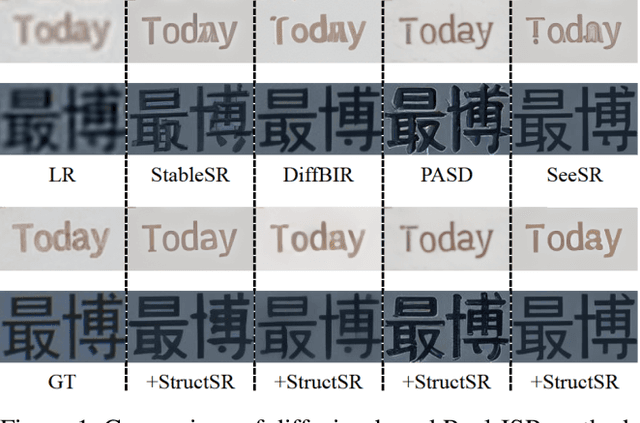
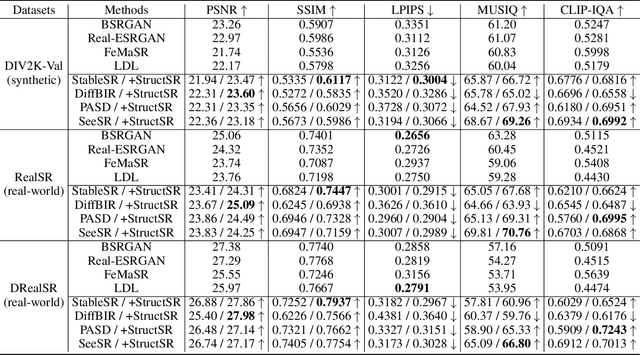
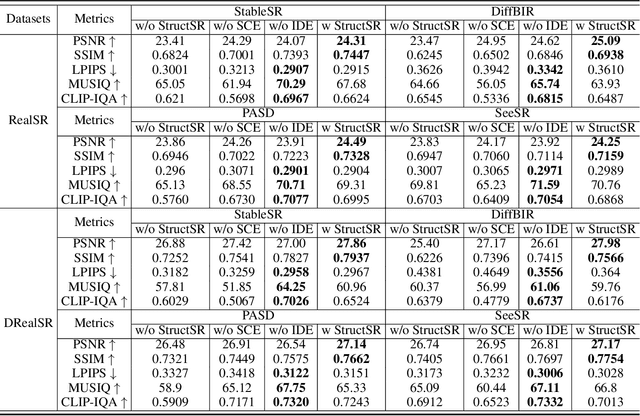
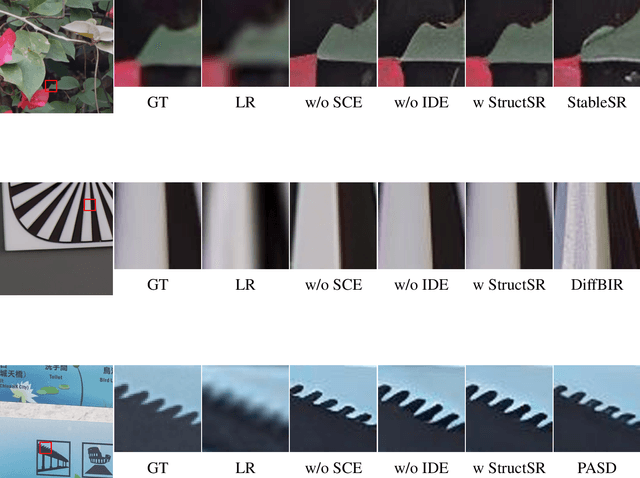
Diffusion-based models have shown great promise in real-world image super-resolution (Real-ISR), but often generate content with structural errors and spurious texture details due to the empirical priors and illusions of these models. To address this issue, we introduce StructSR, a simple, effective, and plug-and-play method that enhances structural fidelity and suppresses spurious details for diffusion-based Real-ISR. StructSR operates without the need for additional fine-tuning, external model priors, or high-level semantic knowledge. At its core is the Structure-Aware Screening (SAS) mechanism, which identifies the image with the highest structural similarity to the low-resolution (LR) input in the early inference stage, allowing us to leverage it as a historical structure knowledge to suppress the generation of spurious details. By intervening in the diffusion inference process, StructSR seamlessly integrates with existing diffusion-based Real-ISR models. Our experimental results demonstrate that StructSR significantly improves the fidelity of structure and texture, improving the PSNR and SSIM metrics by an average of 5.27% and 9.36% on a synthetic dataset (DIV2K-Val) and 4.13% and 8.64% on two real-world datasets (RealSR and DRealSR) when integrated with four state-of-the-art diffusion-based Real-ISR methods.