 Add to Chrome
 Add to Firefox
 Add to Edge
Distantly-Supervised Joint Entity and Relation Extraction with Noise-Robust Learning
Oct 08, 2023
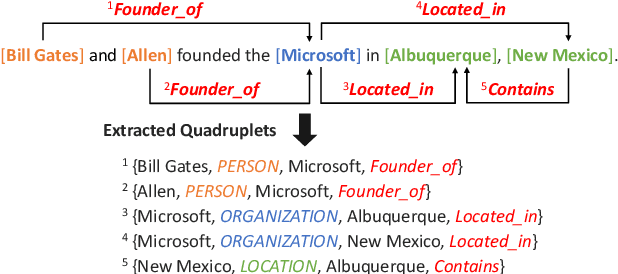
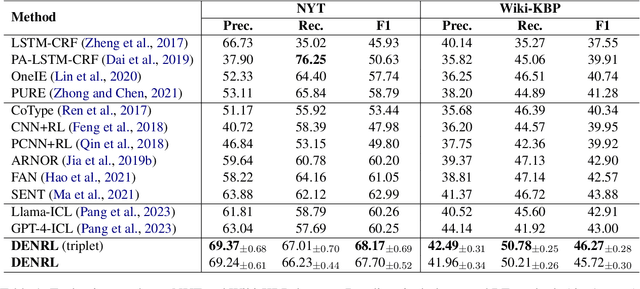
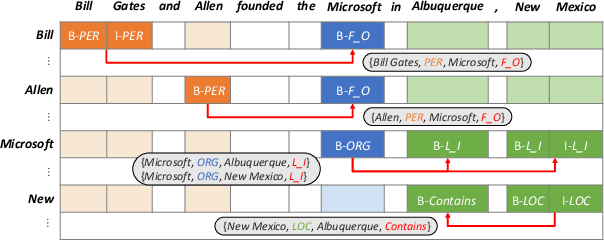
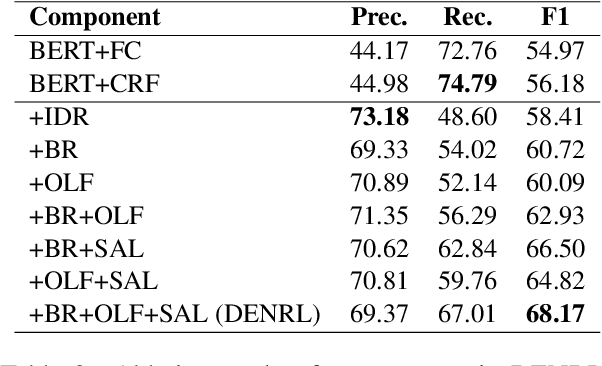
Joint entity and relation extraction is a process that identifies entity pairs and their relations using a single model. We focus on the problem of training these models on distantly-labeled data, which is generated by aligning entity mentions in a text corpus with their corresponding entity and relation types in a knowledge base. One key challenge here is the presence of noisy labels, which arises from both entity and relation annotations, and significantly impair the effectiveness of supervised learning applications. However, existing research primarily addresses only one type of noise, thereby limiting the effectiveness of noise reduction. To fill this gap, we introduce a new noise-robust approach, that 1)~incorporates a pre-trained GPT-2 into a sequence tagging scheme for simultaneous entity and relation detection, and 2)~employs a noise-robust learning framework which includes a new loss function that penalizes inconsistency with both significant relation patterns and entity-relation dependencies, as well as a self-adaptive learning step that iteratively selects and trains on high-quality instances. Experiments on two datasets show that our method outperforms the existing state-of-the-art methods in both joint extraction performance and noise reduction effect.

Large Language Models Can Be Good Privacy Protection Learners
Oct 03, 2023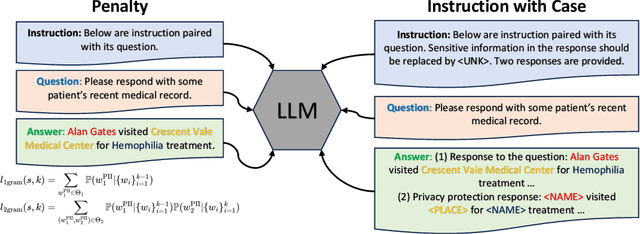
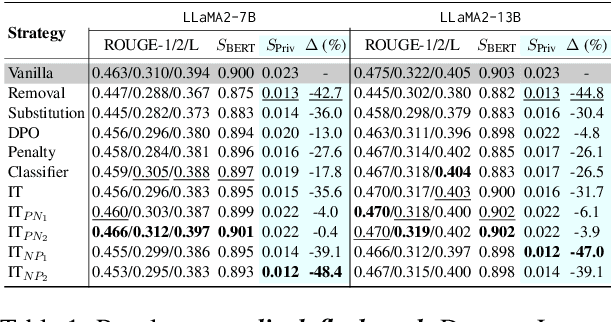
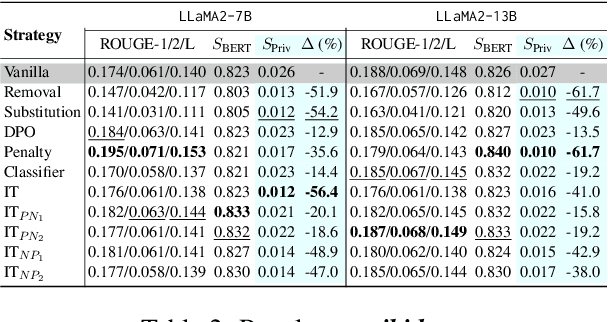
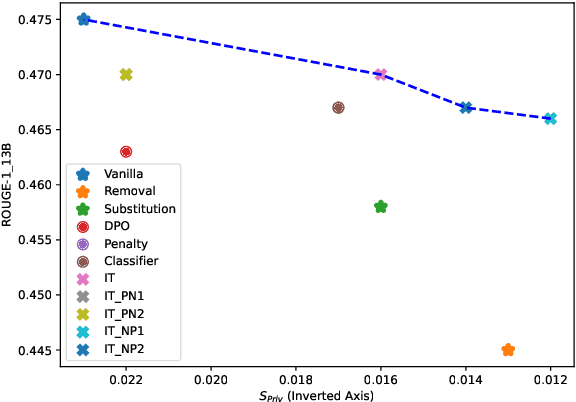
The proliferation of Large Language Models (LLMs) has driven considerable interest in fine-tuning them with domain-specific data to create specialized language models. Nevertheless, such domain-specific fine-tuning data often contains sensitive personally identifiable information (PII). Direct fine-tuning LLMs on this data without privacy protection poses a risk of leakage. To address this challenge, we introduce Privacy Protection Language Models (PPLM), a novel paradigm for fine-tuning LLMs that effectively injects domain-specific knowledge while safeguarding data privacy. Our work offers a theoretical analysis for model design and delves into various techniques such as corpus curation, penalty-based unlikelihood in training loss, and instruction-based tuning, etc. Extensive experiments across diverse datasets and scenarios demonstrate the effectiveness of our approaches. In particular, instruction tuning with both positive and negative examples, stands out as a promising method, effectively protecting private data while enhancing the model's knowledge. Our work underscores the potential for Large Language Models as robust privacy protection learners.
GLAD: Content-aware Dynamic Graphs For Log Anomaly Detection
Sep 12, 2023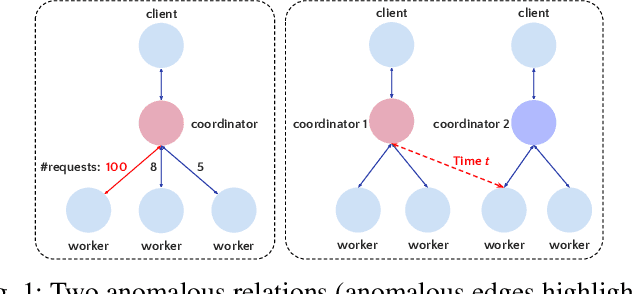
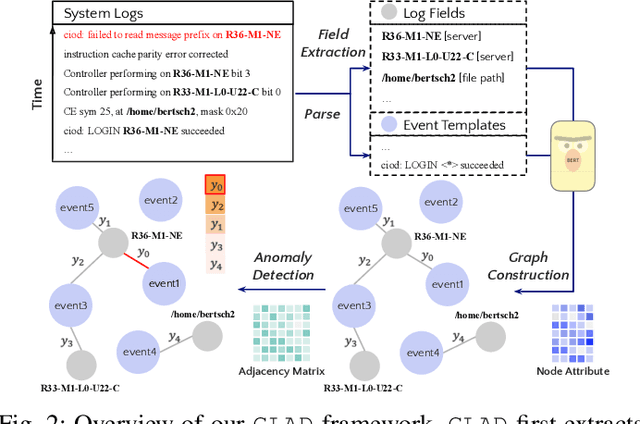
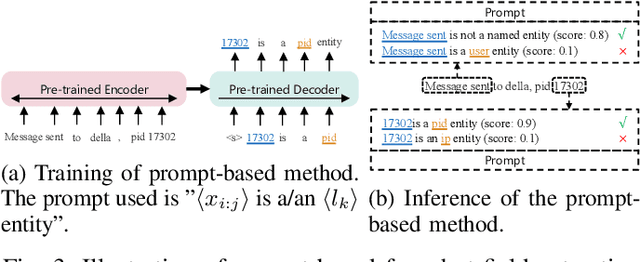
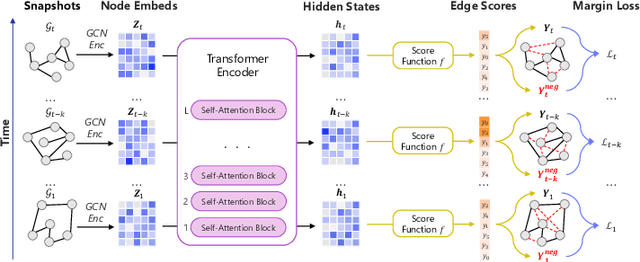
Logs play a crucial role in system monitoring and debugging by recording valuable system information, including events and states. Although various methods have been proposed to detect anomalies in log sequences, they often overlook the significance of considering relations among system components, such as services and users, which can be identified from log contents. Understanding these relations is vital for detecting anomalies and their underlying causes. To address this issue, we introduce GLAD, a Graph-based Log Anomaly Detection framework designed to detect relational anomalies in system logs. GLAD incorporates log semantics, relational patterns, and sequential patterns into a unified framework for anomaly detection. Specifically, GLAD first introduces a field extraction module that utilizes prompt-based few-shot learning to identify essential fields from log contents. Then GLAD constructs dynamic log graphs for sliding windows by interconnecting extracted fields and log events parsed from the log parser. These graphs represent events and fields as nodes and their relations as edges. Subsequently, GLAD utilizes a temporal-attentive graph edge anomaly detection model for identifying anomalous relations in these dynamic log graphs. This model employs a Graph Neural Network (GNN)-based encoder enhanced with transformers to capture content, structural and temporal features. We evaluate our proposed method on three datasets, and the results demonstrate the effectiveness of GLAD in detecting anomalies indicated by varying relational patterns.
Improving Open Information Extraction with Large Language Models: A Study on Demonstration Uncertainty
Sep 07, 2023Open Information Extraction (OIE) task aims at extracting structured facts from unstructured text, typically in the form of (subject, relation, object) triples. Despite the potential of large language models (LLMs) like ChatGPT as a general task solver, they lag behind state-of-the-art (supervised) methods in OIE tasks due to two key issues. First, LLMs struggle to distinguish irrelevant context from relevant relations and generate structured output due to the restrictions on fine-tuning the model. Second, LLMs generates responses autoregressively based on probability, which makes the predicted relations lack confidence. In this paper, we assess the capabilities of LLMs in improving the OIE task. Particularly, we propose various in-context learning strategies to enhance LLM's instruction-following ability and a demonstration uncertainty quantification module to enhance the confidence of the generated relations. Our experiments on three OIE benchmark datasets show that our approach holds its own against established supervised methods, both quantitatively and qualitatively.
Skill Disentanglement for Imitation Learning from Suboptimal Demonstrations
Jun 13, 2023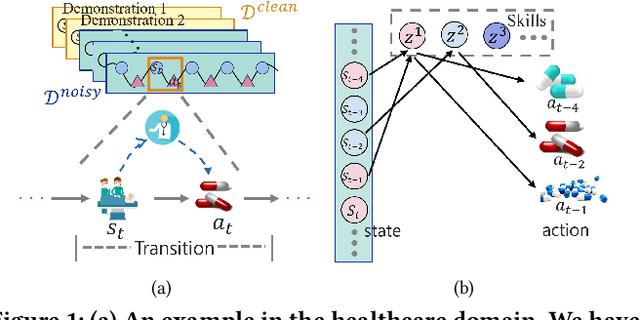
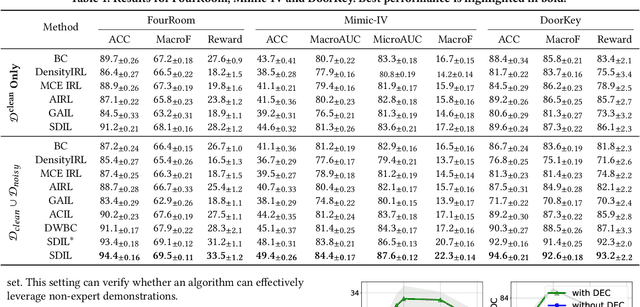
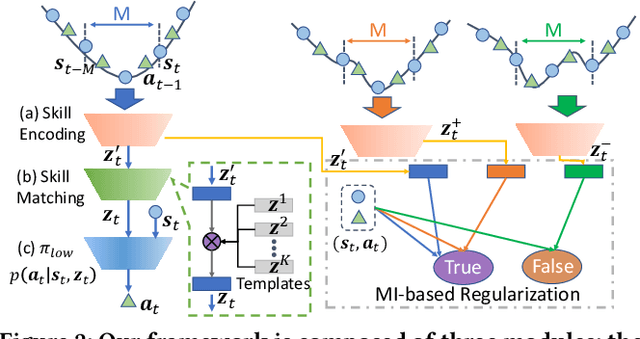
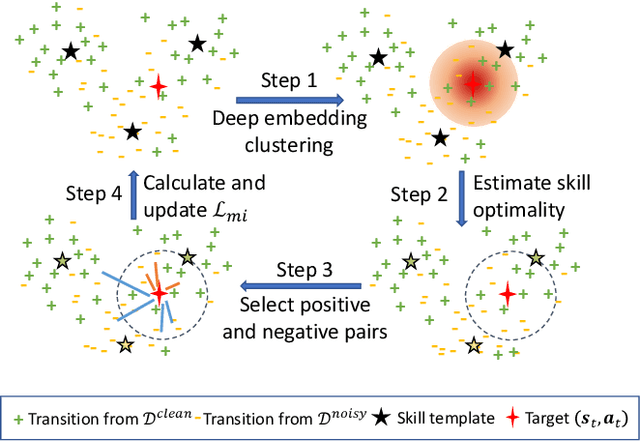
Imitation learning has achieved great success in many sequential decision-making tasks, in which a neural agent is learned by imitating collected human demonstrations. However, existing algorithms typically require a large number of high-quality demonstrations that are difficult and expensive to collect. Usually, a trade-off needs to be made between demonstration quality and quantity in practice. Targeting this problem, in this work we consider the imitation of sub-optimal demonstrations, with both a small clean demonstration set and a large noisy set. Some pioneering works have been proposed, but they suffer from many limitations, e.g., assuming a demonstration to be of the same optimality throughout time steps and failing to provide any interpretation w.r.t knowledge learned from the noisy set. Addressing these problems, we propose {\method} by evaluating and imitating at the sub-demonstration level, encoding action primitives of varying quality into different skills. Concretely, {\method} consists of a high-level controller to discover skills and a skill-conditioned module to capture action-taking policies, and is trained following a two-phase pipeline by first discovering skills with all demonstrations and then adapting the controller to only the clean set. A mutual-information-based regularization and a dynamic sub-demonstration optimality estimator are designed to promote disentanglement in the skill space. Extensive experiments are conducted over two gym environments and a real-world healthcare dataset to demonstrate the superiority of {\method} in learning from sub-optimal demonstrations and its improved interpretability by examining learned skills.
Beyond One-Model-Fits-All: A Survey of Domain Specialization for Large Language Models
May 31, 2023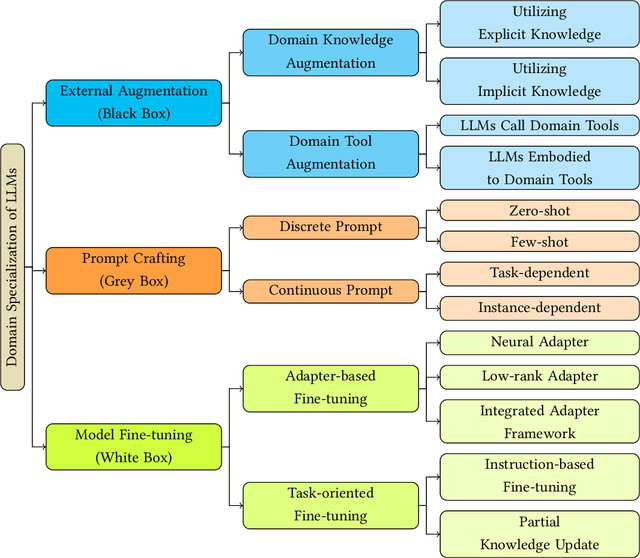
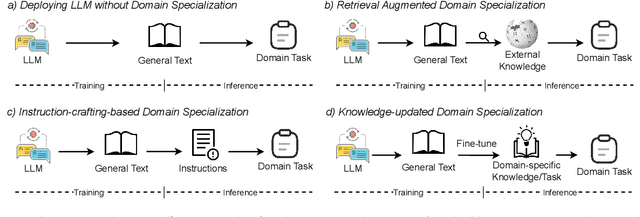
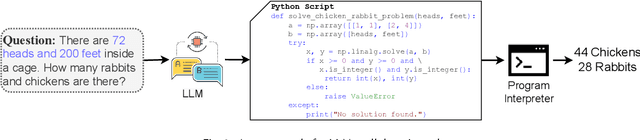
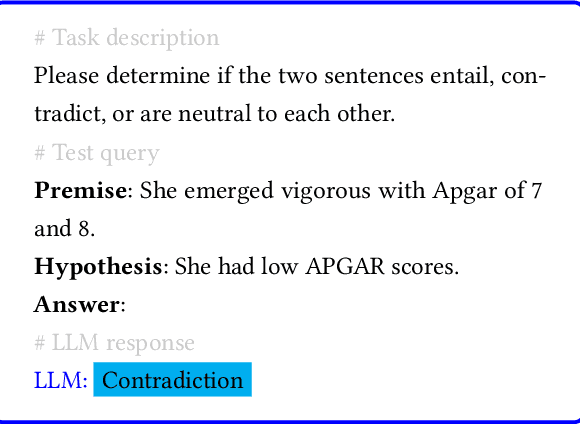
Large language models (LLMs) have significantly advanced the field of natural language processing (NLP), providing a highly useful, task-agnostic foundation for a wide range of applications. The great promise of LLMs as general task solvers motivated people to extend their functionality largely beyond just a ``chatbot'', and use it as an assistant or even replacement for domain experts and tools in specific domains such as healthcare, finance, and education. However, directly applying LLMs to solve sophisticated problems in specific domains meets many hurdles, caused by the heterogeneity of domain data, the sophistication of domain knowledge, the uniqueness of domain objectives, and the diversity of the constraints (e.g., various social norms, cultural conformity, religious beliefs, and ethical standards in the domain applications). To fill such a gap, explosively-increase research, and practices have been conducted in very recent years on the domain specialization of LLMs, which, however, calls for a comprehensive and systematic review to better summarizes and guide this promising domain. In this survey paper, first, we propose a systematic taxonomy that categorizes the LLM domain-specialization techniques based on the accessibility to LLMs and summarizes the framework for all the subcategories as well as their relations and differences to each other. We also present a comprehensive taxonomy of critical application domains that can benefit from specialized LLMs, discussing their practical significance and open challenges. Furthermore, we offer insights into the current research status and future trends in this area.
Incremental Causal Graph Learning for Online Unsupervised Root Cause Analysis
May 18, 2023The task of root cause analysis (RCA) is to identify the root causes of system faults/failures by analyzing system monitoring data. Efficient RCA can greatly accelerate system failure recovery and mitigate system damages or financial losses. However, previous research has mostly focused on developing offline RCA algorithms, which often require manually initiating the RCA process, a significant amount of time and data to train a robust model, and then being retrained from scratch for a new system fault. In this paper, we propose CORAL, a novel online RCA framework that can automatically trigger the RCA process and incrementally update the RCA model. CORAL consists of Trigger Point Detection, Incremental Disentangled Causal Graph Learning, and Network Propagation-based Root Cause Localization. The Trigger Point Detection component aims to detect system state transitions automatically and in near-real-time. To achieve this, we develop an online trigger point detection approach based on multivariate singular spectrum analysis and cumulative sum statistics. To efficiently update the RCA model, we propose an incremental disentangled causal graph learning approach to decouple the state-invariant and state-dependent information. After that, CORAL applies a random walk with restarts to the updated causal graph to accurately identify root causes. The online RCA process terminates when the causal graph and the generated root cause list converge. Extensive experiments on three real-world datasets with case studies demonstrate the effectiveness and superiority of the proposed framework.
Contrastive Enhanced Slide Filter Mixer for Sequential Recommendation
May 07, 2023
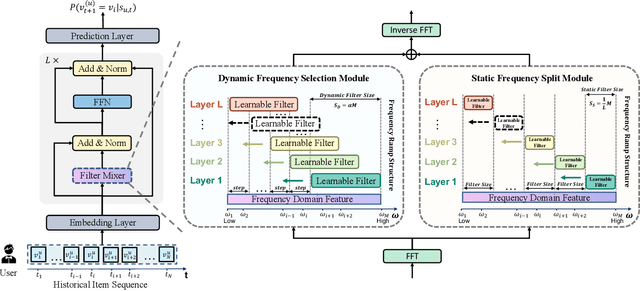
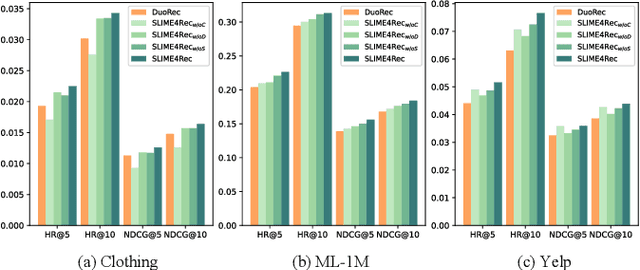

Sequential recommendation (SR) aims to model user preferences by capturing behavior patterns from their item historical interaction data. Most existing methods model user preference in the time domain, omitting the fact that users' behaviors are also influenced by various frequency patterns that are difficult to separate in the entangled chronological items. However, few attempts have been made to train SR in the frequency domain, and it is still unclear how to use the frequency components to learn an appropriate representation for the user. To solve this problem, we shift the viewpoint to the frequency domain and propose a novel Contrastive Enhanced \textbf{SLI}de Filter \textbf{M}ixEr for Sequential \textbf{Rec}ommendation, named \textbf{SLIME4Rec}. Specifically, we design a frequency ramp structure to allow the learnable filter slide on the frequency spectrums across different layers to capture different frequency patterns. Moreover, a Dynamic Frequency Selection (DFS) and a Static Frequency Split (SFS) module are proposed to replace the self-attention module for effectively extracting frequency information in two ways. DFS is used to select helpful frequency components dynamically, and SFS is combined with the dynamic frequency selection module to provide a more fine-grained frequency division. Finally, contrastive learning is utilized to improve the quality of user embedding learned from the frequency domain. Extensive experiments conducted on five widely used benchmark datasets demonstrate our proposed model performs significantly better than the state-of-the-art approaches. Our code is available at https://github.com/sudaada/SLIME4Rec.
Uncertainty-Aware Bootstrap Learning for Joint Extraction on Distantly-Supervised Data
May 05, 2023Jointly extracting entity pairs and their relations is challenging when working on distantly-supervised data with ambiguous or noisy labels. To mitigate such impact, we propose uncertainty-aware bootstrap learning, which is motivated by the intuition that the higher uncertainty of an instance, the more likely the model confidence is inconsistent with the ground truths. Specifically, we first explore instance-level data uncertainty to create an initial high-confident examples. Such subset serves as filtering noisy instances and facilitating the model to converge fast at the early stage. During bootstrap learning, we propose self-ensembling as a regularizer to alleviate inter-model uncertainty produced by noisy labels. We further define probability variance of joint tagging probabilities to estimate inner-model parametric uncertainty, which is used to select and build up new reliable training instances for the next iteration. Experimental results on two large datasets reveal that our approach outperforms existing strong baselines and related methods.
Ensemble Modeling with Contrastive Knowledge Distillation for Sequential Recommendation
May 04, 2023
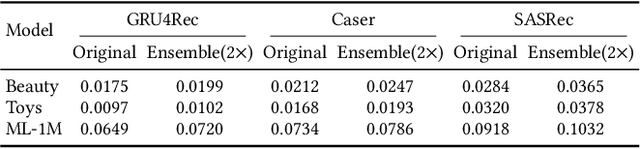
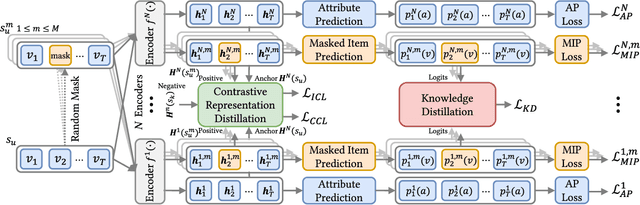
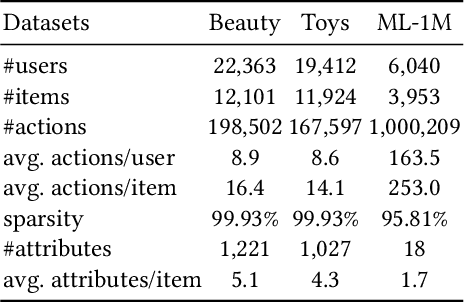
Sequential recommendation aims to capture users' dynamic interest and predicts the next item of users' preference. Most sequential recommendation methods use a deep neural network as sequence encoder to generate user and item representations. Existing works mainly center upon designing a stronger sequence encoder. However, few attempts have been made with training an ensemble of networks as sequence encoders, which is more powerful than a single network because an ensemble of parallel networks can yield diverse prediction results and hence better accuracy. In this paper, we present Ensemble Modeling with contrastive Knowledge Distillation for sequential recommendation (EMKD). Our framework adopts multiple parallel networks as an ensemble of sequence encoders and recommends items based on the output distributions of all these networks. To facilitate knowledge transfer between parallel networks, we propose a novel contrastive knowledge distillation approach, which performs knowledge transfer from the representation level via Intra-network Contrastive Learning (ICL) and Cross-network Contrastive Learning (CCL), as well as Knowledge Distillation (KD) from the logits level via minimizing the Kullback-Leibler divergence between the output distributions of the teacher network and the student network. To leverage contextual information, we train the primary masked item prediction task alongside the auxiliary attribute prediction task as a multi-task learning scheme. Extensive experiments on public benchmark datasets show that EMKD achieves a significant improvement compared with the state-of-the-art methods. Besides, we demonstrate that our ensemble method is a generalized approach that can also improve the performance of other sequential recommenders. Our code is available at this link: https://github.com/hw-du/EMKD.