 Add to Chrome
 Add to Firefox
 Add to Edge
Macaron-V1: Towards Open Continual Learning with Self-Improvement and Mixture-of-LoRA
Aug 10, 2026
Macaron-V1 is an open agent-model family for experiential intelligence: learning from experience in real environments and continuing to learn after deployment. It is organized around two system goals. Adaptation is pursued through recursive improvement of versioned model-harness pairs, where experience from one configuration is evaluated under an external contract and used to construct its successor. Collaboration is pursued via the Mixture-of-LoRA (MoL) architecture that freezes a base model, composes specialist LoRA adapters, and selects one LoRA per user turn. The flagship Macaron-V1-Venti combines a 744B GLM-5.2 base with four LoRAs for chat, agent, coding, and GenUI; the Qwen3.6-based Macaron-V1-Tall (50B) uses the same design for local deployment. This report presents Macaron-V1 as a co-designed system spanning architecture, algorithms, and infrastructure. The MoL architecture supports continual learning through extensible LoRA specialists. The algorithm combines Model-Harness Co-design and recursive self-improvement loop, including the UI4A component-native GenUI harness, a stateful action substrate, versioned HCP contract, and the agentic RL framework MindForge. The supporting infrastructure includes the post-training platform MinT, the long-context RL method LongStraw, and stability techniques for sparse MoE and DSA base models. We evaluate Macaron-V1 on Personal Intelligence, GenUI, and general capability benchmarks against frontier baselines. Our results validate the current system, while compounding gains from continual learning and collective intelligence remain open questions.

Debias in Text, Believe Your Eyes: Text-Anchored Cross-Modal Transfer for Visual Counter-Commonsense Reasoning
Aug 07, 2026The visual reasoning ability of multimodal large language models (MLLMs) is crucial for downstream applications, particularly counter-commonsense reasoning, which requires models to reason beyond common assumptions. Recent studies mainly improve visual counter-commonsense reasoning by enhancing visual inputs, following the assumption that failures originate from insufficient visual grounding. However, our empirical analysis reveals that the bottleneck is not visual perception. MLLMs already capture the relevant visual evidence, and the correct answer exists in their decoding space. Instead, the shared language decoder resolves prior--evidence conflicts by favoring dominant language priors, especially for low-frequency factual scenarios. Motivated by this, we first propose a text-anchored data construction pipeline, whose core component, Fact-Frequency Distillation (FFD), estimates the prior strength of commonsense facts and distills verified counter-commonsense scenarios into a high-quality text corpus. Building upon this corpus, we introduce TACT, a text-anchored post-training framework that debiases the shared language decoder without requiring any visual training data. TACT routes evidence-following and prior-driven reasoning trajectories into different optimization stages, enabling the decoder to resolve prior--evidence conflicts. Across counter-commonsense visual benchmarks, TACT substantially improves visual reasoning while preserving general capabilities, demonstrating effective text-to-vision cross-modal transfer.
PACE: Two-Timescale Self-Evolution for Small Language Model Agents
May 21, 2026Deploying language-model agents in production often requires substantial compute and human effort to tune prompts, parsers, validators, and other components of the agent pipeline. Self-evolution offers a promising alternative, but most existing frameworks assume access to frontier models that can reliably diagnose failures, propose revisions, and judge their own updates. We study whether frozen small language models (SLMs) can serve as effective self-evolving agents under resource constraints. We propose PACE (Prompt And Control Logic Evolution), a two-timescale framework that coordinates low-risk prompt refinement with higher-risk control-logic updates. PACE evolves prompts under fixed control logic until prompt-level gains saturate, then considers constrained control-logic updates that are accepted through held-out validation. Across three frozen SLM backbones ranging from 4B to 14B parameters and four controlled benchmarks, PACE achieves the best performance on all 12 backbone--benchmark combinations, improving over vanilla SLM agents by up to +9.2% relative improvement and over the stronger single-mode evolution baseline by up to +5.4% relative improvement. A tau-bench case study further shows that PACE improves multi-turn tool-use success over vanilla and prompt-only evolution. These results suggest that reliable SLM agent self-evolution is possible without updating model weights or relying on frontier-model teachers, and that the key benefit is not any single final solver pattern but autonomous, validated discovery of task-appropriate inference strategies.
SR$^{2}$-Net: A General Plug-and-Play Model for Spectral Refinement in Hyperspectral Image Super-Resolution
Jan 29, 2026HSI-SR aims to enhance spatial resolution while preserving spectrally faithful and physically plausible characteristics. Recent methods have achieved great progress by leveraging spatial correlations to enhance spatial resolution. However, these methods often neglect spectral consistency across bands, leading to spurious oscillations and physically implausible artifacts. While spectral consistency can be addressed by designing the network architecture, it results in a loss of generality and flexibility. To address this issue, we propose a lightweight plug-and-play rectifier, physically priors Spectral Rectification Super-Resolution Network (SR$^{2}$-Net), which can be attached to a wide range of HSI-SR models without modifying their architectures. SR$^{2}$-Net follows an enhance-then-rectify pipeline consisting of (i) Hierarchical Spectral-Spatial Synergy Attention (H-S$^{3}$A) to reinforce cross-band interactions and (ii) Manifold Consistency Rectification (MCR) to constrain the reconstructed spectra to a compact, physically plausible spectral manifold. In addition, we introduce a degradation-consistency loss to enforce data fidelity by encouraging the degraded SR output to match the observed low resolution input. Extensive experiments on multiple benchmarks and diverse backbones demonstrate consistent improvements in spectral fidelity and overall reconstruction quality with negligible computational overhead. Our code will be released upon publication.
Physical Prompt Injection Attacks on Large Vision-Language Models
Jan 24, 2026Large Vision-Language Models (LVLMs) are increasingly deployed in real-world intelligent systems for perception and reasoning in open physical environments. While LVLMs are known to be vulnerable to prompt injection attacks, existing methods either require access to input channels or depend on knowledge of user queries, assumptions that rarely hold in practical deployments. We propose the first Physical Prompt Injection Attack (PPIA), a black-box, query-agnostic attack that embeds malicious typographic instructions into physical objects perceivable by the LVLM. PPIA requires no access to the model, its inputs, or internal pipeline, and operates solely through visual observation. It combines offline selection of highly recognizable and semantically effective visual prompts with strategic environment-aware placement guided by spatiotemporal attention, ensuring that the injected prompts are both perceivable and influential on model behavior. We evaluate PPIA across 10 state-of-the-art LVLMs in both simulated and real-world settings on tasks including visual question answering, planning, and navigation, PPIA achieves attack success rates up to 98%, with strong robustness under varying physical conditions such as distance, viewpoint, and illumination. Our code is publicly available at https://github.com/2023cghacker/Physical-Prompt-Injection-Attack.
Evaluating the encoding competence of visual language models using uncommon actions
Jan 12, 2026We propose UAIT (Uncommon-sense Action Image-Text) dataset, a new evaluation benchmark designed to test the semantic understanding ability of visual language models (VLMs) in uncommon-sense action scenes. Unlike previous datasets that focus on common visual scenes with statistical frequency advantages, UAIT challenges models with grammatically reasonable but semantically counter-common sense image-text pairs. Such tasks require models to go beyond superficial pattern recognition and demonstrate a deep understanding of agent-patient relationships and physical feasibility. To build UAIT, we designed a semi-automated process to synthesize high-quality uncommon-sense image-text samples using large language models, few-shot prompt engineering, and text-to-image generation. Each sample is accompanied by a carefully designed multiple-choice question to test the model's competence in fine-grained reasoning. We evaluate multiple state-of-the-art visual language models and compare them with models based on contrastive learning. Experiments show that all models perform significantly worse than humans in semantic judgment, especially in distinguishing grammatical correctness from semantic rationality. Further experiments show that even the lightweight model can improve its accuracy after fine-tuning, demonstrating the great potential of directional adaptation. This study not only reveals the key weaknesses of VLMs, but also provides diagnostic tools and research directions for the development of robust models with real visual semantic reasoning capabilities.
M2SE: A Multistage Multitask Instruction Tuning Strategy for Unified Sentiment and Emotion Analysis
Dec 11, 2024


Sentiment analysis and emotion recognition are crucial for applications such as human-computer interaction and depression detection. Traditional unimodal methods often fail to capture the complexity of emotional expressions due to conflicting signals from different modalities. Current Multimodal Large Language Models (MLLMs) also face challenges in detecting subtle facial expressions and addressing a wide range of emotion-related tasks. To tackle these issues, we propose M2SE, a Multistage Multitask Sentiment and Emotion Instruction Tuning Strategy for general-purpose MLLMs. It employs a combined approach to train models on tasks such as multimodal sentiment analysis, emotion recognition, facial expression recognition, emotion reason inference, and emotion cause-pair extraction. We also introduce the Emotion Multitask dataset (EMT), a custom dataset that supports these five tasks. Our model, Emotion Universe (EmoVerse), is built on a basic MLLM framework without modifications, yet it achieves substantial improvements across these tasks when trained with the M2SE strategy. Extensive experiments demonstrate that EmoVerse outperforms existing methods, achieving state-of-the-art results in sentiment and emotion tasks. These results highlight the effectiveness of M2SE in enhancing multimodal emotion perception. The dataset and code are available at https://github.com/xiaoyaoxinyi/M2SE.
Enhancing Security Control Production With Generative AI
Nov 06, 2024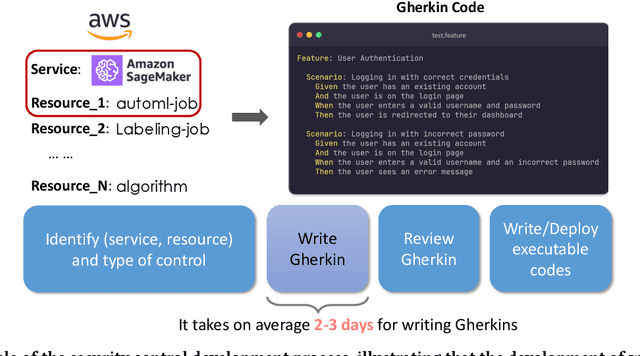
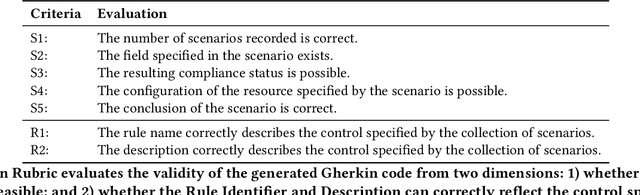
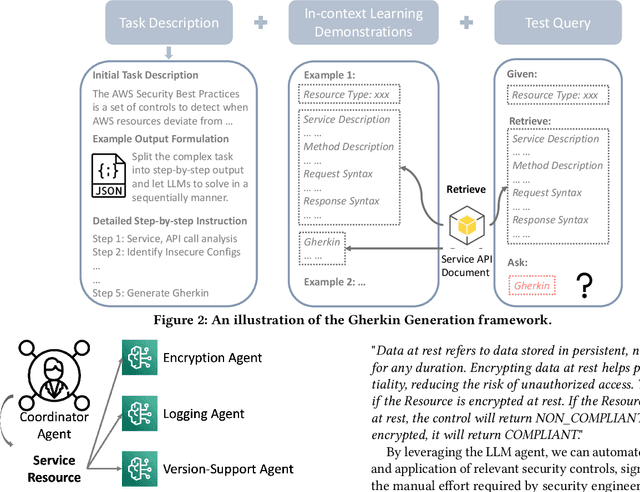
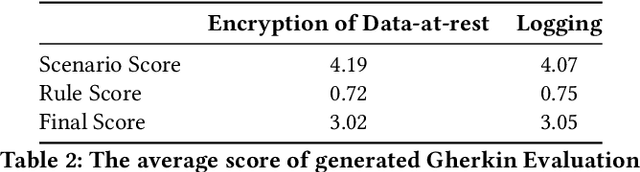
Security controls are mechanisms or policies designed for cloud based services to reduce risk, protect information, and ensure compliance with security regulations. The development of security controls is traditionally a labor-intensive and time-consuming process. This paper explores the use of Generative AI to accelerate the generation of security controls. We specifically focus on generating Gherkin codes which are the domain-specific language used to define the behavior of security controls in a structured and understandable format. By leveraging large language models and in-context learning, we propose a structured framework that reduces the time required for developing security controls from 2-3 days to less than one minute. Our approach integrates detailed task descriptions, step-by-step instructions, and retrieval-augmented generation to enhance the accuracy and efficiency of the generated Gherkin code. Initial evaluations on AWS cloud services demonstrate promising results, indicating that GenAI can effectively streamline the security control development process, thus providing a robust and dynamic safeguard for cloud-based infrastructures.
HiReview: Hierarchical Taxonomy-Driven Automatic Literature Review Generation
Oct 02, 2024In this work, we present HiReview, a novel framework for hierarchical taxonomy-driven automatic literature review generation. With the exponential growth of academic documents, manual literature reviews have become increasingly labor-intensive and time-consuming, while traditional summarization models struggle to generate comprehensive document reviews effectively. Large language models (LLMs), with their powerful text processing capabilities, offer a potential solution; however, research on incorporating LLMs for automatic document generation remains limited. To address key challenges in large-scale automatic literature review generation (LRG), we propose a two-stage taxonomy-then-generation approach that combines graph-based hierarchical clustering with retrieval-augmented LLMs. First, we retrieve the most relevant sub-community within the citation network, then generate a hierarchical taxonomy tree by clustering papers based on both textual content and citation relationships. In the second stage, an LLM generates coherent and contextually accurate summaries for clusters or topics at each hierarchical level, ensuring comprehensive coverage and logical organization of the literature. Extensive experiments demonstrate that HiReview significantly outperforms state-of-the-art methods, achieving superior hierarchical organization, content relevance, and factual accuracy in automatic literature review generation tasks.
PIXELMOD: Improving Soft Moderation of Visual Misleading Information on Twitter
Jul 30, 2024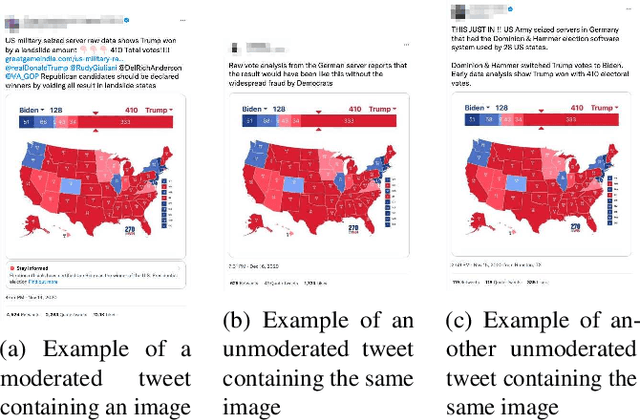
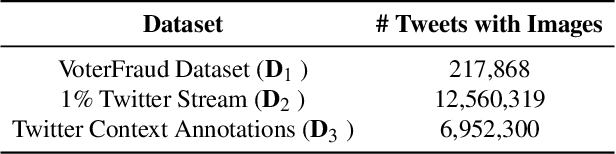
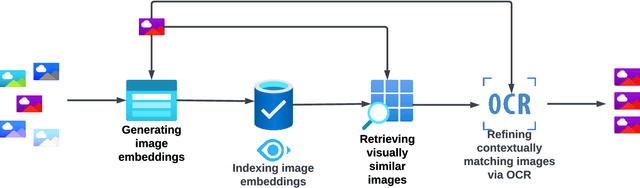
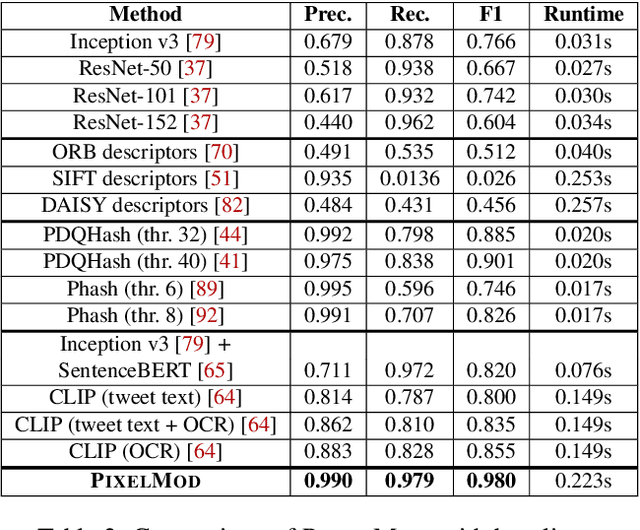
Images are a powerful and immediate vehicle to carry misleading or outright false messages, yet identifying image-based misinformation at scale poses unique challenges. In this paper, we present PIXELMOD, a system that leverages perceptual hashes, vector databases, and optical character recognition (OCR) to efficiently identify images that are candidates to receive soft moderation labels on Twitter. We show that PIXELMOD outperforms existing image similarity approaches when applied to soft moderation, with negligible performance overhead. We then test PIXELMOD on a dataset of tweets surrounding the 2020 US Presidential Election, and find that it is able to identify visually misleading images that are candidates for soft moderation with 0.99% false detection and 2.06% false negatives.