 Add to Chrome
 Add to Firefox
 Add to Edge
CELLO: Causal Evaluation of Large Vision-Language Models
Jun 27, 2024
Causal reasoning is fundamental to human intelligence and crucial for effective decision-making in real-world environments. Despite recent advancements in large vision-language models (LVLMs), their ability to comprehend causality remains unclear. Previous work typically focuses on commonsense causality between events and/or actions, which is insufficient for applications like embodied agents and lacks the explicitly defined causal graphs required for formal causal reasoning. To overcome these limitations, we introduce a fine-grained and unified definition of causality involving interactions between humans and/or objects. Building on the definition, we construct a novel dataset, CELLO, consisting of 14,094 causal questions across all four levels of causality: discovery, association, intervention, and counterfactual. This dataset surpasses traditional commonsense causality by including explicit causal graphs that detail the interactions between humans and objects. Extensive experiments on CELLO reveal that current LVLMs still struggle with causal reasoning tasks, but they can benefit significantly from our proposed CELLO-CoT, a causally inspired chain-of-thought prompting strategy. Both quantitative and qualitative analyses from this study provide valuable insights for future research. Our project page is at https://github.com/OpenCausaLab/CELLO.

Retrieval Augmented Instruction Tuning for Open NER with Large Language Models
Jun 25, 2024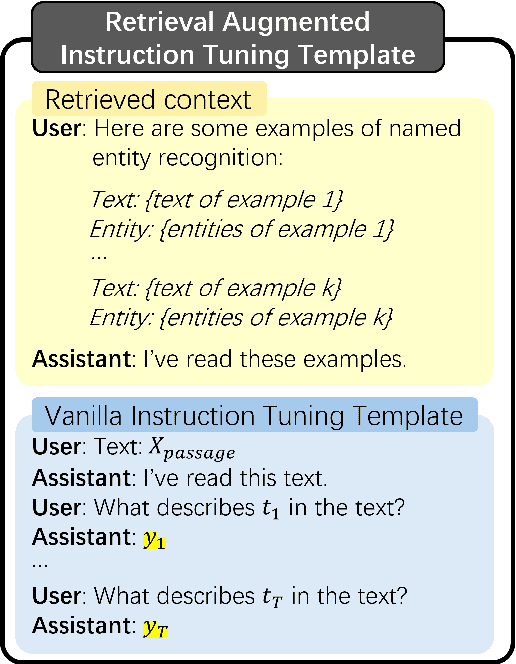


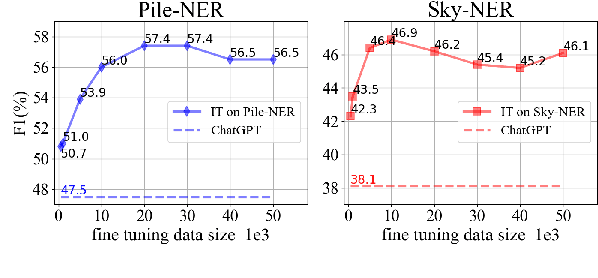
The strong capability of large language models (LLMs) has been applied to information extraction (IE) through either retrieval augmented prompting or instruction tuning (IT). However, the best way to incorporate information with LLMs for IE remains an open question. In this paper, we explore Retrieval Augmented Instruction Tuning (RA-IT) for IE, focusing on the task of open named entity recognition (NER). Specifically, for each training sample, we retrieve semantically similar examples from the training dataset as the context and prepend them to the input of the original instruction. To evaluate our RA-IT approach more thoroughly, we construct a Chinese IT dataset for open NER and evaluate RA-IT in both English and Chinese scenarios. Experimental results verify the effectiveness of RA-IT across various data sizes and in both English and Chinese scenarios. We also conduct thorough studies to explore the impacts of various retrieval strategies in the proposed RA-IT framework. Code and data are available at: https://github.com/Emma1066/Retrieval-Augmented-IT-OpenNER
Ladder: A Model-Agnostic Framework Boosting LLM-based Machine Translation to the Next Level
Jun 22, 2024General-purpose Large Language Models (LLMs) like GPT-4 have achieved remarkable advancements in machine translation (MT) by leveraging extensive web content. On the other hand, translation-specific LLMs are built by pre-training on domain-specific monolingual corpora and fine-tuning with human-annotated translation data. Despite the superior performance, these methods either demand an unprecedented scale of computing and data or substantial human editing and annotation efforts. In this paper, we develop Ladder, a novel model-agnostic and cost-effective tool to refine the performance of general LLMs for MT. Ladder is trained on pseudo-refinement triplets which can be easily obtained from existing LLMs without additional human cost. During training, we propose a hierarchical fine-tuning strategy with an easy-to-hard schema, improving Ladder's refining performance progressively. The trained Ladder can be seamlessly integrated with any general-purpose LLMs to boost their translation performance. By utilizing Gemma-2B/7B as the backbone, Ladder-2B can elevate raw translations to the level of top-tier open-source models (e.g., refining BigTranslate-13B with +6.91 BLEU and +3.52 COMET for XX-En), and Ladder-7B can further enhance model performance to be on par with the state-of-the-art GPT-4. Extensive ablation and analysis corroborate the effectiveness of Ladder in diverse settings. Our code is available at https://github.com/fzp0424/Ladder
AI-Empowered Multiple Access for 6G: A Survey of Spectrum Sensing, Protocol Designs, and Optimizations
Jun 19, 2024With the rapidly increasing number of bandwidth-intensive terminals capable of intelligent computing and communication, such as smart devices equipped with shallow neural network models, the complexity of multiple access for these intelligent terminals is increasing due to the dynamic network environment and ubiquitous connectivity in 6G systems. Traditional multiple access (MA) design and optimization methods are gradually losing ground to artificial intelligence (AI) techniques that have proven their superiority in handling complexity. AI-empowered MA and its optimization strategies aimed at achieving high Quality-of-Service (QoS) are attracting more attention, especially in the area of latency-sensitive applications in 6G systems. In this work, we aim to: 1) present the development and comparative evaluation of AI-enabled MA; 2) provide a timely survey focusing on spectrum sensing, protocol design, and optimization for AI-empowered MA; and 3) explore the potential use cases of AI-empowered MA in the typical application scenarios within 6G systems. Specifically, we first present a unified framework of AI-empowered MA for 6G systems by incorporating various promising machine learning techniques in spectrum sensing, resource allocation, MA protocol design, and optimization. We then introduce AI-empowered MA spectrum sensing related to spectrum sharing and spectrum interference management. Next, we discuss the AI-empowered MA protocol designs and implementation methods by reviewing and comparing the state-of-the-art, and we further explore the optimization algorithms related to dynamic resource management, parameter adjustment, and access scheme switching. Finally, we discuss the current challenges, point out open issues, and outline potential future research directions in this field.
Degrees of Freedom Matter: Inferring Dynamics from Point Trajectories
Jun 05, 2024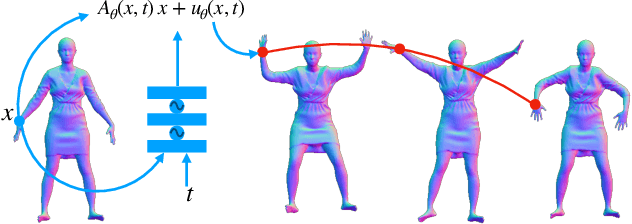
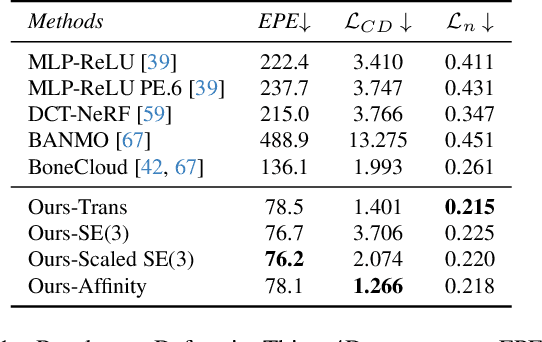
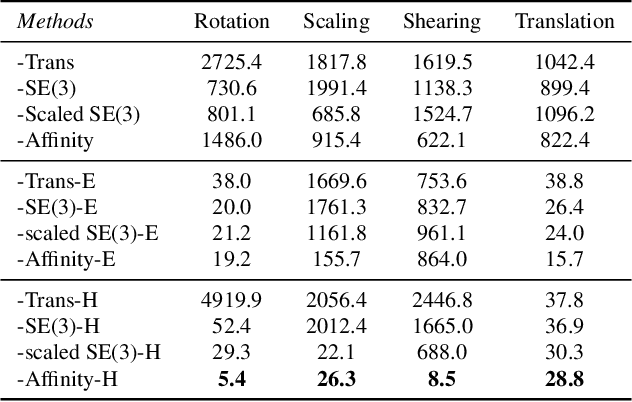
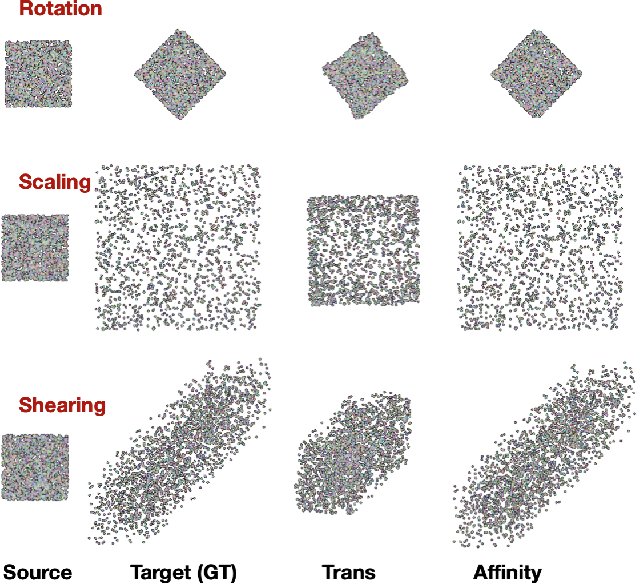
Understanding the dynamics of generic 3D scenes is fundamentally challenging in computer vision, essential in enhancing applications related to scene reconstruction, motion tracking, and avatar creation. In this work, we address the task as the problem of inferring dense, long-range motion of 3D points. By observing a set of point trajectories, we aim to learn an implicit motion field parameterized by a neural network to predict the movement of novel points within the same domain, without relying on any data-driven or scene-specific priors. To achieve this, our approach builds upon the recently introduced dynamic point field model that learns smooth deformation fields between the canonical frame and individual observation frames. However, temporal consistency between consecutive frames is neglected, and the number of required parameters increases linearly with the sequence length due to per-frame modeling. To address these shortcomings, we exploit the intrinsic regularization provided by SIREN, and modify the input layer to produce a spatiotemporally smooth motion field. Additionally, we analyze the motion field Jacobian matrix, and discover that the motion degrees of freedom (DOFs) in an infinitesimal area around a point and the network hidden variables have different behaviors to affect the model's representational power. This enables us to improve the model representation capability while retaining the model compactness. Furthermore, to reduce the risk of overfitting, we introduce a regularization term based on the assumption of piece-wise motion smoothness. Our experiments assess the model's performance in predicting unseen point trajectories and its application in temporal mesh alignment with guidance. The results demonstrate its superiority and effectiveness. The code and data for the project are publicly available: \url{https://yz-cnsdqz.github.io/eigenmotion/DOMA/}
UniQA: Unified Vision-Language Pre-training for Image Quality and Aesthetic Assessment
Jun 03, 2024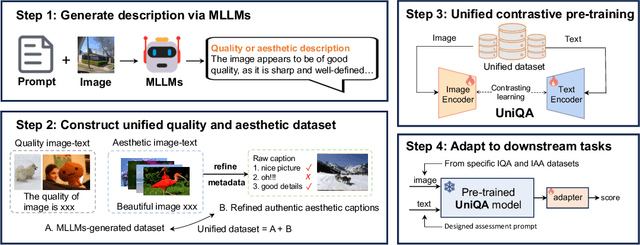
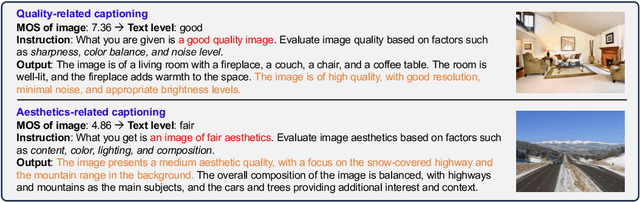
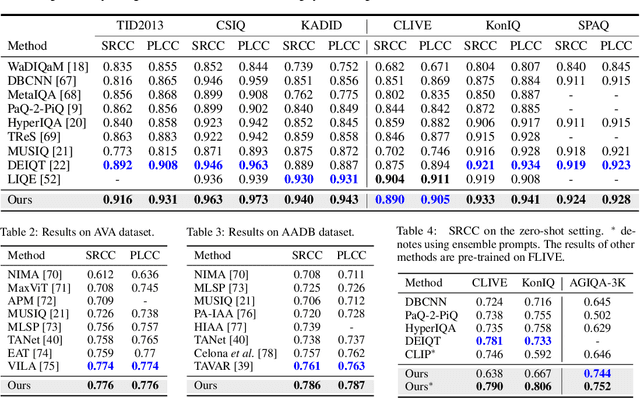
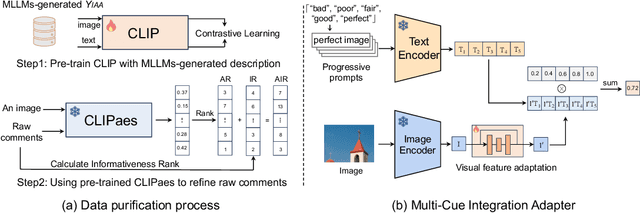
Image Quality Assessment (IQA) and Image Aesthetic Assessment (IAA) aim to simulate human subjective perception of image visual quality and aesthetic appeal. Existing methods typically address these tasks independently due to distinct learning objectives. However, they neglect the underlying interconnectedness of both tasks, which hinders the learning of task-agnostic shared representations for human subjective perception. To confront this challenge, we propose Unified vision-language pre-training of Quality and Aesthetics (UniQA), to learn general perceptions of two tasks, thereby benefiting them simultaneously. Addressing the absence of text in the IQA datasets and the presence of textual noise in the IAA datasets, (1) we utilize multimodal large language models (MLLMs) to generate high-quality text descriptions; (2) the generated text for IAA serves as metadata to purify noisy IAA data. To effectively adapt the pre-trained UniQA to downstream tasks, we further propose a lightweight adapter that utilizes versatile cues to fully exploit the extensive knowledge of the pre-trained model. Extensive experiments demonstrate that our approach attains a new state-of-the-art performance on both IQA and IAA tasks, while concurrently showcasing exceptional zero-shot and few-label image assessment capabilities. The source code will be available at https://github.com/zht8506/UniQA.
Faces of the Mind: Unveiling Mental Health States Through Facial Expressions in 11,427 Adolescents
May 30, 2024Mood disorders, including depression and anxiety, often manifest through facial expressions. While previous research has explored the connection between facial features and emotions, machine learning algorithms for estimating mood disorder severity have been hindered by small datasets and limited real-world application. To address this gap, we analyzed facial videos of 11,427 participants, a dataset two orders of magnitude larger than previous studies. This comprehensive collection includes standardized facial expression videos from reading tasks, along with a detailed psychological scale that measures depression, anxiety, and stress. By examining the relationships among these emotional states and employing clustering analysis, we identified distinct subgroups embodying different emotional profiles. We then trained tree-based classifiers and deep learning models to estimate emotional states from facial features. Results indicate that models previously effective on small datasets experienced decreased performance when applied to our large dataset, highlighting the importance of data scale and mitigating overfitting in practical settings. Notably, our study identified subtle shifts in pupil dynamics and gaze orientation as potential markers of mood disorders, providing valuable information on the interaction between facial expressions and mental health. This research marks the first large-scale and comprehensive investigation of facial expressions in the context of mental health, laying the groundwork for future data-driven advancements in this field.
Exploring the Impact of Synthetic Data for Aerial-view Human Detection
May 27, 2024


Aerial-view human detection has a large demand for large-scale data to capture more diverse human appearances compared to ground-view human detection. Therefore, synthetic data can be a good resource to expand data, but the domain gap with real-world data is the biggest obstacle to its use in training. As a common solution to deal with the domain gap, the sim2real transformation is used, and its quality is affected by three factors: i) the real data serving as a reference when calculating the domain gap, ii) the synthetic data chosen to avoid the transformation quality degradation, and iii) the synthetic data pool from which the synthetic data is selected. In this paper, we investigate the impact of these factors on maximizing the effectiveness of synthetic data in training in terms of improving learning performance and acquiring domain generalization ability--two main benefits expected of using synthetic data. As an evaluation metric for the second benefit, we introduce a method for measuring the distribution gap between two datasets, which is derived as the normalized sum of the Mahalanobis distances of all test data. As a result, we have discovered several important findings that have never been investigated or have been used previously without accurate understanding. We expect that these findings can break the current trend of either naively using or being hesitant to use synthetic data in machine learning due to the lack of understanding, leading to more appropriate use in future research.
AIGB: Generative Auto-bidding via Diffusion Modeling
May 25, 2024
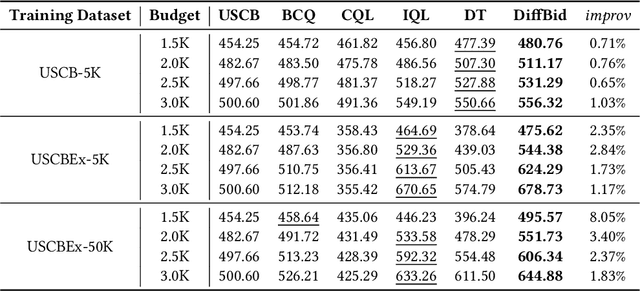
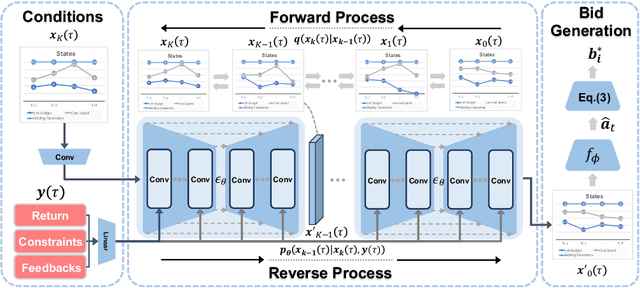
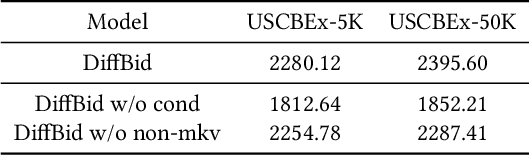
Auto-bidding plays a crucial role in facilitating online advertising by automatically providing bids for advertisers. Reinforcement learning (RL) has gained popularity for auto-bidding. However, most current RL auto-bidding methods are modeled through the Markovian Decision Process (MDP), which assumes the Markovian state transition. This assumption restricts the ability to perform in long horizon scenarios and makes the model unstable when dealing with highly random online advertising environments. To tackle this issue, this paper introduces AI-Generated Bidding (AIGB), a novel paradigm for auto-bidding through generative modeling. In this paradigm, we propose DiffBid, a conditional diffusion modeling approach for bid generation. DiffBid directly models the correlation between the return and the entire trajectory, effectively avoiding error propagation across time steps in long horizons. Additionally, DiffBid offers a versatile approach for generating trajectories that maximize given targets while adhering to specific constraints. Extensive experiments conducted on the real-world dataset and online A/B test on Alibaba advertising platform demonstrate the effectiveness of DiffBid, achieving 2.81% increase in GMV and 3.36% increase in ROI.
Semi-Supervised Disease Classification based on Limited Medical Image Data
May 07, 2024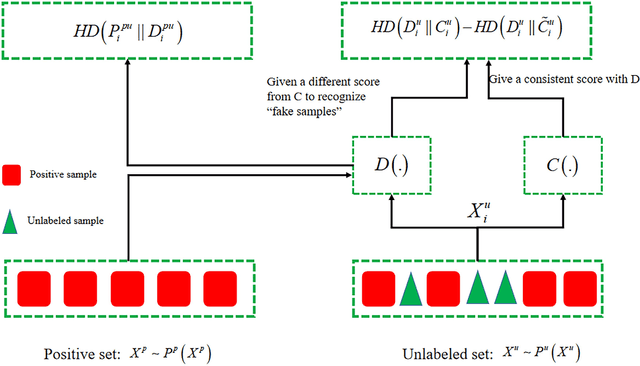
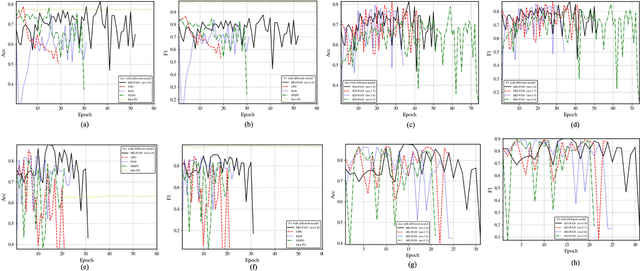
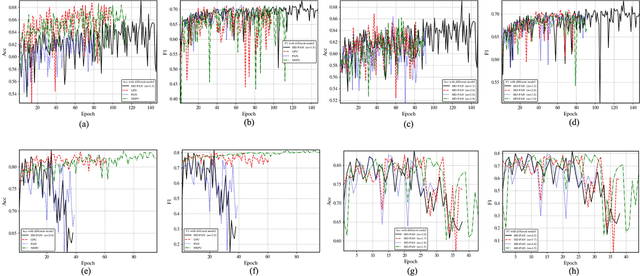
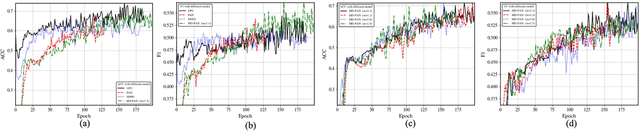
In recent years, significant progress has been made in the field of learning from positive and unlabeled examples (PU learning), particularly in the context of advancing image and text classification tasks. However, applying PU learning to semi-supervised disease classification remains a formidable challenge, primarily due to the limited availability of labeled medical images. In the realm of medical image-aided diagnosis algorithms, numerous theoretical and practical obstacles persist. The research on PU learning for medical image-assisted diagnosis holds substantial importance, as it aims to reduce the time spent by professional experts in classifying images. Unlike natural images, medical images are typically accompanied by a scarcity of annotated data, while an abundance of unlabeled cases exists. Addressing these challenges, this paper introduces a novel generative model inspired by H\"older divergence, specifically designed for semi-supervised disease classification using positive and unlabeled medical image data. In this paper, we present a comprehensive formulation of the problem and establish its theoretical feasibility through rigorous mathematical analysis. To evaluate the effectiveness of our proposed approach, we conduct extensive experiments on five benchmark datasets commonly used in PU medical learning: BreastMNIST, PneumoniaMNIST, BloodMNIST, OCTMNIST, and AMD. The experimental results clearly demonstrate the superiority of our method over existing approaches based on KL divergence. Notably, our approach achieves state-of-the-art performance on all five disease classification benchmarks. By addressing the limitations imposed by limited labeled data and harnessing the untapped potential of unlabeled medical images, our novel generative model presents a promising direction for enhancing semi-supervised disease classification in the field of medical image analysis.