 Add to Chrome
 Add to Firefox
 Add to Edge
The Label Defines the Timescale: Trait-State Limits of Temporal-Aggregate Learning
Aug 03, 2026
Machine-learning benchmarks often pair a label that aggregates a long temporal horizon with input observed through one or a few short windows. Their apparent performance ceiling may therefore be an acquisition-protocol ceiling rather than a model-capacity ceiling. We study labels of the form $Θ_{g,T}=T^{-1}\int_0^T g\{Z(t)\}\,\mathrm{d}t$ when the latent Gaussian process contains both a stable individual trait and a correlated within-individual state. An exact protocol-conditioned Bayes-risk identity provides a common tool. First, we decompose label variance into an $O(1)$ trait component and an $O(T^{-1})$ state component, explaining why a snapshot can retain cross-sectional predictability while poorly tracking within-person change. Second, we derive task-dependent effective temporal spans: mean labels depend on the ordinary correlation time, whereas occupation-time labels depend on an entire spectrum of higher-order correlation times. Third, state-driven occupation-label variance is maximal when the stable trait lies at the threshold; window efficiency decays much more slowly away from that boundary. Under an equal segment budget, exact risks and Monte Carlo experiments show that repeated segments at one time rapidly saturate, whereas temporally dispersed observations continue to increase state explainability. The trait ceiling uses quantities available from ordinary test-retest data; only the state ceiling requires short-lag temporal calibration. The results distinguish architectural limits from protocol limits and show that the label, rather than duration or segment count alone, defines the relevant timescale.

Noise-Robust Box-Supervised Infrared Small Target Detection via Physics-Inspired Soft Label Optimization
Jul 19, 2026Infrared small target detection (IRSTD) commonly relies on pixel-level mask supervision. Such annotations, however, are costly and inherently uncertain because infrared targets have blurred boundaries and weak textures. We formulate box-supervised IRSTD as a problem distinct from generic box-to-mask segmentation and point-supervised IRSTD. Its central challenge is to construct stable pixel-level soft supervision from highly contaminated boxes. To this end, we propose Hotspot-Anchored Label Optimization (HALO). HALO localizes a radiometric anchor inside each box under local background-statistics constraints, then synthesizes a Physically Anchored Gaussian (PAG) soft label around the anchor. This turns noisy box supervision into continuous, pixel-level soft labels. The entire process is performed offline before training, remains decoupled from the detector backbone, and requires no online label updates. Experiments on public datasets show that HALO is competitive with representative box-supervised methods under standard tight boxes. Under looser or shifted box annotations that better approximate real scenarios, HALO is substantially more robust while remaining consistent across backbones. We further introduce a contamination-aware operating-regime analysis to characterize the effective boundary of this class of methods and reveal how intrinsic signal-to-clutter ratio relates to performance.
Heatmap Guided Query Transformers for Robust Astrocyte Detection across Immunostains and Resolutions
Sep 03, 2025Astrocytes are critical glial cells whose altered morphology and density are hallmarks of many neurological disorders. However, their intricate branching and stain dependent variability make automated detection of histological images a highly challenging task. To address these challenges, we propose a hybrid CNN Transformer detector that combines local feature extraction with global contextual reasoning. A heatmap guided query mechanism generates spatially grounded anchors for small and faint astrocytes, while a lightweight Transformer module improves discrimination in dense clusters. Evaluated on ALDH1L1 and GFAP stained astrocyte datasets, the model consistently outperformed Faster R-CNN, YOLOv11 and DETR, achieving higher sensitivity with fewer false positives, as confirmed by FROC analysis. These results highlight the potential of hybrid CNN Transformer architectures for robust astrocyte detection and provide a foundation for advanced computational pathology tools.
GridRoute: A Benchmark for LLM-Based Route Planning with Cardinal Movement in Grid Environments
May 30, 2025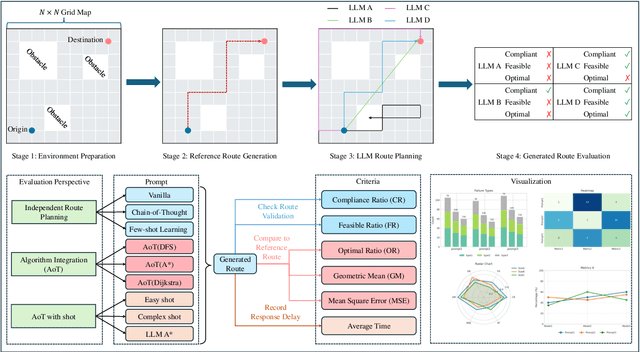
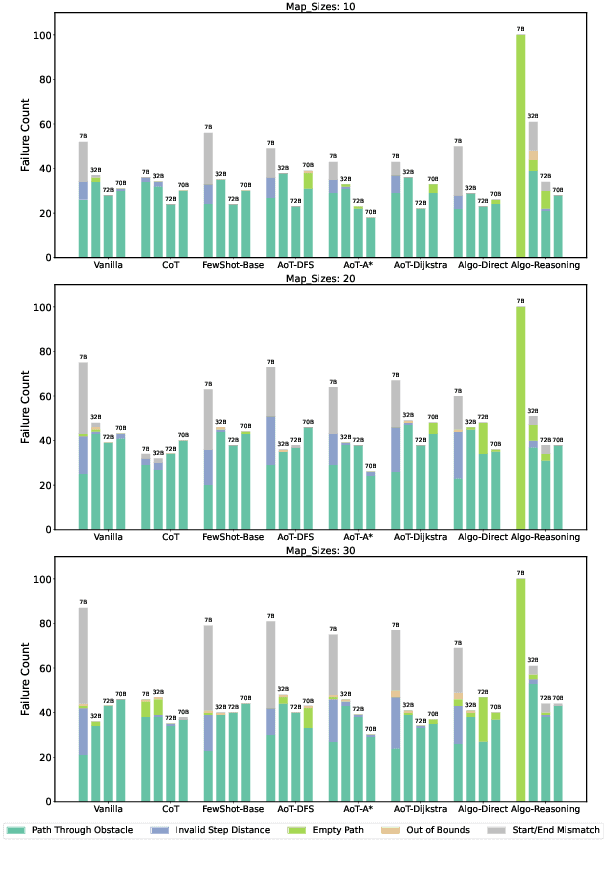
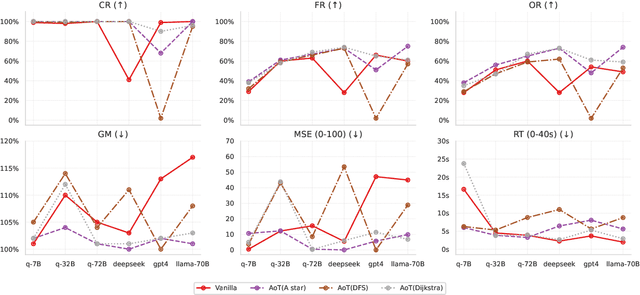
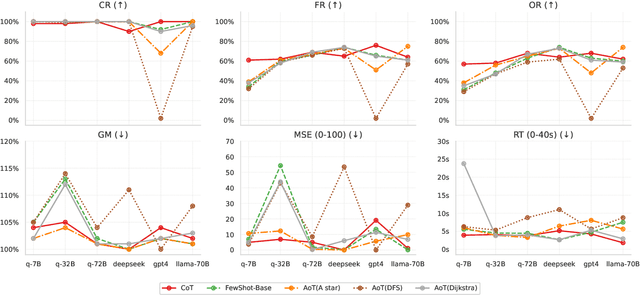
Recent advancements in Large Language Models (LLMs) have demonstrated their potential in planning and reasoning tasks, offering a flexible alternative to classical pathfinding algorithms. However, most existing studies focus on LLMs' independent reasoning capabilities and overlook the potential synergy between LLMs and traditional algorithms. To fill this gap, we propose a comprehensive evaluation benchmark GridRoute to assess how LLMs can take advantage of traditional algorithms. We also propose a novel hybrid prompting technique called Algorithm of Thought (AoT), which introduces traditional algorithms' guidance into prompting. Our benchmark evaluates six LLMs ranging from 7B to 72B parameters across various map sizes, assessing their performance in correctness, optimality, and efficiency in grid environments with varying sizes. Our results show that AoT significantly boosts performance across all model sizes, particularly in larger or more complex environments, suggesting a promising approach to addressing path planning challenges. Our code is open-sourced at https://github.com/LinChance/GridRoute.
Faces of the Mind: Unveiling Mental Health States Through Facial Expressions in 11,427 Adolescents
May 30, 2024Mood disorders, including depression and anxiety, often manifest through facial expressions. While previous research has explored the connection between facial features and emotions, machine learning algorithms for estimating mood disorder severity have been hindered by small datasets and limited real-world application. To address this gap, we analyzed facial videos of 11,427 participants, a dataset two orders of magnitude larger than previous studies. This comprehensive collection includes standardized facial expression videos from reading tasks, along with a detailed psychological scale that measures depression, anxiety, and stress. By examining the relationships among these emotional states and employing clustering analysis, we identified distinct subgroups embodying different emotional profiles. We then trained tree-based classifiers and deep learning models to estimate emotional states from facial features. Results indicate that models previously effective on small datasets experienced decreased performance when applied to our large dataset, highlighting the importance of data scale and mitigating overfitting in practical settings. Notably, our study identified subtle shifts in pupil dynamics and gaze orientation as potential markers of mood disorders, providing valuable information on the interaction between facial expressions and mental health. This research marks the first large-scale and comprehensive investigation of facial expressions in the context of mental health, laying the groundwork for future data-driven advancements in this field.
Exploring the relationship between response time sequence in scale answering process and severity of insomnia: a machine learning approach
Oct 13, 2023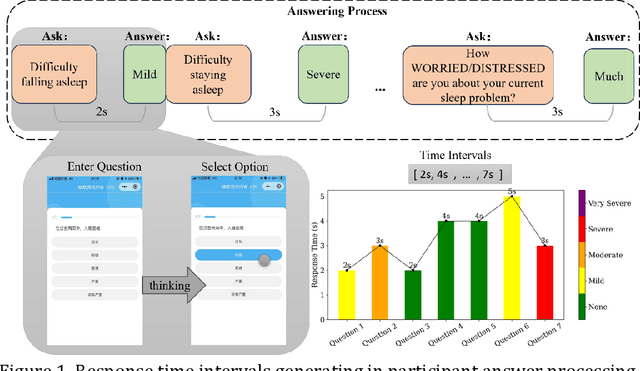
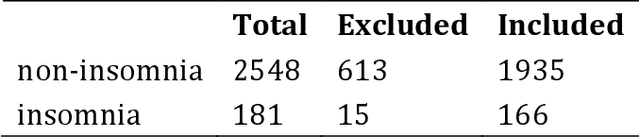
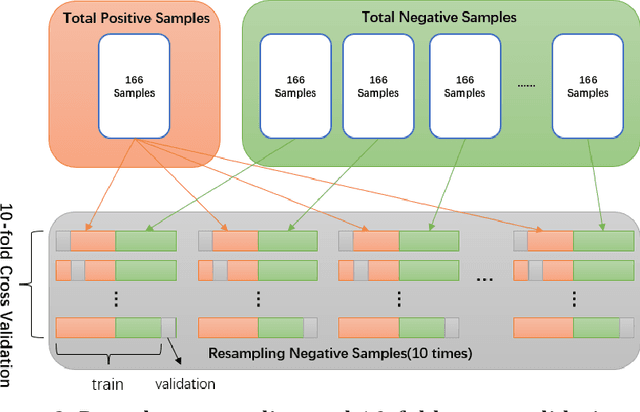
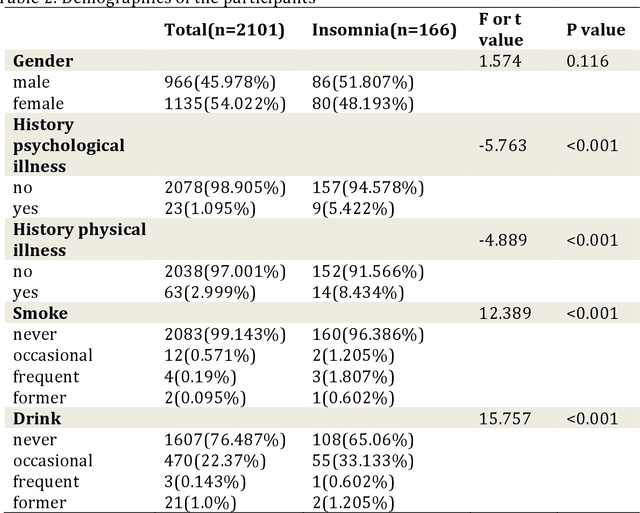
Objectives: The study aims to investigate the relationship between insomnia and response time. Additionally, it aims to develop a machine learning model to predict the presence of insomnia in participants using response time data. Methods: A mobile application was designed to administer scale tests and collect response time data from 2729 participants. The relationship between symptom severity and response time was explored, and a machine learning model was developed to predict the presence of insomnia. Results: The result revealed a statistically significant difference (p<.001) in the total response time between participants with or without insomnia symptoms. A correlation was observed between the severity of specific insomnia aspects and response times at the individual questions level. The machine learning model demonstrated a high predictive accuracy of 0.743 in predicting insomnia symptoms based on response time data. Conclusions: These findings highlight the potential utility of response time data to evaluate cognitive and psychological measures, demonstrating the effectiveness of using response time as a diagnostic tool in the assessment of insomnia.
Attention-Based Acoustic Feature Fusion Network for Depression Detection
Aug 24, 2023Depression, a common mental disorder, significantly influences individuals and imposes considerable societal impacts. The complexity and heterogeneity of the disorder necessitate prompt and effective detection, which nonetheless, poses a difficult challenge. This situation highlights an urgent requirement for improved detection methods. Exploiting auditory data through advanced machine learning paradigms presents promising research directions. Yet, existing techniques mainly rely on single-dimensional feature models, potentially neglecting the abundance of information hidden in various speech characteristics. To rectify this, we present the novel Attention-Based Acoustic Feature Fusion Network (ABAFnet) for depression detection. ABAFnet combines four different acoustic features into a comprehensive deep learning model, thereby effectively integrating and blending multi-tiered features. We present a novel weight adjustment module for late fusion that boosts performance by efficaciously synthesizing these features. The effectiveness of our approach is confirmed via extensive validation on two clinical speech databases, CNRAC and CS-NRAC, thereby outperforming previous methods in depression detection and subtype classification. Further in-depth analysis confirms the key role of each feature and highlights the importance of MFCCrelated features in speech-based depression detection.
Response to: Significance and stability of deep learning-based identification of subtypes within major psychiatric disorders. Molecular Psychiatry (2022)
Jun 10, 2022Recently, Winter and Hahn [1] commented on our work on identifying subtypes of major psychiatry disorders (MPDs) based on neurobiological features using machine learning [2]. They questioned the generalizability of our methods and the statistical significance, stability, and overfitting of the results, and proposed a pipeline for disease subtyping. We appreciate their earnest consideration of our work, however, we need to point out their misconceptions of basic machine-learning concepts and delineate some key issues involved.