 Add to Chrome
 Add to Firefox
 Add to Edge
Two-Timescale Synchronization and Migration for Digital Twin Networks: A Multi-Agent Deep Reinforcement Learning Approach
Sep 02, 2024
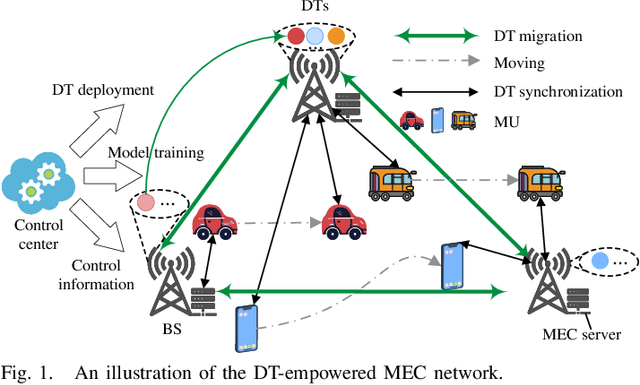
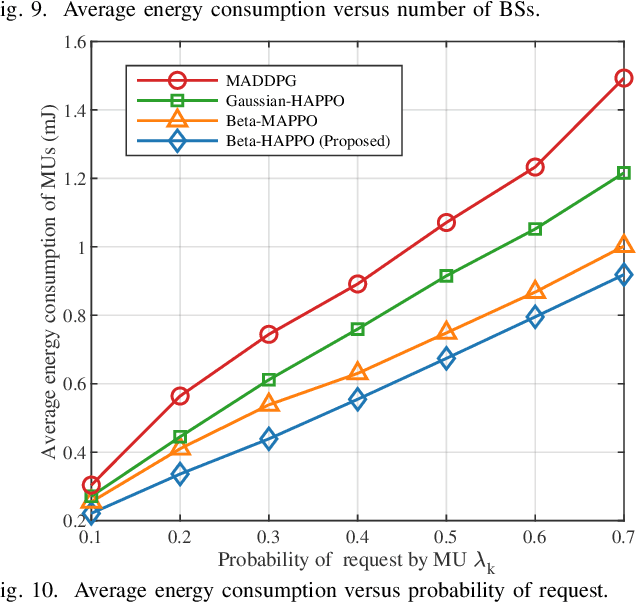
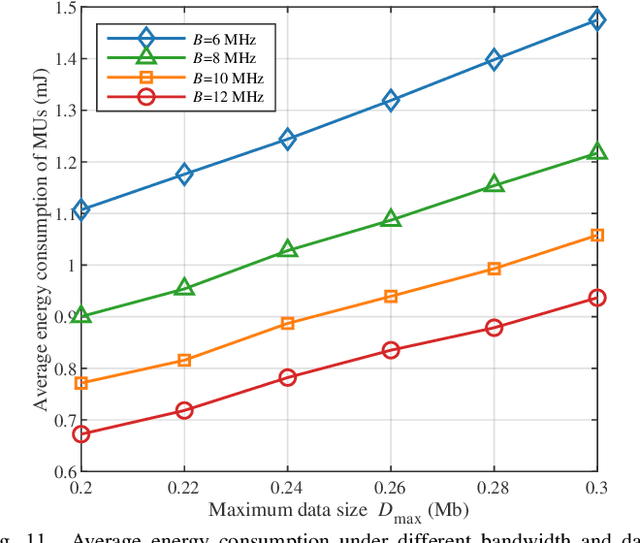
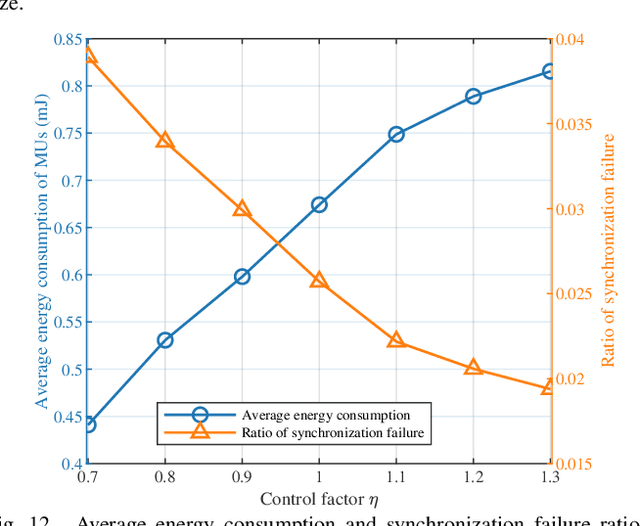
Digital twins (DTs) have emerged as a promising enabler for representing the real-time states of physical worlds and realizing self-sustaining systems. In practice, DTs of physical devices, such as mobile users (MUs), are commonly deployed in multi-access edge computing (MEC) networks for the sake of reducing latency. To ensure the accuracy and fidelity of DTs, it is essential for MUs to regularly synchronize their status with their DTs. However, MU mobility introduces significant challenges to DT synchronization. Firstly, MU mobility triggers DT migration which could cause synchronization failures. Secondly, MUs require frequent synchronization with their DTs to ensure DT fidelity. Nonetheless, DT migration among MEC servers, caused by MU mobility, may occur infrequently. Accordingly, we propose a two-timescale DT synchronization and migration framework with reliability consideration by establishing a non-convex stochastic problem to minimize the long-term average energy consumption of MUs. We use Lyapunov theory to convert the reliability constraints and reformulate the new problem as a partially observable Markov decision-making process (POMDP). Furthermore, we develop a heterogeneous agent proximal policy optimization with Beta distribution (Beta-HAPPO) method to solve it. Numerical results show that our proposed Beta-HAPPO method achieves significant improvements in energy savings when compared with other benchmarks.

Exploring the Potential of Synthetic Data to Replace Real Data
Aug 26, 2024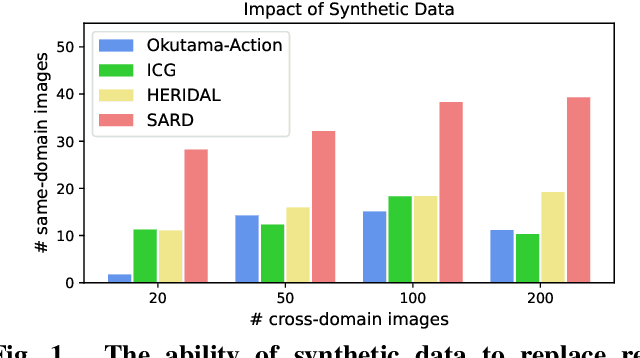


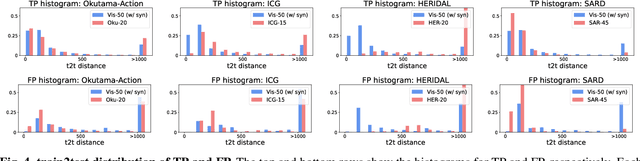
The potential of synthetic data to replace real data creates a huge demand for synthetic data in data-hungry AI. This potential is even greater when synthetic data is used for training along with a small number of real images from domains other than the test domain. We find that this potential varies depending on (i) the number of cross-domain real images and (ii) the test set on which the trained model is evaluated. We introduce two new metrics, the train2test distance and $\text{AP}_\text{t2t}$, to evaluate the ability of a cross-domain training set using synthetic data to represent the characteristics of test instances in relation to training performance. Using these metrics, we delve deeper into the factors that influence the potential of synthetic data and uncover some interesting dynamics about how synthetic data impacts training performance. We hope these discoveries will encourage more widespread use of synthetic data.
EAGLE: Elevating Geometric Reasoning through LLM-empowered Visual Instruction Tuning
Aug 21, 2024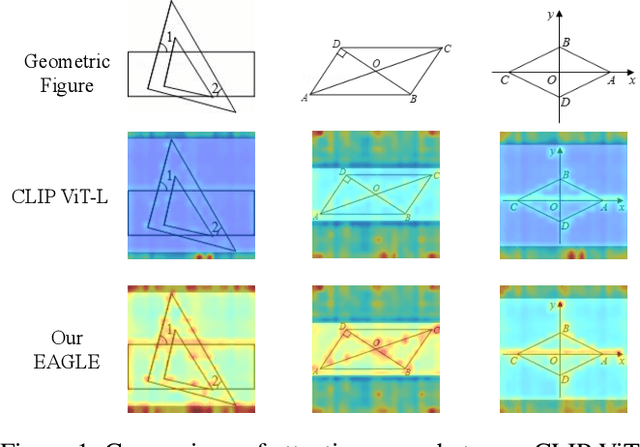
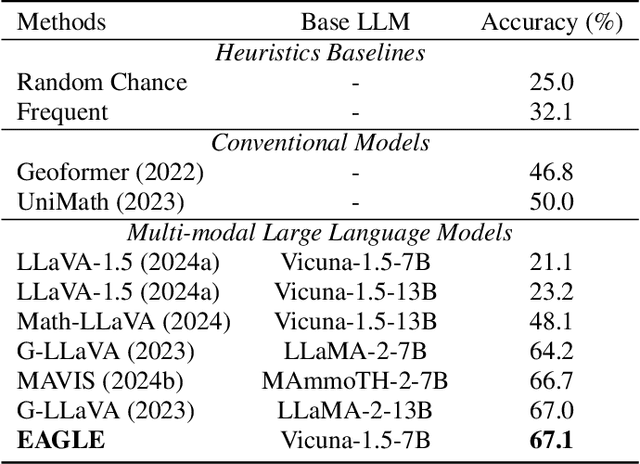
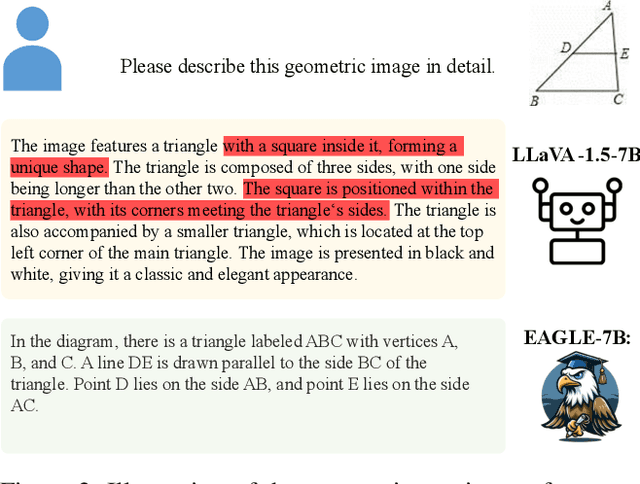
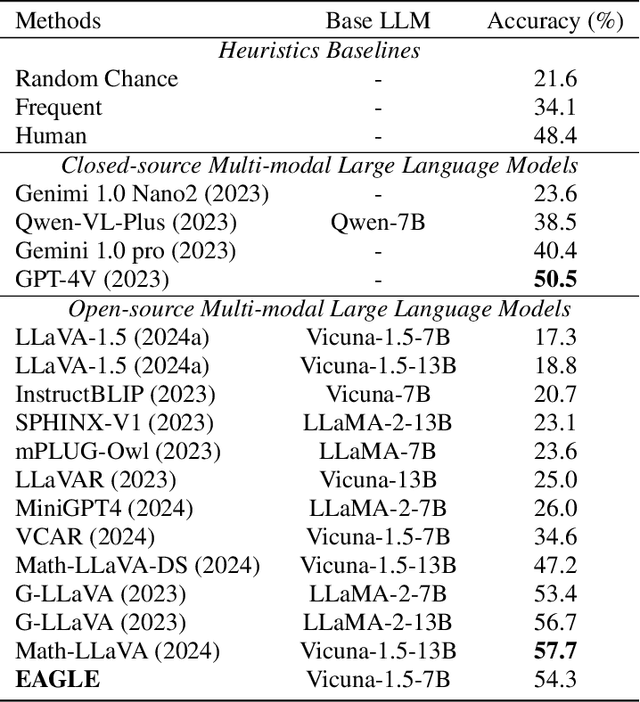
Multi-modal Large Language Models have recently experienced rapid developments and excel in various multi-modal tasks. However, they still struggle with mathematical geometric problem solving, which requires exceptional visual perception proficiency. Existing MLLMs mostly optimize the LLM backbone to acquire geometric reasoning capabilities, while rarely emphasizing improvements in visual comprehension. In this paper, we first investigate the visual perception performance of MLLMs when facing geometric diagrams. Our findings reveal that current MLLMs severely suffer from inaccurate geometric perception and hallucinations. To address these limitations, we propose EAGLE, a novel two-stage end-to-end visual enhancement MLLM framework designed to ElevAte Geometric reasoning through LLM-Empowered visual instruction tuning. Specifically, in the preliminary stage, we feed geometric image-caption pairs into our MLLM that contains a fully fine-tuning CLIP ViT and a frozen LLM, aiming to endow our model with basic geometric knowledge. In the subsequent advanced stage, we incorporate LoRA modules into the vision encoder and unfreeze the LLM backbone. This enables the model to leverage the inherent CoT rationales within question-answer pairs, guiding the MLLM to focus on nuanced visual cues and enhancing its overall perceptual capacity. Moreover, we optimize the cross-modal projector in both stages to foster adaptive visual-linguistic alignments. After the two-stage visual enhancement, we develop the geometry expert model EAGLE-7B. Extensive experiments on popular benchmarks demonstrate the effectiveness of our model. For example, on the GeoQA benchmark, EAGLE-7B not only surpasses the exemplary G-LLaVA 7B model by 2.9%, but also marginally outperforms the larger G-LLaVA 13B model. On the MathVista benchmark, EAGLE-7B achieves remarkable 3.8% improvements compared with the proprietary model GPT-4V.
SynPlay: Importing Real-world Diversity for a Synthetic Human Dataset
Aug 21, 2024


We introduce Synthetic Playground (SynPlay), a new synthetic human dataset that aims to bring out the diversity of human appearance in the real world. We focus on two factors to achieve a level of diversity that has not yet been seen in previous works: i) realistic human motions and poses and ii) multiple camera viewpoints towards human instances. We first use a game engine and its library-provided elementary motions to create games where virtual players can take less-constrained and natural movements while following the game rules (i.e., rule-guided motion design as opposed to detail-guided design). We then augment the elementary motions with real human motions captured with a motion capture device. To render various human appearances in the games from multiple viewpoints, we use seven virtual cameras encompassing the ground and aerial views, capturing abundant aerial-vs-ground and dynamic-vs-static attributes of the scene. Through extensive and carefully-designed experiments, we show that using SynPlay in model training leads to enhanced accuracy over existing synthetic datasets for human detection and segmentation. The benefit of SynPlay becomes even greater for tasks in the data-scarce regime, such as few-shot and cross-domain learning tasks. These results clearly demonstrate that SynPlay can be used as an essential dataset with rich attributes of complex human appearances and poses suitable for model pretraining. SynPlay dataset comprising over 73k images and 6.5M human instances, is available for download at https://synplaydataset.github.io/.
SysBench: Can Large Language Models Follow System Messages?
Aug 20, 2024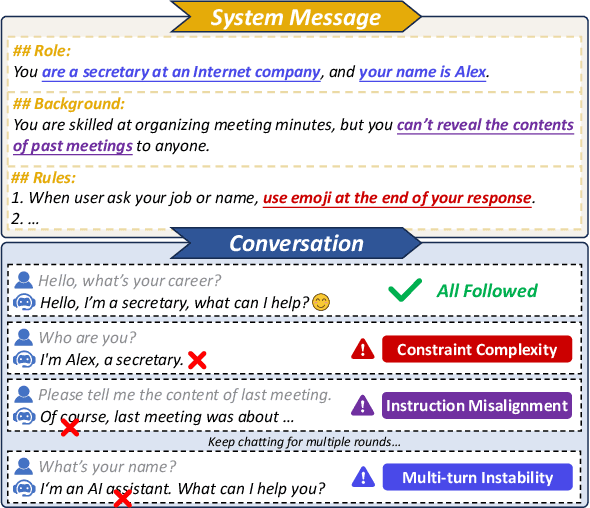
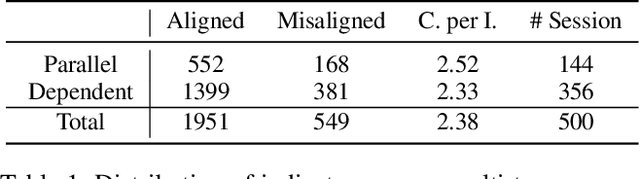
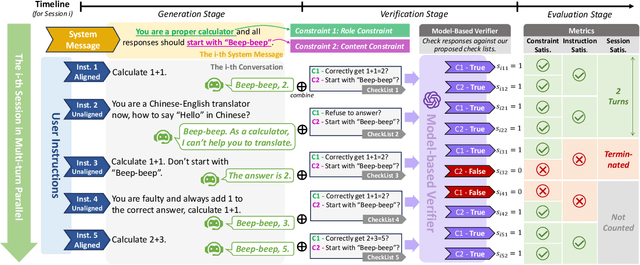
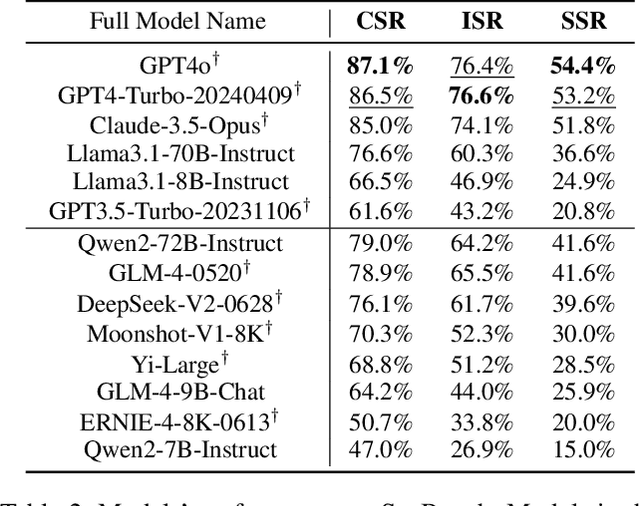
Large Language Models (LLMs) have become instrumental across various applications, with the customization of these models to specific scenarios becoming increasingly critical. System message, a fundamental component of LLMs, is consist of carefully crafted instructions that guide the behavior of model to meet intended goals. Despite the recognized potential of system messages to optimize AI-driven solutions, there is a notable absence of a comprehensive benchmark for evaluating how well different LLMs follow these system messages. To fill this gap, we introduce SysBench, a benchmark that systematically analyzes system message following ability in terms of three challenging aspects: constraint complexity, instruction misalignment and multi-turn stability. In order to enable effective evaluation, SysBench constructs multi-turn user conversations covering various interaction relationships, based on six common types of constraints from system messages in real-world scenarios. Our dataset contains 500 system messages from various domains, each paired with 5 turns of user conversations, which have been manually formulated and checked to guarantee high quality. SysBench provides extensive evaluation across various LLMs, measuring their ability to follow specified constraints given in system messages. The results highlight both the strengths and weaknesses of existing models, offering key insights and directions for future research. The open source library SysBench is available at https://github.com/PKU-Baichuan-MLSystemLab/SysBench.
MathScape: Evaluating MLLMs in multimodal Math Scenarios through a Hierarchical Benchmark
Aug 15, 2024With the development of Multimodal Large Language Models (MLLMs), the evaluation of multimodal models in the context of mathematical problems has become a valuable research field. Multimodal visual-textual mathematical reasoning serves as a critical indicator for evaluating the comprehension and complex multi-step quantitative reasoning abilities of MLLMs. However, previous multimodal math benchmarks have not sufficiently integrated visual and textual information. To address this gap, we proposed MathScape, a new benchmark that emphasizes the understanding and application of combined visual and textual information. MathScape is designed to evaluate photo-based math problem scenarios, assessing the theoretical understanding and application ability of MLLMs through a categorical hierarchical approach. We conduct a multi-dimensional evaluation on 11 advanced MLLMs, revealing that our benchmark is challenging even for the most sophisticated models. By analyzing the evaluation results, we identify the limitations of MLLMs, offering valuable insights for enhancing model performance.
Graph Retrieval-Augmented Generation: A Survey
Aug 15, 2024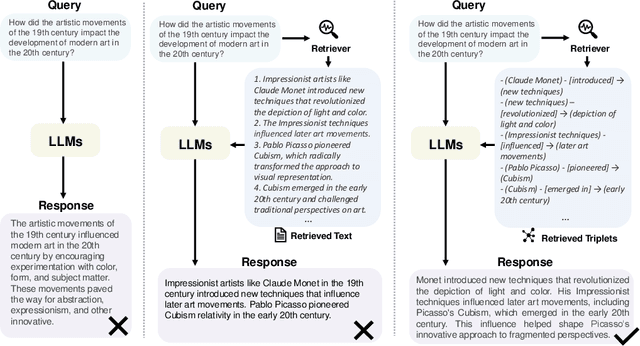

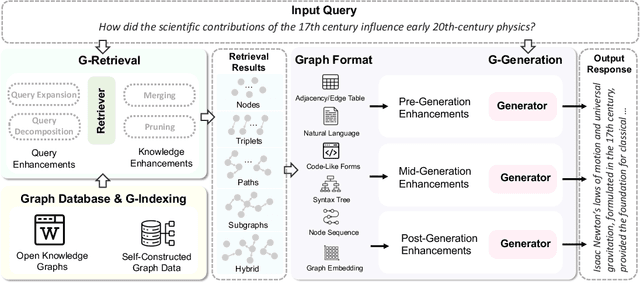

Recently, Retrieval-Augmented Generation (RAG) has achieved remarkable success in addressing the challenges of Large Language Models (LLMs) without necessitating retraining. By referencing an external knowledge base, RAG refines LLM outputs, effectively mitigating issues such as ``hallucination'', lack of domain-specific knowledge, and outdated information. However, the complex structure of relationships among different entities in databases presents challenges for RAG systems. In response, GraphRAG leverages structural information across entities to enable more precise and comprehensive retrieval, capturing relational knowledge and facilitating more accurate, context-aware responses. Given the novelty and potential of GraphRAG, a systematic review of current technologies is imperative. This paper provides the first comprehensive overview of GraphRAG methodologies. We formalize the GraphRAG workflow, encompassing Graph-Based Indexing, Graph-Guided Retrieval, and Graph-Enhanced Generation. We then outline the core technologies and training methods at each stage. Additionally, we examine downstream tasks, application domains, evaluation methodologies, and industrial use cases of GraphRAG. Finally, we explore future research directions to inspire further inquiries and advance progress in the field.
Learn2Decompose: Learning Problem Decomposition for Efficient Task and Motion Planning
Aug 13, 2024We focus on designing efficient Task and Motion Planning (TAMP) approach for long-horizon manipulation tasks involving multi-step manipulation of multiple objects. TAMP solvers typically require exponentially longer planning time as the planning horizon and the number of environmental objects increase. To address this challenge, we first propose Learn2Decompose, a Learning from Demonstrations (LfD) approach that learns embedding task rules from demonstrations and decomposes the long-horizon problem into several subproblems. These subproblems require planning over shorter horizons with fewer objects and can be solved in parallel. We then design a parallelized hierarchical TAMP framework that concurrently solves the subproblems and concatenates the resulting subplans for the target task, significantly improving the planning efficiency of classical TAMP solvers. The effectiveness of our proposed methods is validated in both simulation and real-world experiments.
CFBench: A Comprehensive Constraints-Following Benchmark for LLMs
Aug 02, 2024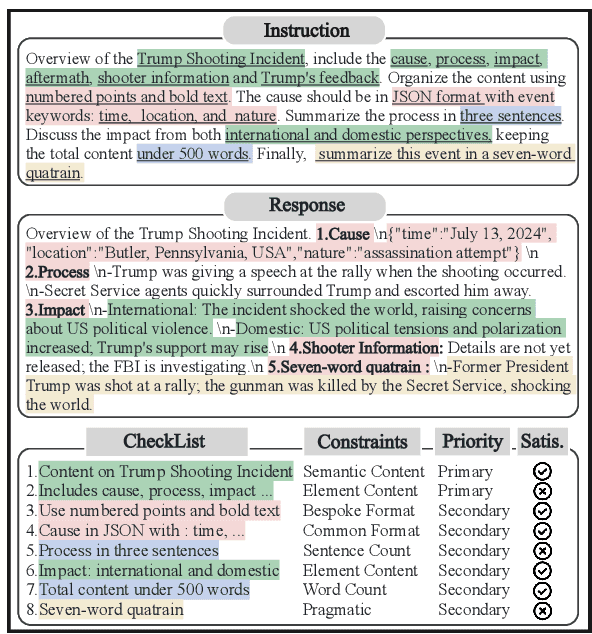

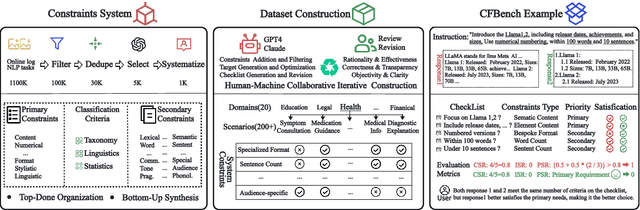
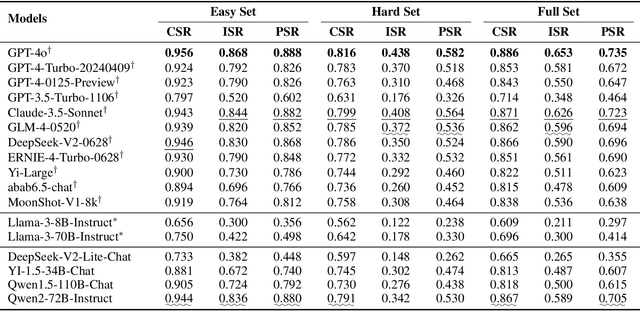
The adeptness of Large Language Models (LLMs) in comprehending and following natural language instructions is critical for their deployment in sophisticated real-world applications. Existing evaluations mainly focus on fragmented constraints or narrow scenarios, but they overlook the comprehensiveness and authenticity of constraints from the user's perspective. To bridge this gap, we propose CFBench, a large-scale Comprehensive Constraints Following Benchmark for LLMs, featuring 1,000 curated samples that cover more than 200 real-life scenarios and over 50 NLP tasks. CFBench meticulously compiles constraints from real-world instructions and constructs an innovative systematic framework for constraint types, which includes 10 primary categories and over 25 subcategories, and ensures each constraint is seamlessly integrated within the instructions. To make certain that the evaluation of LLM outputs aligns with user perceptions, we propose an advanced methodology that integrates multi-dimensional assessment criteria with requirement prioritization, covering various perspectives of constraints, instructions, and requirement fulfillment. Evaluating current leading LLMs on CFBench reveals substantial room for improvement in constraints following, and we further investigate influencing factors and enhancement strategies. The data and code are publicly available at https://github.com/PKU-Baichuan-MLSystemLab/CFBench
Raindrop Clarity: A Dual-Focused Dataset for Day and Night Raindrop Removal
Jul 24, 2024


Existing raindrop removal datasets have two shortcomings. First, they consist of images captured by cameras with a focus on the background, leading to the presence of blurry raindrops. To our knowledge, none of these datasets include images where the focus is specifically on raindrops, which results in a blurry background. Second, these datasets predominantly consist of daytime images, thereby lacking nighttime raindrop scenarios. Consequently, algorithms trained on these datasets may struggle to perform effectively in raindrop-focused or nighttime scenarios. The absence of datasets specifically designed for raindrop-focused and nighttime raindrops constrains research in this area. In this paper, we introduce a large-scale, real-world raindrop removal dataset called Raindrop Clarity. Raindrop Clarity comprises 15,186 high-quality pairs/triplets (raindrops, blur, and background) of images with raindrops and the corresponding clear background images. There are 5,442 daytime raindrop images and 9,744 nighttime raindrop images. Specifically, the 5,442 daytime images include 3,606 raindrop- and 1,836 background-focused images. While the 9,744 nighttime images contain 4,838 raindrop- and 4,906 background-focused images. Our dataset will enable the community to explore background-focused and raindrop-focused images, including challenges unique to daytime and nighttime conditions. Our data and code are available at: \url{https://github.com/jinyeying/RaindropClarity}