 Add to Chrome
 Add to Firefox
 Add to Edge
Energy Efficiency Maximization for Discrete Activation based NOMA-assisted Pinching-Antenna Systems
Apr 27, 2026
Pinching-antenna systems (PASS) have recently attracted significant attention as a promising architecture for flexible and reconfigurable wireless communications. Despite notable advancements, research on energy efficiency (EE) maximization for PASS is limited as existing studies mainly focus on transmit power minimization or utilizing a simple power consumption model. This paper evaluates the impact of pinching antenna (PA) activation power on EE maximization in a downlink NOMA-assisted PASS by jointly optimizing PA activation and user power allocation under quality-of-service and transmit power constraints. To tackle the resulting mixed-integer nonlinear programming problem, we develop a two-layer iterative algorithm, where the outer layer performs matching-based PA selection and the inner layer computes a closed-form optimal power allocation solution. Numerical results demonstrate that the proposed solution achieves substantial EE gains over conventional fixed antennas systems and the considered benchmark schemes, approaches the exhaustive-search upper bound with significantly reduced complexity, while exhibiting fast convergence. It also demonstrates the significance of accounting for PA activation power in EE maximization problem.

Optimization for Pinching Antennas System With Multiple Carriers and Rate Splitting Multiple Access
Apr 16, 2026To meet the urgent demands for spectral efficiency and multi-user access in high-frequency application scenario for the sixth-generation wireless communication, this paper investigates a rate splitting multiple access (RSMA) system assisted by pinching antennas (PAs) with multiple waveguides and multiple carriers, aiming to maximize the overall system sum rate. To address the high sensitivity of high-frequency signals to PA movement in the overloaded scenarios, a two-stage PA position optimization method based on both path loss and phase shift error minimization is proposed under RSMA framework. Specifically, the first step is to perform coarse adjustment by minimizing large-scale path loss. Then, based on the derivation of a closed-form solution for the ideal phase shift in a single-user single-carrier case, the fine-grained positions of PAs are optimized via a one-dimensional line search to minimize the composite phase shift error across all users and carriers. In order to meet the quality of service requirements, the Lagrange dual method is employed to obtain the closed form of beamforming vectors after the PA positions are determined. Simulation results demonstrate that the proposed scheme achieves significant improvement in sum rate and confirm that RSMA exhibits stronger robustness to inaccurate PA positions caused by both discrete position channel estimation and physical hardware compared to other multiple-access techniques in PA-assisted systems. Furthermore, the results validate that fine-grained PA position adjustment is particularly crucial in high-frequency bands.
Sky-Ear: An Unmanned Aerial Vehicle-Enabled Victim Sound Detection and Localization System
Apr 14, 2026Unmanned Aerial Vehicles (UAVs) are increasingly deployed in search-and-rescue (SAR) missions, yet continuous and reliable victim detection and localization remain challenging due to on-board hardware constraints. This paper designs an UAV-Enabled Victim Sound Detection and Localization System (called ``Sky-Ear'' for brevity) to achieve energy-efficient acoustic sensing and sound detection for SAR. Based on a circular-shaped microphone array, two-stage (Sentinel and Responder) audio processing is developed for energy-consuming and highly reliable sound detection. A Masking autoencoder (MAE)-based sound detection method is designed in the Sentinel stage to analyze frequency-time acoustic features. For improved precision, a continuous localization method is designed by optimizing detected directions from multiple observations. Extensive simulation experiments are conducted to validate the system's performance in terms of victim detection accuracy and localization error.
Multi-Waveguide Pinching Antenna Placement Optimization for Rate Maximization
Dec 21, 2025Pinching antenna systems (PASS) have emerged as a technology that enables the large-scale movement of antenna elements, offering significant potential for performance gains in next-generation wireless networks. This paper investigates the problem of maximizing the average per-user data rate by optimizing the antenna placement of a multi-waveguide PASS, subject to a stringent physical minimum spacing constraint. To address this complex challenge, which involves a coupled fractional objective and a non-convex constraint, we employ the fractional programming (FP) framework to transform the non-convex rate maximization problem into a more tractable one, and devise a projected gradient ascent (PGA)-based algorithm to iteratively solve the transformed problem. Simulation results demonstrate that our proposed scheme significantly outperforms various geometric placement baselines, achieving superior per-user data rates by actively mitigating multi-user interference.
Content-Aware RSMA-Enabled Pinching-Antenna Systems for Latency Optimization in 6G Networks
Dec 19, 2025The Pinching Antenna System (PAS) has emerged as a promising technology to dynamically reconfigure wireless propagation environments in 6G networks. By activating radiating elements at arbitrary positions along a dielectric waveguide, PAS can establish strong line-of-sight (LoS) links with users, significantly enhancing channel gain and deployment flexibility, particularly in high-frequency bands susceptible to severe path loss. To further improve multi-user performance, this paper introduces a novel content-aware transmission framework that integrates PAS with rate-splitting multiple access (RSMA). Unlike conventional RSMA, the proposed RSMA scheme enables users requesting the same content to share a unified private stream, thereby mitigating inter-user interference and reducing power fragmentation. We formulate a joint optimization problem aimed at minimizing the average system latency by dynamically adapting both antenna positioning and RSMA parameters according to channel conditions and user requests. A Content-Aware RSMA and Pinching-antenna Joint Optimization (CARP-JO) algorithm is developed, which decomposes the non-convex problem into tractable subproblems solved via bisection search, convex programming, and golden-section search. Simulation results demonstrate that the proposed CARP-JO scheme consistently outperforms Traditional RSMA, NOMA, and Fixed-antenna systems across diverse network scenarios in terms of latency, underscoring the effectiveness of co-designing physical-layer reconfigurability with intelligent communication strategies.
Enhancing Mobile Crowdsensing Efficiency: A Coverage-aware Resource Allocation Approach
Mar 27, 2025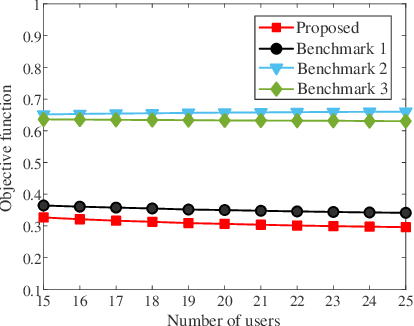
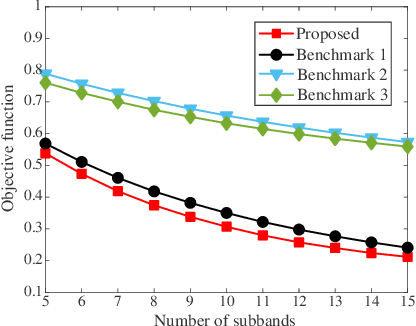
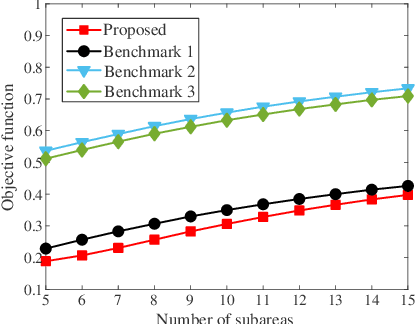
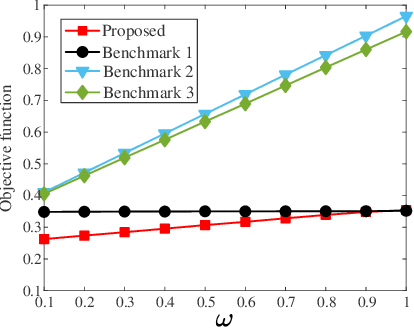
In this study, we investigate the resource management challenges in next-generation mobile crowdsensing networks with the goal of minimizing task completion latency while ensuring coverage performance, i.e., an essential metric to ensure comprehensive data collection across the monitored area, yet it has been commonly overlooked in existing studies. To this end, we formulate a weighted latency and coverage gap minimization problem via jointly optimizing user selection, subchannel allocation, and sensing task allocation. The formulated minimization problem is a non-convex mixed-integer programming issue. To facilitate the analysis, we decompose the original optimization problem into two subproblems. One focuses on optimizing sensing task and subband allocation under fixed sensing user selection, which is optimally solved by the Hungarian algorithm via problem reformulation. Building upon these findings, we introduce a time-efficient two-sided swapping method to refine the scheduled user set and enhance system performance. Extensive numerical results demonstrate the effectiveness of our proposed approach compared to various benchmark strategies.
Energy-Efficient Federated Learning and Migration in Digital Twin Edge Networks
Mar 20, 2025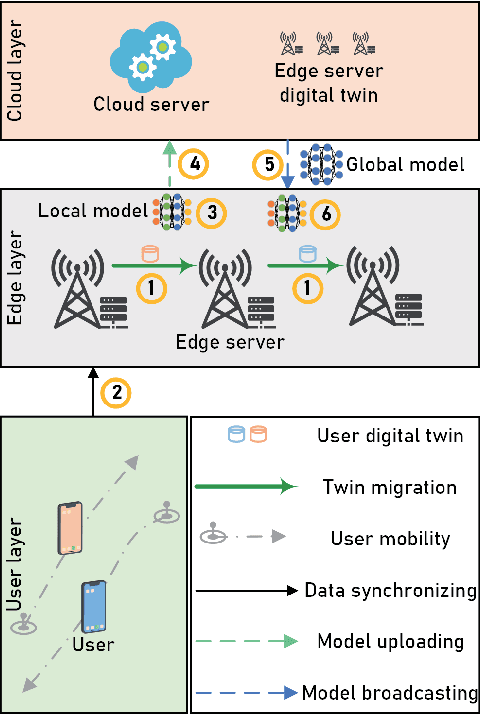
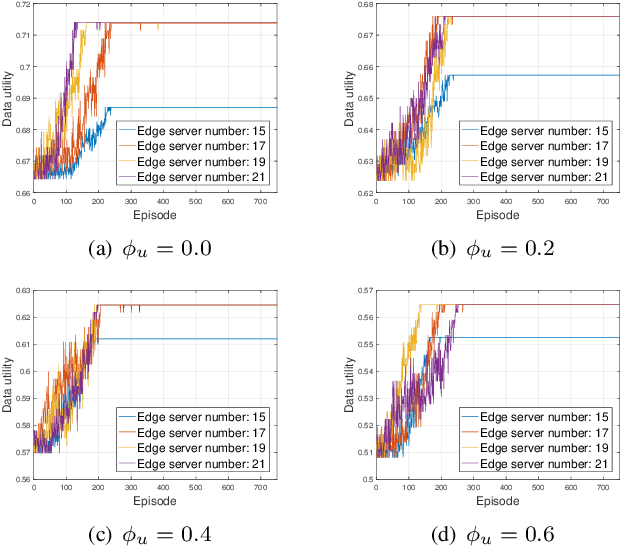
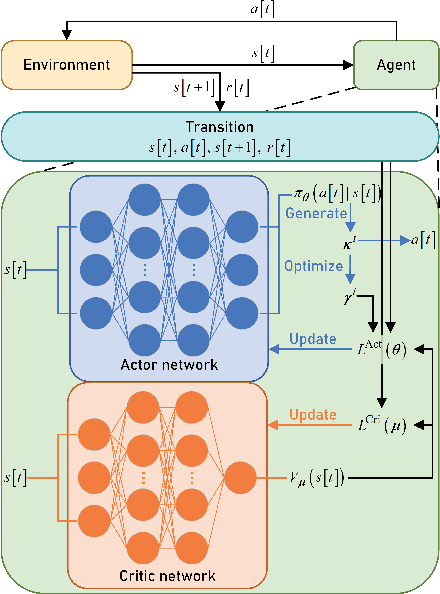
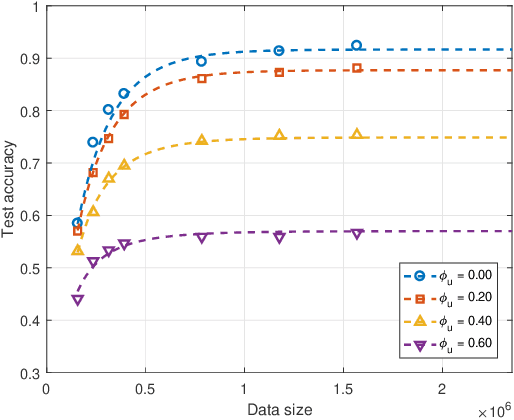
The digital twin edge network (DITEN) is a significant paradigm in the sixth-generation wireless system (6G) that aims to organize well-developed infrastructures to meet the requirements of evolving application scenarios. However, the impact of the interaction between the long-term DITEN maintenance and detailed digital twin tasks, which often entail privacy considerations, is commonly overlooked in current research. This paper addresses this issue by introducing a problem of digital twin association and historical data allocation for a federated learning (FL) task within DITEN. To achieve this goal, we start by introducing a closed-form function to predict the training accuracy of the FL task, referring to it as the data utility. Subsequently, we carry out comprehensive convergence analyses on the proposed FL methodology. Our objective is to jointly optimize the data utility of the digital twin-empowered FL task and the energy costs incurred by the long-term DITEN maintenance, encompassing FL model training, data synchronization, and twin migration. To tackle the aforementioned challenge, we present an optimization-driven learning algorithm that effectively identifies optimized solutions for the formulated problem. Numerical results demonstrate that our proposed algorithm outperforms various baseline approaches.
Joint System Latency and Data Freshness Optimization for Cache-enabled Mobile Crowdsensing Networks
Jan 24, 2025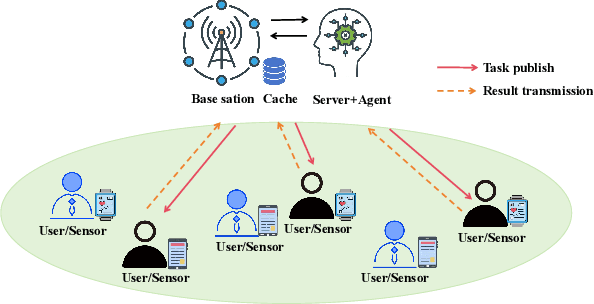
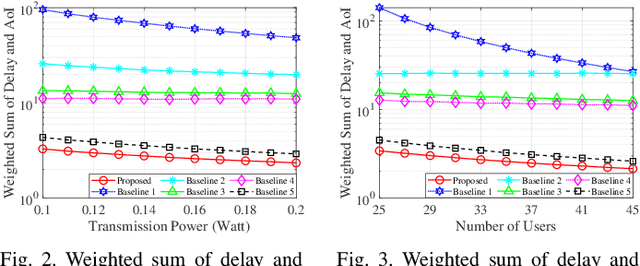
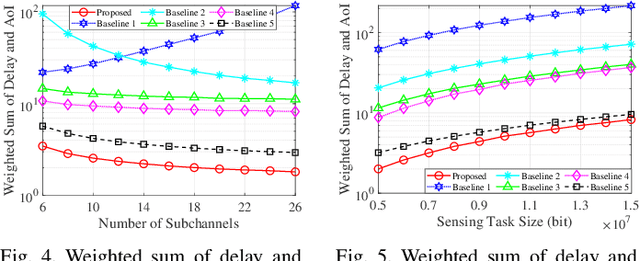
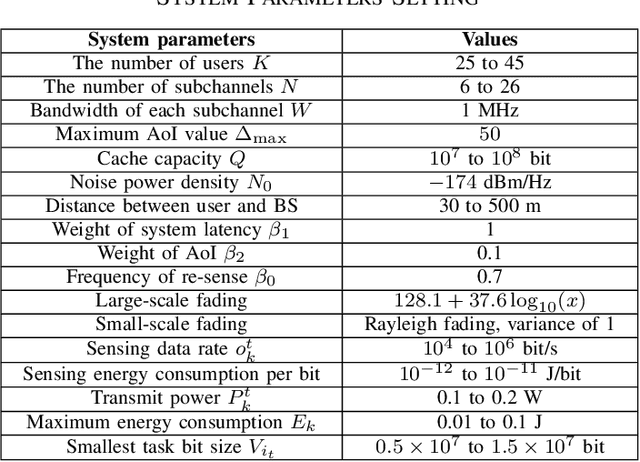
Mobile crowdsensing (MCS) networks enable large-scale data collection by leveraging the ubiquity of mobile devices. However, frequent sensing and data transmission can lead to significant resource consumption. To mitigate this issue, edge caching has been proposed as a solution for storing recently collected data. Nonetheless, this approach may compromise data freshness. In this paper, we investigate the trade-off between re-using cached task results and re-sensing tasks in cache-enabled MCS networks, aiming to minimize system latency while maintaining information freshness. To this end, we formulate a weighted delay and age of information (AoI) minimization problem, jointly optimizing sensing decisions, user selection, channel selection, task allocation, and caching strategies. The problem is a mixed-integer non-convex programming problem which is intractable. Therefore, we decompose the long-term problem into sequential one-shot sub-problems and design a framework that optimizes system latency, task sensing decision, and caching strategy subproblems. When one task is re-sensing, the one-shot problem simplifies to the system latency minimization problem, which can be solved optimally. The task sensing decision is then made by comparing the system latency and AoI. Additionally, a Bayesian update strategy is developed to manage the cached task results. Building upon this framework, we propose a lightweight and time-efficient algorithm that makes real-time decisions for the long-term optimization problem. Extensive simulation results validate the effectiveness of our approach.
When Digital Twin Meets 6G: Concepts, Obstacles, and Research Prospects
Sep 03, 2024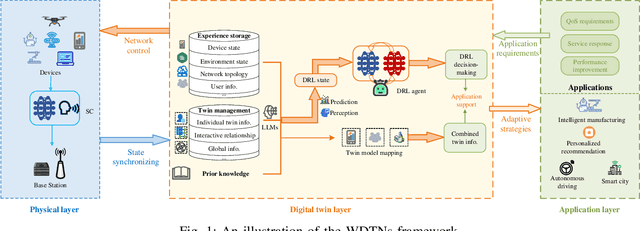
The convergence of digital twin technology and the emerging 6G network presents both challenges and numerous research opportunities. This article explores the potential synergies between digital twin and 6G, highlighting the key challenges and proposing fundamental principles for their integration. We discuss the unique requirements and capabilities of digital twin in the context of 6G networks, such as sustainable deployment, real-time synchronization, seamless migration, predictive analytic, and closed-loop control. Furthermore, we identify research opportunities for leveraging digital twin and artificial intelligence to enhance various aspects of 6G, including network optimization, resource allocation, security, and intelligent service provisioning. This article aims to stimulate further research and innovation at the intersection of digital twin and 6G, paving the way for transformative applications and services in the future.
Two-Timescale Synchronization and Migration for Digital Twin Networks: A Multi-Agent Deep Reinforcement Learning Approach
Sep 02, 2024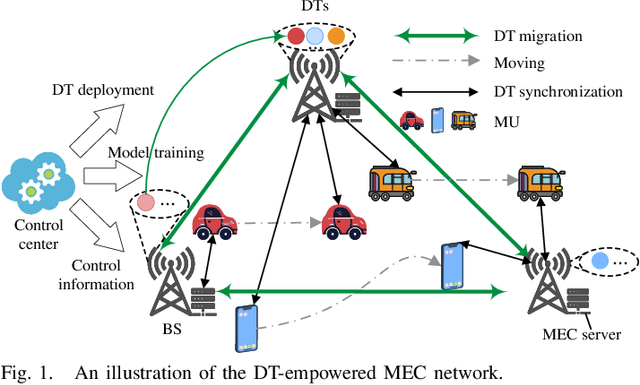
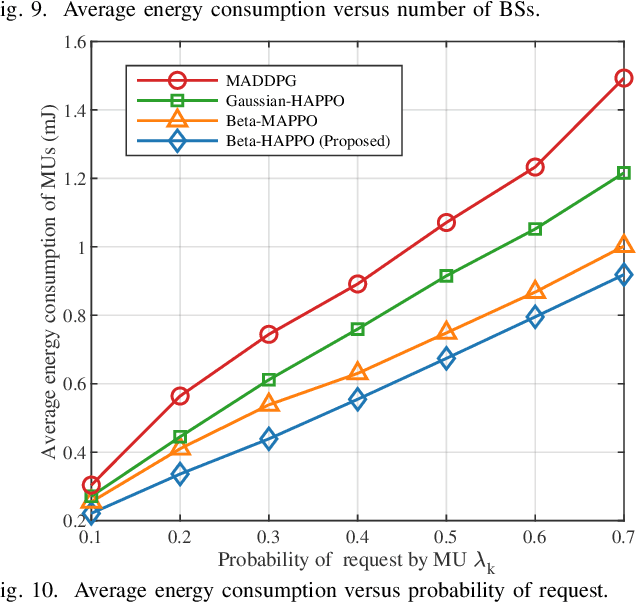
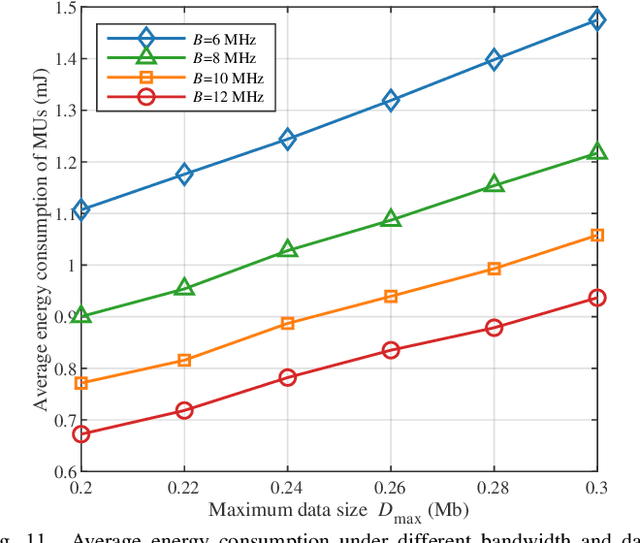
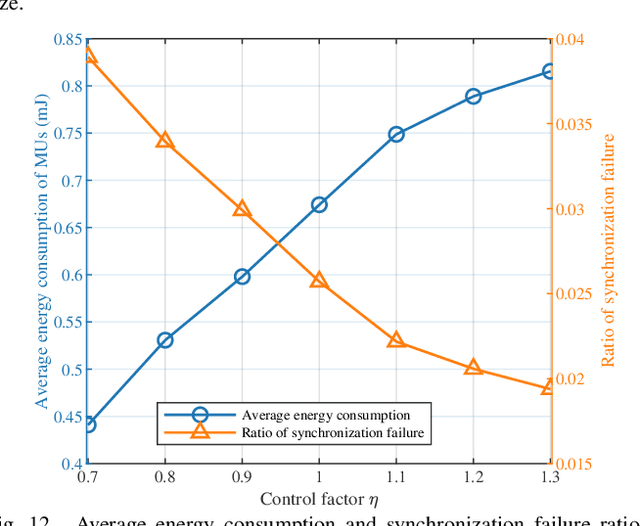
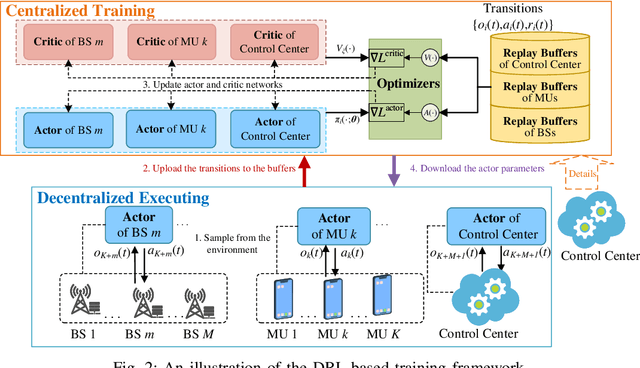
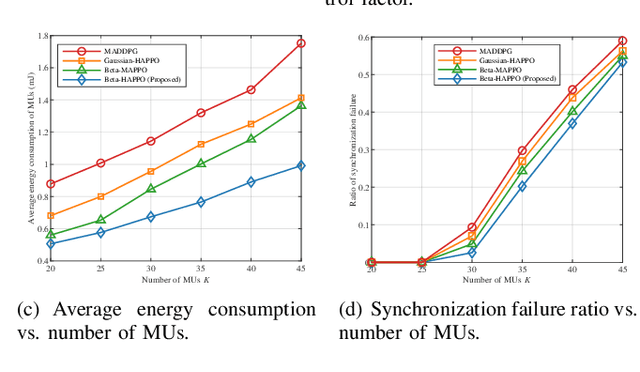
Digital twins (DTs) have emerged as a promising enabler for representing the real-time states of physical worlds and realizing self-sustaining systems. In practice, DTs of physical devices, such as mobile users (MUs), are commonly deployed in multi-access edge computing (MEC) networks for the sake of reducing latency. To ensure the accuracy and fidelity of DTs, it is essential for MUs to regularly synchronize their status with their DTs. However, MU mobility introduces significant challenges to DT synchronization. Firstly, MU mobility triggers DT migration which could cause synchronization failures. Secondly, MUs require frequent synchronization with their DTs to ensure DT fidelity. Nonetheless, DT migration among MEC servers, caused by MU mobility, may occur infrequently. Accordingly, we propose a two-timescale DT synchronization and migration framework with reliability consideration by establishing a non-convex stochastic problem to minimize the long-term average energy consumption of MUs. We use Lyapunov theory to convert the reliability constraints and reformulate the new problem as a partially observable Markov decision-making process (POMDP). Furthermore, we develop a heterogeneous agent proximal policy optimization with Beta distribution (Beta-HAPPO) method to solve it. Numerical results show that our proposed Beta-HAPPO method achieves significant improvements in energy savings when compared with other benchmarks.