 Add to Chrome
 Add to Firefox
 Add to Edge
Towards a General Intelligence and Interface for Wearable Health Data
May 21, 2026
While ubiquitous wearable sensors capture a wealth of behavioral and physiological information, effectively transforming these signals into personalized health insights is challenging. Specifically, converting low-level sensor data into representations capable of characterizing higher-level states is difficult due to high phenotypic diversity and variation in individual baseline health, physiology, and lifestyle factors. Moreover, collecting wearable data paired with health outcome annotations is laborious and expensive, and retrospective annotation remains practically unfeasible, contributing to a scarcity of data with high-quality labels. To overcome these limitations, we propose a foundation model for wearable health that is pretrained on more than one trillion minutes of unlabeled sensor signals drawn from a large cohort of five million participants. We demonstrate that the joint scaling of model capacity and pretraining data volume leads to systematic improvements in performance, as evaluated on a diverse set of 35 health prediction tasks, spanning cardiovascular, metabolic, sleep, and mental health, as well as lifestyle choices and demographic factors. We find that this population scale representation unlocks label-efficient few-shot learning and generative capabilities for robust daily metric estimation. To further leverage this learned representation, we deploy a classroom of LLM agents to autonomously search the space of downstream predictive heads built on the model embeddings, showing broad performance improvements that increase with LLM model capacity. Finally, we show how integrating these downstream predictors into a Personal Health Agent can support model responses that are more relevant, contextually aware, and safe, and we validate this via 1,860 ratings from a cohort of clinicians.

TimeSRL: Generalizable Time-Series Behavioral Modeling via Semantic RL-Tuned LLMs -- A Case Study in Mental Health
May 20, 2026Longitudinal passive sensing enables continuous health prediction, yet models often fail under cross-dataset distribution shifts. Traditional ML overfits cohort-specific artifacts, while Large Language Models (LLMs) struggle to reason reliably over long, heterogeneous time-series. We introduce TimeSRL, a two-stage LLM framework that routes predictions through an explicit semantic bottleneck. The model first abstracts raw signals into high-level natural language, then predicts behavioral outcomes from these abstractions alone. This forces the model to reason over semantic concepts that we argue generalize better than raw numbers. We optimize this process end-to-end using Group Relative Policy Optimization (GRPO) with Reinforcement Learning from Verifiable Rewards (RLVR), learning outcome-aligned abstractions without gold intermediate annotations. Instantiated on mental-health prediction, TimeSRL achieves state-of-the-art performance on a benchmark designed to stress-test cross-cohort generalization under a rigorous leave-one-dataset-out (LOSO) protocol, reducing mean absolute error (MAE) over strong non-LLM ML and LLM baselines by 3.1--10.1% and 9.5--44.1% for anxiety, and 3.2--9.6% and 27.4--57.6% for depression (all $p$s<0.05). TimeSRL significantly outperforms prior methods in cross-benchmark transfer across different sensing pipelines, rivaling its own within-domain performance without target-domain fine-tuning. These results demonstrate that semantic abstractions are reusable and point to a new direction for generalizable behavior modeling via RL-tuned LLMs.
A longitudinal health agent framework
Apr 13, 2026Although artificial intelligence (AI) agents are increasingly proposed to support potentially longitudinal health tasks, such as symptom management, behavior change, and patient support, most current implementations fall short of facilitating user intent and fostering accountability. This contrasts with prior work on supporting longitudinal needs, where follow-up, coherent reasoning, and sustained alignment with individuals' goals are critical for both effectiveness and safety. In this paper, we draw on established clinical and personal health informatics frameworks to define what it would mean to orchestrate longitudinal health interactions with AI agents. We propose a multi-layer framework and corresponding agent architecture that operationalizes adaptation, coherence, continuity, and agency across repeated interactions. Through representative use cases, we demonstrate how longitudinal agents can maintain meaningful engagement, adapt to evolving goals, and support safe, personalized decision-making over time. Our findings underscore both the promise and the complexity of designing systems capable of supporting health trajectories beyond isolated interactions, and we offer guidance for future research and development in multi-session, user-centered health AI.
Using Large Language Models to Assist Video Content Analysis: An Exploratory Study of Short Videos on Depression
Jun 27, 2024


Despite the growing interest in leveraging Large Language Models (LLMs) for content analysis, current studies have primarily focused on text-based content. In the present work, we explored the potential of LLMs in assisting video content analysis by conducting a case study that followed a new workflow of LLM-assisted multimodal content analysis. The workflow encompasses codebook design, prompt engineering, LLM processing, and human evaluation. We strategically crafted annotation prompts to get LLM Annotations in structured form and explanation prompts to generate LLM Explanations for a better understanding of LLM reasoning and transparency. To test LLM's video annotation capabilities, we analyzed 203 keyframes extracted from 25 YouTube short videos about depression. We compared the LLM Annotations with those of two human coders and found that LLM has higher accuracy in object and activity Annotations than emotion and genre Annotations. Moreover, we identified the potential and limitations of LLM's capabilities in annotating videos. Based on the findings, we explore opportunities and challenges for future research and improvements to the workflow. We also discuss ethical concerns surrounding future studies based on LLM-assisted video analysis.
Time2Stop: Adaptive and Explainable Human-AI Loop for Smartphone Overuse Intervention
Mar 03, 2024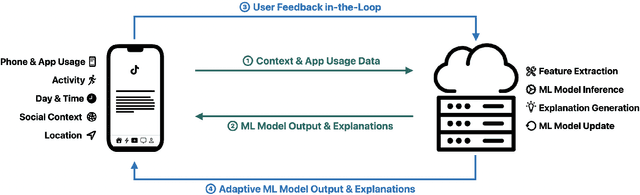
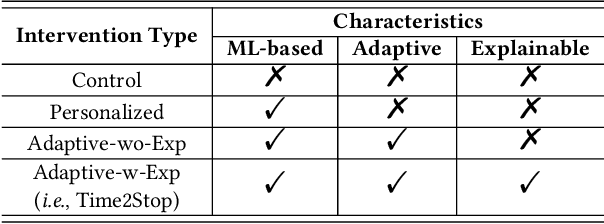
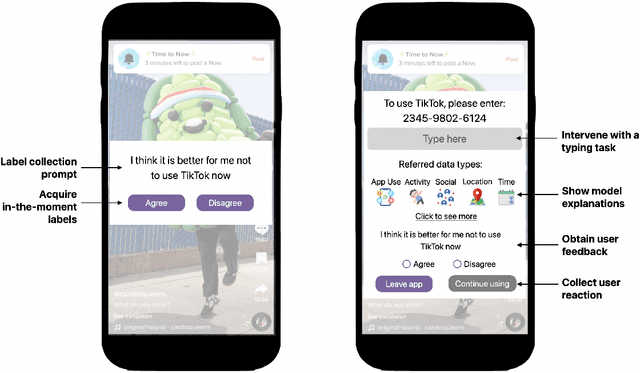
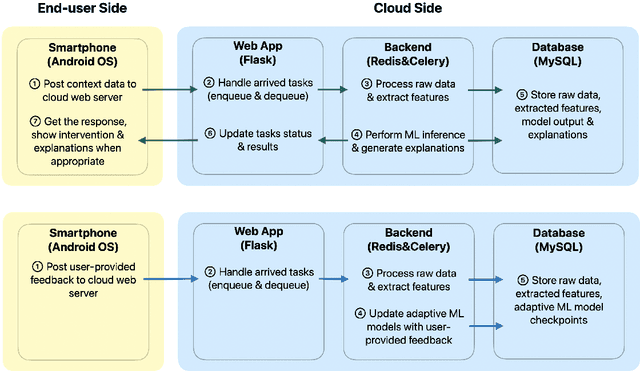
Despite a rich history of investigating smartphone overuse intervention techniques, AI-based just-in-time adaptive intervention (JITAI) methods for overuse reduction are lacking. We develop Time2Stop, an intelligent, adaptive, and explainable JITAI system that leverages machine learning to identify optimal intervention timings, introduces interventions with transparent AI explanations, and collects user feedback to establish a human-AI loop and adapt the intervention model over time. We conducted an 8-week field experiment (N=71) to evaluate the effectiveness of both the adaptation and explanation aspects of Time2Stop. Our results indicate that our adaptive models significantly outperform the baseline methods on intervention accuracy (>32.8\% relatively) and receptivity (>8.0\%). In addition, incorporating explanations further enhances the effectiveness by 53.8\% and 11.4\% on accuracy and receptivity, respectively. Moreover, Time2Stop significantly reduces overuse, decreasing app visit frequency by 7.0$\sim$8.9\%. Our subjective data also echoed these quantitative measures. Participants preferred the adaptive interventions and rated the system highly on intervention time accuracy, effectiveness, and level of trust. We envision our work can inspire future research on JITAI systems with a human-AI loop to evolve with users.
Towards Open-World Gesture Recognition
Jan 20, 2024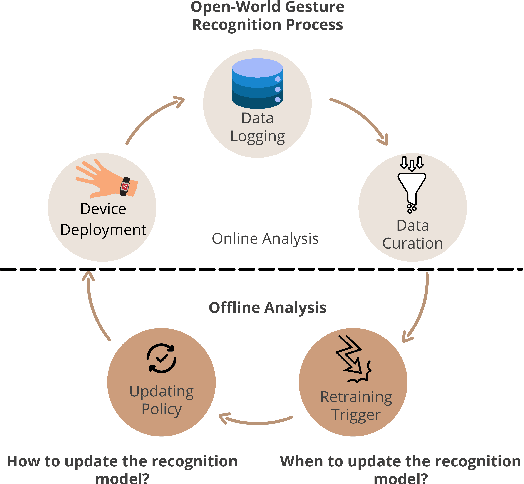
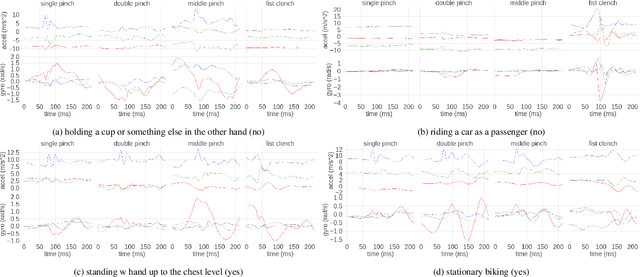

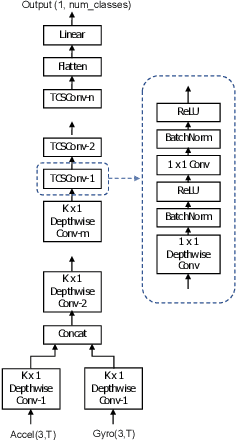
Static machine learning methods in gesture recognition assume that training and test data come from the same underlying distribution. However, in real-world applications involving gesture recognition on wrist-worn devices, data distribution may change over time. We formulate this problem of adapting recognition models to new tasks, where new data patterns emerge, as open-world gesture recognition (OWGR). We propose leveraging continual learning to make machine learning models adaptive to new tasks without degrading performance on previously learned tasks. However, the exploration of parameters for questions around when and how to train and deploy recognition models requires time-consuming user studies and is sometimes impractical. To address this challenge, we propose a design engineering approach that enables offline analysis on a collected large-scale dataset with various parameters and compares different continual learning methods. Finally, design guidelines are provided to enhance the development of an open-world wrist-worn gesture recognition process.
From Classification to Clinical Insights: Towards Analyzing and Reasoning About Mobile and Behavioral Health Data With Large Language Models
Nov 25, 2023Passively collected behavioral health data from ubiquitous sensors holds significant promise to provide mental health professionals insights from patient's daily lives; however, developing analysis tools to use this data in clinical practice requires addressing challenges of generalization across devices and weak or ambiguous correlations between the measured signals and an individual's mental health. To address these challenges, we take a novel approach that leverages large language models (LLMs) to synthesize clinically useful insights from multi-sensor data. We develop chain of thought prompting methods that use LLMs to generate reasoning about how trends in data such as step count and sleep relate to conditions like depression and anxiety. We first demonstrate binary depression classification with LLMs achieving accuracies of 61.1% which exceed the state of the art. While it is not robust for clinical use, this leads us to our key finding: even more impactful and valued than classification is a new human-AI collaboration approach in which clinician experts interactively query these tools and combine their domain expertise and context about the patient with AI generated reasoning to support clinical decision-making. We find models like GPT-4 correctly reference numerical data 75% of the time, and clinician participants express strong interest in using this approach to interpret self-tracking data.