 Add to Chrome
 Add to Firefox
 Add to Edge
MedMix: Specialization-Consistent Federated Sparse MoEs under Modality Heterogeneity
Aug 14, 2026
Federated multimodal medical AI faces modality heterogeneity at both the client and sample levels: clients may systematically lack access to specific modality types, while individual records within the same client may contain different partial modality subsets. Sparse Mixture-of-Experts (MoE) architectures are a promising remedy for modality-adaptive computation, but their use in federated learning is fragile under cross-client modality heterogeneity, where locally learned routing policies can diverge across clients and drive experts toward incompatible specializations. Different clients may assign the same observed modality configuration to different experts, or train similarly indexed experts on different missing-modality configurations, causing standard aggregation to misalign or overwrite the expert specialization that sparse MoEs are intended to learn. To address this challenge, we propose MedMix, a semantic-alignment framework for federated multimodal sparse MoEs that coordinates cross-client routing and expert specialization using modality context. At the client side, MedMix uses modality-context-aware routing to guide expert selection using each token's modality identity, position, and incompleteness context. Across clients, it uses consensus-guided routing alignment to construct server-side consensus anchors for shared modality patterns and align local routing distributions across clients. Complementing these routing mechanisms, client-adaptive expert aggregation leverages client-specific modality-pattern prototypes to match and aggregate functionally similar experts across clients. Experiments on real-world multimodal medical datasets show that MedMix achieves the best average F1 across diverse modality heterogeneity and modality incompleteness settings, with especially clear gains under severe heterogeneity.

Multimodal Federated Learning under Dual-Axis Modality Missingness
Aug 10, 2026Multimodal federated learning (FL) supports collaborative modeling in privacy-sensitive health-sensing and medical settings, but realistic deployments often exhibit dual-axis modality missingness: clients have different modality sets, and individual samples may contain only subsets of the modalities available locally. Existing methods typically address these two axes separately. We propose Flux, a multimodal federated learning framework built around two complementary components. First, modality-aware confidence tempering learns sample-specific confidence for each modality through mask-aware unimodal supervision and fuses the confidence estimates from observed modalities into a sample-adaptive temperature that adjusts predictive sharpness according to evidence quality and completeness. Second, gradient-decoupled private adaptation applies this temperature only to a client-private prediction pathway, while training the shared federated model with a standard, untempered objective. This enables sample-specific, client-local confidence adaptation without allowing confidence-dependent gradients to perturb shared representation learning. Across four multimodal datasets, Flux achieves the highest average macro-F1 on every dataset, outperforming the strongest dataset-specific baseline by 0.8~2.2 points and by 1.6 points on average. Additional analyses demonstrate favorable calibration, temperature sensitivity to both modality missingness and input corruption, and more stable shared optimization under private-only tempering. Our code is available at https://github.com/AdibaOrz/Flux.
Federated Learning with Incomplete Sensing Modalities
May 20, 2024Many mobile sensing applications utilize data from various modalities, including motion and physiological sensors in mobile and wearable devices. Federated Learning (FL) is particularly suitable for these applications thanks to its privacy-preserving feature. However, challenges such as limited battery life, poor network conditions, and sensor malfunctions can restrict the use of all available modalities for local model training. Additionally, existing multimodal FL systems also struggle with scalability and efficiency as the number of modality sources increases. To address these issues, we introduce FLISM, a framework designed to enable multimodal FL with incomplete modalities. FLISM leverages simulation technique to learn robust representations that can handle missing modalities and transfers model knowledge across clients with varying set of modalities. The evaluation results using three real-world datasets and simulations demonstrate FLISM's effective balance between model performance and system efficiency. It shows an average improvement of .067 in F1-score, while also reducing communication (2.69x faster) and computational (2.28x more efficient) overheads compared to existing methods addressing incomplete modalities. Moreover, in simulated scenarios involving tasks with a larger number of modalities, FLISM achieves a significant speedup of 3.23x~85.10x in communication and 3.73x~32.29x in computational efficiency.
Time2Stop: Adaptive and Explainable Human-AI Loop for Smartphone Overuse Intervention
Mar 03, 2024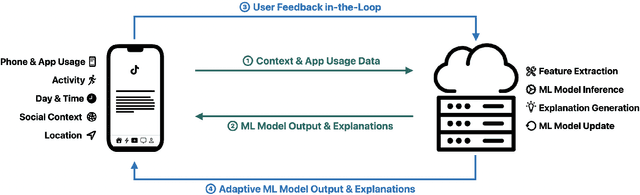
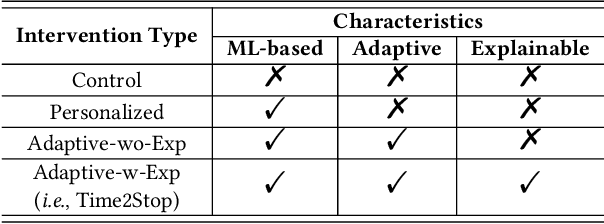
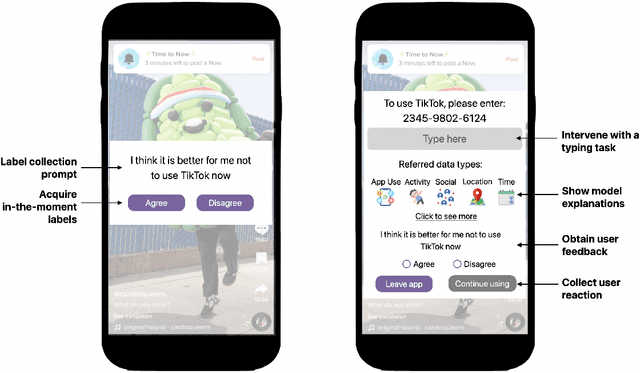
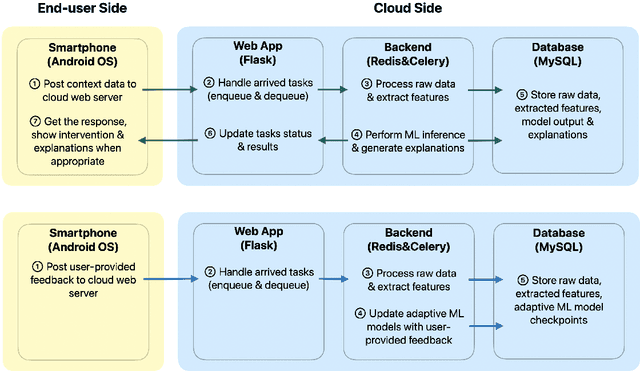
Despite a rich history of investigating smartphone overuse intervention techniques, AI-based just-in-time adaptive intervention (JITAI) methods for overuse reduction are lacking. We develop Time2Stop, an intelligent, adaptive, and explainable JITAI system that leverages machine learning to identify optimal intervention timings, introduces interventions with transparent AI explanations, and collects user feedback to establish a human-AI loop and adapt the intervention model over time. We conducted an 8-week field experiment (N=71) to evaluate the effectiveness of both the adaptation and explanation aspects of Time2Stop. Our results indicate that our adaptive models significantly outperform the baseline methods on intervention accuracy (>32.8\% relatively) and receptivity (>8.0\%). In addition, incorporating explanations further enhances the effectiveness by 53.8\% and 11.4\% on accuracy and receptivity, respectively. Moreover, Time2Stop significantly reduces overuse, decreasing app visit frequency by 7.0$\sim$8.9\%. Our subjective data also echoed these quantitative measures. Participants preferred the adaptive interventions and rated the system highly on intervention time accuracy, effectiveness, and level of trust. We envision our work can inspire future research on JITAI systems with a human-AI loop to evolve with users.
Time-bound Contextual Bio-ID Generation for Minimalist Wearables
Mar 01, 2024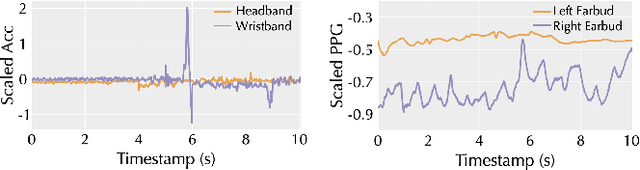
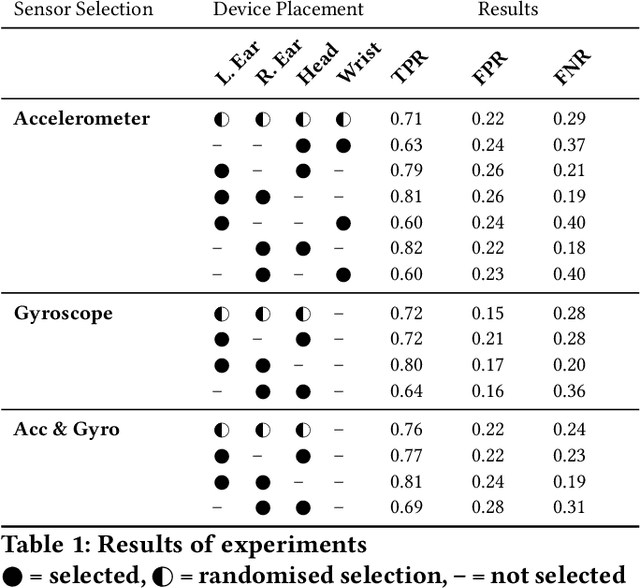
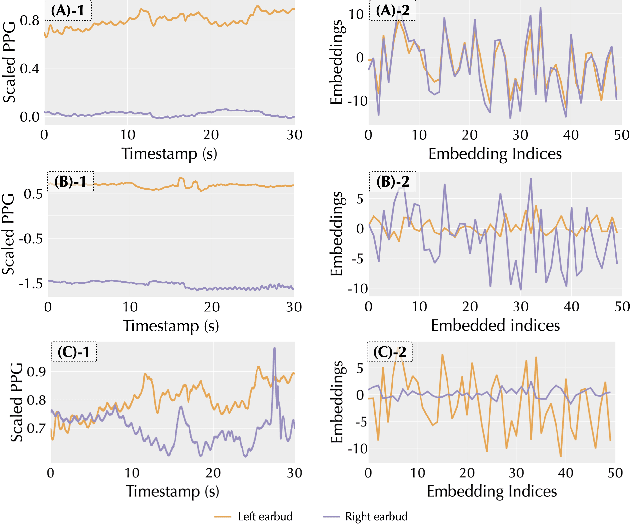
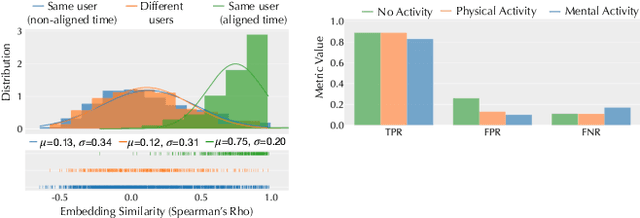
As wearable devices become increasingly miniaturized and powerful, a new opportunity arises for instant and dynamic device-to-device collaboration and human-to-device interaction. However, this progress presents a unique challenge: these minimalist wearables lack inherent mechanisms for real-time authentication, posing significant risks to data privacy and overall security. To address this, we introduce Proteus that realizes an innovative concept of time-bound contextual bio-IDs, which are generated from on-device sensor data and embedded into a common latent space. These bio-IDs act as a time-bound unique user identifier that can be used to identify the wearer in a certain context. Proteus enables dynamic and contextual device collaboration as well as robust human-to-device interaction. Our evaluations demonstrate the effectiveness of our method, particularly in the context of minimalist wearables.
DAPPER: Performance Estimation of Domain Adaptation in Mobile Sensing
Nov 22, 2021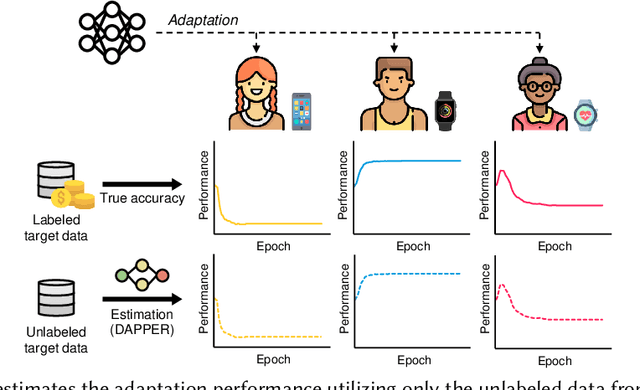
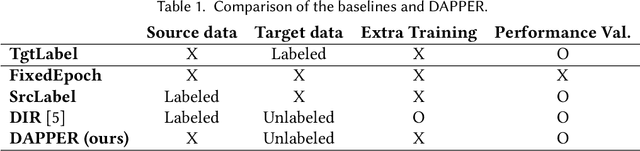
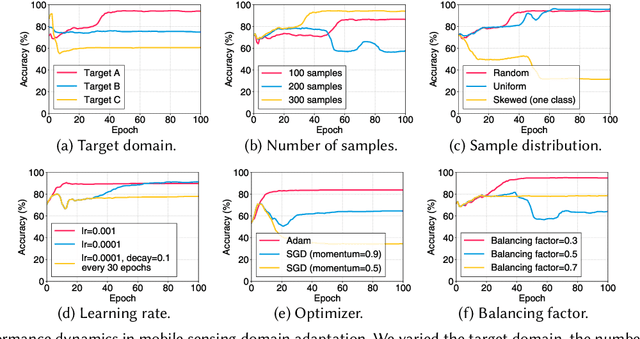
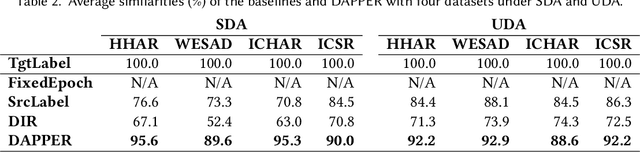
Many applications that utilize sensors in mobile devices and apply machine learning to provide novel services have emerged. However, various factors such as different users, devices, environments, and hyperparameters, affect the performance for such applications, thus making the domain shift (i.e., distribution shift of a target user from the training source dataset) an important problem. Although recent domain adaptation techniques attempt to solve this problem, the complex interplay between the diverse factors often limits their effectiveness. We argue that accurately estimating the performance in untrained domains could significantly reduce performance uncertainty. We present DAPPER (Domain AdaPtation Performance EstimatoR) that estimates the adaptation performance in a target domain with only unlabeled target data. Our intuition is that the outputs of a model on the target data provide clues for the model's actual performance in the target domain. DAPPER does not require expensive labeling costs nor involve additional training after deployment. Our evaluation with four real-world sensing datasets compared against four baselines shows that DAPPER outperforms the baselines by on average 17% in estimation accuracy. Moreover, our on-device experiment shows that DAPPER achieves up to 216X less computation overhead compared with the baselines.