 Add to Chrome
 Add to Firefox
 Add to Edge
TimeSRL: Generalizable Time-Series Behavioral Modeling via Semantic RL-Tuned LLMs -- A Case Study in Mental Health
May 20, 2026
Longitudinal passive sensing enables continuous health prediction, yet models often fail under cross-dataset distribution shifts. Traditional ML overfits cohort-specific artifacts, while Large Language Models (LLMs) struggle to reason reliably over long, heterogeneous time-series. We introduce TimeSRL, a two-stage LLM framework that routes predictions through an explicit semantic bottleneck. The model first abstracts raw signals into high-level natural language, then predicts behavioral outcomes from these abstractions alone. This forces the model to reason over semantic concepts that we argue generalize better than raw numbers. We optimize this process end-to-end using Group Relative Policy Optimization (GRPO) with Reinforcement Learning from Verifiable Rewards (RLVR), learning outcome-aligned abstractions without gold intermediate annotations. Instantiated on mental-health prediction, TimeSRL achieves state-of-the-art performance on a benchmark designed to stress-test cross-cohort generalization under a rigorous leave-one-dataset-out (LOSO) protocol, reducing mean absolute error (MAE) over strong non-LLM ML and LLM baselines by 3.1--10.1% and 9.5--44.1% for anxiety, and 3.2--9.6% and 27.4--57.6% for depression (all $p$s<0.05). TimeSRL significantly outperforms prior methods in cross-benchmark transfer across different sensing pipelines, rivaling its own within-domain performance without target-domain fine-tuning. These results demonstrate that semantic abstractions are reusable and point to a new direction for generalizable behavior modeling via RL-tuned LLMs.

Pro$^2$Assist: Continuous Step-Aware Proactive Assistance with Multimodal Egocentric Perception for Long-Horizon Procedural Tasks
May 05, 2026Procedural tasks with multiple ordered steps are ubiquitous in daily life. Recent advances in multimodal large language models (MLLMs) have enabled personal assistants that support daily activities. However, existing systems primarily provide reactive guidance triggered by user queries, or limited proactive assistance for isolated short-term events rather than long-horizon procedural tasks. In this work, we introduce Pro$^2$Assist, a step-aware proactive assistant that continuously tracks fine-grained task progress and reasons over the user's evolving state to provide timely assistance throughout tasks. Pro$^2$Assist leverages multimodal data from augmented reality (AR) glasses to achieve motion-based perception. It then extracts step-oriented procedural context from multi-scale temporal dynamics and task-specific expert knowledge. Based on both sensory input and procedural context, Pro$^2$Assist performs continuous reasoning to infer user needs and display timely assistance on AR glasses. We evaluate Pro$^2$Assist using a dataset curated from public sources and a real-world dataset collected on our testbed with AR glasses. Extensive evaluations show that Pro$^2$Assist outperforms the best-performing baselines by over 21% in procedural action understanding accuracy, and it achieves up to 2.29x the proactive timing accuracy of baselines. A user study with 20 participants further shows that 90% find Pro$^2$Assist useful, indicating its effectiveness for real-world procedural assistance.
ReSPEC: A Framework for Online Multispectral Sensor Reconfiguration in Dynamic Environments
Feb 11, 2026Multi-sensor fusion is central to robust robotic perception, yet most existing systems operate under static sensor configurations, collecting all modalities at fixed rates and fidelity regardless of their situational utility. This rigidity wastes bandwidth, computation, and energy, and prevents systems from prioritizing sensors under challenging conditions such as poor lighting or occlusion. Recent advances in reinforcement learning (RL) and modality-aware fusion suggest the potential for adaptive perception, but prior efforts have largely focused on re-weighting features at inference time, ignoring the physical cost of sensor data collection. We introduce a framework that unifies sensing, learning, and actuation into a closed reconfiguration loop. A task-specific detection backbone extracts multispectral features (e.g. RGB, IR, mmWave, depth) and produces quantitative contribution scores for each modality. These scores are passed to an RL agent, which dynamically adjusts sensor configurations, including sampling frequency, resolution, sensing range, and etc., in real time. Less informative sensors are down-sampled or deactivated, while critical sensors are sampled at higher fidelity as environmental conditions evolve. We implement and evaluate this framework on a mobile rover, showing that adaptive control reduces GPU load by 29.3\% with only a 5.3\% accuracy drop compared to a heuristic baseline. These results highlight the potential of resource-aware adaptive sensing for embedded robotic platforms.
LLM-based Conversational AI Therapist for Daily Functioning Screening and Psychotherapeutic Intervention via Everyday Smart Devices
Mar 16, 2024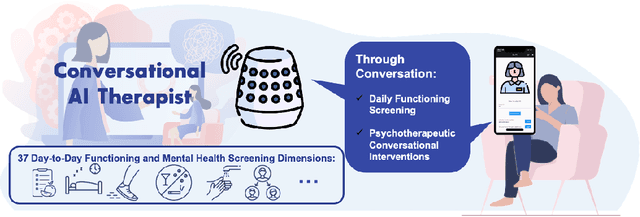
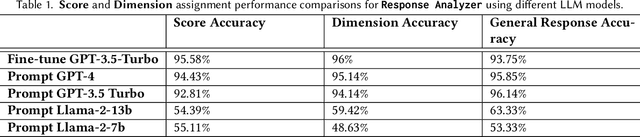
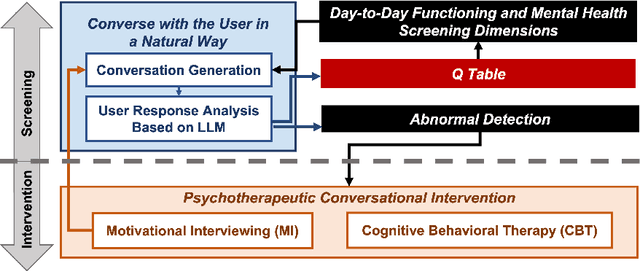

Despite the global mental health crisis, access to screenings, professionals, and treatments remains high. In collaboration with licensed psychotherapists, we propose a Conversational AI Therapist with psychotherapeutic Interventions (CaiTI), a platform that leverages large language models (LLM)s and smart devices to enable better mental health self-care. CaiTI can screen the day-to-day functioning using natural and psychotherapeutic conversations. CaiTI leverages reinforcement learning to provide personalized conversation flow. CaiTI can accurately understand and interpret user responses. When the user needs further attention during the conversation, CaiTI can provide conversational psychotherapeutic interventions, including cognitive behavioral therapy (CBT) and motivational interviewing (MI). Leveraging the datasets prepared by the licensed psychotherapists, we experiment and microbenchmark various LLMs' performance in tasks along CaiTI's conversation flow and discuss their strengths and weaknesses. With the psychotherapists, we implement CaiTI and conduct 14-day and 24-week studies. The study results, validated by therapists, demonstrate that CaiTI can converse with users naturally, accurately understand and interpret user responses, and provide psychotherapeutic interventions appropriately and effectively. We showcase the potential of CaiTI LLMs to assist the mental therapy diagnosis and treatment and improve day-to-day functioning screening and precautionary psychotherapeutic intervention systems.