 Add to Chrome
 Add to Firefox
 Add to Edge
Secure Tug-of-War (SecTOW): Iterative Defense-Attack Training with Reinforcement Learning for Multimodal Model Security
Jul 29, 2025
The rapid advancement of multimodal large language models (MLLMs) has led to breakthroughs in various applications, yet their security remains a critical challenge. One pressing issue involves unsafe image-query pairs--jailbreak inputs specifically designed to bypass security constraints and elicit unintended responses from MLLMs. Compared to general multimodal data, such unsafe inputs are relatively sparse, which limits the diversity and richness of training samples available for developing robust defense models. Meanwhile, existing guardrail-type methods rely on external modules to enforce security constraints but fail to address intrinsic vulnerabilities within MLLMs. Traditional supervised fine-tuning (SFT), on the other hand, often over-refuses harmless inputs, compromising general performance. Given these challenges, we propose Secure Tug-of-War (SecTOW), an innovative iterative defense-attack training method to enhance the security of MLLMs. SecTOW consists of two modules: a defender and an auxiliary attacker, both trained iteratively using reinforcement learning (GRPO). During the iterative process, the attacker identifies security vulnerabilities in the defense model and expands jailbreak data. The expanded data are then used to train the defender, enabling it to address identified security vulnerabilities. We also design reward mechanisms used for GRPO to simplify the use of response labels, reducing dependence on complex generative labels and enabling the efficient use of synthetic data. Additionally, a quality monitoring mechanism is used to mitigate the defender's over-refusal of harmless inputs and ensure the diversity of the jailbreak data generated by the attacker. Experimental results on safety-specific and general benchmarks demonstrate that SecTOW significantly improves security while preserving general performance.

TELEVAL: A Dynamic Benchmark Designed for Spoken Language Models in Chinese Interactive Scenarios
Jul 24, 2025Spoken language models (SLMs) have seen rapid progress in recent years, along with the development of numerous benchmarks for evaluating their performance. However, most existing benchmarks primarily focus on evaluating whether SLMs can perform complex tasks comparable to those tackled by large language models (LLMs), often failing to align with how users naturally interact in real-world conversational scenarios. In this paper, we propose TELEVAL, a dynamic benchmark specifically designed to evaluate SLMs' effectiveness as conversational agents in realistic Chinese interactive settings. TELEVAL defines three evaluation dimensions: Explicit Semantics, Paralinguistic and Implicit Semantics, and System Abilities. It adopts a dialogue format consistent with real-world usage and evaluates text and audio outputs separately. TELEVAL particularly focuses on the model's ability to extract implicit cues from user speech and respond appropriately without additional instructions. Our experiments demonstrate that despite recent progress, existing SLMs still have considerable room for improvement in natural conversational tasks. We hope that TELEVAL can serve as a user-centered evaluation framework that directly reflects the user experience and contributes to the development of more capable dialogue-oriented SLMs.
Technical Report of TeleChat2, TeleChat2.5 and T1
Jul 24, 2025
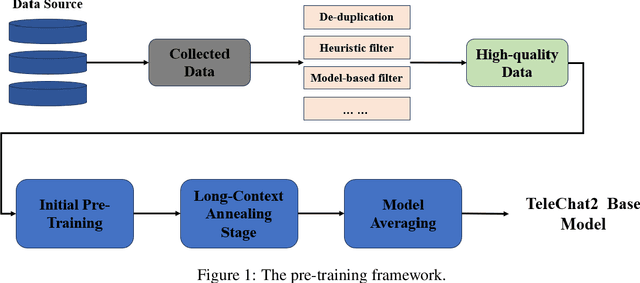
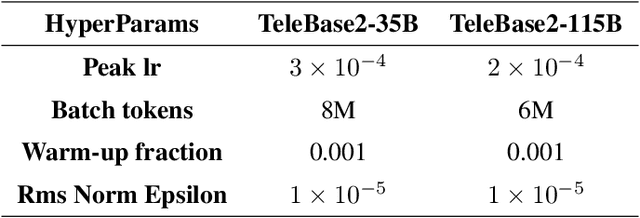
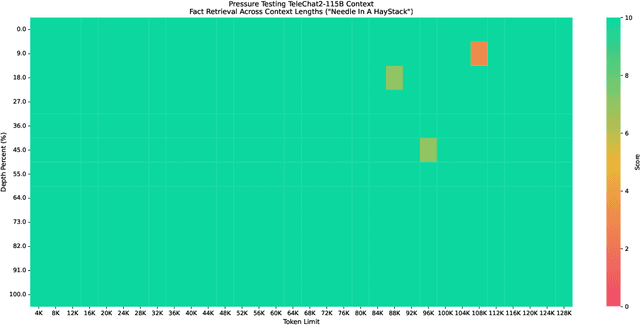
We introduce the latest series of TeleChat models: \textbf{TeleChat2}, \textbf{TeleChat2.5}, and \textbf{T1}, offering a significant upgrade over their predecessor, TeleChat. Despite minimal changes to the model architecture, the new series achieves substantial performance gains through enhanced training strategies in both pre-training and post-training stages. The series begins with \textbf{TeleChat2}, which undergoes pretraining on 10 trillion high-quality and diverse tokens. This is followed by Supervised Fine-Tuning (SFT) and Direct Preference Optimization (DPO) to further enhance its capabilities. \textbf{TeleChat2.5} and \textbf{T1} expand the pipeline by incorporating a continual pretraining phase with domain-specific datasets, combined with reinforcement learning (RL) to improve performance in code generation and mathematical reasoning tasks. The \textbf{T1} variant is designed for complex reasoning, supporting long Chain-of-Thought (CoT) reasoning and demonstrating substantial improvements in mathematics and coding. In contrast, \textbf{TeleChat2.5} prioritizes speed, delivering rapid inference. Both flagship models of \textbf{T1} and \textbf{TeleChat2.5} are dense Transformer-based architectures with 115B parameters, showcasing significant advancements in reasoning and general task performance compared to the original TeleChat. Notably, \textbf{T1-115B} outperform proprietary models such as OpenAI's o1-mini and GPT-4o. We publicly release \textbf{TeleChat2}, \textbf{TeleChat2.5} and \textbf{T1}, including post-trained versions with 35B and 115B parameters, to empower developers and researchers with state-of-the-art language models tailored for diverse applications.
BoSS: Beyond-Semantic Speech
Jul 23, 2025Human communication involves more than explicit semantics, with implicit signals and contextual cues playing a critical role in shaping meaning. However, modern speech technologies, such as Automatic Speech Recognition (ASR) and Text-to-Speech (TTS) often fail to capture these beyond-semantic dimensions. To better characterize and benchmark the progression of speech intelligence, we introduce Spoken Interaction System Capability Levels (L1-L5), a hierarchical framework illustrated the evolution of spoken dialogue systems from basic command recognition to human-like social interaction. To support these advanced capabilities, we propose Beyond-Semantic Speech (BoSS), which refers to the set of information in speech communication that encompasses but transcends explicit semantics. It conveys emotions, contexts, and modifies or extends meanings through multidimensional features such as affective cues, contextual dynamics, and implicit semantics, thereby enhancing the understanding of communicative intentions and scenarios. We present a formalized framework for BoSS, leveraging cognitive relevance theories and machine learning models to analyze temporal and contextual speech dynamics. We evaluate BoSS-related attributes across five different dimensions, reveals that current spoken language models (SLMs) are hard to fully interpret beyond-semantic signals. These findings highlight the need for advancing BoSS research to enable richer, more context-aware human-machine communication.
KungfuBot: Physics-Based Humanoid Whole-Body Control for Learning Highly-Dynamic Skills
Jun 15, 2025Humanoid robots are promising to acquire various skills by imitating human behaviors. However, existing algorithms are only capable of tracking smooth, low-speed human motions, even with delicate reward and curriculum design. This paper presents a physics-based humanoid control framework, aiming to master highly-dynamic human behaviors such as Kungfu and dancing through multi-steps motion processing and adaptive motion tracking. For motion processing, we design a pipeline to extract, filter out, correct, and retarget motions, while ensuring compliance with physical constraints to the maximum extent. For motion imitation, we formulate a bi-level optimization problem to dynamically adjust the tracking accuracy tolerance based on the current tracking error, creating an adaptive curriculum mechanism. We further construct an asymmetric actor-critic framework for policy training. In experiments, we train whole-body control policies to imitate a set of highly-dynamic motions. Our method achieves significantly lower tracking errors than existing approaches and is successfully deployed on the Unitree G1 robot, demonstrating stable and expressive behaviors. The project page is https://kungfu-bot.github.io.
AI Flow: Perspectives, Scenarios, and Approaches
Jun 14, 2025Pioneered by the foundational information theory by Claude Shannon and the visionary framework of machine intelligence by Alan Turing, the convergent evolution of information and communication technologies (IT/CT) has created an unbroken wave of connectivity and computation. This synergy has sparked a technological revolution, now reaching its peak with large artificial intelligence (AI) models that are reshaping industries and redefining human-machine collaboration. However, the realization of ubiquitous intelligence faces considerable challenges due to substantial resource consumption in large models and high communication bandwidth demands. To address these challenges, AI Flow has been introduced as a multidisciplinary framework that integrates cutting-edge IT and CT advancements, with a particular emphasis on the following three key points. First, device-edge-cloud framework serves as the foundation, which integrates end devices, edge servers, and cloud clusters to optimize scalability and efficiency for low-latency model inference. Second, we introduce the concept of familial models, which refers to a series of different-sized models with aligned hidden features, enabling effective collaboration and the flexibility to adapt to varying resource constraints and dynamic scenarios. Third, connectivity- and interaction-based intelligence emergence is a novel paradigm of AI Flow. By leveraging communication networks to enhance connectivity, the collaboration among AI models across heterogeneous nodes achieves emergent intelligence that surpasses the capability of any single model. The innovations of AI Flow provide enhanced intelligence, timely responsiveness, and ubiquitous accessibility to AI services, paving the way for the tighter fusion of AI techniques and communication systems.
MoRE: Mixture of Residual Experts for Humanoid Lifelike Gaits Learning on Complex Terrains
Jun 12, 2025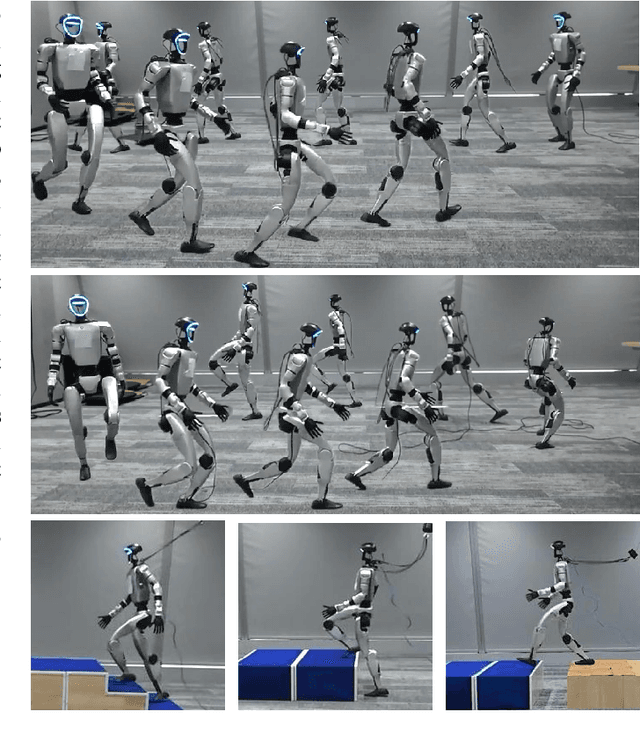
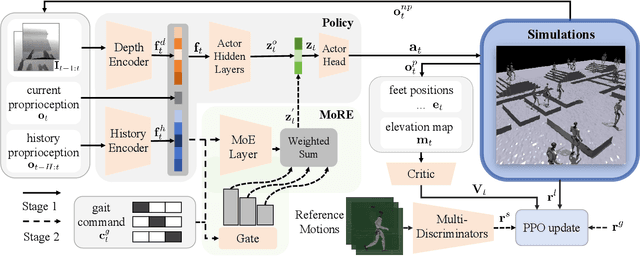
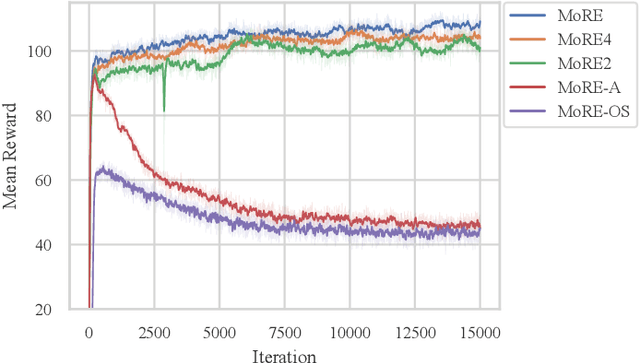
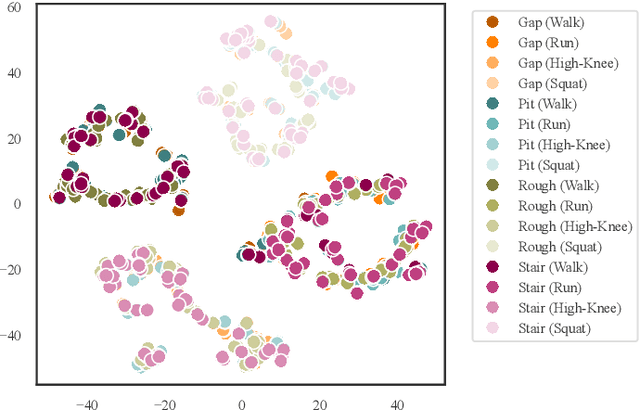
Humanoid robots have demonstrated robust locomotion capabilities using Reinforcement Learning (RL)-based approaches. Further, to obtain human-like behaviors, existing methods integrate human motion-tracking or motion prior in the RL framework. However, these methods are limited in flat terrains with proprioception only, restricting their abilities to traverse challenging terrains with human-like gaits. In this work, we propose a novel framework using a mixture of latent residual experts with multi-discriminators to train an RL policy, which is capable of traversing complex terrains in controllable lifelike gaits with exteroception. Our two-stage training pipeline first teaches the policy to traverse complex terrains using a depth camera, and then enables gait-commanded switching between human-like gait patterns. We also design gait rewards to adjust human-like behaviors like robot base height. Simulation and real-world experiments demonstrate that our framework exhibits exceptional performance in traversing complex terrains, and achieves seamless transitions between multiple human-like gait patterns.
Decoupling the Image Perception and Multimodal Reasoning for Reasoning Segmentation with Digital Twin Representations
Jun 09, 2025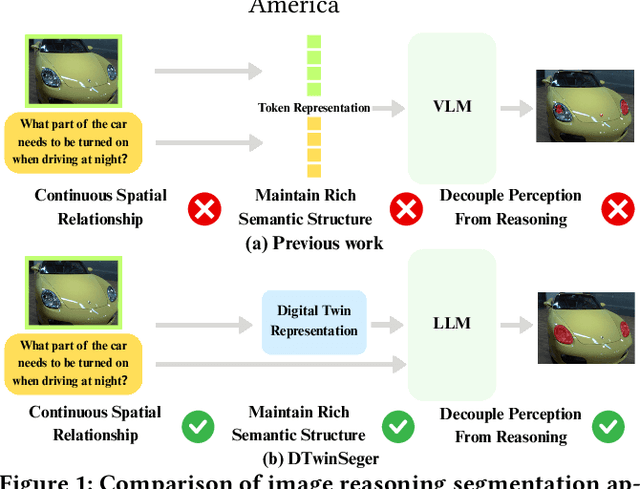
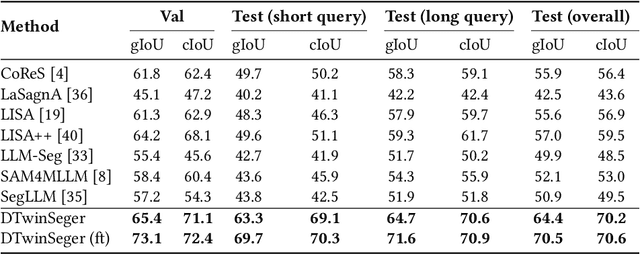
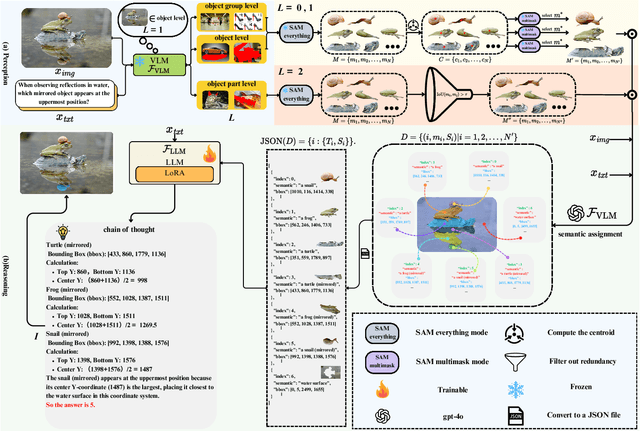

Reasoning Segmentation (RS) is a multimodal vision-text task that requires segmenting objects based on implicit text queries, demanding both precise visual perception and vision-text reasoning capabilities. Current RS approaches rely on fine-tuning vision-language models (VLMs) for both perception and reasoning, but their tokenization of images fundamentally disrupts continuous spatial relationships between objects. We introduce DTwinSeger, a novel RS approach that leverages Digital Twin (DT) representation as an intermediate layer to decouple perception from reasoning. Innovatively, DTwinSeger reformulates RS as a two-stage process, where the first transforms the image into a structured DT representation that preserves spatial relationships and semantic properties and then employs a Large Language Model (LLM) to perform explicit reasoning over this representation to identify target objects. We propose a supervised fine-tuning method specifically for LLM with DT representation, together with a corresponding fine-tuning dataset Seg-DT, to enhance the LLM's reasoning capabilities with DT representations. Experiments show that our method can achieve state-of-the-art performance on two image RS benchmarks and three image referring segmentation benchmarks. It yields that DT representation functions as an effective bridge between vision and text, enabling complex multimodal reasoning tasks to be accomplished solely with an LLM.
LLMs Caught in the Crossfire: Malware Requests and Jailbreak Challenges
Jun 09, 2025The widespread adoption of Large Language Models (LLMs) has heightened concerns about their security, particularly their vulnerability to jailbreak attacks that leverage crafted prompts to generate malicious outputs. While prior research has been conducted on general security capabilities of LLMs, their specific susceptibility to jailbreak attacks in code generation remains largely unexplored. To fill this gap, we propose MalwareBench, a benchmark dataset containing 3,520 jailbreaking prompts for malicious code-generation, designed to evaluate LLM robustness against such threats. MalwareBench is based on 320 manually crafted malicious code generation requirements, covering 11 jailbreak methods and 29 code functionality categories. Experiments show that mainstream LLMs exhibit limited ability to reject malicious code-generation requirements, and the combination of multiple jailbreak methods further reduces the model's security capabilities: specifically, the average rejection rate for malicious content is 60.93%, dropping to 39.92% when combined with jailbreak attack algorithms. Our work highlights that the code security capabilities of LLMs still pose significant challenges.
WebUIBench: A Comprehensive Benchmark for Evaluating Multimodal Large Language Models in WebUI-to-Code
Jun 09, 2025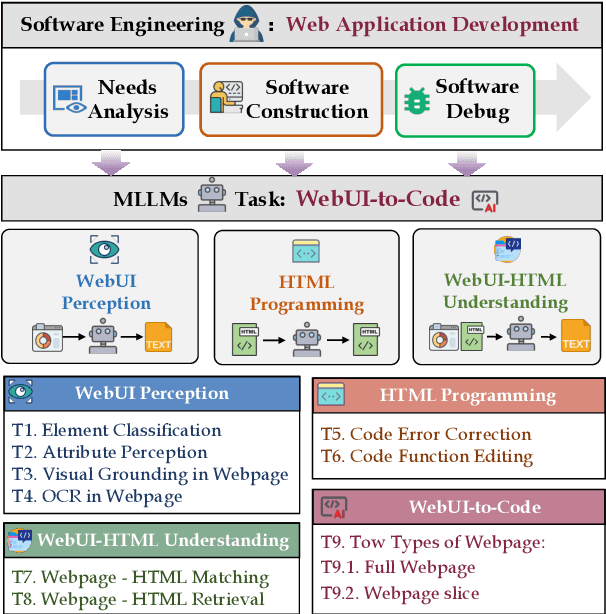
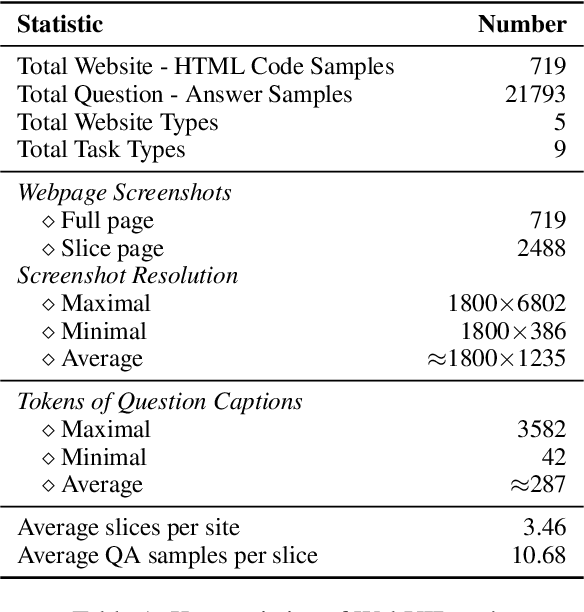
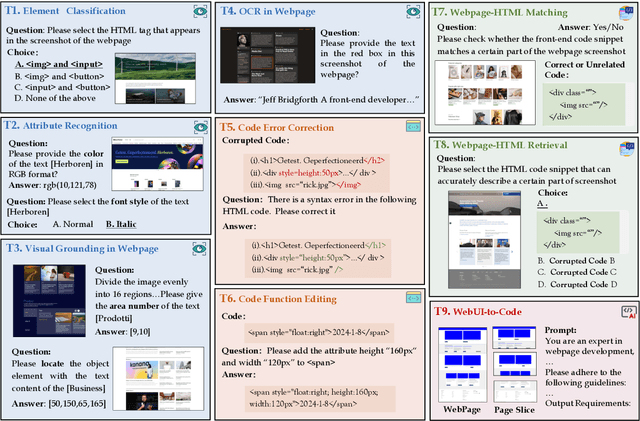
With the rapid advancement of Generative AI technology, Multimodal Large Language Models(MLLMs) have the potential to act as AI software engineers capable of executing complex web application development. Considering that the model requires a confluence of multidimensional sub-capabilities to address the challenges of various development phases, constructing a multi-view evaluation framework is crucial for accurately guiding the enhancement of development efficiency. However, existing benchmarks usually fail to provide an assessment of sub-capabilities and focus solely on webpage generation outcomes. In this work, we draw inspiration from the principles of software engineering and further propose WebUIBench, a benchmark systematically designed to evaluate MLLMs in four key areas: WebUI Perception, HTML Programming,WebUI-HTML Understanding, and WebUI-to-Code. WebUIBench comprises 21K high-quality question-answer pairs derived from over 0.7K real-world websites. The extensive evaluation of 29 mainstream MLLMs uncovers the skill characteristics and various weakness that models encountered during the development process.