 Add to Chrome
 Add to Firefox
 Add to Edge
Do MLLMs Really See It: Reinforcing Visual Attention in Multimodal LLMs
Feb 09, 2026
While chain-of-thought (CoT) reasoning has substantially improved multimodal large language models (MLLMs) on complex reasoning tasks, existing approaches largely rely on long textual reasoning trajectories and provide limited mechanisms for learning stable visual attention policies. Our analysis shows that current MLLMs exhibit weak visual focus: early-stage visual misalignment is rarely corrected during subsequent reasoning, leading to error propagation and failed inferences. We argue that this limitation stems from inadequate credit assignment for visual attention during training. To address this issue, we propose SAYO, a visual reasoning model trained with a reinforcement learning (RL) framework that introduces a region-level visual attention-based reward. This reward explicitly aligns optimization signals with visually grounded reasoning steps, enabling the model to learn more reliable attention behaviors. Extensive experiments across multiple multimodal benchmarks demonstrate that SAYO consistently improves performance on diverse reasoning and perception tasks.

WebUIBench: A Comprehensive Benchmark for Evaluating Multimodal Large Language Models in WebUI-to-Code
Jun 09, 2025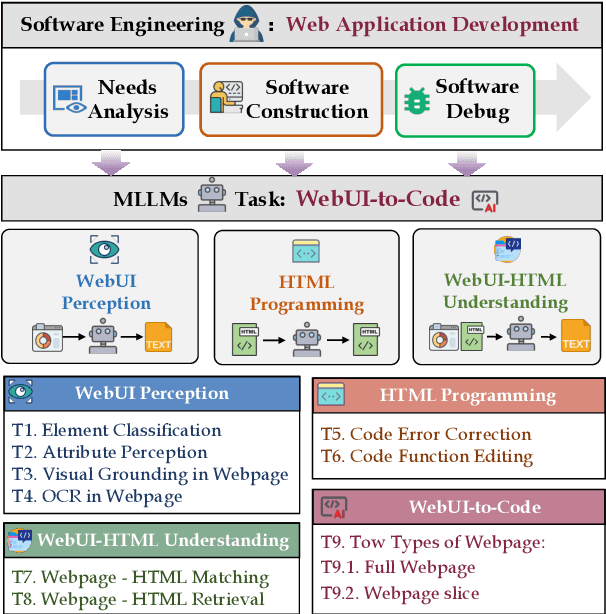
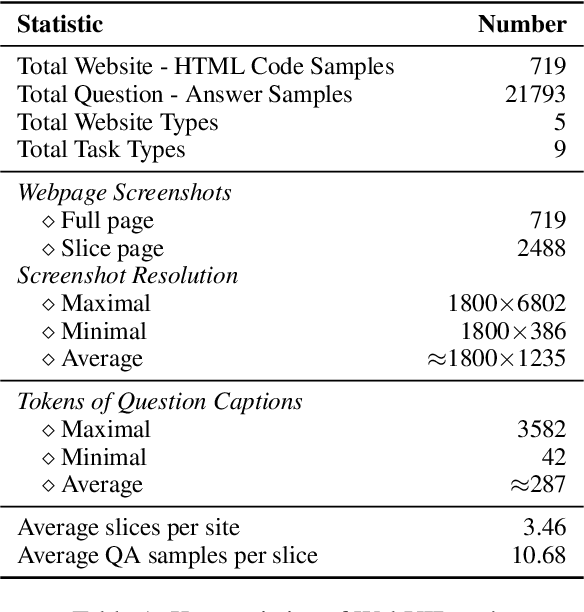
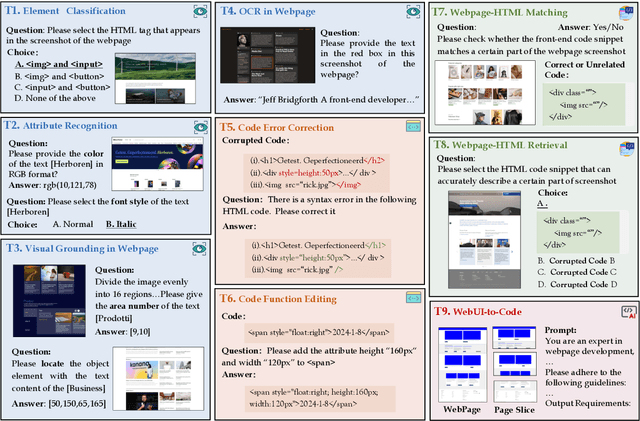
With the rapid advancement of Generative AI technology, Multimodal Large Language Models(MLLMs) have the potential to act as AI software engineers capable of executing complex web application development. Considering that the model requires a confluence of multidimensional sub-capabilities to address the challenges of various development phases, constructing a multi-view evaluation framework is crucial for accurately guiding the enhancement of development efficiency. However, existing benchmarks usually fail to provide an assessment of sub-capabilities and focus solely on webpage generation outcomes. In this work, we draw inspiration from the principles of software engineering and further propose WebUIBench, a benchmark systematically designed to evaluate MLLMs in four key areas: WebUI Perception, HTML Programming,WebUI-HTML Understanding, and WebUI-to-Code. WebUIBench comprises 21K high-quality question-answer pairs derived from over 0.7K real-world websites. The extensive evaluation of 29 mainstream MLLMs uncovers the skill characteristics and various weakness that models encountered during the development process.