 Add to Chrome
 Add to Firefox
 Add to Edge
DBGroup: Dual-Branch Point Grouping for Weakly Supervised 3D Instance Segmentation
Nov 13, 2025
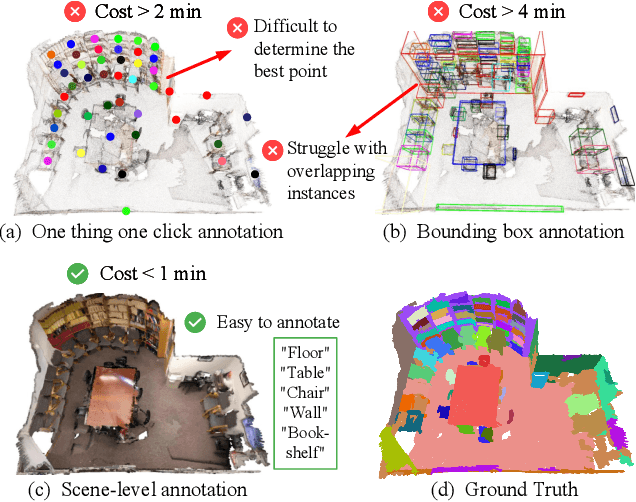
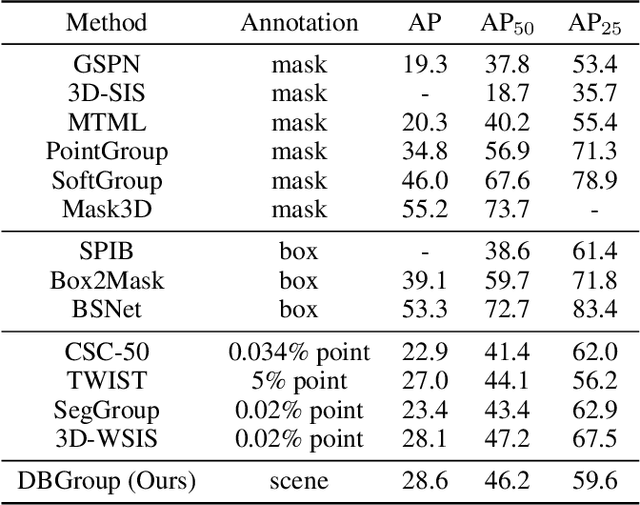
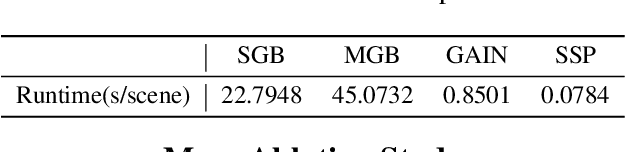
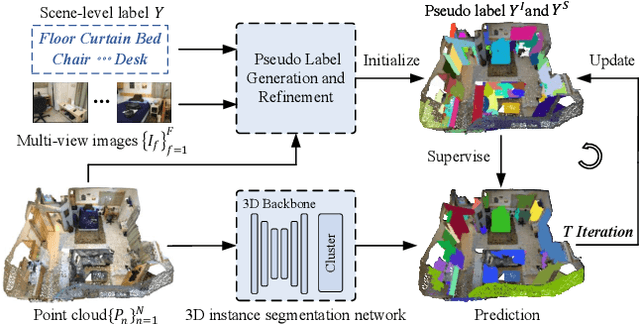
Weakly supervised 3D instance segmentation is essential for 3D scene understanding, especially as the growing scale of data and high annotation costs associated with fully supervised approaches. Existing methods primarily rely on two forms of weak supervision: one-thing-one-click annotations and bounding box annotations, both of which aim to reduce labeling efforts. However, these approaches still encounter limitations, including labor-intensive annotation processes, high complexity, and reliance on expert annotators. To address these challenges, we propose \textbf{DBGroup}, a two-stage weakly supervised 3D instance segmentation framework that leverages scene-level annotations as a more efficient and scalable alternative. In the first stage, we introduce a Dual-Branch Point Grouping module to generate pseudo labels guided by semantic and mask cues extracted from multi-view images. To further improve label quality, we develop two refinement strategies: Granularity-Aware Instance Merging and Semantic Selection and Propagation. The second stage involves multi-round self-training on an end-to-end instance segmentation network using the refined pseudo-labels. Additionally, we introduce an Instance Mask Filter strategy to address inconsistencies within the pseudo labels. Extensive experiments demonstrate that DBGroup achieves competitive performance compared to sparse-point-level supervised 3D instance segmentation methods, while surpassing state-of-the-art scene-level supervised 3D semantic segmentation approaches. Code is available at https://github.com/liuxuexun/DBGroup.

Semantic-Consistent Bidirectional Contrastive Hashing for Noisy Multi-Label Cross-Modal Retrieval
Nov 11, 2025Cross-modal hashing (CMH) facilitates efficient retrieval across different modalities (e.g., image and text) by encoding data into compact binary representations. While recent methods have achieved remarkable performance, they often rely heavily on fully annotated datasets, which are costly and labor-intensive to obtain. In real-world scenarios, particularly in multi-label datasets, label noise is prevalent and severely degrades retrieval performance. Moreover, existing CMH approaches typically overlook the partial semantic overlaps inherent in multi-label data, limiting their robustness and generalization. To tackle these challenges, we propose a novel framework named Semantic-Consistent Bidirectional Contrastive Hashing (SCBCH). The framework comprises two complementary modules: (1) Cross-modal Semantic-Consistent Classification (CSCC), which leverages cross-modal semantic consistency to estimate sample reliability and reduce the impact of noisy labels; (2) Bidirectional Soft Contrastive Hashing (BSCH), which dynamically generates soft contrastive sample pairs based on multi-label semantic overlap, enabling adaptive contrastive learning between semantically similar and dissimilar samples across modalities. Extensive experiments on four widely-used cross-modal retrieval benchmarks validate the effectiveness and robustness of our method, consistently outperforming state-of-the-art approaches under noisy multi-label conditions.
MG2FlowNet: Accelerating High-Reward Sample Generation via Enhanced MCTS and Greediness Control
Oct 01, 2025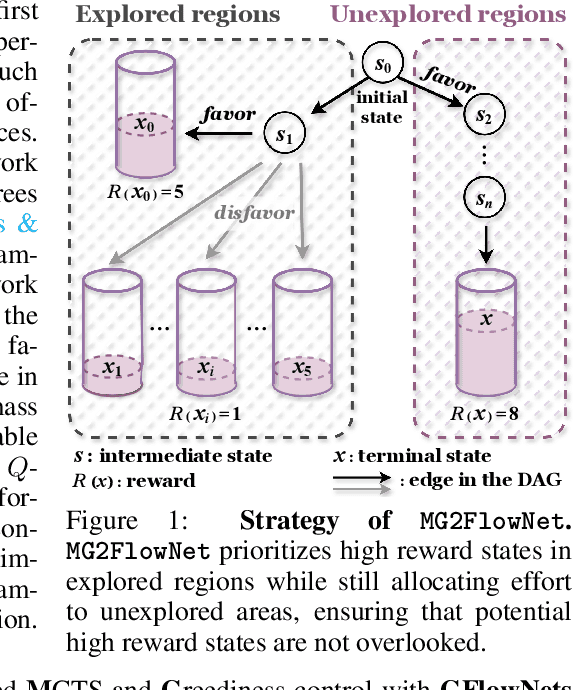
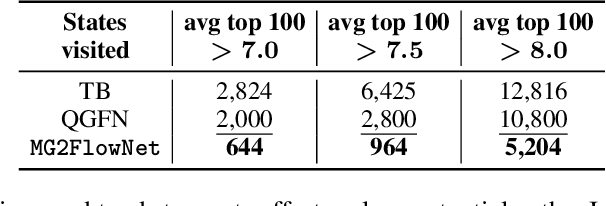
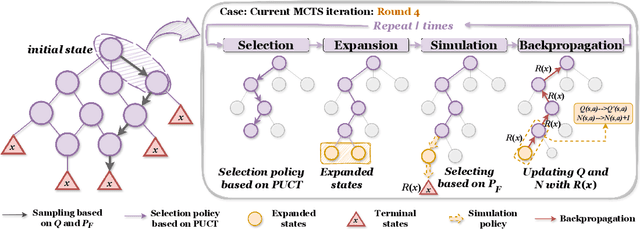
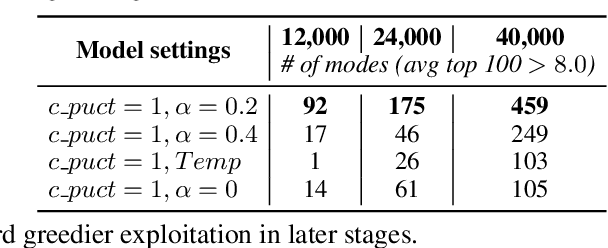
Generative Flow Networks (GFlowNets) have emerged as a powerful tool for generating diverse and high-reward structured objects by learning to sample from a distribution proportional to a given reward function. Unlike conventional reinforcement learning (RL) approaches that prioritize optimization of a single trajectory, GFlowNets seek to balance diversity and reward by modeling the entire trajectory distribution. This capability makes them especially suitable for domains such as molecular design and combinatorial optimization. However, existing GFlowNets sampling strategies tend to overexplore and struggle to consistently generate high-reward samples, particularly in large search spaces with sparse high-reward regions. Therefore, improving the probability of generating high-reward samples without sacrificing diversity remains a key challenge under this premise. In this work, we integrate an enhanced Monte Carlo Tree Search (MCTS) into the GFlowNets sampling process, using MCTS-based policy evaluation to guide the generation toward high-reward trajectories and Polynomial Upper Confidence Trees (PUCT) to balance exploration and exploitation adaptively, and we introduce a controllable mechanism to regulate the degree of greediness. Our method enhances exploitation without sacrificing diversity by dynamically balancing exploration and reward-driven guidance. The experimental results show that our method can not only accelerate the speed of discovering high-reward regions but also continuously generate high-reward samples, while preserving the diversity of the generative distribution. All implementations are available at https://github.com/ZRNB/MG2FlowNet.
BaseReward: A Strong Baseline for Multimodal Reward Model
Sep 19, 2025

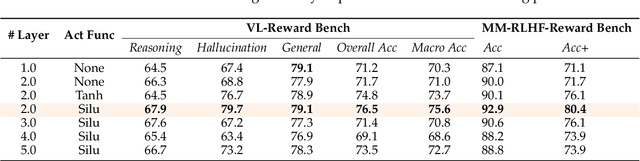
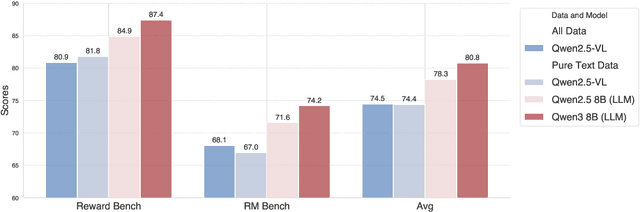
The rapid advancement of Multimodal Large Language Models (MLLMs) has made aligning them with human preferences a critical challenge. Reward Models (RMs) are a core technology for achieving this goal, but a systematic guide for building state-of-the-art Multimodal Reward Models (MRMs) is currently lacking in both academia and industry. Through exhaustive experimental analysis, this paper aims to provide a clear ``recipe'' for constructing high-performance MRMs. We systematically investigate every crucial component in the MRM development pipeline, including \textit{reward modeling paradigms} (e.g., Naive-RM, Critic-based RM, and Generative RM), \textit{reward head architecture}, \textit{training strategies}, \textit{data curation} (covering over ten multimodal and text-only preference datasets), \textit{backbone model} and \textit{model scale}, and \textit{ensemble methods}. Based on these experimental insights, we introduce \textbf{BaseReward}, a powerful and efficient baseline for multimodal reward modeling. BaseReward adopts a simple yet effective architecture, built upon a {Qwen2.5-VL} backbone, featuring an optimized two-layer reward head, and is trained on a carefully curated mixture of high-quality multimodal and text-only preference data. Our results show that BaseReward establishes a new SOTA on major benchmarks such as MM-RLHF-Reward Bench, VL-Reward Bench, and Multimodal Reward Bench, outperforming previous models. Furthermore, to validate its practical utility beyond static benchmarks, we integrate BaseReward into a real-world reinforcement learning pipeline, successfully enhancing an MLLM's performance across various perception, reasoning, and conversational tasks. This work not only delivers a top-tier MRM but, more importantly, provides the community with a clear, empirically-backed guide for developing robust reward models for the next generation of MLLMs.
Camera Pose Refinement via 3D Gaussian Splatting
Aug 25, 2025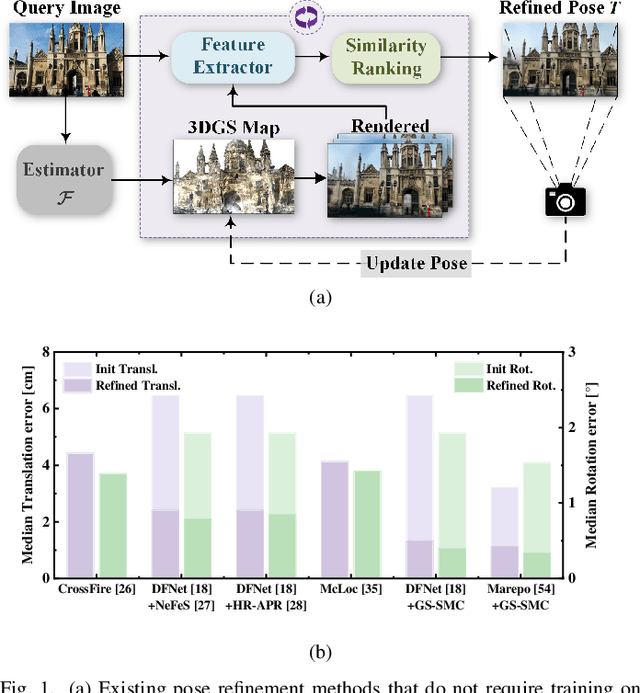
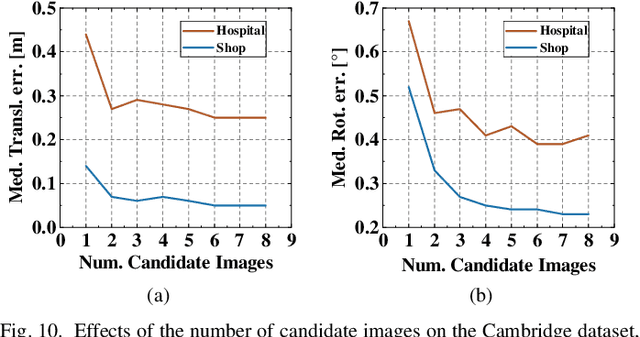
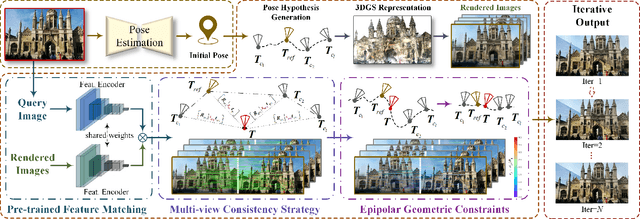
Camera pose refinement aims at improving the accuracy of initial pose estimation for applications in 3D computer vision. Most refinement approaches rely on 2D-3D correspondences with specific descriptors or dedicated networks, requiring reconstructing the scene again for a different descriptor or fully retraining the network for each scene. Some recent methods instead infer pose from feature similarity, but their lack of geometry constraints results in less accuracy. To overcome these limitations, we propose a novel camera pose refinement framework leveraging 3D Gaussian Splatting (3DGS), referred to as GS-SMC. Given the widespread usage of 3DGS, our method can employ an existing 3DGS model to render novel views, providing a lightweight solution that can be directly applied to diverse scenes without additional training or fine-tuning. Specifically, we introduce an iterative optimization approach, which refines the camera pose using epipolar geometric constraints among the query and multiple rendered images. Our method allows flexibly choosing feature extractors and matchers to establish these constraints. Extensive empirical evaluations on the 7-Scenes and the Cambridge Landmarks datasets demonstrate that our method outperforms state-of-the-art camera pose refinement approaches, achieving 53.3% and 56.9% reductions in median translation and rotation errors on 7-Scenes, and 40.7% and 53.2% on Cambridge.
SLRTP2025 Sign Language Production Challenge: Methodology, Results, and Future Work
Aug 09, 2025Sign Language Production (SLP) is the task of generating sign language video from spoken language inputs. The field has seen a range of innovations over the last few years, with the introduction of deep learning-based approaches providing significant improvements in the realism and naturalness of generated outputs. However, the lack of standardized evaluation metrics for SLP approaches hampers meaningful comparisons across different systems. To address this, we introduce the first Sign Language Production Challenge, held as part of the third SLRTP Workshop at CVPR 2025. The competition's aims are to evaluate architectures that translate from spoken language sentences to a sequence of skeleton poses, known as Text-to-Pose (T2P) translation, over a range of metrics. For our evaluation data, we use the RWTH-PHOENIX-Weather-2014T dataset, a German Sign Language - Deutsche Gebardensprache (DGS) weather broadcast dataset. In addition, we curate a custom hidden test set from a similar domain of discourse. This paper presents the challenge design and the winning methodologies. The challenge attracted 33 participants who submitted 231 solutions, with the top-performing team achieving BLEU-1 scores of 31.40 and DTW-MJE of 0.0574. The winning approach utilized a retrieval-based framework and a pre-trained language model. As part of the workshop, we release a standardized evaluation network, including high-quality skeleton extraction-based keypoints establishing a consistent baseline for the SLP field, which will enable future researchers to compare their work against a broader range of methods.
Motion is the Choreographer: Learning Latent Pose Dynamics for Seamless Sign Language Generation
Aug 06, 2025Sign language video generation requires producing natural signing motions with realistic appearances under precise semantic control, yet faces two critical challenges: excessive signer-specific data requirements and poor generalization. We propose a new paradigm for sign language video generation that decouples motion semantics from signer identity through a two-phase synthesis framework. First, we construct a signer-independent multimodal motion lexicon, where each gloss is stored as identity-agnostic pose, gesture, and 3D mesh sequences, requiring only one recording per sign. This compact representation enables our second key innovation: a discrete-to-continuous motion synthesis stage that transforms retrieved gloss sequences into temporally coherent motion trajectories, followed by identity-aware neural rendering to produce photorealistic videos of arbitrary signers. Unlike prior work constrained by signer-specific datasets, our method treats motion as a first-class citizen: the learned latent pose dynamics serve as a portable "choreography layer" that can be visually realized through different human appearances. Extensive experiments demonstrate that disentangling motion from identity is not just viable but advantageous - enabling both high-quality synthesis and unprecedented flexibility in signer personalization.
Driving by Hybrid Navigation: An Online HD-SD Map Association Framework and Benchmark for Autonomous Vehicles
Jul 10, 2025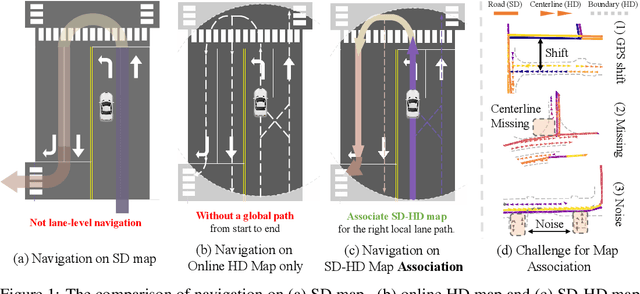
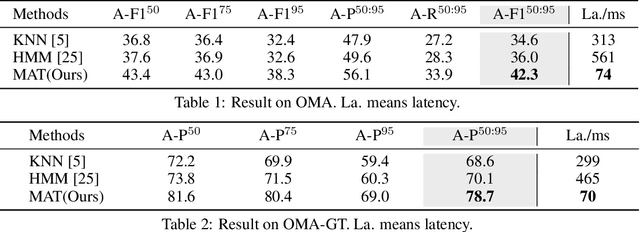
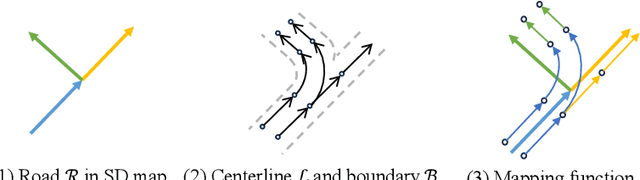
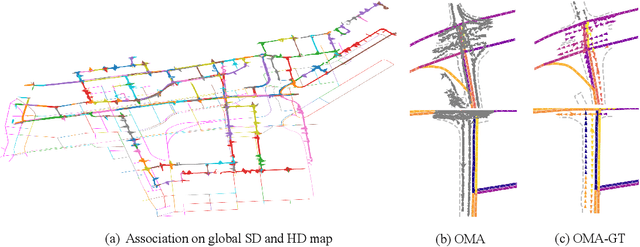
Autonomous vehicles rely on global standard-definition (SD) maps for road-level route planning and online local high-definition (HD) maps for lane-level navigation. However, recent work concentrates on construct online HD maps, often overlooking the association of global SD maps with online HD maps for hybrid navigation, making challenges in utilizing online HD maps in the real world. Observing the lack of the capability of autonomous vehicles in navigation, we introduce \textbf{O}nline \textbf{M}ap \textbf{A}ssociation, the first benchmark for the association of hybrid navigation-oriented online maps, which enhances the planning capabilities of autonomous vehicles. Based on existing datasets, the OMA contains 480k of roads and 260k of lane paths and provides the corresponding metrics to evaluate the performance of the model. Additionally, we propose a novel framework, named Map Association Transformer, as the baseline method, using path-aware attention and spatial attention mechanisms to enable the understanding of geometric and topological correspondences. The code and dataset can be accessed at https://github.com/WallelWan/OMA-MAT.
XVerse: Consistent Multi-Subject Control of Identity and Semantic Attributes via DiT Modulation
Jun 26, 2025Achieving fine-grained control over subject identity and semantic attributes (pose, style, lighting) in text-to-image generation, particularly for multiple subjects, often undermines the editability and coherence of Diffusion Transformers (DiTs). Many approaches introduce artifacts or suffer from attribute entanglement. To overcome these challenges, we propose a novel multi-subject controlled generation model XVerse. By transforming reference images into offsets for token-specific text-stream modulation, XVerse allows for precise and independent control for specific subject without disrupting image latents or features. Consequently, XVerse offers high-fidelity, editable multi-subject image synthesis with robust control over individual subject characteristics and semantic attributes. This advancement significantly improves personalized and complex scene generation capabilities.
SignAligner: Harmonizing Complementary Pose Modalities for Coherent Sign Language Generation
Jun 13, 2025Sign language generation aims to produce diverse sign representations based on spoken language. However, achieving realistic and naturalistic generation remains a significant challenge due to the complexity of sign language, which encompasses intricate hand gestures, facial expressions, and body movements. In this work, we introduce PHOENIX14T+, an extended version of the widely-used RWTH-PHOENIX-Weather 2014T dataset, featuring three new sign representations: Pose, Hamer and Smplerx. We also propose a novel method, SignAligner, for realistic sign language generation, consisting of three stages: text-driven pose modalities co-generation, online collaborative correction of multimodality, and realistic sign video synthesis. First, by incorporating text semantics, we design a joint sign language generator to simultaneously produce posture coordinates, gesture actions, and body movements. The text encoder, based on a Transformer architecture, extracts semantic features, while a cross-modal attention mechanism integrates these features to generate diverse sign language representations, ensuring accurate mapping and controlling the diversity of modal features. Next, online collaborative correction is introduced to refine the generated pose modalities using a dynamic loss weighting strategy and cross-modal attention, facilitating the complementarity of information across modalities, eliminating spatiotemporal conflicts, and ensuring semantic coherence and action consistency. Finally, the corrected pose modalities are fed into a pre-trained video generation network to produce high-fidelity sign language videos. Extensive experiments demonstrate that SignAligner significantly improves both the accuracy and expressiveness of the generated sign videos.