 Add to Chrome
 Add to Firefox
 Add to Edge
MotionHalluc: Diagnosing Kinematic Hallucinations in Fine-Grained Motion Reasoning
Jun 22, 2026
Motion instruction generation in cross-video comparison aims to produce corrective feedback that describes the differences between a query and a reference motion. However, existing models often generate instructions that exhibit motion hallucinations, failing to reflect actual kinematic differences between paired videos. To systematically investigate these hallucinations, we introduce MotionHalluc, a dedicated benchmark for evaluating motion hallucinations in paired-video comparison. MotionHalluc comprises 1540 fine-grained questions over 553 video pairs, evaluating hallucinations along three core dimensions: (1)directional hallucination, (2)attributional hallucination, and (3)temporal hallucination. Extensive evaluations of state-of-the-art large multimodal models demonstrate high susceptibility to these hallucinations. Furthermore, we provide Perceive-Parse-Verify (PPV) as a training-free measurements extraction and verification baseline that converts candidate instructions into executable measurement queries and supplies kinematic measurements at inference time. Our results show that this simple measurements injection yields an average 10.6% performance gain across models, suggesting that motion reasoning with explicit quantitative measurements is a key factor in reducing hallucinations in cross-video comparison. Our code and dataset will be made publicly available upon acceptance.

DBGroup: Dual-Branch Point Grouping for Weakly Supervised 3D Instance Segmentation
Nov 13, 2025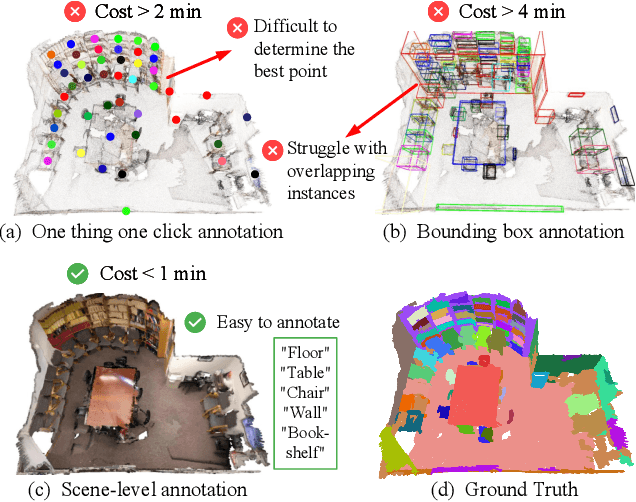
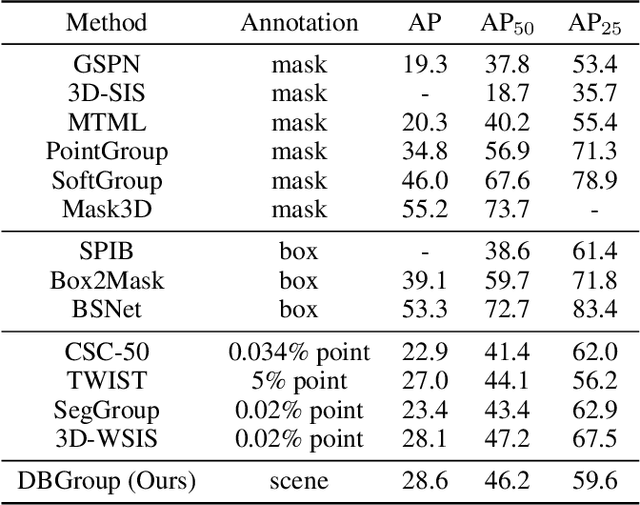
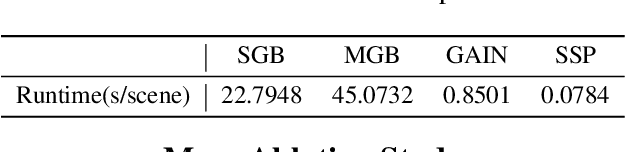
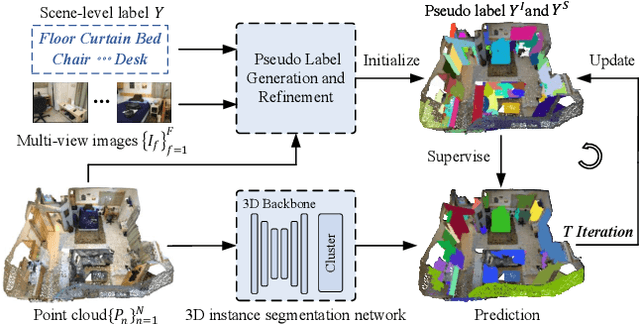
Weakly supervised 3D instance segmentation is essential for 3D scene understanding, especially as the growing scale of data and high annotation costs associated with fully supervised approaches. Existing methods primarily rely on two forms of weak supervision: one-thing-one-click annotations and bounding box annotations, both of which aim to reduce labeling efforts. However, these approaches still encounter limitations, including labor-intensive annotation processes, high complexity, and reliance on expert annotators. To address these challenges, we propose \textbf{DBGroup}, a two-stage weakly supervised 3D instance segmentation framework that leverages scene-level annotations as a more efficient and scalable alternative. In the first stage, we introduce a Dual-Branch Point Grouping module to generate pseudo labels guided by semantic and mask cues extracted from multi-view images. To further improve label quality, we develop two refinement strategies: Granularity-Aware Instance Merging and Semantic Selection and Propagation. The second stage involves multi-round self-training on an end-to-end instance segmentation network using the refined pseudo-labels. Additionally, we introduce an Instance Mask Filter strategy to address inconsistencies within the pseudo labels. Extensive experiments demonstrate that DBGroup achieves competitive performance compared to sparse-point-level supervised 3D instance segmentation methods, while surpassing state-of-the-art scene-level supervised 3D semantic segmentation approaches. Code is available at https://github.com/liuxuexun/DBGroup.
LESS: Label-Efficient and Single-Stage Referring 3D Segmentation
Oct 17, 2024
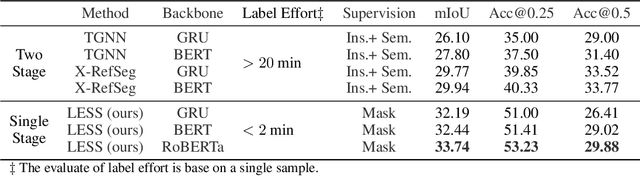
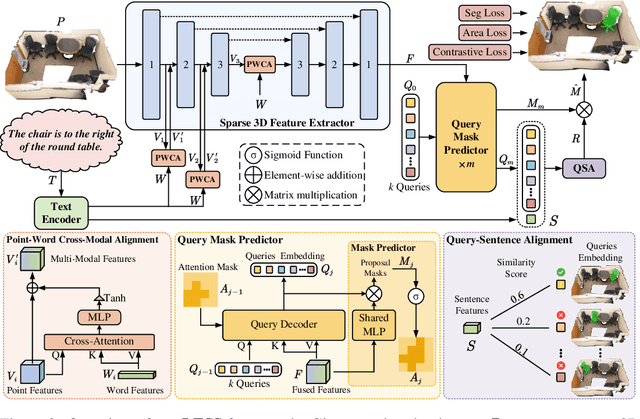

Referring 3D Segmentation is a visual-language task that segments all points of the specified object from a 3D point cloud described by a sentence of query. Previous works perform a two-stage paradigm, first conducting language-agnostic instance segmentation then matching with given text query. However, the semantic concepts from text query and visual cues are separately interacted during the training, and both instance and semantic labels for each object are required, which is time consuming and human-labor intensive. To mitigate these issues, we propose a novel Referring 3D Segmentation pipeline, Label-Efficient and Single-Stage, dubbed LESS, which is only under the supervision of efficient binary mask. Specifically, we design a Point-Word Cross-Modal Alignment module for aligning the fine-grained features of points and textual embedding. Query Mask Predictor module and Query-Sentence Alignment module are introduced for coarse-grained alignment between masks and query. Furthermore, we propose an area regularization loss, which coarsely reduces irrelevant background predictions on a large scale. Besides, a point-to-point contrastive loss is proposed concentrating on distinguishing points with subtly similar features. Through extensive experiments, we achieve state-of-the-art performance on ScanRefer dataset by surpassing the previous methods about 3.7% mIoU using only binary labels.