 Add to Chrome
 Add to Firefox
 Add to Edge
Decision-Aware Quadratic ReLU Replacement for HE-Friendly Inference
May 21, 2026
Fully homomorphic encryption (FHE) supports only additions and multiplications, so FHE-only neural-network inference typically replaces ReLU with polynomials fitted over empirical activation intervals. Such interval fitting often requires higher-degree polynomials to control activation error, incurring homomorphic evaluation costs, while classification is determined by the final logit decision. We revisit ReLU replacement from a decision-aware perspective: given a trained single-hidden-layer ReLU MLP and a specified calibration set, can an HE-friendly low-degree polynomial replace ReLU without retraining while preserving calibration-set decisions? We focus on quadratic replacement, the lowest-degree choice that retains a genuine per-unit nonlinearity. For calibration sets positive-margin separable in the lifted space, we formulate quadratic replacement as a linear separation problem, yielding necessary and sufficient conditions for calibration-lossless replacement and a constructive algorithm for the coefficients. When the positive-margin condition fails -- typically due to a few misclassified calibration samples -- we extend the same geometric framework via reduced convex hulls and Lagrangian-dual soft-margin relaxations, which bound the influence of any single sample, converting the problem into smaller convex quadratic programs that yield approximately feasible coefficients with high empirical agreement on calibration-set decisions. In particular, at the maximal weight cap $μ=1$, the reduced-convex-hull relaxation reduces to the convex-hull separation of the strictly separable case; the relaxation thus continuously extends the exact theory. Under CKKS, the quadratic replacement matches plaintext top-1 accuracy on multiple benchmarks, running 3.7--4.1$\times$ faster than Remez-7 in the activation module and 1.18--1.68$\times$ faster end-to-end.

Data-Driven Reachability Analysis via Diffusion Models with PAC Guarantees
Mar 31, 2026We present a data-driven framework for reachability analysis of nonlinear dynamical systems that requires no explicit model. A denoising diffusion probabilistic model learns the time-evolving state distribution of a dynamical system from trajectory data alone. The predicted reachable set takes the form of a sublevel set of a nonconformity score derived from the reconstruction error, with the threshold calibrated via the Learn Then Test procedure so that the probability of excluding a reachable state is bounded with high probability. Experiments on three nonlinear systems, a forced Duffing oscillator, a planar quadrotor, and a high-dimensional reaction-diffusion system, confirm that the empirical miss rate remains below the Probably Approximately Correct (PAC) bound while scaling to state dimensions beyond the reach of classical grid-based and polynomial methods.
Double Coupling Architecture and Training Method for Optimization Problems of Differential Algebraic Equations with Parameters
Mar 24, 2026Simulation and modeling are essential in product development, integrated into the design and manufacturing process to enhance efficiency and quality. They are typically represented as complex nonlinear differential algebraic equations. The growing diversity of product requirements demands multi-task optimization, a key challenge in simulation modeling research. A dual physics-informed neural network architecture has been proposed to decouple constraints and objective functions in parametric differential algebraic equation optimization problems. Theoretical analysis shows that introducing a relaxation variable with a global error bound ensures solution equivalence between the network and optimization problem. A genetic algorithm-enhanced training framework for physics-informed neural networks improves training precision and efficiency, avoiding redundant solving of differential algebraic equations. This approach enables generalization for multi-task objectives with a single, training maintaining real-time responsiveness to product requirements.
GNN-DIP: Neural Corridor Selection for Decomposition-Based Motion Planning
Mar 12, 2026Motion planning through narrow passages remains a core challenge: sampling-based planners rarely place samples inside these narrow but critical regions, and even when samples land inside a passage, the straight-line connections between them run close to obstacle boundaries and are frequently rejected by collision checking. Decomposition-based planners resolve both issues by partitioning free space into convex cells -- every passage is captured exactly as a cell boundary, and any path within a cell is collision-free by construction. However, the number of candidate corridors through the cell graph grows combinatorially with environment complexity, creating a bottleneck in corridor selection. We present GNN-DIP, a framework that addresses this by integrating a Graph Neural Network (GNN) with a two-phase Decomposition-Informed Planner (DIP). The GNN predicts portal scores on the cell adjacency graph to bias corridor search toward near-optimal regions while preserving completeness. In 2D, Constrained Delaunay Triangulation (CDT) with the Funnel algorithm yields exact shortest paths within corridors; in 3D, Slab convex decomposition with portal-face sampling provides near-optimal path evaluation. Benchmarks on 2D narrow-passage scenarios, 3D bottleneck environments with up to 246 obstacles, and dynamic 2D settings show that GNN-DIP achieves 99--100% success rates with 2--280 times speedup over sampling-based baselines.
Semantic-Consistent Bidirectional Contrastive Hashing for Noisy Multi-Label Cross-Modal Retrieval
Nov 11, 2025Cross-modal hashing (CMH) facilitates efficient retrieval across different modalities (e.g., image and text) by encoding data into compact binary representations. While recent methods have achieved remarkable performance, they often rely heavily on fully annotated datasets, which are costly and labor-intensive to obtain. In real-world scenarios, particularly in multi-label datasets, label noise is prevalent and severely degrades retrieval performance. Moreover, existing CMH approaches typically overlook the partial semantic overlaps inherent in multi-label data, limiting their robustness and generalization. To tackle these challenges, we propose a novel framework named Semantic-Consistent Bidirectional Contrastive Hashing (SCBCH). The framework comprises two complementary modules: (1) Cross-modal Semantic-Consistent Classification (CSCC), which leverages cross-modal semantic consistency to estimate sample reliability and reduce the impact of noisy labels; (2) Bidirectional Soft Contrastive Hashing (BSCH), which dynamically generates soft contrastive sample pairs based on multi-label semantic overlap, enabling adaptive contrastive learning between semantically similar and dissimilar samples across modalities. Extensive experiments on four widely-used cross-modal retrieval benchmarks validate the effectiveness and robustness of our method, consistently outperforming state-of-the-art approaches under noisy multi-label conditions.
PROMISE: A Framework for Model-Driven Stateful Prompt Orchestration
Dec 07, 2023
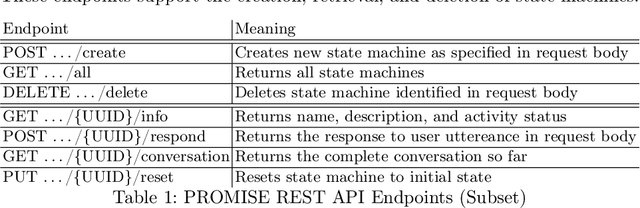


The advent of increasingly powerful language models has raised expectations for language-based interactions. However, controlling these models is a challenge, emphasizing the need to be able to investigate the feasibility and value of their application. We present PROMISE, a framework that facilitates the development of complex language-based interactions with information systems. Its use of state machine modeling concepts enables model-driven, dynamic prompt orchestration across hierarchically nested states and transitions. This improves the control of the behavior of language models and thus enables their effective and efficient use. We show the benefits of PROMISE in the context of application scenarios within health information systems and demonstrate its ability to handle complex interactions.