 Add to Chrome
 Add to Firefox
 Add to Edge
MuseCoco: Generating Symbolic Music from Text
May 31, 2023
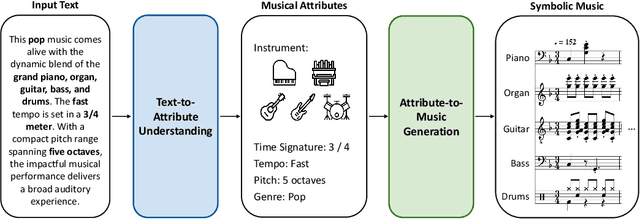
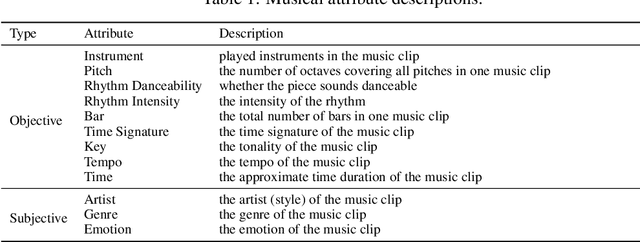
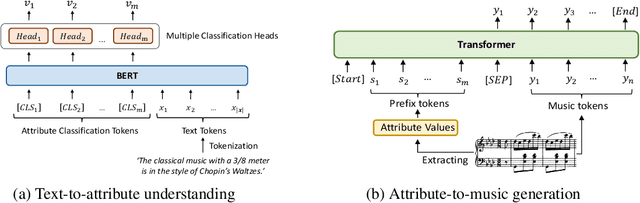
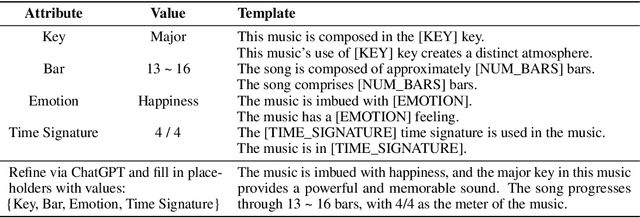
Generating music from text descriptions is a user-friendly mode since the text is a relatively easy interface for user engagement. While some approaches utilize texts to control music audio generation, editing musical elements in generated audio is challenging for users. In contrast, symbolic music offers ease of editing, making it more accessible for users to manipulate specific musical elements. In this paper, we propose MuseCoco, which generates symbolic music from text descriptions with musical attributes as the bridge to break down the task into text-to-attribute understanding and attribute-to-music generation stages. MuseCoCo stands for Music Composition Copilot that empowers musicians to generate music directly from given text descriptions, offering a significant improvement in efficiency compared to creating music entirely from scratch. The system has two main advantages: Firstly, it is data efficient. In the attribute-to-music generation stage, the attributes can be directly extracted from music sequences, making the model training self-supervised. In the text-to-attribute understanding stage, the text is synthesized and refined by ChatGPT based on the defined attribute templates. Secondly, the system can achieve precise control with specific attributes in text descriptions and offers multiple control options through attribute-conditioned or text-conditioned approaches. MuseCoco outperforms baseline systems in terms of musicality, controllability, and overall score by at least 1.27, 1.08, and 1.32 respectively. Besides, there is a notable enhancement of about 20% in objective control accuracy. In addition, we have developed a robust large-scale model with 1.2 billion parameters, showcasing exceptional controllability and musicality.

Deliberate then Generate: Enhanced Prompting Framework for Text Generation
May 31, 2023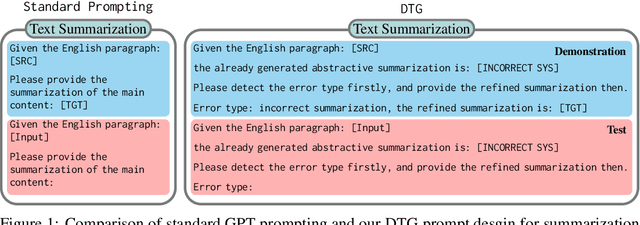
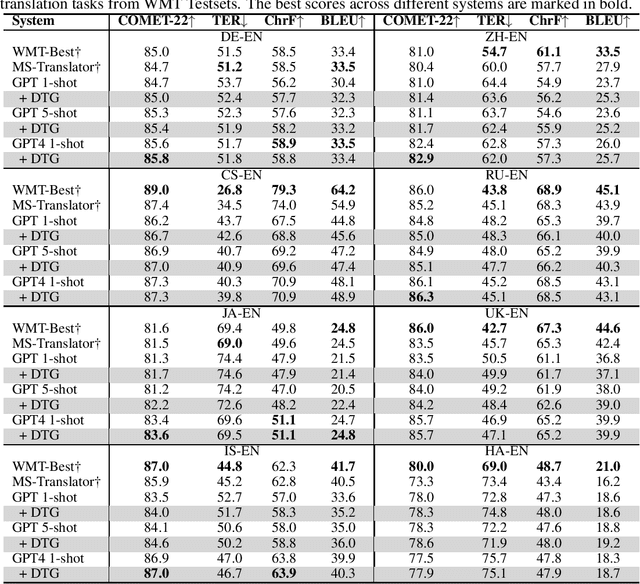
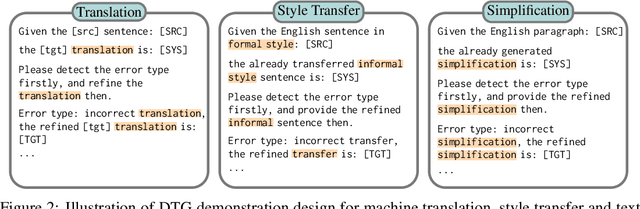
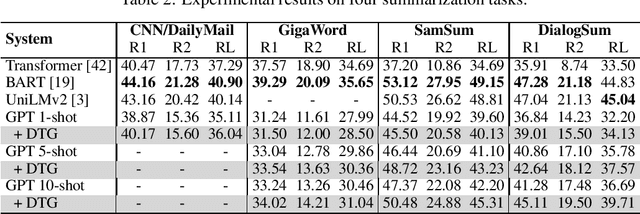
Large language models (LLMs) have shown remarkable success across a wide range of natural language generation tasks, where proper prompt designs make great impacts. While existing prompting methods are normally restricted to providing correct information, in this paper, we encourage the model to deliberate by proposing a novel Deliberate then Generate (DTG) prompting framework, which consists of error detection instructions and candidates that may contain errors. DTG is a simple yet effective technique that can be applied to various text generation tasks with minimal modifications. We conduct extensive experiments on 20+ datasets across 7 text generation tasks, including summarization, translation, dialogue, and more. We show that DTG consistently outperforms existing prompting methods and achieves state-of-the-art performance on multiple text generation tasks. We also provide in-depth analyses to reveal the underlying mechanisms of DTG, which may inspire future research on prompting for LLMs.
TranSFormer: Slow-Fast Transformer for Machine Translation
May 26, 2023


Learning multiscale Transformer models has been evidenced as a viable approach to augmenting machine translation systems. Prior research has primarily focused on treating subwords as basic units in developing such systems. However, the incorporation of fine-grained character-level features into multiscale Transformer has not yet been explored. In this work, we present a \textbf{S}low-\textbf{F}ast two-stream learning model, referred to as Tran\textbf{SF}ormer, which utilizes a ``slow'' branch to deal with subword sequences and a ``fast'' branch to deal with longer character sequences. This model is efficient since the fast branch is very lightweight by reducing the model width, and yet provides useful fine-grained features for the slow branch. Our TranSFormer shows consistent BLEU improvements (larger than 1 BLEU point) on several machine translation benchmarks.
DiffusionNER: Boundary Diffusion for Named Entity Recognition
May 22, 2023In this paper, we propose DiffusionNER, which formulates the named entity recognition task as a boundary-denoising diffusion process and thus generates named entities from noisy spans. During training, DiffusionNER gradually adds noises to the golden entity boundaries by a fixed forward diffusion process and learns a reverse diffusion process to recover the entity boundaries. In inference, DiffusionNER first randomly samples some noisy spans from a standard Gaussian distribution and then generates the named entities by denoising them with the learned reverse diffusion process. The proposed boundary-denoising diffusion process allows progressive refinement and dynamic sampling of entities, empowering DiffusionNER with efficient and flexible entity generation capability. Experiments on multiple flat and nested NER datasets demonstrate that DiffusionNER achieves comparable or even better performance than previous state-of-the-art models.
NAS-FM: Neural Architecture Search for Tunable and Interpretable Sound Synthesis based on Frequency Modulation
May 22, 2023Developing digital sound synthesizers is crucial to the music industry as it provides a low-cost way to produce high-quality sounds with rich timbres. Existing traditional synthesizers often require substantial expertise to determine the overall framework of a synthesizer and the parameters of submodules. Since expert knowledge is hard to acquire, it hinders the flexibility to quickly design and tune digital synthesizers for diverse sounds. In this paper, we propose ``NAS-FM'', which adopts neural architecture search (NAS) to build a differentiable frequency modulation (FM) synthesizer. Tunable synthesizers with interpretable controls can be developed automatically from sounds without any prior expert knowledge and manual operating costs. In detail, we train a supernet with a specifically designed search space, including predicting the envelopes of carriers and modulators with different frequency ratios. An evolutionary search algorithm with adaptive oscillator size is then developed to find the optimal relationship between oscillators and the frequency ratio of FM. Extensive experiments on recordings of different instrument sounds show that our algorithm can build a synthesizer fully automatically, achieving better results than handcrafted synthesizers. Audio samples are available at https://nas-fm.github.io/.
GETMusic: Generating Any Music Tracks with a Unified Representation and Diffusion Framework
May 18, 2023Symbolic music generation aims to create musical notes, which can help users compose music, such as generating target instrumental tracks from scratch, or based on user-provided source tracks. Considering the diverse and flexible combination between source and target tracks, a unified model capable of generating any arbitrary tracks is of crucial necessity. Previous works fail to address this need due to inherent constraints in music representations and model architectures. To address this need, we propose a unified representation and diffusion framework named GETMusic (`GET' stands for GEnerate music Tracks), which includes a novel music representation named GETScore, and a diffusion model named GETDiff. GETScore represents notes as tokens and organizes them in a 2D structure, with tracks stacked vertically and progressing horizontally over time. During training, tracks are randomly selected as either the target or source. In the forward process, target tracks are corrupted by masking their tokens, while source tracks remain as ground truth. In the denoising process, GETDiff learns to predict the masked target tokens, conditioning on the source tracks. With separate tracks in GETScore and the non-autoregressive behavior of the model, GETMusic can explicitly control the generation of any target tracks from scratch or conditioning on source tracks. We conduct experiments on music generation involving six instrumental tracks, resulting in a total of 665 combinations. GETMusic provides high-quality results across diverse combinations and surpasses prior works proposed for some specific combinations.
CoMoSpeech: One-Step Speech and Singing Voice Synthesis via Consistency Model
May 11, 2023
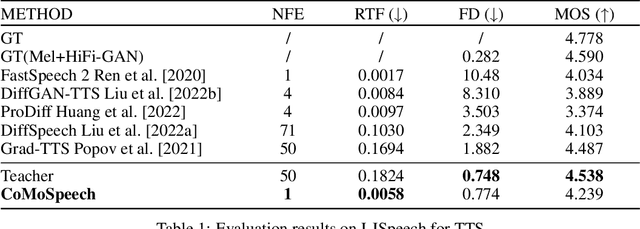
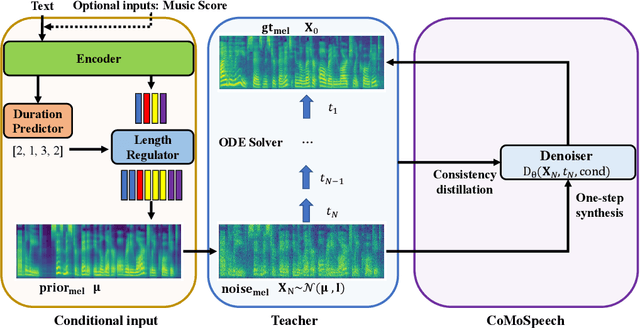
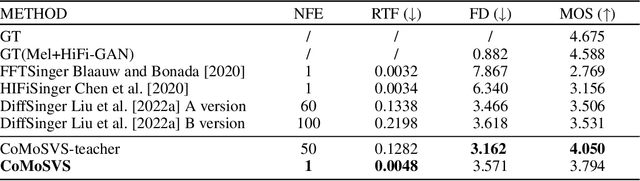
Denoising diffusion probabilistic models (DDPMs) have shown promising performance for speech synthesis. However, a large number of iterative steps are required to achieve high sample quality, which restricts the inference speed. Maintaining sample quality while increasing sampling speed has become a challenging task. In this paper, we propose a "Co"nsistency "Mo"del-based "Speech" synthesis method, CoMoSpeech, which achieve speech synthesis through a single diffusion sampling step while achieving high audio quality. The consistency constraint is applied to distill a consistency model from a well-designed diffusion-based teacher model, which ultimately yields superior performances in the distilled CoMoSpeech. Our experiments show that by generating audio recordings by a single sampling step, the CoMoSpeech achieves an inference speed more than 150 times faster than real-time on a single NVIDIA A100 GPU, which is comparable to FastSpeech2, making diffusion-sampling based speech synthesis truly practical. Meanwhile, objective and subjective evaluations on text-to-speech and singing voice synthesis show that the proposed teacher models yield the best audio quality, and the one-step sampling based CoMoSpeech achieves the best inference speed with better or comparable audio quality to other conventional multi-step diffusion model baselines. Audio samples are available at https://comospeech.github.io/.
NaturalSpeech 2: Latent Diffusion Models are Natural and Zero-Shot Speech and Singing Synthesizers
May 04, 2023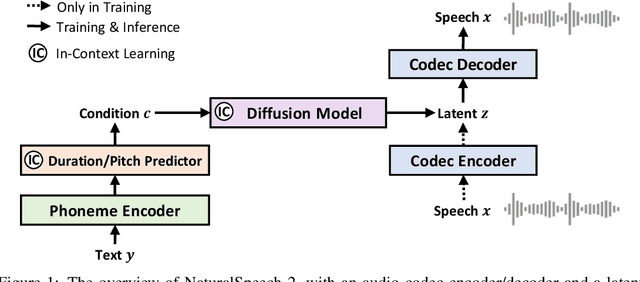
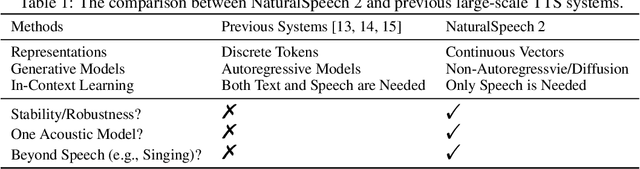

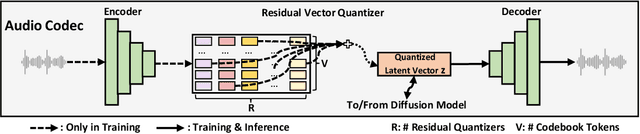
Scaling text-to-speech (TTS) to large-scale, multi-speaker, and in-the-wild datasets is important to capture the diversity in human speech such as speaker identities, prosodies, and styles (e.g., singing). Current large TTS systems usually quantize speech into discrete tokens and use language models to generate these tokens one by one, which suffer from unstable prosody, word skipping/repeating issue, and poor voice quality. In this paper, we develop NaturalSpeech 2, a TTS system that leverages a neural audio codec with residual vector quantizers to get the quantized latent vectors and uses a diffusion model to generate these latent vectors conditioned on text input. To enhance the zero-shot capability that is important to achieve diverse speech synthesis, we design a speech prompting mechanism to facilitate in-context learning in the diffusion model and the duration/pitch predictor. We scale NaturalSpeech 2 to large-scale datasets with 44K hours of speech and singing data and evaluate its voice quality on unseen speakers. NaturalSpeech 2 outperforms previous TTS systems by a large margin in terms of prosody/timbre similarity, robustness, and voice quality in a zero-shot setting, and performs novel zero-shot singing synthesis with only a speech prompt. Audio samples are available at https://speechresearch.github.io/naturalspeech2.
ResiDual: Transformer with Dual Residual Connections
Apr 28, 2023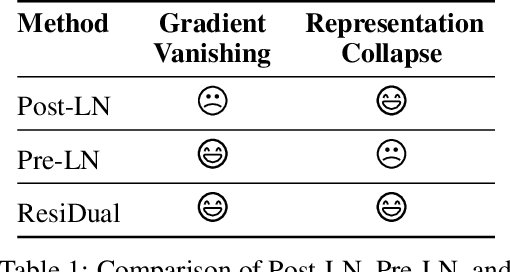
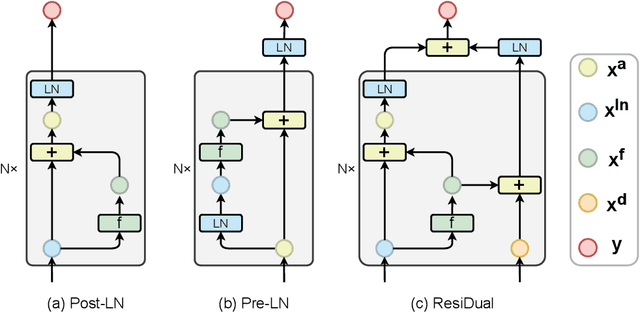
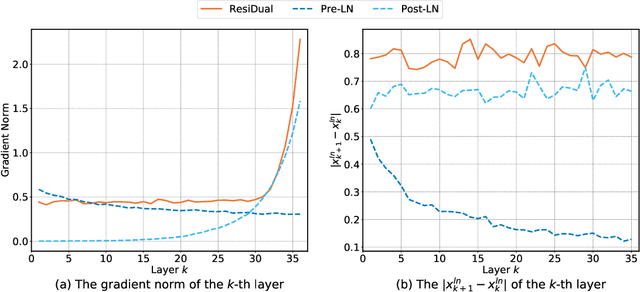
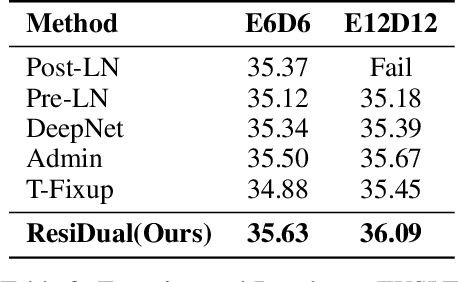
Transformer networks have become the preferred architecture for many tasks due to their state-of-the-art performance. However, the optimal way to implement residual connections in Transformer, which are essential for effective training, is still debated. Two widely used variants are the Post-Layer-Normalization (Post-LN) and Pre-Layer-Normalization (Pre-LN) Transformers, which apply layer normalization after each residual block's output or before each residual block's input, respectively. While both variants enjoy their advantages, they also suffer from severe limitations: Post-LN causes gradient vanishing issue that hinders training deep Transformers, and Pre-LN causes representation collapse issue that limits model capacity. In this paper, we propose ResiDual, a novel Transformer architecture with Pre-Post-LN (PPLN), which fuses the connections in Post-LN and Pre-LN together and inherits their advantages while avoids their limitations. We conduct both theoretical analyses and empirical experiments to verify the effectiveness of ResiDual. Theoretically, we prove that ResiDual has a lower bound on the gradient to avoid the vanishing issue due to the residual connection from Pre-LN. Moreover, ResiDual also has diverse model representations to avoid the collapse issue due to the residual connection from Post-LN. Empirically, ResiDual outperforms both Post-LN and Pre-LN on several machine translation benchmarks across different network depths and data sizes. Thanks to the good theoretical and empirical performance, ResiDual Transformer can serve as a foundation architecture for different AI models (e.g., large language models). Our code is available at https://github.com/microsoft/ResiDual.
CLaMP: Contrastive Language-Music Pre-training for Cross-Modal Symbolic Music Information Retrieval
Apr 24, 2023We introduce CLaMP: Contrastive Language-Music Pre-training, which learns cross-modal representations between natural language and symbolic music using a music encoder and a text encoder trained jointly with a contrastive loss. To pre-train CLaMP, we collected a large dataset of 1.4 million music-text pairs. It employed text dropout as a data augmentation technique and bar patching to efficiently represent music data which reduces sequence length to less than 10\%. In addition, we developed a masked music model pre-training objective to enhance the music encoder's comprehension of musical context and structure. CLaMP integrates textual information to enable semantic search and zero-shot classification for symbolic music, surpassing the capabilities of previous models. To support the evaluation of semantic search and music classification, we publicly release WikiMusicText (WikiMT), a dataset of 1010 lead sheets in ABC notation, each accompanied by a title, artist, genre, and description. In comparison to state-of-the-art models that require fine-tuning, zero-shot CLaMP demonstrated comparable or superior performance on score-oriented datasets. Our models and code are available at https://github.com/microsoft/muzic/tree/main/clamp.