 Add to Chrome
 Add to Firefox
 Add to Edge
Ring-Zero: Scaling Zero RL to a Trillion Parameters for Emergent Reasoning
Jul 14, 2026
Reinforcement learning with verifiable rewards without human-annotated data, often referred to as zero RL, has emerged as a powerful paradigm for eliciting chain-of-thought reasoning. However, due to computational constraints, existing studies are largely restricted to small models, leaving the training dynamics and emergent capabilities at a large scale unexplored. To meaningfully explore this frontier, we aim to elicit high-quality reasoning behaviors from the model. However, we find that naive scaling often suffers from poor readability, token redundancy, and a lack of adaptive reasoning depth. To address these challenges, we present a stable and efficient training pipeline, incorporating algorithmic and system optimizations such as clipped importance sampling, training-inference ratio correction, and mixed-precision control. Our experiments offer three key findings that validate the "bitter lesson" of scaling: (1) scaling to 1T parameters significantly enhances sample efficiency and performance ceilings; (2) the training process progresses sequentially through an initial discovery phase followed by a sharpening phase; and (3) the model spontaneously develops advanced cognitive behaviors, including anthropomorphism, structured formatting, self-verification, parallel reasoning, and context anxiety, rendering hand-crafted heuristics redundant. Evaluated on seven mathematical benchmarks, Ring-2.5-1T-Zero achieves competitive performance. Additionally, to assess CoT quality beyond final-answer correctness, we propose a structured evaluation framework across three dimensions: comprehensibility, reproducibility, and efficiency, where our model demonstrates clear advantages in producing structured and concise reasoning traces. By sharing our observed emergent phenomena, we hope to provide the community with deeper insights into scaling behaviors, particularly at the 1-trillion scale.

Speaking the Language of Science: Toward a General-Purpose Generative Foundation Model for the Natural Sciences
Jun 15, 2026In this report, we present LOGOS (Language Of Generative Objects in Science), a scientific generative language model that unifies heterogeneous tasks across the natural sciences within a single autoregressive framework based on a shared scientific grammar. It encodes diverse scientific objects and their spatial interactions as token sequences over a common vocabulary. By representing spatial contact and constraint patterns as discrete tokens, the model captures complex structural interactions in a purely sequential manner, without relying on explicit coordinates or geometric neural networks. This unified representation enables a wide range of downstream tasks to be formulated consistently as next-token prediction in the same grammar space, creating strong alignment between continued multi-domain pre-training and downstream objectives. Across diverse tasks, LOGOS consistently matches or outperforms domain-specific baselines, providing preliminary evidence for the feasibility of "one model fits all" in the natural sciences. We train LOGOS models at different scales (1B, 3B, and 8B parameters) and find a consistent positive correlation between model size and performance. This suggests that the future of AI for Science (AI4S) may not lie in building an independent technical stack that is separated from large language models (LLMs). Instead, it may depend on deeply aligning scientific foundation models with LLMs through shared architectures, shared training paradigms, and shared inference infrastructure, so that LLMs can truly become a new entry point for AI4S. We release the model weights and associated resources to facilitate further research.
Probing RLVR training instability through the lens of objective-level hacking
Feb 01, 2026Prolonged reinforcement learning with verifiable rewards (RLVR) has been shown to drive continuous improvements in the reasoning capabilities of large language models, but the training is often prone to instabilities, especially in Mixture-of-Experts (MoE) architectures. Training instability severely undermines model capability improvement, yet its underlying causes and mechanisms remain poorly understood. In this work, we introduce a principled framework for understanding RLVR instability through the lens of objective-level hacking. Unlike reward hacking, which arises from exploitable verifiers, objective-level hacking emerges from token-level credit misalignment and is manifested as system-level spurious signals in the optimization objective. Grounded in our framework, together with extensive experiments on a 30B MoE model, we trace the origin and formalize the mechanism behind a key pathological training dynamic in MoE models: the abnormal growth of the training-inference discrepancy, a phenomenon widely associated with instability but previously lacking a mechanistic explanation. These findings provide a concrete and causal account of the training dynamics underlying instabilities in MoE models, offering guidance for the design of stable RLVR algorithms.
Atomic and Subgraph-aware Bilateral Aggregation for Molecular Representation Learning
May 22, 2023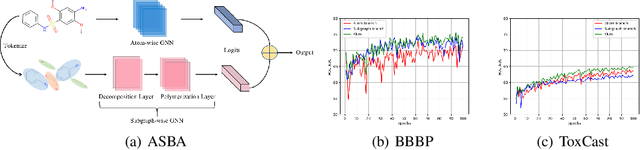
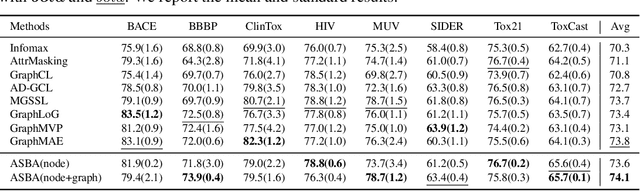

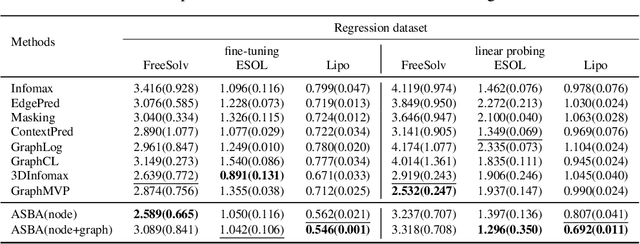
Molecular representation learning is a crucial task in predicting molecular properties. Molecules are often modeled as graphs where atoms and chemical bonds are represented as nodes and edges, respectively, and Graph Neural Networks (GNNs) have been commonly utilized to predict atom-related properties, such as reactivity and solubility. However, functional groups (subgraphs) are closely related to some chemical properties of molecules, such as efficacy, and metabolic properties, which cannot be solely determined by individual atoms. In this paper, we introduce a new model for molecular representation learning called the Atomic and Subgraph-aware Bilateral Aggregation (ASBA), which addresses the limitations of previous atom-wise and subgraph-wise models by incorporating both types of information. ASBA consists of two branches, one for atom-wise information and the other for subgraph-wise information. Considering existing atom-wise GNNs cannot properly extract invariant subgraph features, we propose a decomposition-polymerization GNN architecture for the subgraph-wise branch. Furthermore, we propose cooperative node-level and graph-level self-supervised learning strategies for ASBA to improve its generalization. Our method offers a more comprehensive way to learn representations for molecular property prediction and has broad potential in drug and material discovery applications. Extensive experiments have demonstrated the effectiveness of our method.