 Add to Chrome
 Add to Firefox
 Add to Edge
AgenticASR: Refining Speech Recognition in Real-World Scenarios via an Agentic Approach
Jul 30, 2026
Automatic speech recognition (ASR) has achieved substantial gains in transcription accuracy, yet verbatim transcription does not necessarily produce readily usable text. It retains fillers, repetitions, false starts, and self-corrections that increase reading effort, obscure the speaker's final intent, and propagate unresolved or abandoned content to downstream tasks. Existing spoken-to-written methods process completed audio or transcripts but cannot revise emitted text when later speech changes how preceding content should be interpreted. We therefore formulate Agentic Speech Recognition (AgenticSR), an audio-to-clean-text task that removes disfluencies, resolves self-corrections, and normalizes written form while preserving the speaker's final intent. AgenticASR implements this task through an ASR--Refiner architecture that repeatedly transforms a bounded active context and replaces its corresponding output span as audio arrives. This enables continual emission and revision over streams of arbitrary duration. We also introduce AASR-Bench, a bilingual benchmark with fine-grained atomic rubrics. Across multiple ASR front ends, AgenticASR attains the highest AASR-Bench scores among evaluated systems. A human--AI agreement study shows that rubric-based judgments align with independent expert assessments. Ablations characterize Refiner capacity, context length, and the quality--latency trade-off between online and offline inference. Together, these results establish AgenticASR as a practical framework for intent-preserving clean transcription during ongoing speech. Code, AASR-Bench, and a demo will be released at https://github.com/AnXMuy/AgenticASR.

OVEarth-Bench: Evaluating Category Breadth and Query Diversity for Open-Vocabulary Earth Observation
Jul 29, 2026Open-vocabulary Earth observation (EO) aims to localize geospatial concepts specified in natural language rather than a fixed label set. Existing benchmarks, however, usually cover narrow category vocabularies or limited query forms. To fill this gap, we introduce OVEarth-Bench, which extends existing evaluation in two directions: category breadth, through broad hierarchical category coverage with positive and negative expressions, and query diversity, through vocabulary, referring, and reasoning queries. The benchmark supports mask and box localization under a unified zero-shot protocol. We evaluate a broad set of general and EO-specific methods. The evaluation reveals that: (1) the performance of current methods remains limited, while broader category coverage yields more stable model rankings; (2) MLLM-based methods achieve the strongest overall performance; and (3) EO-specific methods generally underperform general models and rarely match the strongest methods. These findings provide guidance for future open-vocabulary EO method design and highlight the importance of developing more realistic, diverse, high-quality, and large-scale benchmarks for reliable evaluation. Our data and evaluation package are released at https://earth-insights.github.io/OVEarth-bench.
MMAE: A Massive Multitask Audio Editing Benchmark
Jun 05, 2026We introduce MMAE, a Massive Multitask Audio Editing benchmark, serving as the first comprehensive evaluation testbed designed for general-purpose instruction-based audio editing. Spurred by the shift toward intelligent creation, interactive editing has rapidly expanded from visual domains, pioneered by models like Nano-banana 2 for images and Gemini-Omni for video, into audio. However, the current evaluation infrastructure lags severely, remaining highly fragmented and restricted to specific subdomains or basic operations. Unlike existing benchmarks that are limited in scope, MMAE extends to a broad spectrum of real-world scenarios, encompassing 7 distinct audio modalities, including sound, speech, music, and their mixtures. Furthermore, we establish a comprehensive taxonomy spanning 6 levels of task complexity, from basic modifications to multi-hop reasoning and multi-round editing, 2 levels of granularity, and 8 distinct operation types. Meticulously curated through human-agent collaboration, MMAE comprises 2,000 high-fidelity samples paired with a pioneering rubric-based evaluation framework. By decomposing free-form tasks into 17,741 verifiable criteria, this robust rubric-based paradigm enables a precise, multi-dimensional assessment of both instruction following and context consistency. Our extensive evaluation of leading models reveals that current systems remain far from achieving reliable edits. Strikingly, the Exact Match Rate (EMR) consistently falls below 5% and plummets to an absolute 0% in complex, mixed-modality tasks, exposing critical bottlenecks in precise execution and structural robustness. We hope MMAE will serve as a catalyst for future advances in the intelligent creation community, providing a clear diagnostic roadmap and establishing a standardized, long-lasting evaluation paradigm for next-generation audio editing systems.
Towards Human-Like Interactive Speech Recognition With Agentic Correction and Semantic Evaluation
May 28, 2026Automatic speech recognition (ASR) is a core component of human--computer interaction and an increasingly important front-end for LLM-based assistants and agents. However, most current ASR systems still follow a single-pass paradigm, which is poorly aligned with human communication, where misunderstandings are resolved through iterative clarification and refinement. This mismatch makes it difficult to correct meaning-critical errors once they occur. Meanwhile, token-level metrics such as WER or CER cannot adequately reflect such a problem. To address these limitations, we formulate \emph{Interactive ASR} as a multi-turn refinement task and propose \textbf{Agentic ASR}, a closed-loop framework that combines a single-pass ASR front-end with semantic correction, intent routing, and reasoning-based editing. We further introduce the \textbf{Sentence-level Semantic Error Rate} ($S^2ER$), an LLM-based semantic evaluation metric, together with an \textbf{Interactive Simulation System} for scalable and reproducible benchmarking. Experiments on multilingual, named-entity-intensive, and code-switching benchmarks show that iterative interaction consistently reduces semantic errors, with much larger gains in $S^2ER$ than in conventional token-level metrics. Human--AI alignment and ablation studies further validate the reliability of the semantic judge and the robustness of the proposed framework. The code is available at: https://interactiveasr.github.io/ and the live demo is available at https://i-asr.sjtuxlance.com/
Interactive ASR: Towards Human-Like Interaction and Semantic Coherence Evaluation for Agentic Speech Recognition
Apr 14, 2026Recent years have witnessed remarkable progress in automatic speech recognition (ASR), driven by advances in model architectures and large-scale training data. However, two important aspects remain underexplored. First, Word Error Rate (WER), the dominant evaluation metric for decades, treats all words equally and often fails to reflect the semantic correctness of an utterance at the sentence level. Second, interactive correction-an essential component of human communication-has rarely been systematically studied in ASR research. In this paper, we integrate these two perspectives under an agentic framework for interactive ASR. We propose leveraging LLM-as-a-Judge as a semantic-aware evaluation metric to assess recognition quality beyond token-level accuracy. Furthermore, we design an LLM-driven agent framework to simulate human-like multi-turn interaction, enabling iterative refinement of recognition outputs through semantic feedback. Extensive experiments are conducted on standard benchmarks, including GigaSpeech (English), WenetSpeech (Chinese), the ASRU 2019 code-switching test set. Both objective and subjective evaluations demonstrate the effectiveness of the proposed framework in improving semantic fidelity and interactive correction capability. We will release the code to facilitate future research in interactive and agentic ASR.
The Second Challenge on Cross-Domain Few-Shot Object Detection at NTIRE 2026: Methods and Results
Apr 13, 2026Cross-domain few-shot object detection (CD-FSOD) remains a challenging problem for existing object detectors and few-shot learning approaches, particularly when generalizing across distinct domains. As part of NTIRE 2026, we hosted the second CD-FSOD Challenge to systematically evaluate and promote progress in detecting objects in unseen target domains under limited annotation conditions. The challenge received strong community interest, with 128 registered participants and a total of 696 submissions. Among them, 31 teams actively participated, and 19 teams submitted valid final results. Participants explored a wide range of strategies, introducing innovative methods that push the performance frontier under both open-source and closed-source tracks. This report presents a detailed overview of the NTIRE 2026 CD-FSOD Challenge, including a summary of the submitted approaches and an analysis of the final results across all participating teams. Challenge Codes: https://github.com/ohMargin/NTIRE2026_CDFSOD.
Annotation-Free Open-Vocabulary Segmentation for Remote-Sensing Images
Aug 25, 2025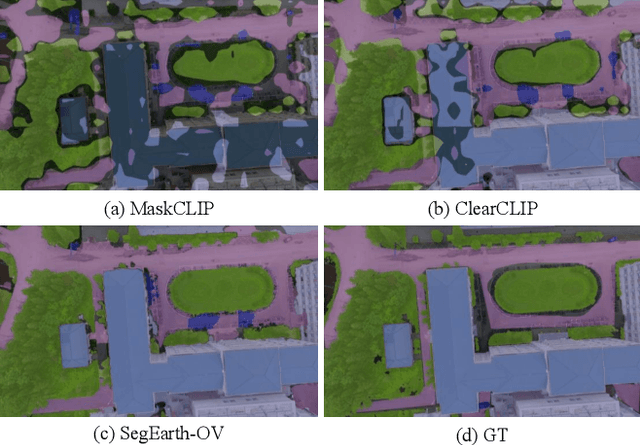
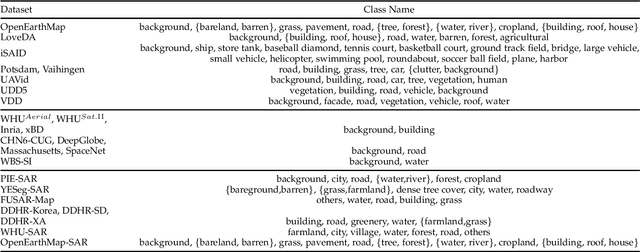
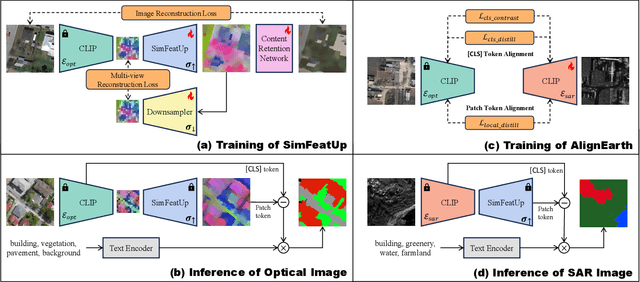
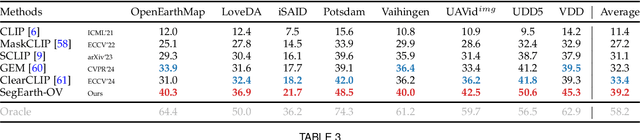
Semantic segmentation of remote sensing (RS) images is pivotal for comprehensive Earth observation, but the demand for interpreting new object categories, coupled with the high expense of manual annotation, poses significant challenges. Although open-vocabulary semantic segmentation (OVSS) offers a promising solution, existing frameworks designed for natural images are insufficient for the unique complexities of RS data. They struggle with vast scale variations and fine-grained details, and their adaptation often relies on extensive, costly annotations. To address this critical gap, this paper introduces SegEarth-OV, the first framework for annotation-free open-vocabulary segmentation of RS images. Specifically, we propose SimFeatUp, a universal upsampler that robustly restores high-resolution spatial details from coarse features, correcting distorted target shapes without any task-specific post-training. We also present a simple yet effective Global Bias Alleviation operation to subtract the inherent global context from patch features, significantly enhancing local semantic fidelity. These components empower SegEarth-OV to effectively harness the rich semantics of pre-trained VLMs, making OVSS possible in optical RS contexts. Furthermore, to extend the framework's universality to other challenging RS modalities like SAR images, where large-scale VLMs are unavailable and expensive to create, we introduce AlignEarth, which is a distillation-based strategy and can efficiently transfer semantic knowledge from an optical VLM encoder to an SAR encoder, bypassing the need to build SAR foundation models from scratch and enabling universal OVSS across diverse sensor types. Extensive experiments on both optical and SAR datasets validate that SegEarth-OV can achieve dramatic improvements over the SOTA methods, establishing a robust foundation for annotation-free and open-world Earth observation.
Hierarchical Multi-Label Contrastive Learning for Protein-Protein Interaction Prediction Across Organisms
Jul 03, 2025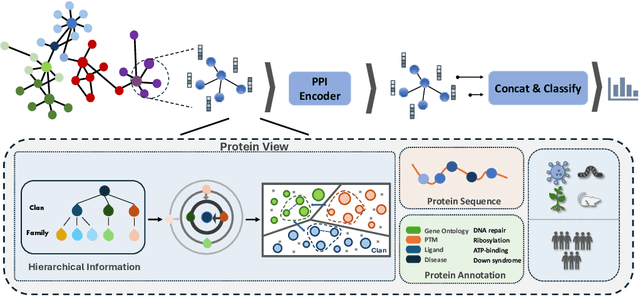
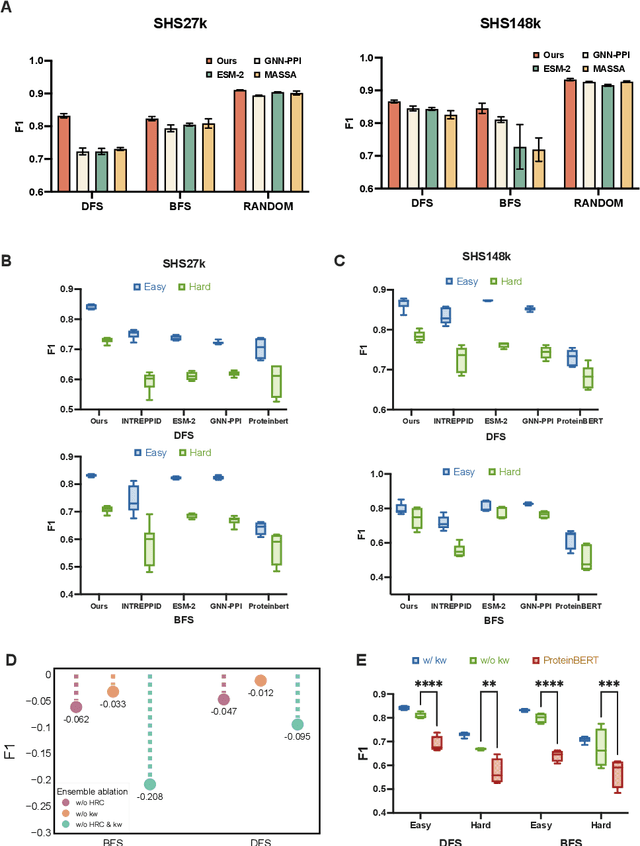
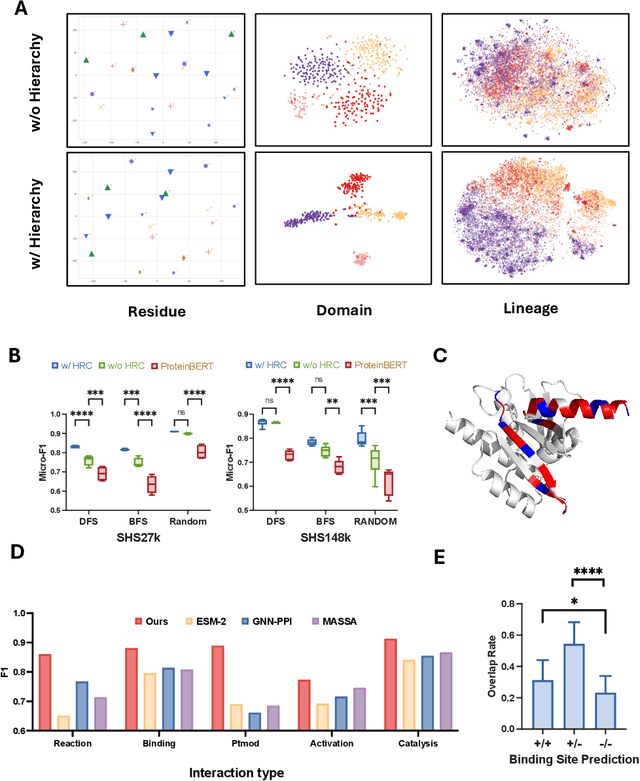
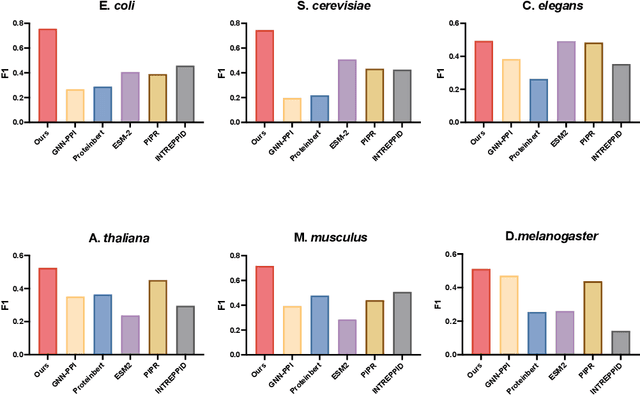
Recent advances in AI for science have highlighted the power of contrastive learning in bridging heterogeneous biological data modalities. Building on this paradigm, we propose HIPPO (HIerarchical Protein-Protein interaction prediction across Organisms), a hierarchical contrastive framework for protein-protein interaction(PPI) prediction, where protein sequences and their hierarchical attributes are aligned through multi-tiered biological representation matching. The proposed approach incorporates hierarchical contrastive loss functions that emulate the structured relationship among functional classes of proteins. The framework adaptively incorporates domain and family knowledge through a data-driven penalty mechanism, enforcing consistency between the learned embedding space and the intrinsic hierarchy of protein functions. Experiments on benchmark datasets demonstrate that HIPPO achieves state-of-the-art performance, outperforming existing methods and showing robustness in low-data regimes. Notably, the model demonstrates strong zero-shot transferability to other species without retraining, enabling reliable PPI prediction and functional inference even in less characterized or rare organisms where experimental data are limited. Further analysis reveals that hierarchical feature fusion is critical for capturing conserved interaction determinants, such as binding motifs and functional annotations. This work advances cross-species PPI prediction and provides a unified framework for interaction prediction in scenarios with sparse or imbalanced multi-species data.
AnnoDPO: Protein Functional Annotation Learning with Direct Preference Optimization
Jun 08, 2025Deciphering protein function remains a fundamental challenge in protein representation learning. The task presents significant difficulties for protein language models (PLMs) due to the sheer volume of functional annotation categories and the highly imbalanced distribution of annotated instances across biological ontologies. Inspired by the remarkable success of reinforcement learning from human feedback (RLHF) in large language model (LLM) alignment, we propose AnnoDPO, a novel multi-modal framework for protein function prediction that leverages Direct Preference Optimization (DPO) to enhance annotation learning. Our methodology addresses the dual challenges of annotation scarcity and category imbalance through preference-aligned training objectives, establishing a new paradigm for biological knowledge integration in protein representation learning.
Multi-Floor Zero-Shot Object Navigation Policy
Sep 17, 2024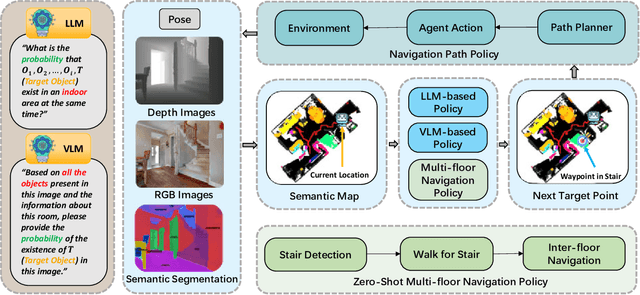



Object navigation in multi-floor environments presents a formidable challenge in robotics, requiring sophisticated spatial reasoning and adaptive exploration strategies. Traditional approaches have primarily focused on single-floor scenarios, overlooking the complexities introduced by multi-floor structures. To address these challenges, we first propose a Multi-floor Navigation Policy (MFNP) and implement it in Zero-Shot object navigation tasks. Our framework comprises three key components: (i) Multi-floor Navigation Policy, which enables an agent to explore across multiple floors; (ii) Multi-modal Large Language Models (MLLMs) for reasoning in the navigation process; and (iii) Inter-Floor Navigation, ensuring efficient floor transitions. We evaluate MFNP on the Habitat-Matterport 3D (HM3D) and Matterport 3D (MP3D) datasets, both include multi-floor scenes. Our experiment results demonstrate that MFNP significantly outperforms all the existing methods in Zero-Shot object navigation, achieving higher success rates and improved exploration efficiency. Ablation studies further highlight the effectiveness of each component in addressing the unique challenges of multi-floor navigation. Meanwhile, we conducted real-world experiments to evaluate the feasibility of our policy. Upon deployment of MFNP, the Unitree quadruped robot demonstrated successful multi-floor navigation and found the target object in a completely unseen environment. By introducing MFNP, we offer a new paradigm for tackling complex, multi-floor environments in object navigation tasks, opening avenues for future research in visual-based navigation in realistic, multi-floor settings.