 Add to Chrome
 Add to Firefox
 Add to Edge
Predictive Repair Management Using a Multi-Head Attention Transformer and Online Learning
Jun 19, 2026
Accurate prediction of repair duration is an important challenge in product maintenance due to its implications for resource allocation, customer satisfaction, and operational performance. This study aims to develop a deep learning framework to help fleet repair shops accurately categorize repair time given product historical data. The study uses an automobile repair and maintenance dataset and creates an end-to-end predictive framework by employing a multi-head attention network designed for tabular data. The developed framework combines categorical information, transformed through embeddings and attention mechanisms, with numerical historical data to facilitate integration and learning from diverse data features. A weighted loss function is introduced to overcome class imbalance issues in large datasets. Moreover, an online learning strategy is used for continuous incremental model updates to maintain predictive accuracy in evolving operational environments. Our empirical findings demonstrate that the multi-head attention mechanism extracts meaningful interactions between vehicle identifiers and repair types compared to a feed-forward neural network and a random forest model. Also, combining historical maintenance data with an online learning strategy facilitates real-time adjustments to changing patterns and increases the model's predictive performance on new data. The model is tested on real-world repair data spanning 2013 to 2020 and achieves an accuracy of 78%, with attention weight analyses illustrating feature interactions.

Evaluating Large and Lightweight Vision Models for Irregular Component Segmentation in E-Waste Disassembly
Mar 28, 2026Precise segmentation of irregular and densely arranged components is essential for robotic disassembly and material recovery in electronic waste (e-waste) recycling. This study evaluates the impact of model architecture and scale on segmentation performance by comparing SAM2, a transformer-based vision model, with the lightweight YOLOv8 network. Both models were trained and tested on a newly collected dataset of 1,456 annotated RGB images of laptop components including logic boards, heat sinks, and fans, captured under varying illumination and orientation conditions. Data augmentation techniques, such as random rotation, flipping, and cropping, were applied to improve model robustness. YOLOv8 achieved higher segmentation accuracy (mAP50 = 98.8%, mAP50-95 = 85%) and stronger boundary precision than SAM2 (mAP50 = 8.4%). SAM2 demonstrated flexibility in representing diverse object structures but often produced overlapping masks and inconsistent contours. These findings show that large pre-trained models require task-specific optimization for industrial applications. The resulting dataset and benchmarking framework provide a foundation for developing scalable vision algorithms for robotic e-waste disassembly and circular manufacturing systems.
A Review of Prospects and Opportunities in Disassembly with Human-Robot Collaboration
Oct 20, 2023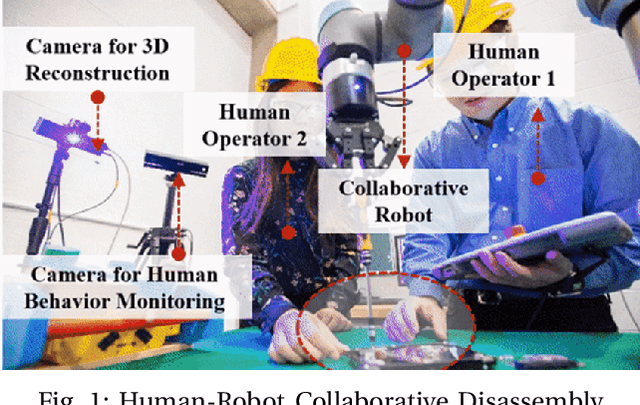
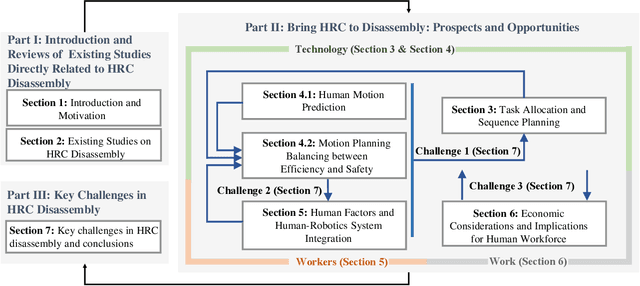
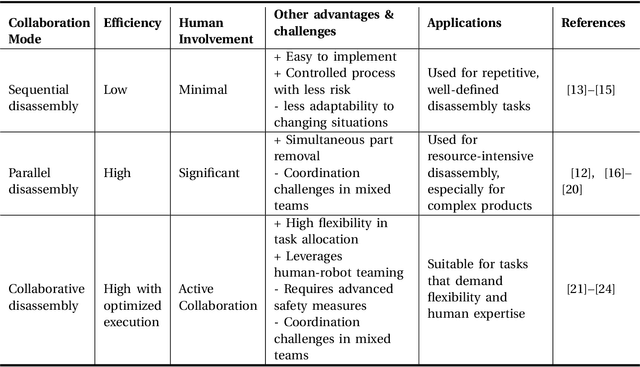
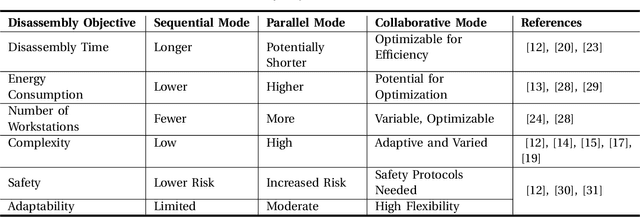
Product disassembly plays a crucial role in the recycling, remanufacturing, and reuse of end-of-use (EoU) products. However, the current manual disassembly process is inefficient due to the complexity and variation of EoU products. While fully automating disassembly is not economically viable given the intricate nature of the task, there is potential in using human-robot collaboration (HRC) to enhance disassembly operations. HRC combines the flexibility and problem-solving abilities of humans with the precise repetition and handling of unsafe tasks by robots. Nevertheless, numerous challenges persist in technology, human workers, and remanufacturing work, that require comprehensive multidisciplinary research to bridge critical gaps. These challenges have motivated the authors to provide a detailed discussion on the opportunities and obstacles associated with introducing HRC to disassembly. In this regard, the authors have conducted a thorough review of the recent progress in HRC disassembly and present the insights gained from this analysis from three distinct perspectives: technology, workers, and work.
A Real-Time Receding Horizon Sequence Planner for Disassembly in A Human-Robot Collaboration Setting
Jul 06, 2020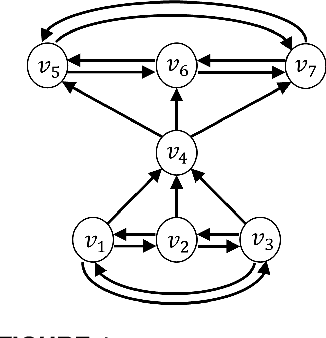
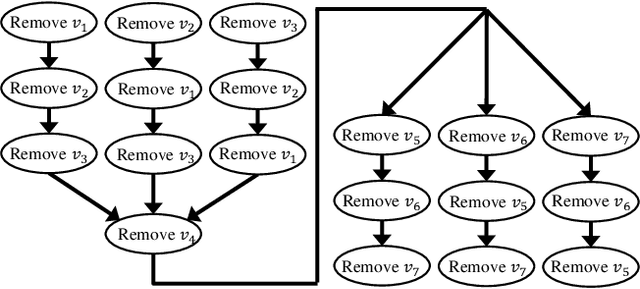
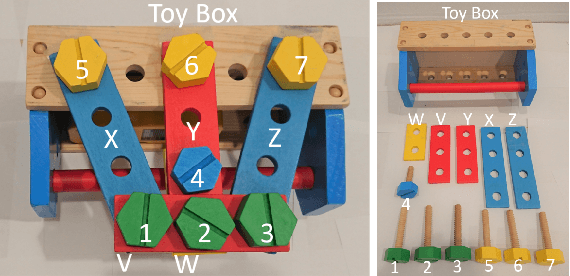
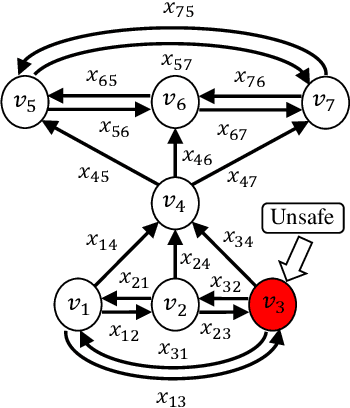
Product disassembly is a labor-intensive process and is far from being automated. Typically, disassembly is not robust enough to handle product varieties from different shapes, models, and physical uncertainties due to component imperfections, damage throughout component usage, or insufficient product information. To overcome these difficulties and to automate the disassembly procedure through human-robot collaboration without excessive computational cost, this paper proposes a real-time receding horizon sequence planner that distributes tasks between robot and human operator while taking real-time human motion into consideration. The sequence planner aims to address several issues in the disassembly line, such as varying orientations, safety constraints of human operators, uncertainty of human operation, and the computational cost of large number of disassembly tasks. The proposed disassembly sequence planner identifies both the positions and orientations of the to-be-disassembled items, as well as the locations of human operator, and obtains an optimal disassembly sequence that follows disassembly rules and safety constraints for human operation. Experimental tests have been conducted to validate the proposed planner: the robot can locate and disassemble the components following the optimal sequence, and consider explicitly human operator's real-time motion, and collaborate with the human operator without violating safety constraints.