 Add to Chrome
 Add to Firefox
 Add to Edge
What Makes an LLM a Good Optimizer? A Trajectory Analysis of LLM-Guided Evolutionary Search
Apr 21, 2026
Recent work has demonstrated the promise of orchestrating large language models (LLMs) within evolutionary and agentic optimization systems. However, the mechanisms driving these optimization gains remain poorly understood. In this work, we present a large-scale study of LLM-guided evolutionary search, collecting optimization trajectories for 15 LLMs across 8 tasks. Although zero-shot problem-solving ability correlates with final optimization outcomes, it explains only part of the variance: models with similar initial capability often induce dramatically different search trajectories and outcomes. By analyzing these trajectories, we find that strong LLM optimizers behave as local refiners, producing frequent incremental improvements while progressively localizing the search in semantic space. Conversely, weaker optimizers exhibit large semantic drift, with sporadic breakthroughs followed by stagnation. Notably, various measures of solution novelty do not predict final performance; novelty is beneficial only when the search remains sufficiently localized around high-performing regions of the solution space. Our results highlight the importance of trajectory analysis for understanding and improving LLM-based optimization systems and provide actionable insights for their design and training.

From Imitation to Discrimination: Progressive Curriculum Learning for Robust Web Navigation
Apr 14, 2026Text-based web agents offer computational efficiency for autonomous web navigation, yet developing robust agents remains challenging due to the noisy and heterogeneous nature of real-world HTML. Standard Supervised Fine-Tuning (SFT) approaches fail in two critical dimensions: they lack discrimination capabilities to reject plausible but incorrect elements in densely populated pages, and exhibit limited generalization to unseen website layouts. To address these challenges, we introduce the Triton dataset (590k instances) and a progressive training curriculum. Triton is constructed via Structural-Semantic Hard Negative Mining, which explicitly mines topologically similar distractors, and a Dual-Agent Consensus pipeline that synthesizes diverse cross-domain tasks with strict verification. Building upon this foundation, our progressive curriculum produces three models: Triton-SFT-32B for basic imitation, Triton-ORPO-32B for robust discrimination via Odds Ratio Preference Optimization, and Triton-GRPO-32B for long-horizon consistency through Group Relative Policy Optimization. Empirical evaluation on Mind2Web demonstrates that Triton-GRPO-32B achieves state-of-the-art performance among open-source models with 58.7% Step Success Rate, surpassing GPT-4.5 (42.4%) and Claude-4.5 (41.4%) by over 16%, validating that specialized data curriculum outweighs raw parameter scale for web navigation.
Diagonal-Tiled Mixed-Precision Attention for Efficient Low-Bit MXFP Inference
Apr 05, 2026Transformer-based large language models (LLMs) have demonstrated remarkable performance across a wide range of real-world tasks, but their inference cost remains prohibitively high due to the quadratic complexity of attention and the memory bandwidth limitations of high-precision operations. In this work, we present a low-bit mixed-precision attention kernel using the microscaling floating-point (MXFP) data format, utilizing the computing capability on next-generation GPU architectures. Our Diagonal-Tiled Mixed-Precision Attention (DMA) incorporates two kinds of low-bit computation at the tiling-level, and is a delicate fused kernel implemented using Triton, exploiting hardware-level parallelism and memory efficiency to enable fast and efficient inference without compromising model performance. Extensive empirical evaluations on NVIDIA B200 GPUs show that our kernel maintains generation quality with negligible degradation, and meanwhile achieves significant speedup by kernel fusion. We release our code at https://github.com/yifu-ding/MP-Sparse-Attn.
RubikSQL: Lifelong Learning Agentic Knowledge Base as an Industrial NL2SQL System
Aug 25, 2025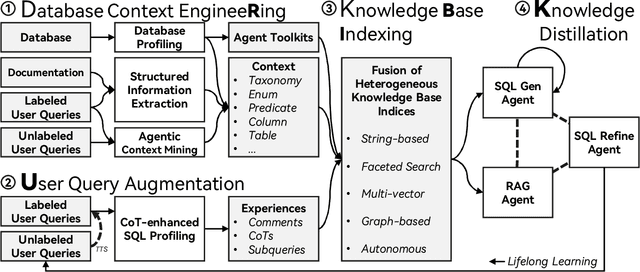
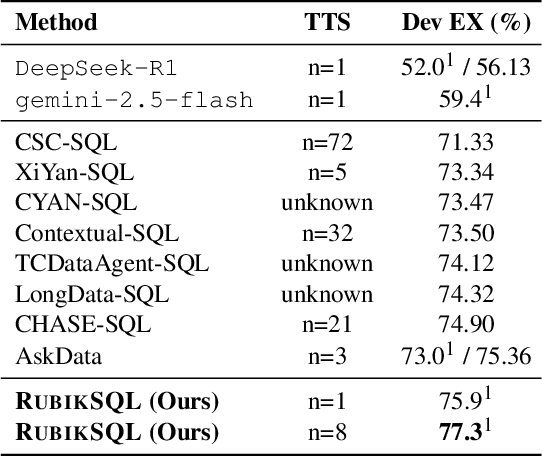
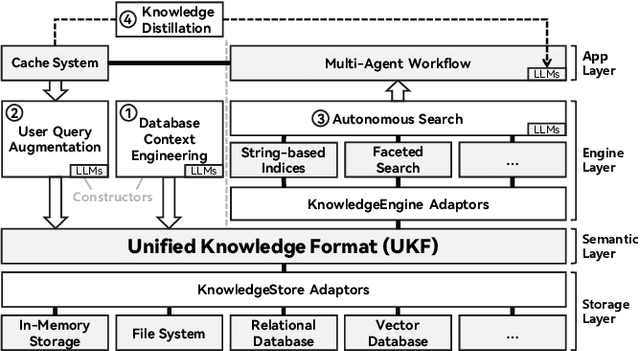
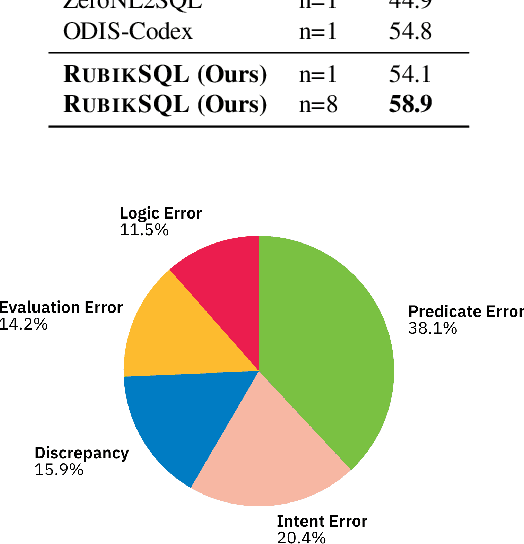
We present RubikSQL, a novel NL2SQL system designed to address key challenges in real-world enterprise-level NL2SQL, such as implicit intents and domain-specific terminology. RubikSQL frames NL2SQL as a lifelong learning task, demanding both Knowledge Base (KB) maintenance and SQL generation. RubikSQL systematically builds and refines its KB through techniques including database profiling, structured information extraction, agentic rule mining, and Chain-of-Thought (CoT)-enhanced SQL profiling. RubikSQL then employs a multi-agent workflow to leverage this curated KB, generating accurate SQLs. RubikSQL achieves SOTA performance on both the KaggleDBQA and BIRD Mini-Dev datasets. Finally, we release the RubikBench benchmark, a new benchmark specifically designed to capture vital traits of industrial NL2SQL scenarios, providing a valuable resource for future research.
Step-Audio-AQAA: a Fully End-to-End Expressive Large Audio Language Model
Jun 10, 2025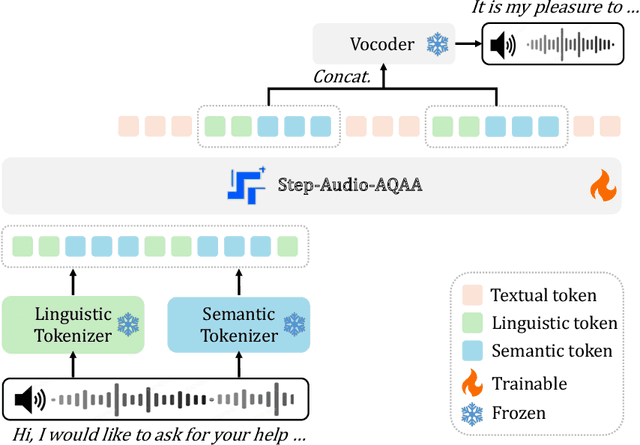
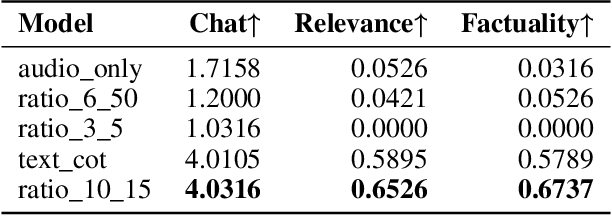
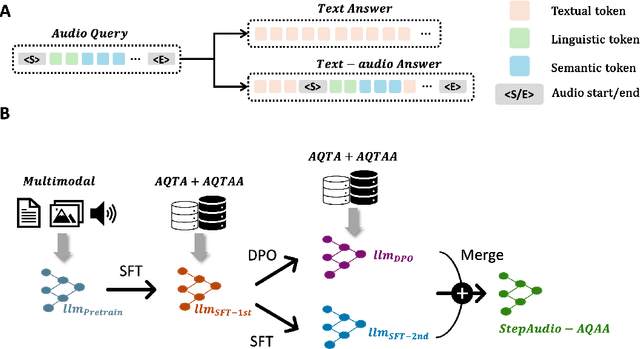

Large Audio-Language Models (LALMs) have significantly advanced intelligent human-computer interaction, yet their reliance on text-based outputs limits their ability to generate natural speech responses directly, hindering seamless audio interactions. To address this, we introduce Step-Audio-AQAA, a fully end-to-end LALM designed for Audio Query-Audio Answer (AQAA) tasks. The model integrates a dual-codebook audio tokenizer for linguistic and semantic feature extraction, a 130-billion-parameter backbone LLM and a neural vocoder for high-fidelity speech synthesis. Our post-training approach employs interleaved token-output of text and audio to enhance semantic coherence and combines Direct Preference Optimization (DPO) with model merge to improve performance. Evaluations on the StepEval-Audio-360 benchmark demonstrate that Step-Audio-AQAA excels especially in speech control, outperforming the state-of-art LALMs in key areas. This work contributes a promising solution for end-to-end LALMs and highlights the critical role of token-based vocoder in enhancing overall performance for AQAA tasks.
Step-Video-TI2V Technical Report: A State-of-the-Art Text-Driven Image-to-Video Generation Model
Mar 14, 2025We present Step-Video-TI2V, a state-of-the-art text-driven image-to-video generation model with 30B parameters, capable of generating videos up to 102 frames based on both text and image inputs. We build Step-Video-TI2V-Eval as a new benchmark for the text-driven image-to-video task and compare Step-Video-TI2V with open-source and commercial TI2V engines using this dataset. Experimental results demonstrate the state-of-the-art performance of Step-Video-TI2V in the image-to-video generation task. Both Step-Video-TI2V and Step-Video-TI2V-Eval are available at https://github.com/stepfun-ai/Step-Video-TI2V.
Step-Audio: Unified Understanding and Generation in Intelligent Speech Interaction
Feb 18, 2025Real-time speech interaction, serving as a fundamental interface for human-machine collaboration, holds immense potential. However, current open-source models face limitations such as high costs in voice data collection, weakness in dynamic control, and limited intelligence. To address these challenges, this paper introduces Step-Audio, the first production-ready open-source solution. Key contributions include: 1) a 130B-parameter unified speech-text multi-modal model that achieves unified understanding and generation, with the Step-Audio-Chat version open-sourced; 2) a generative speech data engine that establishes an affordable voice cloning framework and produces the open-sourced lightweight Step-Audio-TTS-3B model through distillation; 3) an instruction-driven fine control system enabling dynamic adjustments across dialects, emotions, singing, and RAP; 4) an enhanced cognitive architecture augmented with tool calling and role-playing abilities to manage complex tasks effectively. Based on our new StepEval-Audio-360 evaluation benchmark, Step-Audio achieves state-of-the-art performance in human evaluations, especially in terms of instruction following. On open-source benchmarks like LLaMA Question, shows 9.3% average performance improvement, demonstrating our commitment to advancing the development of open-source multi-modal language technologies. Our code and models are available at https://github.com/stepfun-ai/Step-Audio.
Diversity-Oriented Data Augmentation with Large Language Models
Feb 17, 2025Data augmentation is an essential technique in natural language processing (NLP) for enriching training datasets by generating diverse samples. This process is crucial for improving the robustness and generalization capabilities of NLP models. However, a significant challenge remains: \textit{Insufficient Attention to Sample Distribution Diversity}. Most existing methods focus on increasing the sample numbers while neglecting the sample distribution diversity, which can lead to model overfitting. In response, we explore data augmentation's impact on dataset diversity and propose a \textbf{\underline{D}}iversity-\textbf{\underline{o}}riented data \textbf{\underline{Aug}}mentation framework (\textbf{DoAug}). % \(\mathscr{DoAug}\) Specifically, we utilize a diversity-oriented fine-tuning approach to train an LLM as a diverse paraphraser, which is capable of augmenting textual datasets by generating diversified paraphrases. Then, we apply the LLM paraphraser to a selected coreset of highly informative samples and integrate the paraphrases with the original data to create a more diverse augmented dataset. Finally, we conduct extensive experiments on 12 real-world textual datasets. The results show that our fine-tuned LLM augmenter improves diversity while preserving label consistency, thereby enhancing the robustness and performance of downstream tasks. Specifically, it achieves an average performance gain of \(10.52\%\), surpassing the runner-up baseline with more than three percentage points.
LEKA:LLM-Enhanced Knowledge Augmentation
Jan 29, 2025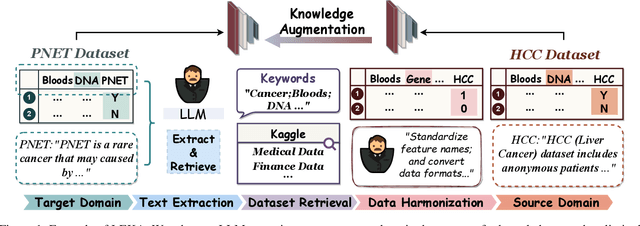
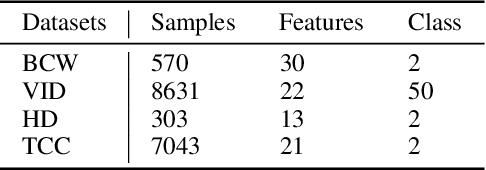


Humans excel in analogical learning and knowledge transfer and, more importantly, possess a unique understanding of identifying appropriate sources of knowledge. From a model's perspective, this presents an interesting challenge. If models could autonomously retrieve knowledge useful for transfer or decision-making to solve problems, they would transition from passively acquiring to actively accessing and learning from knowledge. However, filling models with knowledge is relatively straightforward -- it simply requires more training and accessible knowledge bases. The more complex task is teaching models about which knowledge can be analogized and transferred. Therefore, we design a knowledge augmentation method LEKA for knowledge transfer that actively searches for suitable knowledge sources that can enrich the target domain's knowledge. This LEKA method extracts key information from textual information from the target domain, retrieves pertinent data from external data libraries, and harmonizes retrieved data with the target domain data in feature space and marginal probability measures. We validate the effectiveness of our approach through extensive experiments across various domains and demonstrate significant improvements over traditional methods in reducing computational costs, automating data alignment, and optimizing transfer learning outcomes.
Scoring with Large Language Models: A Study on Measuring Empathy of Responses in Dialogues
Dec 28, 2024In recent years, Large Language Models (LLMs) have become increasingly more powerful in their ability to complete complex tasks. One such task in which LLMs are often employed is scoring, i.e., assigning a numerical value from a certain scale to a subject. In this paper, we strive to understand how LLMs score, specifically in the context of empathy scoring. We develop a novel and comprehensive framework for investigating how effective LLMs are at measuring and scoring empathy of responses in dialogues, and what methods can be employed to deepen our understanding of LLM scoring. Our strategy is to approximate the performance of state-of-the-art and fine-tuned LLMs with explicit and explainable features. We train classifiers using various features of dialogues including embeddings, the Motivational Interviewing Treatment Integrity (MITI) Code, a set of explicit subfactors of empathy as proposed by LLMs, and a combination of the MITI Code and the explicit subfactors. Our results show that when only using embeddings, it is possible to achieve performance close to that of generic LLMs, and when utilizing the MITI Code and explicit subfactors scored by an LLM, the trained classifiers can closely match the performance of fine-tuned LLMs. We employ feature selection methods to derive the most crucial features in the process of empathy scoring. Our work provides a new perspective toward understanding LLM empathy scoring and helps the LLM community explore the potential of LLM scoring in social science studies.