 Add to Chrome
 Add to Firefox
 Add to Edge
Validating Causal Abstraction Metrics on Simulated Complex Systems
Jun 30, 2026
A central goal of science is to produce valid explanations of complex systems: high-level causal accounts that faithfully reflect the behavior of lower-level mechanisms. Yet no consensus exists on how to measure whether a proposed high-level explanation is actually valid. We introduce a benchmark of ten complex systems spanning both discrete and continuous state spaces, as well as static and dynamical regimes, each equipped with consensual ground-truth causal explanations and invalid contrastive conditions. Within a unified causal abstraction framework, we systematically evaluate over thirty candidate metrics drawn from observational, functional, information-theoretic, and causal families. Our results show that only the latter reliably discriminates valid from invalid abstractions, and only when incorporating faithfulness testing over unmapped variables. Building on these findings, we introduce the Causal Abstraction Error (CAE), a continuous validity metric with an explicit faithfulness test, which passes all discrimination tests across every system and can converge with as few as 30 sampled interventions. We offer it as a general-purpose metric for the discovery and validation of high-level explanations.

Observable Patterns Are Not Explanations: A Causal-Geometric Analysis of Latent Reasoning Models
Jun 10, 2026Latent reasoning models (LRMs) replace explicit chain-of-thought with continuous thoughts. Recent work treats observable latent-state patterns, such as BFS-like frontiers and decodable arithmetic computation, as evidence for internal reasoning mechanisms. Evaluating two LRMs (Coconut and CODI) against controls lacking the proposed recurrence or curriculum, we find these patterns also appear in the controls and do not always causally affect behavior. Causal interventions reveal that latent-thought utilization is not binary but graded, scaling with a thought's causal effect on model behavior. Geometric analyses reveal this effect concentrates in low-rank directions whose step-to-step geometry grows more structured as their behavioral influence increases. Latent thoughts should therefore be treated as hidden computation, not hidden explanation: decodability, attention, or static structure alone cannot establish mechanism. LRM interpretability thus requires matched controls and causal tests.
What Makes an LLM a Good Optimizer? A Trajectory Analysis of LLM-Guided Evolutionary Search
Apr 21, 2026Recent work has demonstrated the promise of orchestrating large language models (LLMs) within evolutionary and agentic optimization systems. However, the mechanisms driving these optimization gains remain poorly understood. In this work, we present a large-scale study of LLM-guided evolutionary search, collecting optimization trajectories for 15 LLMs across 8 tasks. Although zero-shot problem-solving ability correlates with final optimization outcomes, it explains only part of the variance: models with similar initial capability often induce dramatically different search trajectories and outcomes. By analyzing these trajectories, we find that strong LLM optimizers behave as local refiners, producing frequent incremental improvements while progressively localizing the search in semantic space. Conversely, weaker optimizers exhibit large semantic drift, with sporadic breakthroughs followed by stagnation. Notably, various measures of solution novelty do not predict final performance; novelty is beneficial only when the search remains sufficiently localized around high-performing regions of the solution space. Our results highlight the importance of trajectory analysis for understanding and improving LLM-based optimization systems and provide actionable insights for their design and training.
What Really Controls Temporal Reasoning in Large Language Models: Tokenisation or Representation of Time?
Mar 19, 2026We present MultiTempBench, a multilingual temporal reasoning benchmark spanning three tasks, date arithmetic, time zone conversion, and temporal relation extraction across five languages (English, German, Chinese, Arabic, and Hausa) and multiple calendar conventions (Gregorian, Hijri, and Chinese Lunar). MultiTempBench contains $15,000$ examples built by translating $750$ curated English questions and expanding each into controlled date-format variants. We evaluate 20 LLMs and introduce the multilingual Date Fragmentation Ratio (mDFR), calibrated with human severity ratings, together with geometric-probing analyses of internal temporal representations. We find tokenisation quality of temporal artefacts is a resource-dependent bottleneck: in low-resource languages and rarer calendar formats, fragmentation disrupts Year/Month/Day separation and accuracy collapses, while high-resource settings are often robust to digit-level splitting. Beyond tokenisation, crossed mixed-effects regression shows that temporal linearity is the strongest predictor of temporal reasoning in high-resource languages, whereas fragmentation is the stronger predictor in low-resource languages. Code is available at: https://github.com/gagan3012/mtb
What Matters to an LLM? Behavioral and Computational Evidences from Summarization
Jan 31, 2026Large Language Models (LLMs) are now state-of-the-art at summarization, yet the internal notion of importance that drives their information selections remains hidden. We propose to investigate this by combining behavioral and computational analyses. Behaviorally, we generate a series of length-controlled summaries for each document and derive empirical importance distributions based on how often each information unit is selected. These reveal that LLMs converge on consistent importance patterns, sharply different from pre-LLM baselines, and that LLMs cluster more by family than by size. Computationally, we identify that certain attention heads align well with empirical importance distributions, and that middle-to-late layers are strongly predictive of importance. Together, these results provide initial insights into what LLMs prioritize in summarization and how this priority is internally represented, opening a path toward interpreting and ultimately controlling information selection in these models.
Pantagruel: Unified Self-Supervised Encoders for French Text and Speech
Jan 09, 2026We release Pantagruel models, a new family of self-supervised encoder models for French text and speech. Instead of predicting modality-tailored targets such as textual tokens or speech units, Pantagruel learns contextualized target representations in the feature space, allowing modality-specific encoders to capture linguistic and acoustic regularities more effectively. Separate models are pre-trained on large-scale French corpora, including Wikipedia, OSCAR and CroissantLLM for text, together with MultilingualLibriSpeech, LeBenchmark, and INA-100k for speech. INA-100k is a newly introduced 100,000-hour corpus of French audio derived from the archives of the Institut National de l'Audiovisuel (INA), the national repository of French radio and television broadcasts, providing highly diverse audio data. We evaluate Pantagruel across a broad range of downstream tasks spanning both modalities, including those from the standard French benchmarks such as FLUE or LeBenchmark. Across these tasks, Pantagruel models show competitive or superior performance compared to strong French baselines such as CamemBERT, FlauBERT, and LeBenchmark2.0, while maintaining a shared architecture that can seamlessly handle either speech or text inputs. These results confirm the effectiveness of feature-space self-supervised objectives for French representation learning and highlight Pantagruel as a robust foundation for multimodal speech-text understanding.
The Dead Salmons of AI Interpretability
Dec 21, 2025In a striking neuroscience study, the authors placed a dead salmon in an MRI scanner and showed it images of humans in social situations. Astonishingly, standard analyses of the time reported brain regions predictive of social emotions. The explanation, of course, was not supernatural cognition but a cautionary tale about misapplied statistical inference. In AI interpretability, reports of similar ''dead salmon'' artifacts abound: feature attribution, probing, sparse auto-encoding, and even causal analyses can produce plausible-looking explanations for randomly initialized neural networks. In this work, we examine this phenomenon and argue for a pragmatic statistical-causal reframing: explanations of computational systems should be treated as parameters of a (statistical) model, inferred from computational traces. This perspective goes beyond simply measuring statistical variability of explanations due to finite sampling of input data; interpretability methods become statistical estimators, and findings should be tested against explicit and meaningful alternative computational hypotheses, with uncertainty quantified with respect to the postulated statistical model. It also highlights important theoretical issues, such as the identifiability of common interpretability queries, which we argue is critical to understand the field's susceptibility to false discoveries, poor generalizability, and high variance. More broadly, situating interpretability within the standard toolkit of statistical inference opens promising avenues for future work aimed at turning AI interpretability into a pragmatic and rigorous science.
Mechanistic Interpretability as Statistical Estimation: A Variance Analysis of EAP-IG
Oct 02, 2025The development of trustworthy artificial intelligence requires moving beyond black-box performance metrics toward an understanding of models' internal computations. Mechanistic Interpretability (MI) aims to meet this need by identifying the algorithmic mechanisms underlying model behaviors. Yet, the scientific rigor of MI critically depends on the reliability of its findings. In this work, we argue that interpretability methods, such as circuit discovery, should be viewed as statistical estimators, subject to questions of variance and robustness. To illustrate this statistical framing, we present a systematic stability analysis of a state-of-the-art circuit discovery method: EAP-IG. We evaluate its variance and robustness through a comprehensive suite of controlled perturbations, including input resampling, prompt paraphrasing, hyperparameter variation, and injected noise within the causal analysis itself. Across a diverse set of models and tasks, our results demonstrate that EAP-IG exhibits high structural variance and sensitivity to hyperparameters, questioning the stability of its findings. Based on these results, we offer a set of best-practice recommendations for the field, advocating for the routine reporting of stability metrics to promote a more rigorous and statistically grounded science of interpretability.
Interactive Evaluation of Large Language Models for Multi-Requirement Software Engineering Tasks
Aug 26, 2025Standard single-turn, static benchmarks fall short in evaluating the nuanced capabilities of Large Language Models (LLMs) on complex tasks such as software engineering. In this work, we propose a novel interactive evaluation framework that assesses LLMs on multi-requirement programming tasks through structured, feedback-driven dialogue. Each task is modeled as a requirement dependency graph, and an ``interviewer'' LLM, aware of the ground-truth solution, provides minimal, targeted hints to an ``interviewee'' model to help correct errors and fulfill target constraints. This dynamic protocol enables fine-grained diagnostic insights into model behavior, uncovering strengths and systematic weaknesses that static benchmarks fail to measure. We build on DevAI, a benchmark of 55 curated programming tasks, by adding ground-truth solutions and evaluating the relevance and utility of interviewer hints through expert annotation. Our results highlight the importance of dynamic evaluation in advancing the development of collaborative code-generating agents.
Date Fragments: A Hidden Bottleneck of Tokenization for Temporal Reasoning
May 22, 2025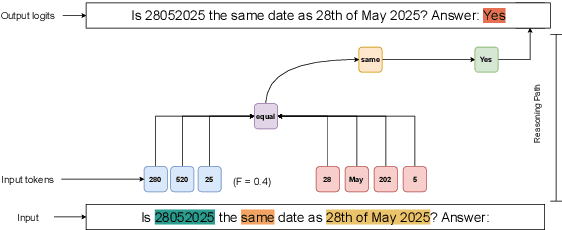
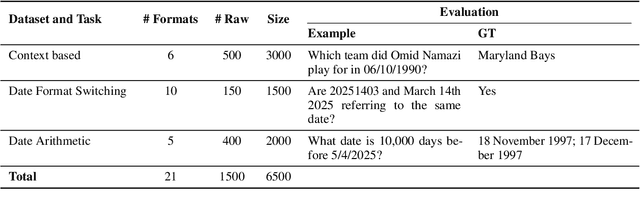
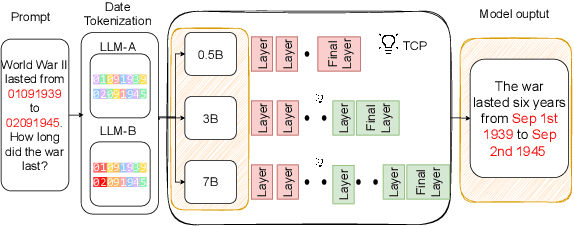
Modern BPE tokenizers often split calendar dates into meaningless fragments, e.g., 20250312 $\rightarrow$ 202, 503, 12, inflating token counts and obscuring the inherent structure needed for robust temporal reasoning. In this work, we (1) introduce a simple yet interpretable metric, termed date fragmentation ratio, that measures how faithfully a tokenizer preserves multi-digit date components; (2) release DateAugBench, a suite of 6500 examples spanning three temporal reasoning tasks: context-based date resolution, format-invariance puzzles, and date arithmetic across historical, contemporary, and future regimes; and (3) through layer-wise probing and causal attention-hop analyses, uncover an emergent date-abstraction mechanism whereby large language models stitch together the fragments of month, day, and year components for temporal reasoning. Our experiments show that excessive fragmentation correlates with accuracy drops of up to 10 points on uncommon dates like historical and futuristic dates. Further, we find that the larger the model, the faster the emergent date abstraction that heals date fragments is accomplished. Lastly, we observe a reasoning path that LLMs follow to assemble date fragments, typically differing from human interpretation (year $\rightarrow$ month $\rightarrow$ day).