 Add to Chrome
 Add to Firefox
 Add to Edge
villa-X: Enhancing Latent Action Modeling in Vision-Language-Action Models
Jul 31, 2025
Visual-Language-Action (VLA) models have emerged as a popular paradigm for learning robot manipulation policies that can follow language instructions and generalize to novel scenarios. Recent work has begun to explore the incorporation of latent actions, an abstract representation of visual change between two frames, into VLA pre-training. In this paper, we introduce villa-X, a novel Visual-Language-Latent-Action (ViLLA) framework that advances latent action modeling for learning generalizable robot manipulation policies. Our approach improves both how latent actions are learned and how they are incorporated into VLA pre-training. Together, these contributions enable villa-X to achieve superior performance across simulated environments including SIMPLER and LIBERO, as well as on two real-world robot setups including gripper and dexterous hand manipulation. We believe the ViLLA paradigm holds significant promise, and that our villa-X provides a strong foundation for future research.

PIG-Nav: Key Insights for Pretrained Image Goal Navigation Models
Jul 23, 2025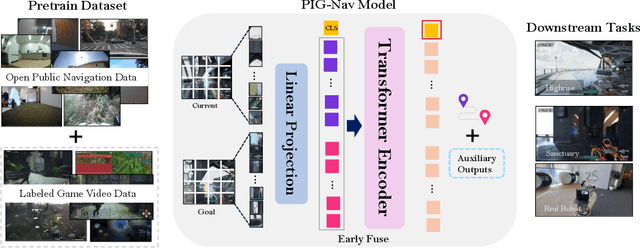
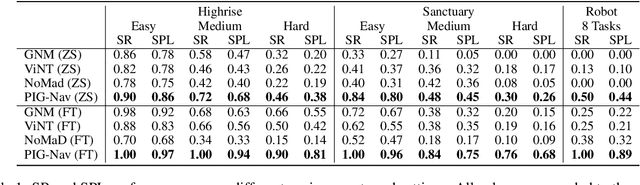
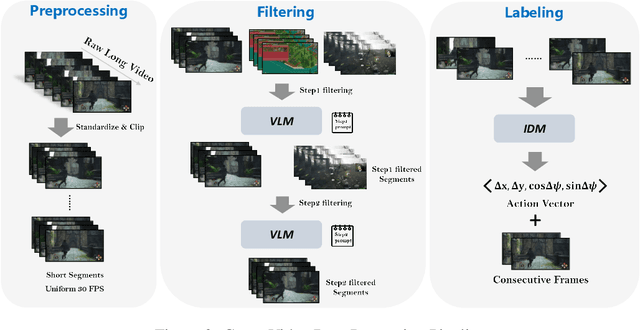
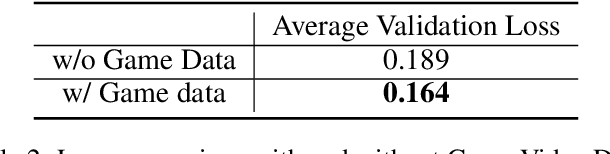
Recent studies have explored pretrained (foundation) models for vision-based robotic navigation, aiming to achieve generalizable navigation and positive transfer across diverse environments while enhancing zero-shot performance in unseen settings. In this work, we introduce PIG-Nav (Pretrained Image-Goal Navigation), a new approach that further investigates pretraining strategies for vision-based navigation models and contributes in two key areas. Model-wise, we identify two critical design choices that consistently improve the performance of pretrained navigation models: (1) integrating an early-fusion network structure to combine visual observations and goal images via appropriately pretrained Vision Transformer (ViT) image encoder, and (2) introducing suitable auxiliary tasks to enhance global navigation representation learning, thus further improving navigation performance. Dataset-wise, we propose a novel data preprocessing pipeline for efficiently labeling large-scale game video datasets for navigation model training. We demonstrate that augmenting existing open navigation datasets with diverse gameplay videos improves model performance. Our model achieves an average improvement of 22.6% in zero-shot settings and a 37.5% improvement in fine-tuning settings over existing visual navigation foundation models in two complex simulated environments and one real-world environment. These results advance the state-of-the-art in pretrained image-goal navigation models. Notably, our model maintains competitive performance while requiring significantly less fine-tuning data, highlighting its potential for real-world deployment with minimal labeled supervision.
The Sample Complexity of Online Strategic Decision Making with Information Asymmetry and Knowledge Transportability
Jun 11, 2025Information asymmetry is a pervasive feature of multi-agent systems, especially evident in economics and social sciences. In these settings, agents tailor their actions based on private information to maximize their rewards. These strategic behaviors often introduce complexities due to confounding variables. Simultaneously, knowledge transportability poses another significant challenge, arising from the difficulties of conducting experiments in target environments. It requires transferring knowledge from environments where empirical data is more readily available. Against these backdrops, this paper explores a fundamental question in online learning: Can we employ non-i.i.d. actions to learn about confounders even when requiring knowledge transfer? We present a sample-efficient algorithm designed to accurately identify system dynamics under information asymmetry and to navigate the challenges of knowledge transfer effectively in reinforcement learning, framed within an online strategic interaction model. Our method provably achieves learning of an $\epsilon$-optimal policy with a tight sample complexity of $O(1/\epsilon^2)$.
Automatic Evaluation Metrics for Document-level Translation: Overview, Challenges and Trends
Apr 21, 2025With the rapid development of deep learning technologies, the field of machine translation has witnessed significant progress, especially with the advent of large language models (LLMs) that have greatly propelled the advancement of document-level translation. However, accurately evaluating the quality of document-level translation remains an urgent issue. This paper first introduces the development status of document-level translation and the importance of evaluation, highlighting the crucial role of automatic evaluation metrics in reflecting translation quality and guiding the improvement of translation systems. It then provides a detailed analysis of the current state of automatic evaluation schemes and metrics, including evaluation methods with and without reference texts, as well as traditional metrics, Model-based metrics and LLM-based metrics. Subsequently, the paper explores the challenges faced by current evaluation methods, such as the lack of reference diversity, dependence on sentence-level alignment information, and the bias, inaccuracy, and lack of interpretability of the LLM-as-a-judge method. Finally, the paper looks ahead to the future trends in evaluation methods, including the development of more user-friendly document-level evaluation methods and more robust LLM-as-a-judge methods, and proposes possible research directions, such as reducing the dependency on sentence-level information, introducing multi-level and multi-granular evaluation approaches, and training models specifically for machine translation evaluation. This study aims to provide a comprehensive analysis of automatic evaluation for document-level translation and offer insights into future developments.
A temporal scale transformer framework for precise remaining useful life prediction in fuel cells
Apr 08, 2025In exploring Predictive Health Management (PHM) strategies for Proton Exchange Membrane Fuel Cells (PEMFC), the Transformer model, widely used in data-driven approaches, excels in many fields but struggles with time series analysis due to its self-attention mechanism, which yields a complexity of the input sequence squared and low computational efficiency. It also faces challenges in capturing both global long-term dependencies and local details effectively. To tackle this, we propose the Temporal Scale Transformer (TSTransformer), an enhanced version of the inverted Transformer (iTransformer). Unlike traditional Transformers that treat each timestep as an input token, TSTransformer maps sequences of varying lengths into tokens at different stages for inter-sequence modeling, using attention to capture multivariate correlations and feed-forward networks (FFN) to encode sequence representations. By integrating a one-dimensional convolutional layer into the multivariate attention for multi-level scaling of K and V matrices, it improves local feature extraction, captures temporal scale characteristics, and reduces token count and computational costs. Experiments comparing TSTransformer with models like Long Short-Term Memory, iTransformer, and Transformer demonstrate its potential as a powerful tool for advancing PHM in renewable energy, effectively addressing the limitations of pure Transformer models in data-driven time series tasks.
Near-infrared Image Deblurring and Event Denoising with Synergistic Neuromorphic Imaging
Mar 05, 2025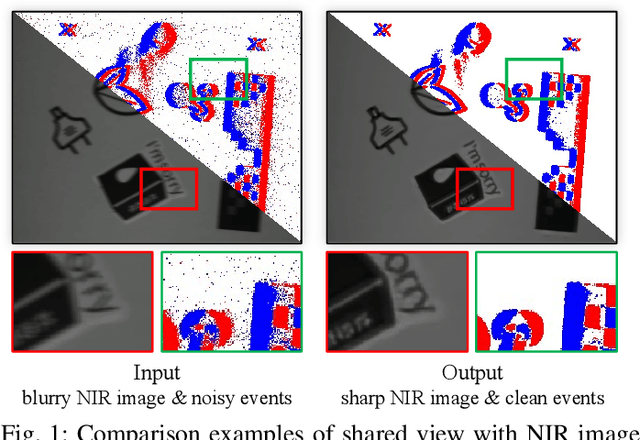
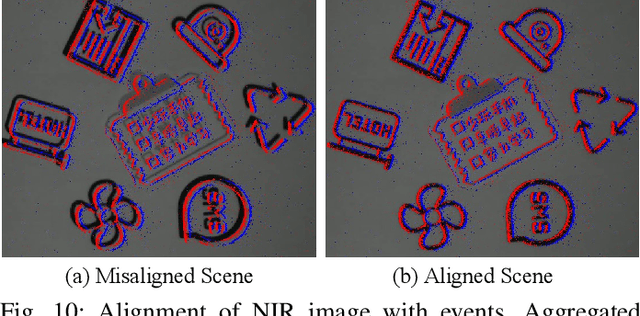
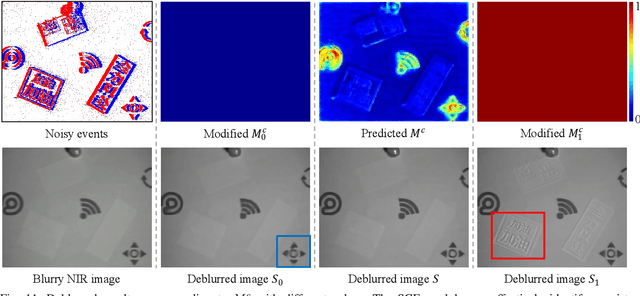
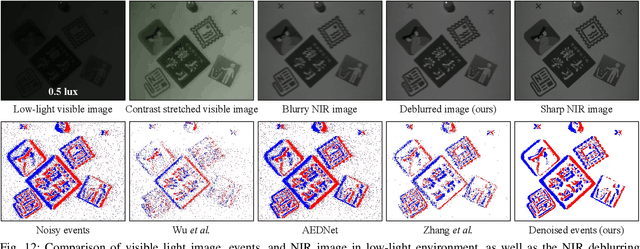
The fields of imaging in the nighttime dynamic and other extremely dark conditions have seen impressive and transformative advancements in recent years, partly driven by the rise of novel sensing approaches, e.g., near-infrared (NIR) cameras with high sensitivity and event cameras with minimal blur. However, inappropriate exposure ratios of near-infrared cameras make them susceptible to distortion and blur. Event cameras are also highly sensitive to weak signals at night yet prone to interference, often generating substantial noise and significantly degrading observations and analysis. Herein, we develop a new framework for low-light imaging combined with NIR imaging and event-based techniques, named synergistic neuromorphic imaging, which can jointly achieve NIR image deblurring and event denoising. Harnessing cross-modal features of NIR images and visible events via spectral consistency and higher-order interaction, the NIR images and events are simultaneously fused, enhanced, and bootstrapped. Experiments on real and realistically simulated sequences demonstrate the effectiveness of our method and indicate better accuracy and robustness than other methods in practical scenarios. This study gives impetus to enhance both NIR images and events, which paves the way for high-fidelity low-light imaging and neuromorphic reasoning.
BP-GPT: Auditory Neural Decoding Using fMRI-prompted LLM
Feb 21, 2025Decoding language information from brain signals represents a vital research area within brain-computer interfaces, particularly in the context of deciphering the semantic information from the fMRI signal. Although existing work uses LLM to achieve this goal, their method does not use an end-to-end approach and avoids the LLM in the mapping of fMRI-to-text, leaving space for the exploration of the LLM in auditory decoding. In this paper, we introduce a novel method, the Brain Prompt GPT (BP-GPT). By using the brain representation that is extracted from the fMRI as a prompt, our method can utilize GPT-2 to decode fMRI signals into stimulus text. Further, we introduce the text prompt and align the fMRI prompt to it. By introducing the text prompt, our BP-GPT can extract a more robust brain prompt and promote the decoding of pre-trained LLM. We evaluate our BP-GPT on the open-source auditory semantic decoding dataset and achieve a significant improvement up to 4.61 on METEOR and 2.43 on BERTScore across all the subjects compared to the state-of-the-art method. The experimental results demonstrate that using brain representation as a prompt to further drive LLM for auditory neural decoding is feasible and effective. The code is available at https://github.com/1994cxy/BP-GPT.
UP-VLA: A Unified Understanding and Prediction Model for Embodied Agent
Jan 31, 2025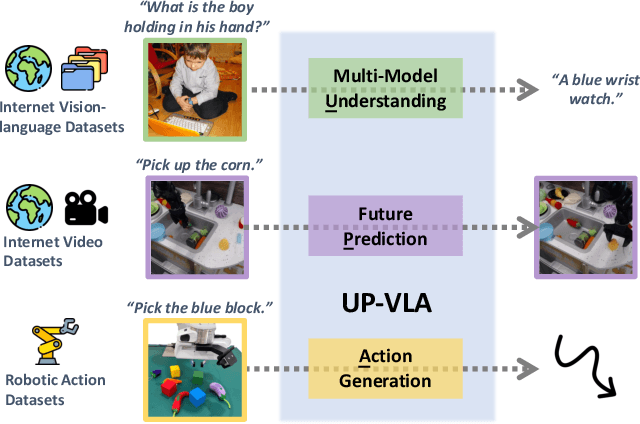
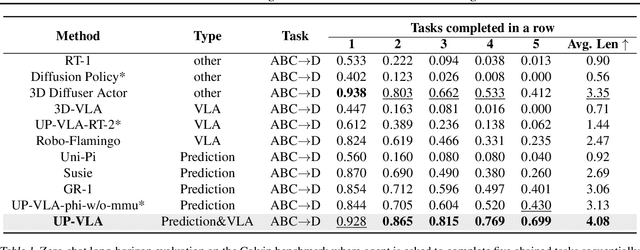
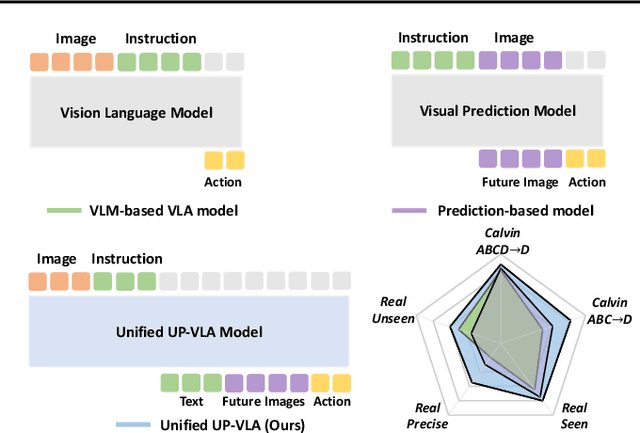
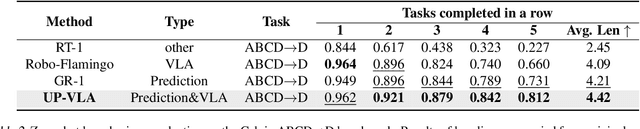
Recent advancements in Vision-Language-Action (VLA) models have leveraged pre-trained Vision-Language Models (VLMs) to improve the generalization capabilities. VLMs, typically pre-trained on vision-language understanding tasks, provide rich semantic knowledge and reasoning abilities. However, prior research has shown that VLMs often focus on high-level semantic content and neglect low-level features, limiting their ability to capture detailed spatial information and understand physical dynamics. These aspects, which are crucial for embodied control tasks, remain underexplored in existing pre-training paradigms. In this paper, we investigate the training paradigm for VLAs, and introduce \textbf{UP-VLA}, a \textbf{U}nified VLA model training with both multi-modal \textbf{U}nderstanding and future \textbf{P}rediction objectives, enhancing both high-level semantic comprehension and low-level spatial understanding. Experimental results show that UP-VLA achieves a 33% improvement on the Calvin ABC-D benchmark compared to the previous state-of-the-art method. Additionally, UP-VLA demonstrates improved success rates in real-world manipulation tasks, particularly those requiring precise spatial information.
Improving Vision-Language-Action Model with Online Reinforcement Learning
Jan 28, 2025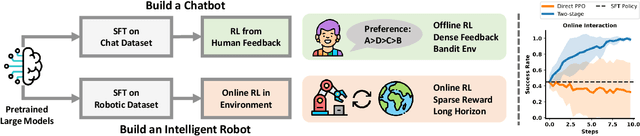
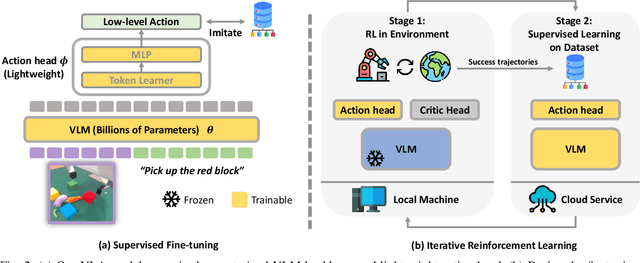
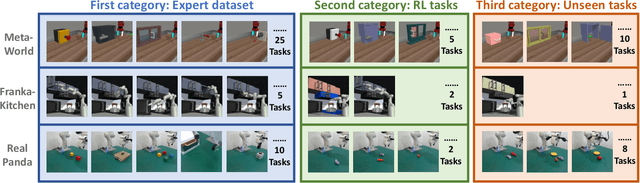
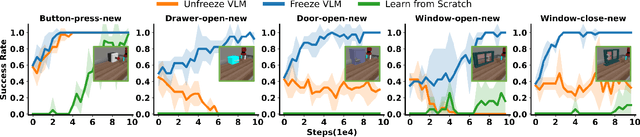
Recent studies have successfully integrated large vision-language models (VLMs) into low-level robotic control by supervised fine-tuning (SFT) with expert robotic datasets, resulting in what we term vision-language-action (VLA) models. Although the VLA models are powerful, how to improve these large models during interaction with environments remains an open question. In this paper, we explore how to further improve these VLA models via Reinforcement Learning (RL), a commonly used fine-tuning technique for large models. However, we find that directly applying online RL to large VLA models presents significant challenges, including training instability that severely impacts the performance of large models, and computing burdens that exceed the capabilities of most local machines. To address these challenges, we propose iRe-VLA framework, which iterates between Reinforcement Learning and Supervised Learning to effectively improve VLA models, leveraging the exploratory benefits of RL while maintaining the stability of supervised learning. Experiments in two simulated benchmarks and a real-world manipulation suite validate the effectiveness of our method.
Video Prediction Policy: A Generalist Robot Policy with Predictive Visual Representations
Dec 19, 2024

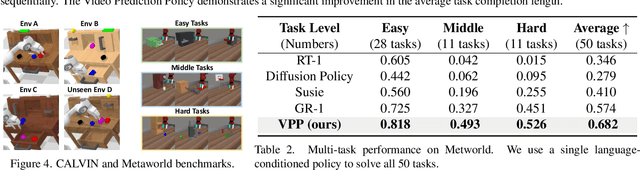

Recent advancements in robotics have focused on developing generalist policies capable of performing multiple tasks. Typically, these policies utilize pre-trained vision encoders to capture crucial information from current observations. However, previous vision encoders, which trained on two-image contrastive learning or single-image reconstruction, can not perfectly capture the sequential information essential for embodied tasks. Recently, video diffusion models (VDMs) have demonstrated the capability to accurately predict future image sequences, exhibiting a good understanding of physical dynamics. Motivated by the strong visual prediction capabilities of VDMs, we hypothesize that they inherently possess visual representations that reflect the evolution of the physical world, which we term predictive visual representations. Building on this hypothesis, we propose the Video Prediction Policy (VPP), a generalist robotic policy conditioned on the predictive visual representations from VDMs. To further enhance these representations, we incorporate diverse human or robotic manipulation datasets, employing unified video-generation training objectives. VPP consistently outperforms existing methods across two simulated and two real-world benchmarks. Notably, it achieves a 28.1\% relative improvement in the Calvin ABC-D benchmark compared to the previous state-of-the-art and delivers a 28.8\% increase in success rates for complex real-world dexterous manipulation tasks.